Autor Cointelegraph By Onkar Singh

Why is Ethereum used for NFTs?

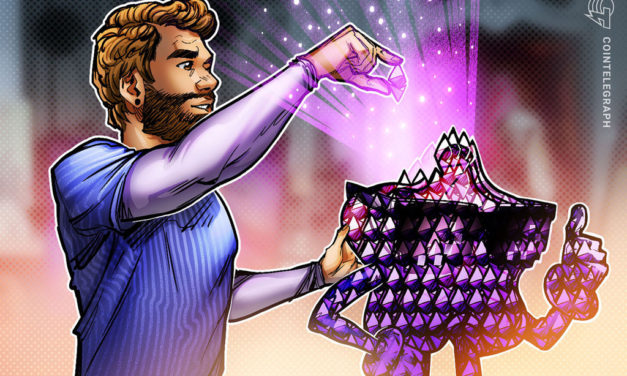
When choosing any blockchain for minting NFTs, such as Ethereum for NFT development, ensure the robustness of its smart contracts, check the blockchain’s fee structure, security measures and transaction speed, and assess the possibility of forking. In the cryptocurrency market, NFTs are a significant niche. They provide further exposure to cryptocurrencies for people who might not otherwise have come into contact with these assets. In addition, they actively contribute to the mass adoption of blockchain technology because they are so closely linked to digital art and gaming. However, the resilience of a blockchain’s smart contracts is a major component of the overall security of distributed ledger technology. Smart contracts must go through extensive testing to provide the highest level of reliability and efficiency, ensuring minimal risk of downtime, breaches and hacks. Additionally, cost-effective solutions are required for NFT-based transactions, which is critical for using and adopting nonfungible assets. As a result, the cost structure for NFTs on the blockchain is an important factor to consider, with feeless being the ideal option. Hard forks can jeopardize nonfungible features, as duplicating NFTs calls their integrity into question. Therefore, it is critical to design NFTs and their marketplaces on fork-resistant blockchains. Similarly, as blockchains are immutable by design, faster finality means attackers have fewer time frames in which to compromise the digital ledgers. Therefore, any platform that achieves faster transaction finality while maintaining decentralization is ideal for creating NFT marketplaces. Other than these considerations, the final selection of blockchain for NFT development depends on your goals, like why you want to own NFTs, your budget and your investment objectives. If you are clear on the questions, you need to do your research and compare various NFT blockchains before spending your hard-earned money.

Čítaj viac
What is impermanent loss and how to avoid it?

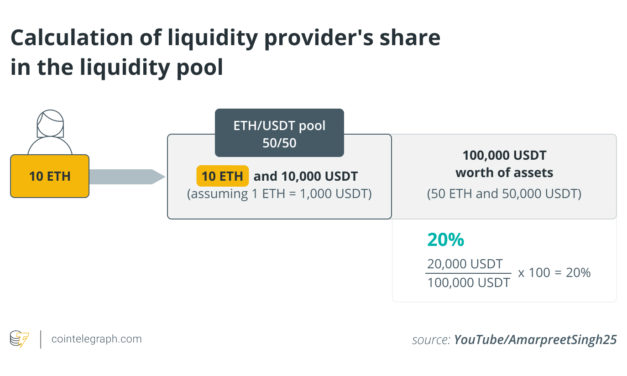
The difference between the LP tokens’ value and the underlying tokens’ theoretical value if they hadn’t been paired leads to IL. Let’s look at a hypothetical situation to see how impermanent/temporary loss occurs. Suppose a liquidity provider with 10 ETH wants to offer liquidity to a 50/50 ETH/USDT pool. They’ll need to deposit 10 ETH and 10,000 USDT in this scenario (assuming 1ETH = 1,000 USDT). If the pool they commit to has a total asset value of 100,000 USDT (50 ETH and 50,000 USDT), their share will be equivalent to 20% using this simple equation = (20,000 USDT/ 100,000 USDT)*100 = 20% The percentage of a liquidity provider’s participation in a pool is also substantial because when a liquidity provider commits or deposits their assets to a pool via a smart contract, they will instantly receive the liquidity pool’s tokens. Liquidity providers can withdraw their portion of the pool (in this case, 20%) at any time using these tokens. So, can you lose money with an impermanent loss? This is where the idea of IL enters the picture. Liquidity providers are susceptible to another layer of risk known as IL because they are entitled to a share of the pool rather than a definite quantity of tokens. As a result, it occurs when the value of your deposited assets changes from when you deposited them. Please keep in mind that the larger the change, the more IL to which the liquidity provider will be exposed. The loss here refers to the fact that the dollar value of the withdrawal is lower than the dollar value of the deposit. This loss is impermanent because no loss happens if the cryptocurrencies can return to the price (i.e., the same price when they were deposited on the AMM). And also, liquidity providers receive 100% of the trading fees that offset the risk exposure to impermanent loss. How to calculate the impermanent loss? In the example discussed above, the price of 1 ETH was 1,000 USDT at the time of deposit, but let’s say the price doubles and 1 ETH starts trading at 2,000 USDT. Since an algorithm adjusts the pool, it uses a formula to manage assets. The most basic and widely used is the constant product formula, which is being popularized by Uniswap. In simple terms, the formula states:  Using figures from our example, based on 50 ETH and 50,000 USDT, we get: 50 * 50,000 = 2,500,000. Similarly, the price of ETH in the pool can be obtained using the formula: Token liquidity / ETH liquidity = ETH price, i.e., 50,000 / 50 = 1,000. Now the new price of 1 ETH= 2,000 USDT. Therefore, This can be verified using the same constant product formula: ETH liquidity * token liquidity = 35.355 * 70, 710.6 = 2,500,000 (same value as before). So, now we have values as follows: If, at this time, the liquidity provider wishes to withdraw their assets from the pool, they will exchange their liquidity provider tokens for the 20% share they own. Then, taking their share from the updated amounts of each asset in the pool, they will get 7 ETH (i.e., 20% of 35 ETH) and 14,142 USDT (i.e., 20% of 70,710 USDT). Now, the total value of assets withdrawn equals: (7 ETH * 2,000 USDT) 14,142 USDT = 28,142 USDT. If these assets could have been non-deposited to a liquidity pool, the owner would have earned 30,000 USDT [(10 ETH * 2,000 USDT) 10,000 USD]. This difference that can occur because of the way AMMs manage asset ratios is called an impermanent loss. In our impermanent loss examples:

Čítaj viac

The integration of CeFi and DeFi through Binance Bridge 2.0

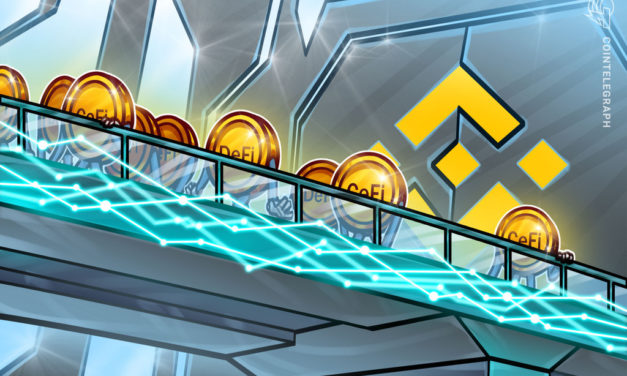
DeFi is driving the development of cutting-edge Web3 use cases such as nonfungible tokens (NFTs), gaming and the metaverse. With the Binance Bridge 2.0, DeFi can be brought to a broader audience worldwide while maintaining the same smooth user experience as CeFi. Most of the “DeFi” ecosystem relies on centralized services because of convenience, which enables us to understand where the traditional world of centralized banking and the new world of decentralized money might intersect to everyone’s benefit. Binance, with its first bridge, made it possible to bridge assets listed on Binance.com to other blockchains. To integrate CeFi and DeFi, the Binance Bridge 2.0 comes to the rescue by allowing you to wrap ERC20 tokens to BEP20 BTokens and start staking your Ethereum or other supported assets with DeFi protocols running on the BNB Smart Chain right away.  Binance also implemented a whole new automatic token circulation control system. Except for a buffer size in hot wallets, the exchange will not keep a surplus of pegged tokens known as wrapped assets. Instead, when users withdraw pegged tokens onto the BNB Smart Chain, it will print more tokens. The Binance Bridge 2.0 is a trusted bridge that operates on the BNB Smart Chain with transaction fees as low as a few cents and transaction speeds as fast as three seconds. It is safeguarded by Binance’s highest security standards and operates on the BNB Smart Chain.  Nearly all Ethereum-based coins will be supported via the Binance Bridge 2.0, allowing direct access to BNB Smart Chain DApps. This cross-chain bridge improves interoperability between several blockchains and gives you direct access to the DeFi world of the BNB Smart Chain. Related: What are DApps? A beginner’s guide to decentralized applications

Čítaj viac

The concept and future of decentralized Web3 domain names

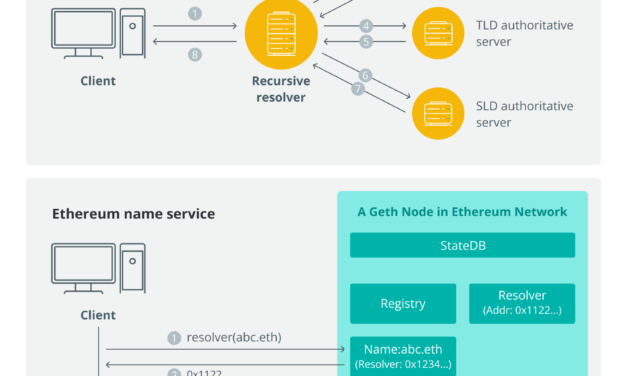
The primary purpose of the Ethereum name service (ENS) is to convert machine-readable identifiers like Ethereum addresses to human-readable names. The web began as a decentralized system based on the DNS, with anybody able to buy, own and manage their domain name and move it from one host to another as needed, with complete control and ownership over all underlying data. But, how does a decentralized Web3 name service work? The community has shown a lot of interest in ENS, which is a new name service built on top of Ethereum. The Ethereum Name Service is a Web3 blockchain system that allows users to establish their own unique and memorable usernames.  Therefore, ENS intends to provide a complementary solution to DNS by utilizing Ethereum smart contracts to govern domain name registration and resolution. Using the service, you can provide a single name to all of your wallet addresses and decentralized websites (DWebs). “alex.eth,” for example, makes you recognize and quickly locate wallet addresses in a distributed environment.  The registry, the registrars and the resolvers are three kinds of smart contracts in ENS, as explained in the sections below. The registry A single smart contract runs the ENS registry and keeps track of all domains and subdomains. The system purposefully has been kept basic, and its sole purpose is to link a name to the resolver that is accountable for it. It also saves the following three crucial pieces of data: The owner of the domain: An external account or a smart contract can be the domain owner. The domain owner can update the domain’s resolver and TTL, transfer the ownership of the domain to another address and alter the right of subdomains. Resolver of domain names: The process of converting names into addresses is handled by resolvers. Any contract can become a resolver if it follows specific guidelines.  ENS Namehash: ENS saves names as hashes, which are produced using the “namehash” method. The namehash is calculated by combining the hash of the highest-level part of ENS domain names (known as “labelhash”) with the namehash of the other parts and then performing another hash on it. The registrars A registrar is a smart contract that holds a domain name and can grant subdomain names to users depending on rules (e.g., payment). The ENS team used the Vickrey auction registrar and the permanent registrar for .eth name registrations. On May 4, 2017, the ENS team released a smart contract implementing a Vickrey auction to register names longer than six characters. The Vickrey auction is a sort of sealed-bid auction in which buyers bid without knowing how many other bidders have bid, and the auction winner is the highest bidder who only has to pay the second-highest amount. On May 4, 2019, the ENS team introduced the “permanent registrar” in place of the auction registrar for registering names longer than six characters. The perpetual registrar is designed to run indefinitely until the registrar contract is replaced due to a severe flaw. The manner of billing for .eth names has been modified to an annual rent payment model, in which each name will be charged $5 per year. Along with the permanent registrar, the registrar controller idea was created to allow name owners to delegate name management. As a result, a name registered by the registrar controller can configure resolver and name records as part of the registration transaction, simplifying the procedure. Another auction called the short name auction for remaining short names with a length of 3–6 commenced in September 2019. The ENS team used OpenSea, a well-known crypto-asset marketplace, as the auction platform, with the English auction as the auction method.  Bids in an English auction are open to the public, and bidders can place numerous bids. The highest bidder will get the name, and the number of deposits will be the first-year registration fee, which is considerably different from the Vickrey auction period. The resolvers The name-to-record mapping is saved in the resolver. The “public resolvers” implemented by the ENS team have preset eight categories of records (see image below), but ENS can hold any records.  The ENS name resolving procedure is two-step. First, the user who wishes to resolve the name must search the registry for the relevant resolver and then obtain the resolver’s resolution results.

Čítaj viac

What is a cryptocurrency mixer and how does it work?

The rapid expansion of cryptocurrencies and the development of crypto infrastructure and vulnerabilities like crypto mixers or tumblers have been a source of concern for government agencies in charge of financial security. Many people use crypto mixers to keep their cryptocurrency transactions private by mixing potentially identifiable cryptocurrency funds with vast sums of other funds. These services are often used to anonymize fund transfers between services and do not require Know Your Customer (KYC) checks. As a result, the risk of employing crypto mixers to launder money or conceal earnings is pretty considerable. Mixers and online gambling sites have the most severe money laundering issues, as they process the vast majority of dirty currencies. Mixers, for example, have consistently processed about a quarter of all incoming illicit Bitcoin (BTC) each year, while the proportion laundered through exchanges and gambling has remained relatively steady (66 to 72%). There are two types of Bitcoin mixers: namely centralized and decentralized mixers. Companies that receive Bitcoin and send back different BTC for a fee are known as centralized mixers, providing a simple solution for tumbling Bitcoin.  Decentralized mixers use protocols like CoinJoin to obfuscate transactions using either a completely coordinated or peer-to-peer (P2P) approach. Essentially, the protocol allows a big group of users to pool an amount of BTC and then redistribute it such that everyone receives one Bitcoin. Still, no one can know who received what or where it originated from. Other types of coin mixers include obfuscation-based and zero-knowledge-based mixers. Obfuscation-based mixers, often called decoy-based mixers, employ ways to conceal a user’s transaction graph. An adversary with sufficient resources, on the other hand, can recreate the transaction graph using a variety of ways.  On the contrary, zero-knowledge-based mixers rely heavily on advanced cryptographic techniques like zero-knowledge proofs to fully erase the transaction graph. The most significant disadvantage of this strategy is that it necessitates extensive cryptography, which may limit scalability.

Čítaj viac

Získaj BONUS 8 € v Bitcoinoch

nakup bitcoin z karty

Registrácia Binance

Burza Binance

Aktuálne kurzy