Autor Cointelegraph By Onkar Singh

Can quantum computers mine Bitcoin faster?

By exploiting its higher processing capacity to defeat the encryption that safeguards private keys and transactions on the Bitcoin network, a quantum computer could theoretically hack Bitcoin. However, the current state of quantum technology is not yet advanced enough to pose a significant threat to Bitcoin’s security. Quantum computers might make public-key cryptography less secure because of their capacity to answer some mathematical problems far more quickly than classical computers. For example, Shor’s algorithm — a quantum algorithm — can factor large integers exponentially faster than classical algorithms. Factoring large integers is the basis of many public key encryption schemes, including the one used in Bitcoin. The public-key cryptography employed in Bitcoin and other cryptocurrencies might hypothetically be cracked if a quantum computer had the processing capability to carry out Shor’s algorithm. An attacker with a quantum computer could potentially steal BTC by computing the private key corresponding to a public key used to receive Bitcoin. The big prime numbers used to generate the public-private key combination could be factored in to achieve this. However, it is crucial to remember that quantum computing is still in its infancy and lacks the power to carry out Shor’s algorithm at the scale necessary to decrypt Bitcoin. Although small-scale quantum computers have been shown to factor in small numbers, there is still a long way to go before a large-scale quantum computer that breaks Bitcoin’s encryption can be built. In addition, the Bitcoin network is constantly developing to counter possible security risks, such as the risk presented by quantum computers. For instance, a hash-based signature system like the Lamport signature method might make Bitcoin more resilient against quantum attacks. Researchers are also investigating the use of post-quantum cryptography, which was created to be resistant to quantum computers. The Lamport signature method is considered one of the post-quantum cryptographic methods that can be used to secure digital signatures from potential threats from quantum computers. This technique generates several pairs of public and private keys to verify digital signatures using a one-time hash function.  The communication is protected against efforts at quantum hacking since each pair is used to sign a distinct section of the message. Due to the one-time nature of the hash function, even if an attacker gets hold of one of the private keys, they cannot use it to forge other signatures or find the other private keys.

Čítaj viac

How can legal chatbots enhance access to justice?

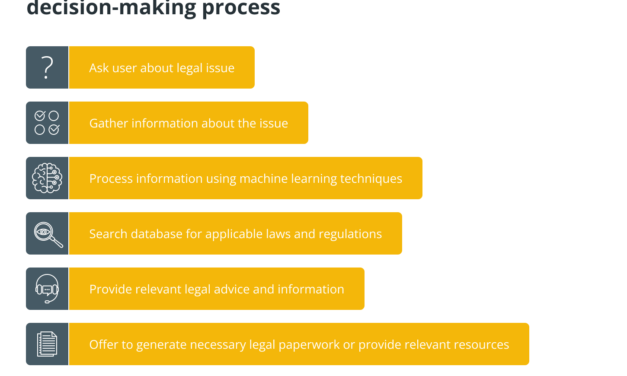
Legal chatbots gather information from users, process that data, find applicable legal information and give the user advice or refer them to a qualified lawyer if necessary. Here are the general steps of how legal chatbots function: Information gathering The chatbot gathers data from the user via queries or prompts, which may include the nature of the legal issue, the location and any other relevant information.  When a user first accesses the chatbot, a message asking about the nature of their legal problem is displayed to them. Suppose the user responded that they have a traffic ticket and wish to contest it. To acquire the applicable information, the chatbot asks for additional details, including the location, time and nature of the infraction. Processing the data The chatbot examines the data it gathers, using machine learning techniques to understand the user’s legal concerns and deliver relevant information. Finding an applicable response The chatbot searches its database or knowledge base for applicable legal information and sources such as laws, regulations and cases. Giving direction Based on the data gathered and examined, the chatbot gives the user direction or legal advice. This could entail recommending a plan of action, offering legal paperwork, or pointing the user toward suitable materials or services. In the case of a traffic ticket, the chatbot’s response may include steps to dispute the ticket or provide information on traffic laws. The chatbot may also offer to generate the necessary legal paperwork or provide a link to a relevant resource. Referring to a lawyer If the user’s legal problem is complicated or outside the chatbot’s scope of expertise, it may refer them to a qualified lawyer for more help.

Čítaj viac

What is a Wells notice, explained

A Wells notice is not a final determination of guilt or wrongdoing, meaning that the recipient has the chance to respond and make a case before any administrative action is initiated. The Wells notice procedure, though, is a clue that the SEC is considering taking action, and how it turns out might have a big impact on the recipient and any linked investors. Consider the case where the SEC is looking into possible insider trading offenses at a publicly traded business. The SEC suspects that one of the company’s officials may have engaged in prohibited stock trading before a significant announcement was made based on non-public information. The SEC would issue a Wells notice to the suspected employee in this situation, alerting the person to the inquiry against trading violations and giving the individual a chance to refute the charges before deciding whether to take enforcement action. So, what happens after a Wells notice is issued? Normally, the Wells notice would list the precise charges against the person and provide a deadline to reply to the SEC, as stated in the steps below. Here’s how the Wells notice process typically works: Investigation To ascertain whether there is sufficient justification for taking enforcement action, the SEC looks into potential violations of securities laws. Notification The SEC will issue a Wells notice to the person or business in question if it decides that there is enough proof of potential misconduct. The Wells notice will normally list the particular accusations and provide the addressee a chance to reply, known as a “Wells response.”  For instance, Coinbase received a Wells notice in March 2023 from the SEC, who identified potential securities law violations in relation to some of its listed digital assets, the Coinbase Earn staking service, Coinbase Prime and Coinbase Wallet. The SEC issued the Wells notice after conducting a preliminary investigation. Response The Wells notice receiver may reply in writing or ask the SEC for a meeting in person to discuss the charges and give a defense. This response could contain arguments or supporting data to back up the defense, as well as any pertinent mitigating circumstances. Decision The SEC will decide whether to move further with enforcement action based on the response and any other data gathered. The SEC may file a complaint in federal court seeking fines or other remedies if it decides to pursue legal action or charges of securities fraud.

Čítaj viac

What is the wash-sale rule, and does it apply to crypto?

Investors cannot claim a tax loss on the sale of a security if they buy a “substantially identical” security within 30 days before or after the sale, as per the wash-sale rule, a tax regulation. The Internal Revenue Service (IRS) in the United States established the wash-sale rule, which restricts investors from deducting a tax loss from their taxes if they sell an investment at a loss and subsequently buy a virtually identical security within the 30-day window. Instead, they must factor the loss into the new security’s cost base, which will reduce their gain or raise their loss when they ultimately sell the new asset. Cost basis refers to the original value of an asset, such as a stock or a cryptocurrency, that is used to determine the taxable gain or loss when the asset is sold or disposed of. The cost basis is typically the purchase price of the asset, including any fees or commissions associated with the purchase. The cost basis may be changed to reflect the asset’s fair market value at the time of acquisition if the asset was received as a gift or through inheritance. When an asset is sold, the capital gain or loss is determined using the cost basis. The investor obtains a capital gain and may be subject to taxation on that gain if the asset’s sale price exceeds its cost basis. The investor experiences a capital loss if the sale price is less than the cost basis. This loss can be used to offset capital gains and minimize the investor’s tax burden. “Substantially identical” refers to securities that are almost identical to the security sold, as in the case of purchasing a stock, selling it, and purchasing the original stock back within 30 days. However, it can be difficult to determine what constitutes a substantially identical security, and the IRS has broad discretion in making this determination. The wash-sale rule was created to stop investors from claiming tax deductions for losses while maintaining their portfolio’s original structure. All forms of securities, such as stocks, bonds, mutual funds and options, are covered by this rule. For instance, the wash-sale rule would likely apply, and the investor would not be able to claim the tax loss on the sale if the investor sold shares of a certain company at a loss and then purchased shares of the same company or a company that is similar in the same industrial sector within 30 days. In a similar vein, if an investor sells shares in a mutual fund that tracks the S&P 500 index and then purchases shares of a different mutual fund that tracks the same index within 30 days, the investor is subject to a 30-day penalty. Related: How are metaverse assets taxed?

Čítaj viac

Can artificial intelligence prevent the next financial crisis?

By analyzing vast amounts of data in real-time, AI can identify potential risks and provide early warnings to enable proactive measures. However, addressing challenges such as transparency and interpretability is vital to ensuring the responsible and effective use of financial services. AI has the potential to play a significant role in preventing the next financial crisis by improving risk management and enhancing decision-making processes. To identify key hazards and provide early warnings of prospective financial crises, AI can examine complicated correlations between various economic indicators, financial markets and global events by processing enormous volumes of data in real-time. This can assist financial firms and regulators in taking preventive steps to reduce risks and avert disasters. AI can also be used to create predictive models that can predict market patterns and spot potential risks before they occur. This can assist financial institutions in managing their risk exposure appropriately and adjusting their investment strategy. AI can also be used to better detect fraud and stop financial crimes, which can be a major cause of instability in the financial system. Related: What are artificial intelligence (AI) crypto coins, and how do they work? Predictive models are statistical models or machine learning algorithms that are used to analyze historical data and make predictions about future events or behaviors. For instance, suppose that a bank wants to identify the clients who are most likely to default on their loans.  The bank can train a machine learning system to find trends connected to defaults using past data on customer credit ratings, income levels, job status and other pertinent criteria. The algorithm can then be used to create a predictive model that gives each client a risk score and predicts how likely they are to default. With the use of this prediction model, the bank may focus on clients who are most at risk of default and allocate its resources accordingly. It can present them with other payment options or collaborate with them to solve the underlying problems that might be causing their financial problems. By using a predictive model, the bank can proactively manage its loan portfolio and minimize losses due to defaults. The use of AI in financial services is not without difficulties, though. One of the key issues is that AI models lack transparency and interpretability, which can make it challenging to comprehend the justification for judgements made by AI. This can be solved by creating transparent explainable AI (XAI) models that permit human monitoring and involvement.  XAI refers to a class of artificial intelligence techniques and methods that are designed to produce human-understandable explanations for the decisions and actions taken by AI systems. This can be particularly crucial in fields like banking, healthcare or criminal justice where judgements made by AI systems may have far-reaching effects. Using XAI can assist in improving the effectiveness and dependability of AI systems as well as their openness, accountability and fairness.

Čítaj viac

Získaj BONUS 8 € v Bitcoinoch

nakup bitcoin z karty

Registrácia Binance

Burza Binance

Aktuálne kurzy