
Autor Cointelegraph By Oleksii Konashevych

Do you have the right to redeem your stablecoin?

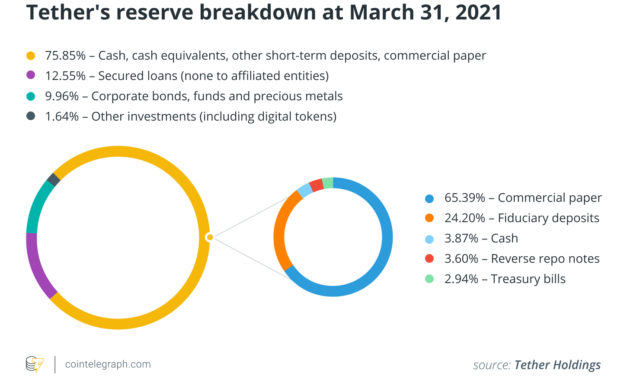
Stablecoins are often discussed with regard to their “stability.” It is usually questioned whether a stablecoin is sufficiently backed with money or other assets. Undoubtedly, it is a very important aspect of stablecoin value. But, does it make sense if the legal terms of a stablecoin do not give you, the stablecoin holder, the legal right to redeem that digital record on blockchain for fiat currency?This article aims to look into the legal terms of the two largest stablecoins — Tether (USDT) by Tether and USD Coin (USDC) by Centre Consortium, established by Coinbase and Circle — to answer the question: Do they owe you anything?Related: Stablecoins will have to reflect and evolve to live up to their nameTetherArticle 3 of Tether’s Terms of Service explicitly states:“Tether reserves the right to delay the redemption or withdrawal of Tether Tokens if such delay is necessitated by the illiquidity or unavailability or loss of any Reserves held by Tether to back the Tether Tokens, and Tether reserves the right to redeem Tether Tokens by in-kind redemptions of securities and other assets held in the Reserves. Tether makes no representations or warranties about whether Tether Tokens that may be traded on the Site may be traded on the Site at any point in the future, if at all.” Let us unpack this. First, Tether may delay any claim in case of lack of liquidity, unavailability or loss of reserves. We reasonably should ask how this can even happen if they claim (in the same article) that “Tether Tokens are 100% backed by Tether’s Reserves.” The answer is found down below in the terms. USDT is “valued” 1:1 but not exclusively backed with fiat currency. And as per the terms, “the composition of the Reserves used to back Tether Tokens is within the sole control and at the sole and absolute discretion of Tether.”As the United States Federal Reserve Board concluded in their recent report: “They are backed by assets that may lose value or become illiquid during stress, leading to redemption risks, and lack of transparency may exacerbate those risks.”More interesting appears the part of Tether’s terms where they reserve the right to return in-kind. It means you buy USDT for the U.S. dollars, but they can return you a bond, a stock or “other assets held in the Reserves.” And, who knows if these assets will be worth anything?It should be noted that redemption from Tether is possible if you are “a verified customer of Tether.” Normally, crypto exchanges and other financial institutions are direct customers of Tether. End-users exchange stablecoins with their applications, not with Tether, and hence must check with legal terms that such providers cast. Nevertheless, according toTether’s FAQ, individuals can also open an account with Tether after accomplishing a Know Your Customer (KYC) check.Related: The United States turns its attention to stablecoin regulationCircle USDCCircle has much in common with its twice-as-big rival, though surprisingly, its terms are even more discouraging. They, similarly, do not promise to hold equivalent fiat reserves and back their stablecoin with “an equivalent amount of U.S. Dollar-denominated assets,” quoted from Article 1.Promising Article 2 of their terms states that “Circle commits to redeem 1 USDC for 1 USD.” The bad news is that this rule applies only to Circle partners (crypto exchanges, financial institutions, etc.), which they call users Type A. End-users become customers of these partners (say, when you open an account with a crypto exchange), and there is no way for an individual to become Circles’ direct user and exercise the right to redemption.In Article 13, they clarify that Circle does not guarantee that the value of 1 USDC will always equal 1 USD because “Circle cannot control how third parties quote or value USDC.” This means Circle does not mandate their partners to cast any specific terms to their end-users, which gives such stablecoin providers freedom in what they legally promise to their customers. Circle states they are not “responsible for any losses or other issues that may result from fluctuations in the value of USDC.”Simply not equal Both Tether’s USDT and Circle’s USDC are not legally equal to fiat money. Moreso, their reserves, which they claim to ensure 1:1 value, are not fully pegged to fiat. They back their digital tokens with various assets, such as securities, which can eventually decrease in value and create trouble with stablecoin liquidity. The main question was whether an individual holding the stablecoin could convert it to fiat. The short answer is that there is no such right that the customer can exercise through legal means, such as claiming it in court. In the case of Tether, they let an individual become their direct customer to redeem USDT. But, they leave the right to return not fiat but any asset in their reserves. In the case of Circle, they legally promise redemption but do not admit individuals to exercise this right, which leaves the customer one to one with multiple exchanges, which do not necessarily guarantee this right.[embedded content]This article is for general information purposes and is not intended to be and should not be taken as legal advice.The views, thoughts and opinions expressed here are the author’s alone and do not necessarily reflect or represent the views and opinions of Cointelegraph.Oleksii Konashevych has a Ph.D. in law, science and technology and is the CEO of the Australian Institute for Digital Transformation. In his academic research, he presented a concept of a new generation of property registries that are based on a blockchain. He presented an idea of title tokens and supported it with technical protocols for smart laws and digital authorities to enable full-featured legal governance of digitized property rights. He has also developed a cross-chain protocol that enables the use of multiple ledgers for a blockchain estate registry, which he presented to the Australian Senate in 2021.

Čítaj viac
DAO regulation in Australia: Issues and solutions, Part 3

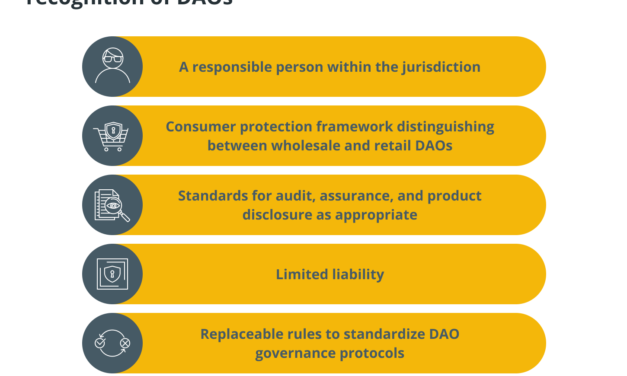
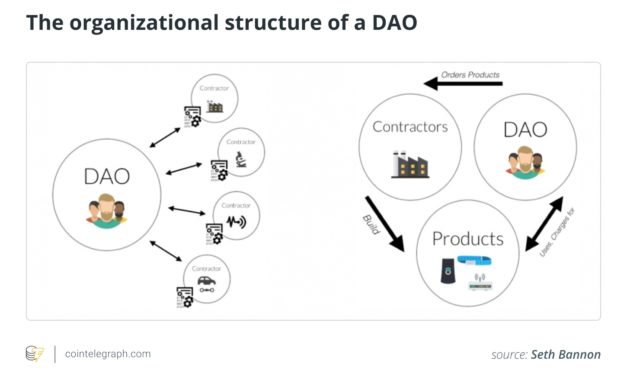
Lawmakers in Australia want to regulate decentralized autonomous organizations (DAOs). In this three-part series, Oleksii Konashevych discusses the risks of stifling the emerging phenomenon of DAOs and possible solutions.Crypto anarchy is unlikely to be the future that the majority of people support. Company regulation, in its essence, has a lot of positive aspects or at least, a good intention, albeit one often embodied in a red tape that stifles business. Nevertheless, nowadays, corporation rules and regulations are formalized to the extent that they could be put in the machine code. So, the role of the government is to establish mandatory standards for those DAOs that would like to operate in the Australian market.[embedded content]Non-digitalThere are cases when a written legal text is necessary. These are situations where the legal interaction goes beyond the program’s code and requires integration with the real world. In this case, there must be formal legal documents and a liable person responsible for delivering business promises to consumers and investors.There can be two types of events in a blockchain network: 1. Internal. For example, the transfer of a token in exchange for a cryptocurrency payment. It can be completely automated because both elements — the token and the cryptocurrency — are internal digital elements of the system. 2. External. But if something is external to the network, it will require human interaction and interaction with the real world.For instance, if a businessman issues tokens pegged to a flock of sheep, this legal condition must be written somewhere in a human language, as sheep are not digital objects, the legal condition is not a part of the network. Therefore, the digital rights of investors (let’s call it so) can and should be automated in a DAO. Hence, they don’t require any written legal terms. Non-digital rights and obligations must be intermediated by a liable person and described in a legal document. And I would say that many DAOs will have both: the digital on-chain part and the off-chain part.Related: DAO regulation in Australia: Issues and solutions, Part 1Let me show one example. Suppose it is promised that token investors can vote and the voting is electronic on the blockchain, and the smart contract automatically executes the decision in a decentralized manner. In that case, it will not need any human assistance and does not require a formalized legal document. This does not mean it will not be described in a human language. This means the description will not prevail over the machine code on the blockchain.As a lawmaker, I would adopt rules that would reduce the ways of misinforming DAO investors. A businessman may not promise DAO investors something that is not encoded in the smart contract. To do so must be interpreted as a deception.When the digital world touches reality and cannot operate autonomously, all those cases will require a complete, legally binding disclosure.Blockchain immutabilityThere is a common fallacy about the issue of immutability. In a blockchain, you cannot retroactively change passed transactions and the deployed code of a smart contract. That’s right, but you don’t need to. The system must be properly designed.Instead of changing the existing records, you need to be able to add new records. All transactions are strictly chronological (because no one can change the order of blocks), so if any legal circumstances change, you don’t change the past, you add a new record to your application. And in the sequence of records, only the latest will reflect the current state of affairs. In this way, you can resolve legal disputes and correct mere mistakes. And I explained how to properly design legal relationships in the video below.[embedded content]In my academic papers as well as in this video, I also described the issue of an “emergency brake” — the need to reset the system if something goes wrong. The proposed technical standard will allow the redesign of an application on blockchain and introduce new rules to a DAO.Related: DAO regulation in Australia: Issues and solutions, Part 2A sustainable DAO solution will need to rely on third parties in governance to some extent as well as in day-to-day operation. And there are many situations when undeniably we need a trusted third party. For example, how will a person transfer an inheritance after death? You won’t develop a mature application on a blockchain, the question is how to make intermediaries accountable, whether it is a state registrar or an authorized professional (lawyer, custodian, broker, etc.). Their operations will require regulations and technical standards.I should note one important thing. Transactions with cryptocurrency, as a native unit of a blockchain, are immutable, and there is nothing you can do about it. This is not addressable or at least, it is not that easy without compromising the technology. Everything I said about the proper design is about crypto tokens, smart contracts, DApps and DAOs, which reside on top of a cryptocurrency.[embedded content]To step into the era of the digital economy, governments need to rethink their role and approaches to regulation. The DAO portrays the struggle to create a fundamental shift from old-fashioned bureaucracy and red tape to automated procedures facilitated by smart laws and smart contracts, generally known as the paradigm of Code is Law. Such a shift requires questioning established institutions: the role of public registries, licensing and other ways of conventional regulation. Some countries have already stepped into the race of regulating innovations and having good intentions is not enough, because they end up with red-tape, which is one of the reasons why DAOs appeared in the first place.The views, thoughts and opinions expressed here are the author’s alone and do not necessarily reflect or represent the views and opinions of Cointelegraph.Oleksii Konashevych has a Ph.D. in Law, Science, and Technology and is the CEO of the Australian Institute for Digital Transformation. In his academic research, he presented a concept of a new generation of property registries that are based on a blockchain. He presented an idea of title tokens and supported it with technical protocols for smart laws and digital authorities to enable full-featured legal governance of digitized property rights. He has also developed a cross-chain protocol that enables the use of multiple ledgers for a blockchain estate registry, which he presented to the Australian Senate in 2021.

Čítaj viac
DAO regulation in Australia: Issues and solutions, Part 2

Lawmakers in Australia want to regulate decentralized autonomous organizations (DAO). In this three-part series, Oleksii Konashevych discusses the risks of stifling the emerging phenomenon of DAOs and possible solutions.Regulating a decentralized autonomous organization (DAO) as a company, first of all, means registration as a company. But who remembers why we need that registry in the first place? Will anyone question whether a blockchain-based DAO needs registration at all?Historically, the government took the role of that trusted third party that, through its public agency — i.e., a registry office — keeps records about a company: who is in charge, its address, its constitution, shares and shareholders, and so on. In any legal issue or dispute, the registrar will take the registry as the source of truth. Registration can be canceled if a company does illegal business. Registration is also needed for taxation. The public registry body keeps this data, ensuring its authenticity and safety.Related: DAO regulation in Australia: Issues and solutions, Part 1Nowadays, the registry is electronic and needs reliable infrastructure: software and data centers, cybersecurity measures, etc. Besides, there are formal rules and requirements for the registration. So, each record is verified against these rules. All of this is the responsibility of the registry office.Now let’s see what a blockchain is. This technology can ensure an unprecedented level of protection for electronic records. Once a record is published on a reliable blockchain, there is no way to tamper with it. Besides, users publish and manage their data on a blockchain without an intermediary.So with blockchains, at least two functions of the registry office become redundant:● The registrar does not need to make records — users can do it themselves.● The registrar does not need to maintain the registry infrastructure.And this can be the most concerning part for bureaucrats and retrogrades. No one is precisely responsible for maintaining the ledger infrastructure. It is an open, self-organized and self-governing network with no authority. Even after 14 years of successful work, people still do not believe and accept that this is happening.We don’t need any conventional registry for a DAO registration because the blockchain is the registry itself.Related: Decentralization, DAOs and the current Web3 concernsWhich blockchain and the role of regulationI should say that not every blockchain is reliable. And here comes the role of the government in terms of regulation. First of all, private and permissioned ledgers — even though crowds call them “blockchains” — are not blockchains in the original sense of Satoshi Nakamoto’s invention. They are not immutable and decentralized. On the contrary, their design supposes that there is a controlling body, effectively making it a centralized technology, which I wrote about in Private distributed ledger technology or public blockchain?The second problem is with blockchains themselves. Even being designed as a decentralized open network, there is a big difference between a network with three nodes, for example, and three thousand nodes. They will have different levels of resilience to cyberthreats.So, the role of the government is to introduce regulations and standards, to make sure that people understand that when they publish a record — say, on Ethereum — it will become immutable and protected by thousands of running nodes all around the globe. If you publish it on some private distributed ledger network controlled by a cartel, you basically need to rely on its goodwill.The conclusion for this part of the discussion is the following. With blockchain, you don’t need any external registry database, as blockchain is the registry, and there is no need for the government to maintain this infrastructure, as the blockchain network is self-sustainable. Users can publish and manage records on a blockchain without a registrar, and there must be standards that allow us to distinguish reliable blockchain systems.ComplianceNowadays, registration procedures are deeply formalized. I don’t remember any procedure that happens at the discretion of a registrar. All the rules can and must be governed by algorithms, thus removing a clerk from the process of making a record. In fact, in most cases, it is already electronic and automated. The difference is that this must be designed as a standard requirement for the development of a compliant DAO. Those who desire to work under the Australian jurisdiction must develop the code of their decentralized applications and smart contacts compliant with these standards.Related: Inside the blockchain developers’ mind: Building a free-to-use social DAppReplaceable rulesThere are two ways to create a company: You can tailor your own company constitution, a charter, and other documents. But you do have to do this if you opt into replaceable rules (in some European countries, it is called a model company constitution).A true DAO will work under the principle of “code is law,” as Larry Lessig wrote. There cannot be such a thing as replaceable rules written in a human language. But the rules themselves can and should be digitally implemented in the form of a machine code, ran and executed by computers.Complications can arise if DAOs try to rely on the code and textual rules. The main concern is consistency. If there is a discrepancy between the written legal text and the machine code, the computer will be unable to read and interpret the text — it will execute the machine code.Moreso, the problem is that records on a blockchain are immutable; you cannot change anything in the history of transitions, revoke a transaction or change a deployed code. I will touch on this problem in Part 3. The problem is in the discrepancy. Having equal legal force in both, the code and the text will potentially create a legal conflict. If lawmakers establish unconditional supremacy of a written text over the machine code, they will kill the whole idea of DAOs.Related: The DAO is a major concept for 2022 and will disrupt many industriesThe correct call is that regulators should not introduce the obligation for DAOs to have their legal documents written in human language. It may sound unreasonable — there will be a temptation of politicians and bureaucrats to be paternalistic to protect customers — but this is the whole idea of the emerging digital economy and innovations. Those who want to enjoy the full power of blockchain technologies must have this right to experiment. At the end of the day, nobody is forced to do this because we will still have the conventional forms of business and old-fashioned registries.Disintermediation and decentralization enabled by blockchain increase the economy’s efficiency and reduce multiple risks. Politicians should let the industry develop the “code is law” paradigm, as this is potentially a greater future for our society.There are a lot of pitfalls on this path, and if we want that future, we’ll need to overcome them. Nevertheless, I don’t support crypto anarchy — this is not a solution. Read about jurisdictions on blockchain in Part 3 of this series.The views, thoughts and opinions expressed here are the author’s alone and do not necessarily reflect or represent the views and opinions of Cointelegraph.Oleksii Konashevych has a Ph.D. in Law, Science, and Technology and is the CEO of the Australian Institute for Digital Transformation. In his academic research, he presented a concept of a new generation of property registries that are based on a blockchain. He presented an idea of title tokens and supported it with technical protocols for smart laws and digital authorities to enable full-featured legal governance of digitized property rights. He has also developed a cross-chain protocol that enables the use of multiple ledgers for a blockchain estate registry, which he presented to the Australian Senate in 2021.

Čítaj viac

DAO regulation in Australia: Issues and solutions, Part 1

Lawmakers in Australia want to regulate decentralized autonomous organizations (DAOs). In this three-part series, Oleksii Konashevych discusses the risks of stifling the emerging phenomenon of DAOs and possible solutions.On March 21, 2022, during Blockchain Week Australia, Australian Senator Andrew Bragg made a few interesting statements, one of which was about the intention of lawmakers to introduce regulations for decentralized autonomous organizations.Per se, it is not new, as the Australian Senate Committee led by Senator Bragg recommended in October 2021 that decentralized autonomous organizations be brought under the fold of the Corporations Act, which provides standards for corporate governance and personalities.Senator’s planSo, what did Senator Andrew Bragg say? “Decentralized Autonomous Organisations can replace Companies. It might be the most significant development since the first joint-stock companies floated on the Amsterdam Stock Exchange in 1602.” He continued: “If that doesn’t make policymakers listen, perhaps this will. Given that DAOs are recognized as partnerships, not companies, they are not liable to pay company tax. Company tax accounted for 17.1% of total Commonwealth government revenue. Our reliance on company income tax is unsustainable.” Bragg added, “DAOs are an existential threat to the tax base and they must be recognized and regulated as a matter of urgency.”On his website, you can find an extended version of the statement, where the senator shows some economic figures to support his conclusions.At this point, I should clarify that the partners of a partnership do pay taxes but separately: Individuals pay income tax and companies in the partnership still pay the company tax, as would any other normal company.Then the senator clarifies what aspects of the DAOs, exactly, the government plans to regulate, “Recognizing the fact that DAOs are self-regulating and transparent, with an in-built system for governance.”He continued, “The Treasury will need to address these issues, leaving the field open for DAOs to continue to live up to their name. Any attempt to prescribe a code [would] be self-defeating.”Related: Australian Senators pushing for country to become the next crypto hubIssueAnd it sounds not bad, doesn’t it?Indeed, if properly implemented, all three objectives can be achieved: the consumers will be protected from malicious and unscrupulous businessmen, revenues will be duly taxed and at the same time, the emerging industry of DAOs will not be stifled.And here is a snag. All DAO and fintech regulations we have seen in the world so far went down that bureaucratic path of relying on conventional approaches and methods. The red tape. The difference between them is just about the tightness of the noose.The problem is that new approaches to regulating this industry are not discussed widely in society and among politicians. They are not on the agenda. But these concepts exist, and I spent five years of my academic research working on them.Related: Decentralized autonomous organizations: Tax considerationsThe risk is that because these new concepts are not raised, they are not on the agenda of politicians and bureaucrats, so when it comes to regulating, they will refer to the existing methods, to something that they know, and this is not good because they only know the conventional ways of regulating. But DAOs appeared as the response to obsolete approaches, excessive bureaucracy and red tape.Read about replacing a company registry and the “Code is Law” paradigm in Parts 2 and 3.The views, thoughts and opinions expressed here are the author’s alone and do not necessarily reflect or represent the views and opinions of Cointelegraph.Oleksii Konashevych has a Ph.D. in Law, Science, and Technology, and is the CEO of the Australian Institute for Digital Transformation. In his academic research, he presented a concept of a new generation of property registries that are based on a blockchain. He presented an idea of title tokens and supported it with technical protocols for smart laws and digital authorities to enable full-featured legal governance of digitized property rights. He also developed a cross-chain protocol that enables the use of multiple ledgers for a blockchain estate registry, which he presented to the Australian Senate in 2021.

Čítaj viac

Získaj BONUS 8 € v Bitcoinoch

nakup bitcoin z karty

Registrácia Binance

Burza Binance

Aktuálne kurzy