Autor Cointelegraph by Nate Kostar

Strategy seeks shareholder approval for daily preferred stock dividends

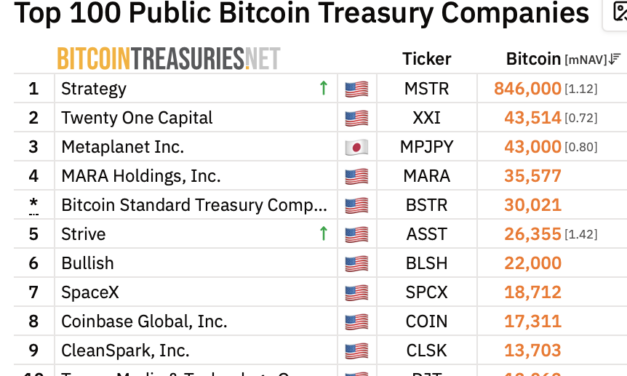
Strategy is seeking shareholder approval to move its four preferred stocks, including STRC, to daily dividend payments without changing their dividend rates or the total amount paid.The company’s board approved the proposal on Thursday, according to a Friday filing with the US Securities and Exchange Commission. Shareholders are scheduled to vote on the amendments at a virtual special meeting on Oct. 28.If approved, each calendar day would become a dividend record date, with the corresponding payment made on the next business day. STRC would move to the new schedule first, with its initial daily dividend payment expected on Nov. 2.STRF, STRK and STRD would follow in January, with their first payments under the daily schedule expected on Jan. 4. The amendments would take effect after Strategy files updated certificates governing the preferred stocks with the state of Delaware.Related: Strategy buys 950 Bitcoin for $76M, repurchases $174M in STRCStrategy follows Strive into daily dividendsStrategy’s proposal comes several months after fellow Bitcoin treasury company Strive moved its SATA preferred stock to daily dividend payments, becoming the first public company to adopt the model.Strive announced in May that SATA would begin paying dividends every business day on June 16 at a 13% annual rate, and also reported that it eliminated its outstanding debt in the first quarter.Unlike Strive’s business-day schedule, Strategy’s proposal would make every calendar day a record date, with the corresponding dividend payable on the following business day.Strive holds 26,355 Bitcoin, compared with Strategy’s 846,000 BTC, according to BitcoinTreasuries.NET.Top 10 Bitcoin treasury companies. Source: BitcoinTreasuries.NETStrategy CEO says leverage drove STRC below $100While Strive was the first public company to offer daily dividends, Strategy pioneered what it calls “digital credit,” preferred securities designed to generate income from a capital structure built around the company’s Bitcoin treasury.STRC, a key part of Strategy’s digital credit strategy, has seen significant price swings this year. In June, the stock fell sharply below its $100 stated amount, hitting an intraday low of $71.25 on June 26, according to Yahoo Finance data.STRC stock price year-to-date. Source: Yahoo FinanceSpeaking on Natalie Brunell’s Coin Stories podcast earlier this week, Strategy CEO Phong Le attributed the decline to more leverage entering the market for STRC than the company had anticipated. He said some investors borrowed against Bitcoin at lower rates to buy STRC and capture the spread between their borrowing costs and STRC’s dividend yield.When Bitcoin’s price fell, investors who had borrowed against their holdings faced pressure to either add more collateral or sell STRC, according to Le.“We did not expect the amount of leverage that came into the system,” Le said. “And so that’s a lesson learned, next time around.”Le said Strategy is seeking to prevent another such unwind by maintaining a strong US dollar reserve and having a policy that allows the company to repurchase STRC when it trades below its $100 stated amount. He also said the company wants to attract more long-term holders, particularly institutional investors.STRC has since recovered to about $98.41, close to Strategy’s stated goal of keeping the security between $99 and $100. It currently carries a 12% variable annual dividend rate.Magazine: Exchanges reporting crypto gains to IRS becomes tax nightmare

Čítaj viac


Fed proposes new capital, redemption rules for stablecoin issuers

The Federal Reserve has proposed capital, redemption and other regulatory requirements for stablecoin issuers under its supervision as it moves to implement the GENIUS Act.The GENIUS Act already requires stablecoin issuers to maintain reserves backing their tokens on a one-to-one basis and limits the types of assets they can hold, including cash, bank deposits and short-term US Treasurys. The law left federal regulators to establish more detailed capital, reserve-diversification and risk-management requirements.Under the Fed proposal, issuers would face an operational-risk capital charge equal to 2% of the first $20 billion in stablecoins outstanding, 1.5% of the next $30 billion and 1% of amounts above $50 billion, along with additional capital requirements tied to credit and operational risks.Issuers would generally be required to process redemptions within two business days. If reserves fall below the required one-to-one backing, an issuer would have to notify the Fed and either restore its reserves under a remediation plan or liquidate them and redeem outstanding stablecoins.Issuers would also have to publish monthly reports detailing their outstanding stablecoins and the value and composition of their reserves. The disclosures would have to be examined by a registered public accounting firm and certified by the issuer’s CEO and CFO.A separate proposal would establish an application process for Fed-supervised banks seeking approval to issue payment stablecoins through subsidiaries, including requirements to submit a business plan and financial information.The proposals are open for public comment for 60 days after publication in the Federal Register.Related: EU banking watchdog calls for crypto lending rules under MiCABarr says stablecoins must remain redeemable during market stressFed Governor Michael Barr supported the proposal on Thursday but said further work would be required for stablecoins to become reliable payment instruments.“Stablecoins will only be stable if they can be reliably and promptly redeemed at par in a range of conditions. This includes during market stress, when pressure can be put on the value of even otherwise liquid government debt, and during episodes of strain on the individual issuer or its related entities,” Barr said.Barr added that he was encouraged by the proposed limits on reserve assets and standardized capital requirements, while calling for public feedback on whether the framework adequately addresses interest-rate and foreign-currency risks.He also said universal redemption rights should be clearly established in the final rule and raised concerns about a standard that would prevent the Fed from taking supervisory or enforcement action over an anti-money laundering deficiency unless the issue is considered “significant or systemic.”The GENIUS Act is set to take effect on Jan. 18, 2027, or 120 days after federal regulators issue final implementing rules, whichever comes first.Magazine: Winners and losers of the SEC’s new tokenized stocks rules

Čítaj viac

DoubleZero brings dedicated fiber market data to Hyperliquid traders

DoubleZero has launched a dedicated market data feed for Hyperliquid, giving professional trading firms access to the decentralized exchange’s full order book over fiber rather than through its public APIs.The feed includes Hyperliquid’s native perpetual futures and markets operated by trade[XYZ], which uses Hyperliquid’s infrastructure to offer perpetual contracts tied to assets including oil, gold and silver. The Hyperliquid feed was developed with validator operators and ecosystem partners including Hyperion DeFi, MAVAN and Kinetiq.DoubleZero said the service delivers a continuous, ordered stream of market data for market makers, quantitative trading firms, and proprietary trading firms that need faster, more consistent order book updates. Previously, firms seeking a complete view of Hyperliquid’s order book had to assemble the data themselves through public API responses or operate their own Hyperliquid nodes. DoubleZero said changes to Hyperliquid’s public APIs have reduced the frequency and depth of updates available through them.DoubleZero operates a global fiber network designed to move data quickly between participants in blockchain networks and other distributed systems. Hyperliquid is the third venue available through its Edge market-data service, following Solana and prediction market Kalshi.Related: Bitwise launches first Lighter ETP amid Hyperliquid rivalryOnchain market infrastructure starts to resemble traditional exchangesHyperliquid’s market data infrastructure is beginning to resemble what traditional electronic exchanges use as professional trading moves onchain, according to Hyperion DeFi CEO Hyunsu Jung.Jung told Cointelegraph that CME, Nasdaq and other major exchanges distribute professional market data over dedicated networks, allowing automated trading firms to receive a consistent stream of ordered data at high speeds.“Hyperliquid data can now be consumed through the same basic model: publish once, distribute simultaneously over dedicated fiber,” he said.However, significant differences remain. Traditional exchanges allow trading firms to place their systems close to the infrastructure that processes trades, while Hyperliquid executes trades onchain. DoubleZero’s service only delivers market data; it does not place or execute trades for firms.“So the convergence is not Hyperliquid becoming CME,” Jung said. “It is onchain markets adopting the market-data infrastructure that professional trading firms already use.”“It does not eliminate latency differences,” Jung said. “A firm in Tokyo will still have a physical advantage over one in New York.”Magazine: Kyle Samani predicts SOL flippening, claims ‘no one’ uses ETH

Čítaj viac

Sequans exits Bitcoin treasury strategy after selling remaining 314 BTC

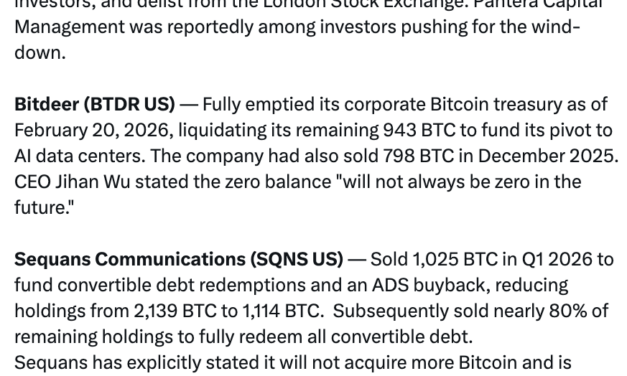
Sequans Communications has sold its remaining 314 Bitcoin, completing its exit from a Bitcoin treasury strategy that once saw the semiconductor company hold more than 3,200 BTC.On Thursday, the French semiconductor company said the exit follows the redemption of its convertible debt in May and will allow it to refocus on its core cellular internet-of-things (IoT) and software-defined radio businesses. CEO Georges Karam said the company used Bitcoin sales to eliminate its convertible debt and strengthen its balance sheet, leaving Sequans with no cryptocurrency holdings and no outstanding debt beyond government-financed research and development obligations.Sequans launched its Bitcoin treasury strategy in June 2025 after announcing a $384 million sale of equity securities and convertible secured debentures. At the time, Karam called Bitcoin “a premier asset and a compelling long-term investment.”The company began reducing its holdings less than six months later, selling 970 BTC in November to redeem half its convertible debt. By May 2026, Sequans said it was “no longer pursuing” the treasury strategy and would monetize its remaining Bitcoin over time.Related: REX launches 2x leveraged ETF tied to Bitcoin treasury firm StriveBitcoin treasury exits mount in 2026A growing number of digital asset treasury companies have abandoned or scaled back their accumulation strategies in 2026 amid the crypto bear market.In late July, Matthew Sigel, head of digital assets research at VanEck, identified at least nine companies that had fully liquidated or abandoned their Bitcoin and crypto treasury strategies in 2026, alongside several others that had reduced their holdings.Source: Mathew SigelUK-listed Satsuma Technology was among the more drastic reversals. In July 2025, the company raised 100 million British pounds ($135 million) through convertible loan notes to expand its Bitcoin treasury, in what Cointelegraph reported at the time was a UK record for a Bitcoin treasury raise.A year later, shareholders voted overwhelmingly to return substantially all of the company’s capital and cancel its listing. The board subsequently authorized the closure of its trading activities and the sale of its entire 669 BTC position.Other companies to fully liquidate their Bitcoin holdings this year include Bitdeer, Genius Group and Prenetics. MARA Holdings and Empery Digital have also made substantial sales without abandoning their treasury strategies altogether.The companies cited by VanEck’s Sigel exited or reduced their holdings for a range of reasons, including debt repayments, working capital needs, shareholder returns and shifts in business strategy.Magazine: Big Questions: Does Satoshi actually own 1.1 million Bitcoin? 

Čítaj viac

Získaj BONUS 8 € v Bitcoinoch

nakup bitcoin z karty

Registrácia Binance

Burza Binance

Aktuálne kurzy