Autor Cointelegraph by Nate Kostar

Bloomberg brings onchain stablecoin data to its Terminal

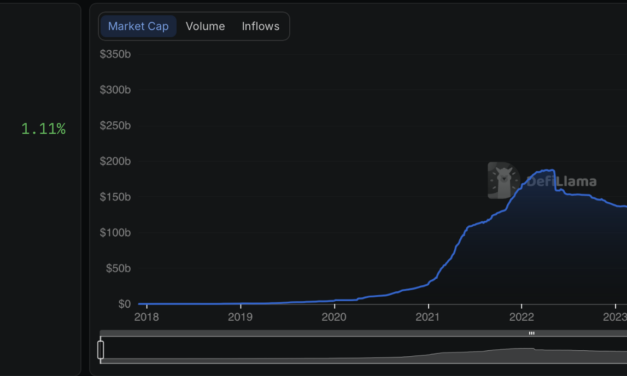
Bloomberg has launched a stablecoin dashboard on its Terminal, giving financial professionals access to onchain data tracking stablecoin supply, issuance and transaction activity.The dashboard, powered by blockchain data platform Allium, covers stablecoins with more than $100 million in circulation, representing over 98% of the market, according to a Wednesday announcement from Bloomberg.Users can compare stablecoins by supply, mints, burns, transfer volume and velocity, and break down activity by blockchain network and peg type, including fiat currencies and commodities.The dashboard is available to all Bloomberg Terminal users through RWAS and places the onchain data alongside the platform’s existing fixed-income, foreign exchange and money-market tools.The Terminal is widely used by banks, asset managers and other financial professionals for real-time market data, news, analytics, trading and communications. Bloomberg has carried Bitcoin pricing on the platform since 2014 and currently provides pricing, reference data, identifiers and benchmarks for 50 cryptocurrencies.The move comes as the stablecoin market capitalization has risen above $306 billion, according to DeFiLlama data, with Tether’s USDT accounting for roughly 60% of the market.Source: DefiLlamaMagazine: Peter Brandt says Bitcoin may hit $600K by 2029, calls XRP a ‘fool coin’Cointelegraph is committed to independent, transparent journalism. This news article is produced in accordance with Cointelegraph’s Editorial Policy and aims to provide accurate and timely information. Readers are encouraged to verify information independently.

Čítaj viac
Brazil’s Petrobras uses Cardano to track sustainable aviation fuel, renewable diesel

Brazilian state-controlled oil company Petrobras has developed two blockchain applications using Cardano to track sustainability data for sustainable aviation fuel (SAF) and its Diesel R renewable fuel.According to a Wednesday announcement from the Cardano Foundation, the first application, developed with PUC-Rio’s Ledger Labs, tokenizes environmental attributes associated with SAF into digital tokens designed to prevent the same claim from being used more than once.The application uses a Book-and-Claim model, which allows the environmental benefit to be separated from the physical fuel and assigned to an airline, company or passenger even if the SAF is used elsewhere.The tokens, known as CS-SAF, contain metadata aligned with the Carbon Offsetting and Reduction Scheme for International Aviation (CORSIA). Passengers can also claim CS-SAF tokens through an application and receive a certificate tied to their journey and associated environmental claim.Source: Cardano FoundationThe second application creates digital checkpoints to track the production, transportation and use of Diesel R, Petrobras’ renewable diesel fuel. The Cardano Foundation said the data could support Scope 3 reporting, which covers indirect emissions across a company’s value chain. The projects are part of an ongoing research and development collaboration that began in 2023 with blockchain education for Petrobras employees and expanded in 2025 to energy-sector research with PUC-Rio’s Ledger Labs. The Cardano Foundation did not disclose fuel volumes covered by the applications or a timeline for broader deployment.Related: Brazil puts tokenized cows to work as loan collateral: ReportBlockchain finds use in sustainable aviation fuel trackingShell has also used blockchain to track environmental attributes associated with sustainable aviation fuel through Avelia, a Book-and-Claim platform launched in 2022 that uses blockchain to track claims and prevent double counting.In a September update, Shell said Avelia had contributed to more than 84 million gallons of SAF entering the global fuel network since its launch in 2022, resulting in more than 780,000 tonnes of CO₂e abatement through June 2026.More recently, Australia’s Viva Energy signed an agreement with NoviqTech in January to research digital Book-and-Claim systems for sustainable aviation fuel, including how blockchain could support emissions reporting and track environmental claims.Magazine: Could THORChain face prosecution over stolen Bitget funds? 

Čítaj viac

Kakaopay partners with Dinari, Ondo to explore tokenized Korean stocks

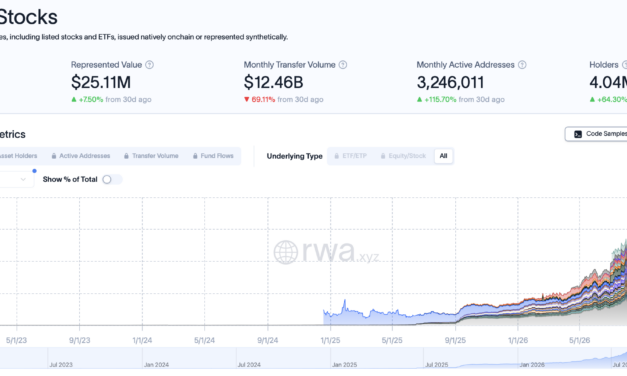
South Korea’s Kakaopay Securities is partnering with tokenization firms Dinari and Ondo Finance to explore bringing Korean-listed stocks onchain and distributing them to investors in international markets.Kakaopay announced separate agreements with Dinari and Ondo on Tuesday, covering the sourcing of underlying Korean shares, tokenization infrastructure and their potential distribution outside South Korea.Under the Dinari partnership, the companies will run a proof of concept using Dinari’s dShares model, which is designed to preserve applicable shareholder rights, including dividends and voting. Dinari offers 724 tokenized US stocks and ETFs through dShares, with the Kakaopay partnership exploring an extension of the model to Korean-listed equities.Dinari CEO Gabe Otte told Cointelegraph that no specific Korean-listed companies have been selected for the proof of concept and that it has not set a public timeline for commercial availability. The proposed model would use locally listed Korean shares as the underlying assets rather than tokens that simply track their prices, he said.Kakaopay’s agreement with Ondo will initially focus on establishing a framework for sourcing and custodying Korean-listed shares that could later be tokenized. Kakaopay would operate a foreign investor omnibus account to hold and administer the underlying shares.Ondo and Kakaopay will also research token issuance and redemption. The companies said any decision on whether or when to commercialize tokenized Korean equities will depend on legal and regulatory requirements in South Korea and overseas markets.Related: Bank of Korea launches 24-hour won settlement pilot for foreign investorsSouth Korea prepares for tokenized securitiesThe agreements come as South Korea prepares to implement a new regulatory framework for tokenized securities. The country’s National Assembly approved amendments in January that recognize distributed ledgers as valid securities registries and permit the issuance and circulation of token securities.In June, the Financial Services Commission linked the development of token securities infrastructure to a broader overhaul of the country’s capital markets. The framework is scheduled to take effect in February 2027, while the Korea Securities Depository is developing infrastructure to connect its existing securities account system with blockchain-based data.Asked about the appetite for tokenized stocks in South Korea, Otte told Cointelegraph:We’re seeing meaningful institutional interest in South Korea, particularly around tokenization as infrastructure for connecting Korean capital markets with global investors… The opportunity isn’t simply to create tokenized versions of Korean equities, but to build infrastructure that can ultimately expand how those equities are distributed internationally while preserving the rights and protections of the underlying securities.Tokenized stocks have surged in 2026, reaching about $3.2 billion in distributed value as of late September, according to RWA.xyz. However, the market remains heavily concentrated in tokenized versions of US equities and exchange-traded funds, including shares in Strategy, Circle, Nvidia and Tesla, along with major US stock ETFs.Source: RWA.xyzMagazine: Peter Brandt says Bitcoin may hit $600K by 2029, calls XRP a ‘fool coin’

Čítaj viac

Bitwise launches first US spot NEAR ETF after token’s recent surge

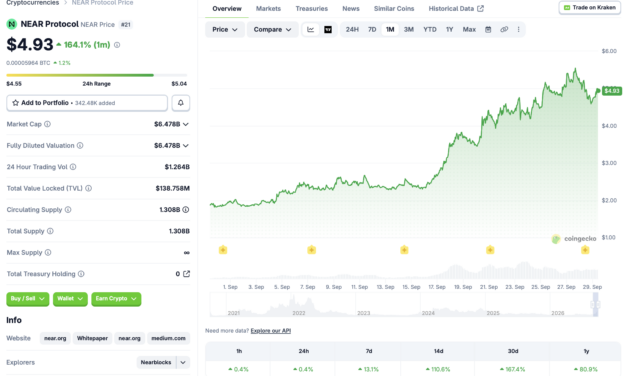
Crypto asset manager Bitwise has launched the first US spot exchange-traded product tracking NEAR, giving investors exposure to the token through a fund trading on NYSE Arca.The Bitwise NEAR ETF, trading under the ticker NRR, carries a 0.75% management fee and will hold NEAR directly, with Bitwise intending to stake a significant portion of the fund’s tokens.The launch comes as activity on NEAR Intents, the network’s cross-chain transaction protocol, has increased sharply, with volume rising to more than $32 billion compared with less than $1 billion a year ago, according to Bitwise.Bitwise chief investment officer Matt Hougan told Cointelegraph that the firm sees AI agents as a growing use case for NEAR and has already seen evidence of agents using the network. He expects that activity to increase over time, although most activity on NEAR today remains human-driven.Hougan added that Bitwise has been working on the US NEAR ETF since launching its European NEAR exchange-traded product in June 2025. NRR joins its US lineup of single-asset crypto products tracking Bitcoin (BITB), Ether (ETHW), Solana (BSOL), XRP (XRP) and Hyperliquid (BHYP).The NEAR token has rallied sharply over the past month, gaining about 167% to trade around $4.94 on Tuesday, according to CoinGecko data. The token is up about 81% over the past year.NEAR price. Source: CoinGeckoAI agents put crypto payment rails in focusNEAR is a layer-1 blockchain for decentralized applications that shifted its strategy toward AI in 2024 and has since focused increasingly on cross-chain infrastructure and autonomous AI agents.The shift comes as major financial institutions examine how autonomous software could drive demand for blockchain-based payment infrastructure. Last week, BlackRock said in a research paper that AI agents could increase demand for stablecoins, cryptocurrencies and tokenized assets as machine-to-machine transactions become more common.BlackRock described AI as a potential “structural catalyst” for digital asset adoption, arguing that programmable assets could be suited to high-frequency, low-value transactions that operate around the clock.NEAR is seeking to capture some of that activity through Intents, which allows users and AI agents to specify a desired transaction while third-party solvers compete to execute it across supported blockchains.“The design of Intents, for instance, aligns with the goal-based orientation of LLMs, and shields them from the complexity of bridging and other challenges,” Hougan told Cointelegraph.Hougan also pointed to cross-chain usability as a key factor behind Intents’ growth. “Bridging and cross-chain abstraction has been a challenge for crypto for nearly a decade, and a lot of people have lost both time and money trying to navigate that space,” he said.The protocol’s role in moving assets across blockchains came into focus this week after NEAR Intents said it blocked more than $50 million in attempted transfers linked to the $387.5 million Bitget hack. Its SHIELD system froze about $503,000 during execution, while roughly $166,000 in suspected stolen funds passed through the protocol.Magazine: Peter Brandt says Bitcoin may hit $600K by 2029, calls XRP a ‘fool coin’

Čítaj viac

OG.com seeks CFTC approval for single-stock perpetual futures

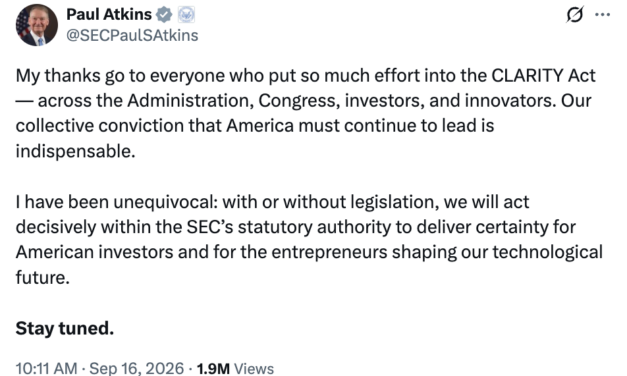
OG.com Markets is seeking US regulatory approval to offer perpetual futures tied to individual stocks, as trading platforms push to bring the popular derivatives product to US equity markets.In a Thursday filing with the Commodity Futures Trading Commission (CFTC), OG.com proposed new rules allowing it to list cash-settled single-stock futures that never expire and can trade 24 hours a day, five days a week.OG.com was recently spun out of crypto exchange Crypto.com as an independent prediction markets and derivatives platform valued at $5 billion. At the time, CEO Kris Marszalek said the platform planned to expand beyond prediction markets into futures and perpetual contracts.Shortly after the spin-off, Robinhood took an equity stake in OG.com as part of a multi-year deal to use its CFTC-regulated derivatives exchange and clearinghouse for prediction markets.Unlike traditional futures contracts, perpetual futures, or “perps,” have no expiration date, allowing traders to maintain exposure without periodically rolling into new contracts. The product was pioneered in crypto by BitMEX in 2016.Related: President Trump’s media company to terminate Crypto.com dealPerpetual futures push expands into US stocksCrypto trading platforms and prediction markets are increasingly looking to bring one of the digital asset market’s most popular derivatives products to US stocks, with OG.com joining a growing group seeking regulatory approval.On Sept. 18, Coinbase, Kraken parent Payward through its Bitnomial exchange, and prediction market Kalshi all filed to offer perpetual futures tied to individual US stocks.The filings came after US regulators, including the Securities and Exchange Commission (SEC) and CFTC, pushed ahead with crypto initiatives despite the CLARITY Act failing to advance in the Senate on Sept. 15.Source: Paul AtkinsJust days after the vote, the SEC cleared limited onchain trading of tokenized US stocks under its Innovation Exemption, while the CFTC expanded regulatory relief for software providers connecting users to regulated derivatives platforms, including those offering perpetual contracts.The CFTC had already begun laying the regulatory groundwork for perpetual futures months earlier.In May, the agency established a case-by-case review process for perpetual contracts and approved Kalshi’s Bitcoin perpetual futures product, followed in June by temporary relief allowing certain registered exchanges to convert existing crypto futures into contracts without expiration dates.Magazine: Exchanges reporting crypto gains to IRS becomes tax nightmare

Čítaj viac

Získaj BONUS 8 € v Bitcoinoch

nakup bitcoin z karty

Registrácia Binance

Burza Binance

Aktuálne kurzy