Autor Cointelegraph by Nate Kostar

71% of UK finance leaders expect tokenization to reshape financial services: Lloyds

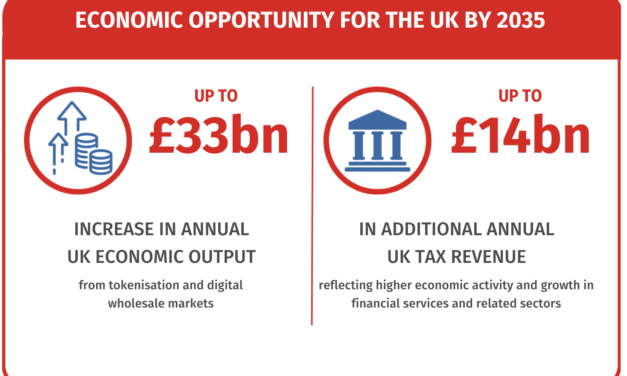
Nearly three-quarters of major UK financial institutions expect tokenization to reshape financial services, as banks and asset managers increasingly explore blockchain-based infrastructure for payments, settlement and liquidity management.The finding comes from an annual survey by Lloyds Banking Group, the UK’s largest financial services provider, which polled 100 senior decision-makers across major UK banks, insurers, asset managers and financial sponsors.Faster payments and settlement emerged as the biggest potential benefit, cited by 60% of respondents, while 41% pointed to improved collateral and liquidity management.Lloyds said moving assets and payments onto digital infrastructure could also free up capital and liquidity tied up in financial transactions, allowing institutions to deploy those resources elsewhere.“The next phase is about turning those individual use cases into infrastructure that works at scale, with the interoperability and common standards needed to connect digital and traditional markets,” said Rob Hale, co-head of global markets at Lloyds.Lloyds has also tested the technology directly. Earlier this year, the bank worked with Archax and Canton Network on what it described as the UK’s first public blockchain transaction using tokenized deposits to purchase a tokenized UK government bond.Related: Crypto adoption blooming in Germany, while UK is falling ‘behind,’ says CoinShares researcherUK builds infrastructure for tokenized financeThe survey comes as UK policymakers push to move tokenization beyond pilot projects and into the country’s financial infrastructure.The Bank of England proposed extending its core settlement infrastructure toward near-24/7 availability in May, while a subsequent government payments blueprint called for tokenized and traditional forms of money to operate within an interoperable payments system.In July, a government-backed industry task force estimated that leadership in tokenized finance could add as much as 33 billion British pounds ($44 billion) to the UK’s annual economic output by 2035, while calling for the country’s first tokenized government bond by early 2027.UK tokenization economic opportunity by 2035. Source: UK Wholesale Markets Digital StrategyThe UK has also sought greater coordination with the US on tokenized finance. That same month, the US and UK treasuries recommended creating a private-sector group to test cross-border uses of tokenized assets and urged US financial regulators and the Bank of England to identify shared approaches to their regulation.Magazine: Furious debate about THORChain vs NEAR shows idealism has limits

Čítaj viac

Evernorth clears shareholder vote ahead of Nasdaq debut with 473M XRP treasury

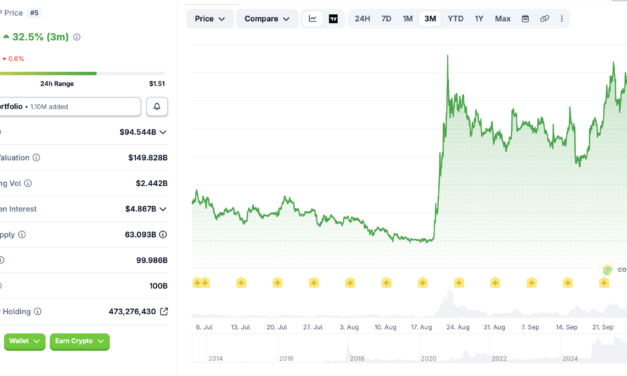
Evernorth is set to become a publicly traded XRP treasury company after shareholders of blank-check firm Armada Acquisition Corp. II approved their proposed business combination.The deal is expected to close on Oct. 7, with shares of the combined company set to begin trading on Nasdaq under the ticker XRPN the following day, subject to remaining closing conditions.The vote clears a key hurdle after Evernorth filed its Form S-4 registration statement with the US Securities and Exchange Commission in March. The registration statement was declared effective in August, leaving shareholder approval as one of the remaining steps before the Nasdaq listing.At closing, Evernorth expects to hold about 473 million XRP, which it says would make it the largest publicly traded pure-play XRP treasury company.According to Thursday’s announcement, the transaction is expected to raise about $300 million in gross cash proceeds, including $225 million from related private placements, $30 million in convertible note financing and roughly $48 million from Armada II’s trust. Investors have also contributed XRP directly to the transaction.XRP was trading at about $1.50 at the time of publication, according to CoinGecko data, putting Evernorth’s expected 473 million-token treasury at roughly $710 million.Related: Ether, XRP ETF inflow streaks end as Bitcoin funds rebound. Source: CoinGeckoEvernorth’s investors include Ripple, Kraken, Pantera Capital, SBI Group, Arrington Capital and GSR. It plans to grow its XRP holdings per share through yield strategies, participation in the XRP ecosystem and capital markets activities.Related: Ether, XRP ETF inflow streaks end as Bitcoin funds reboundCrypto treasury SPACs face market headwindsEvernorth’s planned Nasdaq debut comes as other crypto companies have pursued SPAC mergers to reach US public markets, with markedly different outcomes this year.Tokenization firm Securitize began trading on the New York Stock Exchange in July after completing its merger with Cantor Equity Partners II, while CoinShares made its Nasdaq debut in April following a $1.2 billion merger with Vine Hill Capital Investment Corp.However, crypto treasury companies have faced setbacks. Ether Machine scrapped its planned merger with Dynamix in April, citing unfavorable market conditions and ending plans to launch a $1.5 billion yield-bearing Ether fund through the deal.In July, Adam Back’s Bitcoin Standard Treasury Company and Cantor Equity Partners I also scrapped the original terms of their proposed merger and postponed a shareholder vote indefinitely while negotiating a deal that would “better reflect market conditions.”Magazine: Stablecoins can drain from banks and nations at lightning speed

Čítaj viac

50,000 Europeans call on EU to ease stablecoin rewards restrictions in MiCA review

More than 50,000 Europeans have urged the European Commission to loosen restrictions on stablecoin rewards as part of its review of the bloc’s Markets in Crypto-Assets (MiCA) framework, according to crypto advocacy group Stand With Crypto EU.The campaign came as the Commission closed its MiCA review consultation on Wednesday, with Stand With Crypto EU pushing for regulated stablecoin providers to be allowed to offer incentives including cashback, loyalty benefits and fee reductions.The group said more than 50,000 supporters wrote to the Commission during the consultation, while more than 126,000 people have separately signed its petition calling for a more permissive EU approach to stablecoins.Stand With Crypto EU campaign vehicle outside the European Parliament in Brussels, Belgium. Source: Stand With Crypto EUMiCA prohibits issuers and crypto service providers from paying interest on stablecoins, a restriction Stand With Crypto argues puts the products at a disadvantage to bank deposits and other e-money products that can offer benefits to customers.Stand With Crypto said the campaign generated more than six times the 8,221 responses submitted to the European Central Bank’s (ECB) digital euro consultation and far exceeded the 198 responses received during the Commission’s 2020 consultation on crypto rules.Stand With Crypto calls for EU to compete with US“We are calling on the Commission to use the MiCA review to allow regulated stablecoins to offer rewards to holders,” Stand With Crypto EU general manager Harry Pearce Gould told Cointelegraph.Asked whether Europe should look to regulatory models outside the EU, Pearce Gould pointed to the US:The US has made a clear choice to back stablecoins as the settlement layer for tokenisation. Europe doesn’t need to copy that, but it does need to compete with it.He added that allowing rewards could help euro-denominated stablecoins gain adoption and compete with dollar stablecoins.“Strong euro stablecoins matter for the euro’s global standing and the EU’s payment sovereignty,” he said.Related: Binance’s EU services face scrutiny over licensing exemption: ReportEU central banks seek changes to stablecoin rulesThe campaign comes as European central banks are pushing for broader changes to MiCA’s treatment of stablecoins.In a Sept. 22 response to the European Commission’s MiCA review, the European System of Central Banks (ESCB) called for the existing prohibition on stablecoin interest to extend to lending, borrowing and staking arrangements that generate yield.The ESCB also proposed replacing MiCA requirements that stablecoin issuers hold a minimum share of their reserves in bank deposits with liquidity thresholds. The central banks argued that the existing rules could strain lenders if a stablecoin run forced an issuer to rapidly withdraw deposits.The ECB has separately highlighted a potential liquidity mismatch, noting in June that stablecoins settle around the clock while their reserve assets may still operate on traditional settlement timelines.Source: European Central BankThe proposals come amid broader concerns from the ECB over stablecoins’ potential impact on financial stability. In May, ECB President Christine Lagarde warned that a shift of deposits from banks into stablecoins could weaken bank lending and monetary policy transmission, while arguing that Europe should instead prioritize tokenized financial infrastructure anchored by central bank money.Magazine: Peter Brandt says Bitcoin may hit $600K by 2029, calls XRP a ‘fool coin’

Čítaj viac

New York, Wyoming regulators sign pact to coordinate crypto oversight 

New York and Wyoming financial regulators have signed an agreement to coordinate oversight of crypto companies operating across both states, including licensing, examinations and potential enforcement actions.The Memorandum of Understanding (MOU), announced Thursday by the New York State Department of Financial Services (NYDFS) and the Wyoming Division of Banking, applies to firms already regulated in either state and those seeking approval in both jurisdictions. Under the agreement, the regulators will share analysis and historical examination data to streamline applications, coordinate examination schedules and work toward joint examinations of companies operating in both states.The agreement also provides an expedited pathway for certain firms already regulated in one state that seek approval in the other. Companies operating under an existing license or charter for at least three years and not subject to enforcement action could receive an expedited review, with the second regulator aiming to reach a decision within six months.The MOU establishes protocols for sharing supervisory reports, market trend data and notifications about potential enforcement actions. The regulators will periodically share investigative information and may undertake enforcement actions jointly, in coordination or separately.The agreement links two states that have historically taken different approaches to crypto regulation. New York has maintained its BitLicense regime since 2015, subjecting crypto firms to what NYDFS calls “rigorous licensing standards,” while Wyoming has sought to accommodate digital asset businesses through crypto-focused laws, regulations and specialized banking charters.Magazine: Stablecoins can drain from banks and nations at lightning speedCointelegraph is committed to independent, transparent journalism. This news article is produced in accordance with Cointelegraph’s Editorial Policy and aims to provide accurate and timely information. Readers are encouraged to verify information independently.

Čítaj viac

Standard Chartered sees Ethena’s USDe reaching $40B, ENA hitting $2

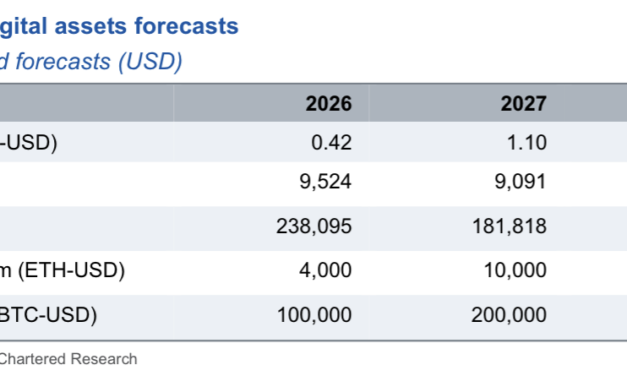
British multinational bank Standard Chartered expects Ethena’s USDe stablecoin supply to grow eightfold to $40 billion by the end of 2028 as the protocol expands its sources of yield beyond crypto markets.In a Wednesday research report shared with Cointelegraph, the bank initiated coverage of Ethena’s ENA token with a year-end 2028 price target of $2, roughly seven times the $0.28 price cited in the report. Standard Chartered also expects USDe to slightly outpace overall stablecoin market growth over the period.Its forecasts imply ENA would also outperform Bitcoin (BTC) and Ether (ETH) through 2028. Standard Chartered sees BTC reaching $300,000 and ETH $18,000 by the end of the period.Standard Chartered’s year-end digital asset price forecasts through 2028. Source: Standard Chartered ResearchStandard Chartered said declining returns from USDe’s traditional crypto basis trade, which involves holding spot crypto while shorting perpetual futures, have pushed Ethena to expand into DeFi and institutional lending, real-world assets and basis trades tied to equities and commodities. Those sources currently generate a blended yield of 5.2%, giving USDe more room to scale.The bank forecasts the broader market for tokenized assets will grow from about $350 billion today to $4 trillion by the end of 2028, expanding the pool of assets Ethena could use to generate yield. Related: Ethena launches USDe payments app, offers 6% rewardsUSDe growth could fuel ENA buybacksThe link between USDe growth and ENA buybacks is central to Standard Chartered’s valuation case for the token. A fee switch approved by Ethena governance in early September directs 95% of net revenue from its business lines toward ENA buybacks once USDe reaches specified supply milestones.At $25 billion in USDe supply, Ethena estimates the mechanism could generate $375 million in annual ENA buybacks, assuming a 6% gross protocol yield and a 25% net revenue take rate.ENA buyback volumes at different USDe supply levels. Source: EthenaStandard Chartered estimates that if USDe reaches its $40 billion forecast and ENA’s price remains unchanged, annual buybacks could amount to roughly 23% of ENA’s circulating market capitalization. The bank said such a rate would likely be unsustainable, so it expects ENA’s price to rise until buybacks settle at a lower percentage of its market value.The bank used Uniswap as a comparison, noting that UNI’s annualized buyback rate has stabilized at around 3% to 4% as its token price increased.ENA was trading at about $0.27 on Wednesday, up roughly 28% over the past week and 77% over the past month, according to CoinGecko data. The token has a market capitalization of about $2.65 billion. Magazine: Could THORChain face prosecution over stolen Bitget funds? 

Čítaj viac

Získaj BONUS 8 € v Bitcoinoch

nakup bitcoin z karty

Registrácia Binance

Burza Binance

Aktuálne kurzy