Autor Cointelegraph by Nate Kostar

Paxos’ $3B USDG stablecoin launches on Arbitrum

Paxos-issued stablecoin Global Dollar (USDG) has launched on Arbitrum as the blockchain joins the Global Dollar Network.According to an announcement shared with Cointelegraph, USDG is natively issued on Arbitrum One, with integrations across decentralized finance protocols including Fluid, Morpho, GMX and Maple. Kraken will support deposits and withdrawals, while Stargate will enable transfers between Arbitrum and other blockchains.A proposal submitted to the ArbitrumDAO would make USDG growth a strategic objective and add 100 million ARB to an incentive program to increase adoption. The proposal also calls for deploying Arbitrum treasury assets to support USDG liquidity, while businesses integrating the stablecoin can apply for support from the Arbitrum Foundation.As a Global Dollar Network partner, Arbitrum will share in rewards generated by USDG activity on the network, with the proceeds directed toward adoption and ecosystem development.Related: Mantle adds Paxos’ USDG stablecoin, joins Global Dollar Network. Source: DefiLlamaAbout $4 billion in stablecoins are currently held on Arbitrum, according to the Arbitrum Foundation. USDG, meanwhile, is the seventh-largest stablecoin by market capitalization, with about $3.09 billion in circulation, according to DeFiLlama data. Most of its supply is concentrated on X Layer, Robinhood Chain and Solana.Related: Mantle adds Paxos’ USDG stablecoin, joins Global Dollar NetworkArbitrum targets growing tokenization marketThe USDG launch comes as Arbitrum expands beyond crypto-native applications and becomes infrastructure for financial platforms bringing traditional assets onchain.The most prominent example is Robinhood Chain, which launched its public mainnet in July after a public testnet debuted in February. The Ethereum layer-2 network is built using Arbitrum and designed to support tokenized real-world and digital assets, including 24/7 trading, lending markets and perpetual futures exchanges.Last month, Standard Chartered said Robinhood Chain could signal a shift in Arbitrum’s economics, with the network receiving 10% of net protocol revenue generated by companies building on its infrastructure.The bank forecast that those economics, combined with growing asset tokenization, could help push ARB to $10 by 2030, roughly 70 times its price at the time. Standard Chartered expects tokenized assets to reach $4 trillion by the end of 2028, with Arbitrum among the potential beneficiaries as more assets move onchain.Magazine: Stablecoins can drain from banks and nations at lightning speed

Čítaj viac

S&P Global brings risk assessments to growing crypto lending vault sector

S&P Global Ratings has launched a risk assessment framework for digital asset lending vaults as the onchain investment products gain traction.According to Monday’s announcement, the framework evaluates vaults across six areas: portfolio credit quality risk, liquidity mismatch risk, curator risk, blockchain risk, protocol risk, and vault security and governance risk.S&P said the assessments will evaluate the risk of losses to investors in lending vaults, but will not constitute credit ratings or evaluate yields. As well, the framework was not designed to single out any one category of the six that poses a greater risk than the others, according to S&P Global Ratings analyst Lisa Schroeer.“A material weakness in any factor can constrain the overall VRA,” Schroeer told Cointelegraph. “A strong score in one factor does not offset a material weakness in another.” She said that the approach reflects a sector where “there are many points of risk/failure that can break.”Digital asset lending vaults pool investor deposits and deploy them through predefined strategies managed by smart contracts or human curators. Depositors receive tokens representing their share of the vault’s assets and returns.According to S&P, deposits in digital asset lending vaults reached about $10 billion in September, up from $1.5 billion two years earlier. S&P said it plans to publish its first Vault Risk Assessments in future announcements, though it did not identify which vaults will be assessed first.Explaining the framework’s potential role for investors, Schroeer said: “The assessment aims to provide more transparency on the risks so that any entity can make more informed decisions when deciding how to allocate capital to DeFi vaults.”Related: Kraken adds S&P 500 to funded trading program, commodities to followCrypto vaults grow as risks draw scrutinyCrypto vaults have expanded over the past year as exchanges, wallets and DeFi platforms have rolled out products that package lending and other yield-generating strategies for users.In February, Wallet in Telegram introduced self-custodial BTC, ETH and USDT vaults using infrastructure from Morpho, TAC and Re7. Kraken followed in May with a Bitcoin yield vault powered by Veda and curated by Sentora, attracting $30 million from 4,000 wallets within its first 10 hours.The model has since expanded into tokenized securities. In September, Kraken launched yield vaults for tokenized versions of Nvidia, the SPDR S&P 500 and Invesco QQQ ETFs, with Sentora managing strategies that lend the assets through DeFi markets.Source: PeckShieldAlertThe growing popularity of crypto vaults has not come without risks. In August, lending protocol Term Finance lost an estimated $8.5 million after an attacker exploited governance control of its Meta Vaults.For the time being, crypto vaults remain in a regulatory gray area in the United States. In July, SEC Commissioner Hester Peirce said some vaults and onchain lending products could fall under federal securities laws depending on how they are structured and operated.Peirce said vaults involving discretionary decisions over asset allocation, yield strategies, lending terms or liquidation thresholds could trigger securities, investment company or investment adviser requirements.Magazine: Former SEC boss made AI Czar, Bitcoin may hit $600K this cycle: Hodler’s Digest

Čítaj viac

Blast to wind down Ethereum L2 after costs outpace revenue

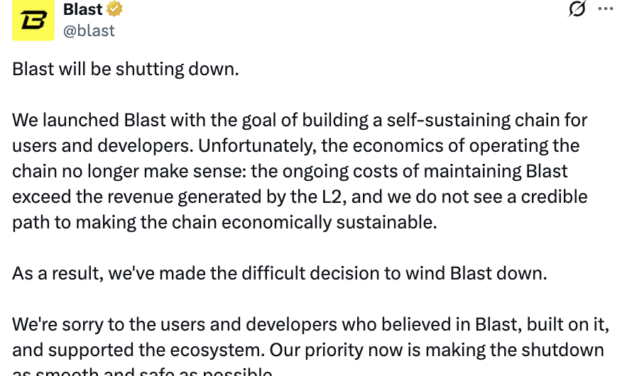
Ethereum layer-2 network Blast is shutting down after its operating costs exceeded the revenue generated by the chain.In a Friday post on X, Blast said it sees no “credible path” to making the network economically sustainable and asked users to withdraw their assets to Ethereum mainnet.“We launched Blast with the goal of building a self-sustaining chain for users and developers,” the team said. “Unfortunately, the economics of operating the chain no longer make sense.”Source: BlastThe network will reduce its withdrawal delay to 24 hours, though withdrawals will be temporarily unavailable while Blast unwinds its Lido assets, a process expected to take about a week.Users will have until Oct. 26 to withdraw through Blast’s interface. After that, assets will remain accessible, but withdrawals will require users to interact directly with the Blast bridge contracts on Ethereum.Blast said it will publish instructions for withdrawing directly through the bridge contracts ahead of the Oct. 26 cutoff and urged users to move their assets to Ethereum mainnet before then.Related: Stablecoins can drain from banks and nations at lightning speedBlast emerged from Blur’s NFT boomBlast was founded by Tieshun “Pacman” Roquerre, the founder of NFT marketplace Blur, which launched in October 2022 and quickly challenged OpenSea by targeting professional traders with token incentives. By the end of 2022, Blur had surpassed then-leading NFT marketplace OpenSea in trading volume and extended its lead in early 2023, fueled in part by its token airdrop and trader rewards.Roquerre unveiled Blast in November 2023 with native yield on Ether (ETH) and stablecoins and a points program tied to an anticipated token airdrop. The strategy helped attract more than $2 billion in deposits before its mainnet launched in February 2024.Blast’s DeFi TVL has fallen more than 98% since its June 2024 peak. Source: DefiLlamaHowever, Blast’s growth proved difficult to sustain amid a broader downturn in the NFT market. Its DeFi total value locked has declined steadily since peaking at roughly $2.2 billion in June 2024, falling by more than 98% since then, according to DeFiLlama data.Blur has undergone a similar decline. Its total value locked, which rose above $200 million at its early-2024 peak, now stands at about $27 million.Magazine: Furious debate about THORChain vs NEAR shows idealism has limits

Čítaj viac

Získaj BONUS 8 € v Bitcoinoch

nakup bitcoin z karty

Registrácia Binance

Burza Binance

Aktuálne kurzy