
Autor Cointelegraph by Nate Kostar

Kraken partners with MoneyGram for global crypto cash-outs

Kraken has teamed up with MoneyGram to let users convert crypto into cash for pickup across more than 100 countries, expanding access to off-ramps through its global retail network.According to Tuesday’s announcement, Kraken users will be able to convert digital assets into local currency and collect cash instantly or near-instantly through MoneyGram’s payout network, which supports hundreds of fiat currencies.The service will roll out in phases across regions including the US, Europe, Latin America, Africa and parts of Asia-Pacific, with plans to add bank deposits and cross-border payouts later.Source: KrakenfxSource: KrakenfxKraken said it will handle customer onboarding and compliance, while MoneyGram provides the locally licensed payout infrastructure through its global money transfer network. The initial launch focuses on cash withdrawals, with both companies planning to expand the integration into additional payment rails and remittance-style flows over time.MoneyGram, one of the largest global remittance providers, operates about 500,000 locations across more than 200 countries and territories, according to the company.Related: Polygon rolls out private stablecoin payments targeting institutionsStablecoins gain traction in remittances and emerging marketsStablecoins are playing a growing role in cross-border payments, from remittance companies integrating new rails to rising use in emerging markets.On Monday, MoneyGram rival Western Union launched its US dollar-denominated stablecoin, USDPT, on the Solana (SOL) network. The token is initially rolling out in Bolivia and the Philippines, with plans to expand to more than 40 countries in 2026, according to the company and infrastructure partner Fireblocks.In March, Western Union announced its planned Digital Asset Network would allow users to convert digital dollars into local currency at more than 360,000 collection points worldwide.Speaking at the World Economic Forum in January, economist Vera Songwe said remittances have become “more important than aid” across parts of Africa, highlighting their growing role in household income and cross-border payments.In Latin America, stablecoins are also seeing increased use. A 2025 report from Bitso found they accounted for 40% of crypto purchases among its users, compared with 18% for Bitcoin (BTC). The regional remittance market is estimated at around $174 billion, according to commentary from former Bybit executive Claudia Wang.Despite growing adoption, some countries are taking a more cautious approach. Brazil’s central bank recently barred the use of virtual assets in certain cross-border payment services, requiring providers to use traditional foreign exchange rails instead.The stablecoin market value currently stands at about $322 billion, up from roughly $243 billion a year ago, per DeFiLlama data.Stablecoin market cap. Source: DefiLlama Stablecoin market cap. Source: DefiLlama Magazine: How to fix suspected insider trading on Polymarket and KalshiCointelegraph is committed to independent, transparent journalism. This news article is produced in accordance with Cointelegraph’s Editorial Policy and aims to provide accurate and timely information. Readers are encouraged to verify information independently.

Čítaj viac

MoonPay buys DFlow to expand into Solana trading infrastructure

MoonPay has acquired DFlow, a trading infrastructure provider on Solana that routes and executes transactions across multiple liquidity sources. Financial terms were not disclosed, though Fortune reported the deal was valued at around $100 million in stock, citing two sources with direct knowledge of the matter.DFlow has processed more than $50 billion in trading volume on Solana since 2025, including over $12 billion in the first quarter of 2026, according to Tuesday’s announcement. The platform supports more than 1 million users across 500 applications.It aggregates liquidity across Solana-based venues, optimizing trade execution during settlement to improve pricing and reduce failed transactions. During peak periods, its routed trades have been included in a majority of Solana blocks, reflecting its role in network-level trading activity.Source: DFlowIn November 2025, DFlow surpassed Solana aggregator Jupiter in daily trading volume, according to the company. It also supports tokenized prediction markets, enabling onchain representations of contracts linked to regulated venues such as Kalshi.MoonPay provides infrastructure for converting between fiat and digital assets, including on- and off-ramps, payments and trading services. Last week, the company said it acquired Sodot, an Israeli firm specializing in key management technology, as part of a push to expand services for institutional clients.Related: Kraken bundles crypto and tokenized stocks to attract investors seeking exposure to multiple assetsCrypto companies expand beyond payments into trading and infrastructureMoonPay’s acquisition of DFlow is the latest in a broader wave of dealmaking among crypto companies seeking to build vertically integrated platforms that include trading, infrastructure and financial services.In February, Bitwise said it had acquired staking provider Chorus One, which oversees more than $2.2 billion in staked assets, expanding its validator infrastructure across more than 30 blockchains and bringing staking capabilities in-house.On Tuesday, Bullish agreed to acquire transfer agent Equiniti from Siris Capital in a $4.2 billion deal, allowing it to combine investor recordkeeping with trading and settlement, including plans for 24/7 markets and stablecoin-based payments.Crypto exchanges Kraken and Coinbase have also expanded through acquisitions. In July, Coinbase bought LiquiFi, followed by the purchase of Echo in October, adding tools for token ownership, vesting, compliance and capital formation. In August, the company closed its acquisition of Deribit, expanding its derivatives offering.Meanwhile, Kraken has focused on regulated trading infrastructure, acquiring NinjaTrader a year ago and derivatives venue Bitnomial in recent weeks.  The company also purchased The Small Exchange in October 2025. The US-regulated futures venue added exchange licensing to Kraken as it builds out its derivatives infrastructure.Magazine: AI-driven hacks could kill DeFi — unless projects act nowCointelegraph is committed to independent, transparent journalism. This news article is produced in accordance with Cointelegraph’s Editorial Policy and aims to provide accurate and timely information. Readers are encouraged to verify information independently.

Čítaj viac
Bitcoin mining stocks climb in 2026 as BTC lags behind

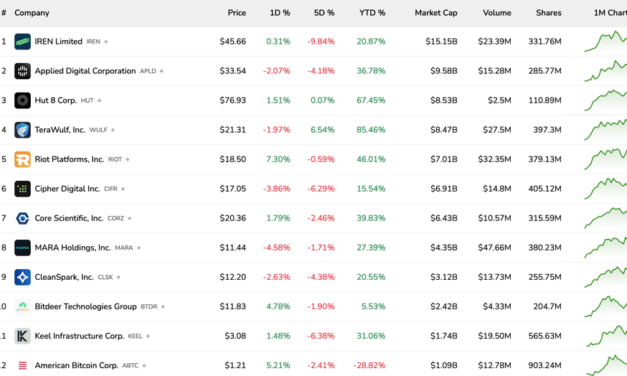
Publicly traded crypto mining companies are posting strong gains in 2026, even as the broader crypto market remains under pressure.All ten of the largest publicly traded mining stocks are in positive territory year-to-date (YTD), with gains ranging from around 5% to more than 85%, according to data from Bitcoinminingstock.io.Top Bitcoin mining stocks by market cap. Source: Bitcoinminingstock.ioTop Bitcoin mining stocks by market cap. Source: Bitcoinminingstock.ioTeraWulf, Inc. leads the group with gains of about 85%, followed by Hut 8 Corp. at roughly 67% and Riot Platforms, Inc. at around 46%.Other major miners have also posted strong gains, including Core Scientific, Inc., up about 40%, and Applied Digital Corporation, which has risen roughly 37% year-to-date.At the lower end, Bitdeer Technologies Group is up around 5%, making it the weakest performer among the top 10. Outside that group, American Bitcoin Corp., a Trump-linked Bitcoin mining and treasury company formed by Hut 8 and backed by Eric Trump and Donald Trump Jr., is down roughly 29%.The move comes even as Bitcoin (BTC) remains down around 20% YTD, even after gaining about 17% in the past 30 days.Source: CoinGeckoSource: CoinGeckoRelated: Canaan, Tether deepen partnership on immersion-cooled mining systemsTop crypto miners move deeper into AI infrastructureThe gains come as many of the largest mining companies push deeper into artificial intelligence and high-performance computing (HPC).On Thursday, Riot Platforms reported $167.2 million in revenue for the first quarter of 2026, with its data center business contributing $33.2 million, helping offset a decline in core mining revenue. CEO Jason Les described the quarter as an “inflection point,” as the company transitioned into a revenue-generating data center operator.Core Scientific, Inc. is also scaling its infrastructure, with plans to develop a Texas site into an AI-focused data center campus with up to 1.5 gigawatts of capacity, including about 1 gigawatt available for leasing. The company said roughly 300 megawatts currently used for Bitcoin mining at the site will be repurposed for data center operations.In February, HIVE Digital Technologies reported a 219% year-over-year jump in quarterly revenue as it built out its AI and high-performance computing business, as well as a $30 million contract to deploy Nvidia GPUs for enterprise AI cloud customers. That same month, MARA Holdings, Inc. acquired a 64% stake in French AI data center company Exaion.A report from Bernstein last week said IREN Limited, the largest publicly traded miner by market cap, could eventually “sunset” its Bitcoin mining operations as it repurposes sites for GPU-based workloads.Magazine: Why is Ethereum Foundation selling? BTC futures warning signs: Market MovesCointelegraph is committed to independent, transparent journalism. This news article is produced in accordance with Cointelegraph’s Editorial Policy and aims to provide accurate and timely information. Readers are encouraged to verify information independently.

Čítaj viac

Kraken parent Payward closes Bitnomial deal to expand US crypto derivatives

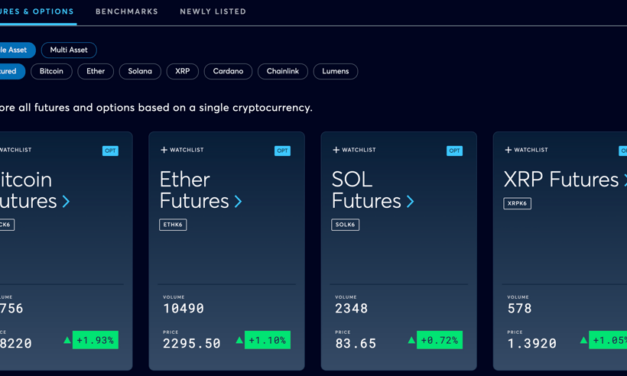
Payward, the parent company of Kraken, announced it has completed its acquisition of crypto derivatives venue Bitnomial, giving it control of a fully CFTC-regulated derivatives stack in the United States.The acquisition gives Payward a Futures Commission Merchant, Designated Contract Market and Derivatives Clearing Organization, infrastructure it plans to use to expand CFTC-regulated products across Kraken and NinjaTrader, starting with spot margin, with perpetuals and options expected to follow.Payward said Bitnomial will continue operating within its existing regulatory structure, with the deal enabling partners, including fintechs, banks and brokerages, to access US-regulated derivatives through the company’s infrastructure platform.The “definitive agreement” to acquire the company was first announced on April 17, when Payward said it would use Bitnomial’s Commodity Futures Trading Commission (CFTC) licenses to expand regulated crypto derivatives offerings in the US.According to Payward’s initial announcement, Bitnomial is the first crypto-native company in the US to hold licenses for exchange, clearing and brokerage functions under the CFTC.Related: Kraken bundles crypto and tokenized stocks to attract investors seeking exposure to multiple assetsCrypto derivatives markets expand as US platforms build offeringsCrypto derivatives, including futures and options tied to assets such as Bitcoin (BTC), account for a majority of digital asset trading volumes, with a significant share of activity taking place on offshore platforms.US regulators have acknowledged this trend. In a joint statement in September 2025, the Securities and Exchange Commission and the CFTC said regulatory fragmentation has pushed some crypto trading activity offshore and noted that perpetual futures have been limited in the US under current frameworks. The agencies said they are exploring ways to bring derivatives activity onshore using existing authorities, including potential frameworks for products such as perpetual futures and efforts to align regulatory requirements across markets.Against this backdrop, US platforms have begun expanding their crypto derivatives offerings. In April, CME Group, the largest derivatives exchange operator in the United States, said it plans to launch futures tied to Avalanche (AVAX) and Sui (SUI), pending regulatory approval, following a January plan to list contracts for Cardano (ADA), Chainlink (LINK) and Stellar (XLM).About a month later, the company announced it would begin offering 24/7 trading for crypto futures and options at the end of May, pending regulatory approval.Source: CME GroupSource: CME GroupOutside the US, crypto exchanges have been expanding derivatives offerings in other markets. In February, Kraken launched tokenized equity perpetual futures for non-US clients, offering 24/7 leveraged exposure to assets including US stock indexes, gold and equities, while in March, Coinbase expanded its derivatives offerings in Europe with new crypto and equity-index futures across 26 countries through its MiFID-regulated entity.Other crypto exchanges, including One Trading, Gemini and Backpack have also launched regulated perpetual contracts in Europe.Magazine: How to fix suspected insider trading on Polymarket and KalshiCointelegraph is committed to independent, transparent journalism. This news article is produced in accordance with Cointelegraph’s Editorial Policy and aims to provide accurate and timely information. Readers are encouraged to verify information independently.

Čítaj viac

MoonPay launches card enabling AI agents to spend stablecoins via Mastercard

MoonPay is launching a virtual debit card that allows users and AI agents to spend stablecoins directly from self-custodied onchain wallets at merchants that accept Mastercard, using real-time crypto-to-fiat conversion at checkout.The card, developed with Monavate and Exodus Movement, Inc., connects onchain wallets to traditional card rails, enabling transactions without preloading funds or transferring assets offchain, with smart contracts authorizing spending at the point of purchase.Available through MoonPay’s CLI and agent workflows to users in the UK and Latin America, the card is designed for programmatic use, allowing users to delegate spending permissions to AI agents, with identity verification required before issuance, the company said.The system converts stablecoins to fiat at the moment of purchase while maintaining user custody, with funds accessed only when a transaction is authorized and returned immediately if a payment is declined. MoonPay, founded in 2019 and based in Miami, is a financial technology company that provides payment infrastructure for moving funds between fiat and digital assets.The card builds on the company’s broader push into AI-driven payments infrastructure. In March, MoonPay released an open-source wallet standard designed to let AI agents hold funds and execute transactions across blockchains from a single wallet.Related: How AI agents can reshape arbitrage in prediction marketsPayment infrastructure evolves for AI-driven transactionsThe launch comes as crypto, technology and payments companies ramp up efforts to build infrastructure for AI-driven transactions.Coinbase introduced its x402 standard for stablecoin payments over HTTP in 2025, enabling applications and AI agents to pay for services programmatically. Recently, the company updated the protocol to support usage-based pricing, allowing payments to scale with compute demand such as data queries and AI processing.In March, Tempo, a blochain backed by payments company Stripe, launched its mainnet alongside a Machine Payments Protocol designed to support agent-driven transactions across payment methods. In a post on X, the project said “agent payments will soon overtake human payments on the internet.”Source: TempoSource: TempoMore recently, crypto exchange OKX unveiled a protocol supporting agent-to-agent payments, recurring flows and escrow-based settlements across blockchains, allowing software agents to execute more complex financial transactions without human input.Elsewhere, non-crypto companies are working to connect AI agents with existing payment systems. Google announced its Agent Payments Protocol in September 2025, designed to support transactions across cards, bank transfers and stablecoins. Visa has also released a command-line tool aimed at enabling programmatic payments by AI agents, allowing developers to initiate transactions directly through code.Magazine: AI agents will kill the web as we know it: Animoca’s Yat SiuCointelegraph is committed to independent, transparent journalism. This news article is produced in accordance with Cointelegraph’s Editorial Policy and aims to provide accurate and timely information. Readers are encouraged to verify information independently.

Čítaj viac

Získaj BONUS 8 € v Bitcoinoch

nakup bitcoin z karty

Registrácia Binance

Burza Binance

Aktuálne kurzy