
Autor Cointelegraph by Nate Kostar

Anchorage Digital adds Marinade-powered staking strategies for Solana clients

Anchorage Digital has integrated Marinade Finance into its platform, allowing institutional clients to stake Solana tokens through automated validator strategies while maintaining custody of their assets.According to Thursday’s announcement, the integration gives clients direct access to Marinade’s staking strategies within Anchorage’s custody and wallet infrastructure, including its Porto self-custody wallet, without requiring external applications.The setup separates staking delegation from withdrawal control, allowing institutions to participate in validator selection and yield generation while retaining asset control.Clients can choose between two staking strategies: one that allocates across a curated set of roughly 30 KYC-verified validators for compliance-focused use cases, including regulated financial products such as exchange-traded funds (ETFs). Another dynamically distributes stake across a broader validator set spanning hundreds of operators to optimize yield.Anchorage Digital X.com post re MarinadeFinance is now live on Anchorage DigitalThe integration is available through Anchorage Digital’s platform and its Porto wallet, where staking, custody and asset management functions are combined within a single interface.Anchorage Digital is a San Francisco-based crypto custody provider that operates the first federally chartered crypto bank in the United States. In January, it was reported to be seeking between $200 million and $400 million in new funding as it considers a potential initial public offering next year.Related: Galaxy expands retail platform with SOL staking, targeting 6.5% yieldInstitutional yield strategies expand from staking to Bitcoin DeFiInstitutions are increasingly seeking yield on crypto holdings without moving assets out of custody, as staking gains traction among asset managers and product issuers.In February, Ripple expanded its custody platform through integrations with Securosys and Figment, enabling banks and custodians to offer staking without running validators or managing keys, with support across on-premises and cloud environments and built-in compliance checks.The following month, Anchorage Digital integrated with Puffer Finance to offer liquid restaking on Ethereum, allowing clients to stake Ether (ETH) and receive pufETH, a transferable token representing a restaked position that continues earning rewards.While staking — that is, earning rewards for securing a network — was traditionally limited to proof-of-stake assets, similar yield strategies are emerging for Bitcoin (BTC) via decentralized finance (DeFi) integrations.Lombard recently teamed with Bitwise Asset Management to enable institutions to earn yield and borrow against Bitcoin without moving assets out of custody, combining DeFi lending and tokenized real-world assets with infrastructure from Morpho.Similarly, Fireblocks has integrated Stacks to provide institutional access to Bitcoin-based lending and yield, using faster block times while settling transactions on Bitcoin for finality.Magazine: Adam Back says current demand is ‘almost’ enough to send Bitcoin to $1MCointelegraph is committed to independent, transparent journalism. This news article is produced in accordance with Cointelegraph’s Editorial Policy and aims to provide accurate and timely information. Readers are encouraged to verify information independently.

Čítaj viac


MoonPay launches fiat-to-stablecoin virtual accounts in New York

MoonPay has launched fiat-to-stablecoin virtual accounts in New York, allowing businesses to convert incoming funds from bank rails such as ACH and SWIFT into stablecoins and settle them directly to non-custodial wallets through a single API.The product is underpinned by technology provider Iron and allows platforms to issue named, dedicated accounts that receive fiat and automatically convert it into stablecoins, enabling payment, trading and treasury flows without relying on prefunded balances or multiple intermediaries.The rollout in New York follows MoonPay’s acquisition of Iron in 2025 and builds on integrations with platforms including Deel and Paysafe, extending its stablecoin infrastructure across payroll and payments networks, according to Thursday’s announcement.MoonPay said it obtained a BitLicense, money transmitter licenses and a New York limited purpose trust charter from the New York State Department of Financial Services in 2025, allowing it to offer the service in one of the most tightly regulated crypto markets.Source: MoonPayThe company said the accounts enable faster settlement and programmable payments by linking traditional banking rails with blockchain-based infrastructure through a single integration.Max von Wallenberg, CEO of Iron, told Cointelegraph that launching in New York allows the company to target institutional clients operating in one of the most tightly regulated financial hubs. He said:New York is the center of global finance — where the largest banks, asset managers and enterprises operate… Being able to operate here signals we meet the highest regulatory and operational standards.He added that demand for the product in other jurisdictions has been driven by enterprise use cases including payroll, treasury management and cross-border payments, as well as tokenized real-world asset issuers that require fiat-to-stablecoin settlement flows.Related: Stablecoins not a threat to banks in near term: Moody’s analystStablecoins reduce reliance on prefunded accountsMajor payment companies and fintechs are increasingly integrating stablecoins into payment infrastructure to streamline cross-border transactions and reduce reliance on prefunded accounts.On Tuesday, Singapore fintech Nium integrated USDC payments through Coinbase, allowing businesses to send, receive and convert stablecoins to fiat across more than 190 countries through a single platform.The setup enables companies to fund cross-border payouts on demand using stablecoins and settle in either digital assets or local currencies, reducing the need to prefund accounts across multiple jurisdictions and streamlining global payment flows.Card networks are also expanding stablecoin-linked payment infrastructure. In March, Visa and Stripe-owned Bridge rolled out stablecoin-linked cards across more than 100 countries and are testing onchain settlement that would allow transactions to be settled in digital assets rather than fiat. As of December 2025, Visa’s annualized stablecoin settlement run rate reached $4.6 billion, according to a company spokesperson.Mastercard has also moved to expand its stablecoin capabilities, agreeing to acquire BVNK in a deal valued at up to $1.8 billion. The acquisition is aimed at strengthening its ability to connect traditional payment rails with blockchain-based transactions, supporting use cases including cross-border payments and business payouts.The total stablecoin market capitalization stands at about $320 billion, according to DefiLlama data.Stablecoin market cap. Source: DefiLlamaMagazine: AI-driven hacks threaten to kill DeFi — unless projects act nowCointelegraph is committed to independent, transparent journalism. This news article is produced in accordance with Cointelegraph’s Editorial Policy and aims to provide accurate and timely information. Readers are encouraged to verify information independently.

Čítaj viac
PUSD stablecoin deploys on ADI Chain, targeting $3T Islamic finance market

PUSD, a Shariah-compliant stablecoin backed by Gulf currencies, is set to deploy on ADI Chain, a Layer 2 network focused on institutional settlement in the Middle East.According to an announcement shared with Cointelegraph, the stablecoin has about $2.3 billion in circulation and is backed 1:1 by reserves held in Saudi riyals and UAE dirhams, which are pegged to the US dollar. It is already available on multiple blockchains, including Ethereum, BNB Chain, Solana and Tron, with ADI Chain marking its latest integration. The stablecoin is positioned to provide access to Islamic finance markets, which represent more than $3 trillion in assets globally, according to the announcement from the ADI Foundation.ADI Chain is the settlement layer for a dirham-backed stablecoin initiated by International Holding Company and First Abu Dhabi Bank and licensed by the Central Bank of the UAE, according to the announcement.The addition of PUSD introduces a second stablecoin to the network, allowing institutions to settle transactions using either a dollar-linked asset or a dirham-denominated token on the same infrastructure.Transactions on the network require its native token for fees and are expected to support settlement across corridors linking the Gulf, the Middle East and parts of Africa. PUSD is issued by Palm Azgar Finance and is designed for institutional use, including corporate treasuries, exchanges and payment processors.Related: Here’s why crypto is moving to Dubai and Abu DhabiUAE builds out stablecoin frameworkThe United Arab Emirates has developed a multi-layered regulatory framework for digital assets, with authorities including the Central Bank of the UAE and Abu Dhabi Global Market (ADGM) establishing rules for stablecoins and virtual asset providers. Within that framework, dirham-pegged payment tokens are being explored as a way to modernize domestic payments and improve cross-border settlement.In December, UAE telecom giant e& signed an agreement with Al Maryah Community Bank to test a dirham-pegged stablecoin licensed by the UAE central bank for consumer payments across its digital platforms in an early-stage pilot.The following month, RAKBank received in-principle approval from the central bank to issue a dirham-backed stablecoin, with the planned token expected to be fully backed 1:1 by reserves held in regulated accounts. The approval is subject to final regulatory and operational conditions before any live issuance.[embedded content]The push has also expanded to dollar-denominated tokens operating under local rules. In January, Universal Digital launched USDU, a US dollar-backed stablecoin registered by the UAE central bank under its Payment Token Services Regulation, making it the first dollar-denominated token approved for payment use within the framework.Separately, the Financial Services Regulatory Authority has granted approvals to several crypto firms, including Tether (USDT), Ripple USD and Circle, to operate inside the ADGM’s financial zone.Magazine: Will the CLARITY Act be good — or bad — for DeFi?Cointelegraph is committed to independent, transparent journalism. This news article is produced in accordance with Cointelegraph’s Editorial Policy and aims to provide accurate and timely information. Readers are encouraged to verify information independently. Read our Editorial Policy https://cointelegraph.com/editorial-policy

Čítaj viac

Thailand regulator mulls crypto futures expansion in licensing overhaul

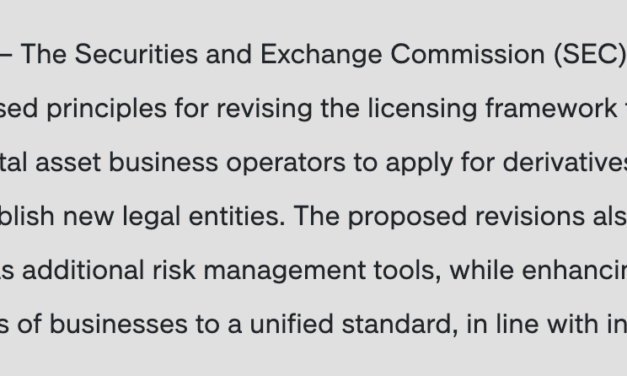
Thailand’s Securities and Exchange Commission (SEC) is seeking public comment on proposed rule changes that would allow licensed digital asset businesses to apply directly for derivatives licenses, removing the requirement to establish separate entities.The proposed revisions would build on earlier changes recognizing digital assets as eligible underlying assets for futures contracts, expanding the scope of Thailand’s derivatives market while introducing additional requirements to manage conflicts of interest and strengthen oversight.Source: The Securities and Exchange Commission, ThailandThe proposal could lower barriers for crypto companies to enter the derivatives market by allowing them to apply for licenses within existing entities, rather than establishing separate companies, while bringing those activities under tighter regulatory oversight.The regulator said the changes are intended to provide investors with additional tools for hedging and portfolio management, as well as bringing standards for derivatives exchanges and clearing houses in line with international practices.The proposed changes are open for public consultation until May 20, with feedback from industry participants expected to inform the final framework.Related: Thailand proposes tighter scrutiny of funders behind crypto firmsCrypto derivatives expand as US moves toward approvalThailand’s proposal comes as crypto derivatives expand globally and momentum builds toward regulatory approval in the United States.On Tuesday, Blockchain.com introduced perpetual futures trading in its self-custody wallet, allowing users to open leveraged positions using Bitcoin (BTC) as collateral without transferring funds to an exchange. Underpinned by Hyperliquid, the feature offers access to more than 190 markets with as much as 40x leverage.Other exchanges have taken a similar approach. Earlier this year, both Kraken and Coinbase launched perpetual futures tied to equities for non-US users as part of a broader push toward 24/7, multi-asset trading.While most of these products remain largely unavailable in the United States, that could change soon. In March, Michael Selig said the Commodity Futures Trading Commission is working to enable crypto perpetual futures, adding the agency could move on the products “within the next month or so.”In the meantime, exchanges appear to be positioning for potential approval. Last week, Kraken parent Payward agreed to acquire Bitnomial, a US-regulated derivatives venue, in a move aimed at expanding access to products including perpetual futures for US clients.Magazine: How to fix insider trading on platforms like Polymarket and KalshiCointelegraph is committed to independent, transparent journalism. This news article is produced in accordance with Cointelegraph’s Editorial Policy and aims to provide accurate and timely information. Readers are encouraged to verify information independently. Read our Editorial Policy https://cointelegraph.com/editorial-policy

Čítaj viac

Binance.US cuts spot trading fees to near zero in push to undercut rivals

Binance.US has reduced spot trading fees to 0% for makers and 0.02% for takers across all trading pairs, extending near-zero pricing to all users without volume thresholds or subscription requirements.The new pricing replaces the platform’s tiered fee structure and applies to all accounts, with the company saying the move could reduce trading costs by as much as 98% compared with competitors such as Coinbase.Coinbase’s fees start at about 0.40% to 0.60% for lower-volume traders while Kraken’s fees start around 0.25% to 0.40% and decline with volume, according to information on those exchanges’ websites.Last week, Charles Schwab, one of the largest US brokerage firms, said it will roll out spot cryptocurrency trading for retail clients in the coming weeks, starting with Bitcoin (BTC) and Ether (ETH) at a fee of 75 basis points per transaction.According to an announcement shared with Cointelegraph, the updated Binance.US fee structure applies to every user with no portfolio minimums, volume tiers or subscription fees and takes effect immediately.The change follows the appointment of Stephen Gregory as chief executive and expands the platform’s earlier zero-fee offering on select Bitcoin pairs to all spot markets.The platform said the new fees are supported by its trading infrastructure and follow the completion of a SOC 2 Type II audit covering its systems and controls.Binance.US is the US-regulated arm of Binance, the largest crypto exchange in the world by trading volume.Separately, Binance begun integrating prediction market features into its main app earlier this month through third-party platforms, starting with Predict.fun, offering “gasless” trading by covering transaction and settlement fees on BNB Smart Chain. Related: Bitcoin inflows to Binance fall to 2023 low as BTC bulls set target on $80KBinance under renewed US scrutiny over Iran-linked transactionsBinance’s operations in the United States have remained under close regulatory and political scrutiny since its 2023 settlement with authorities.In 2023, the exchange reached a $4.3 billion settlement with US authorities over anti-money laundering and sanctions violations, with former CEO Changpeng “CZ” Zhao pleading guilty to a felony charge. The agreement also placed the company under a court-imposed monitoring program requiring ongoing oversight and reporting to US regulators.In March 2025, scrutiny intensified after a UAE-based entity invested $2 billion in Binance using a stablecoin issued by a company linked to US President Donald Trump and his family, raising conflict-of-interest concerns among lawmakers. Later that year, Trump issued a pardon to Zhao following his four-month prison sentence.[embedded content]Regulatory pressure has continued into 2026. In February, a group of US senators urged Treasury and Justice Department officials to conduct a comprehensive review of Binance’s compliance controls following reports that more than $1.7 billion in transactions linked to Iranian entities may have flowed through the platform. Binance denied the allegations in a letter to Senators Richard Blumenthal and Ron Johnson, calling the reports “false” and unsupported by evidence. The company also said it had filed a defamation lawsuit against The Wall Street Journal.Most recently, Blumenthal sent letters to the Justice Department and the Financial Crimes Enforcement Network to determine whether Binance is meeting its obligations under the 2023 court-imposed monitoring program. Magazine: Adam Back says current demand is ‘almost’ enough to send Bitcoin to $1MCointelegraph is committed to independent, transparent journalism. This news article is produced in accordance with Cointelegraph’s Editorial Policy and aims to provide accurate and timely information. Readers are encouraged to verify information independently. Read our Editorial Policy https://cointelegraph.com/editorial-policy

Čítaj viac

Získaj BONUS 8 € v Bitcoinoch

nakup bitcoin z karty

Registrácia Binance

Burza Binance

Aktuálne kurzy