
Autor Cointelegraph by Nate Kostar

Bank of Italy finds no consistent cost advantage for stablecoin remittances

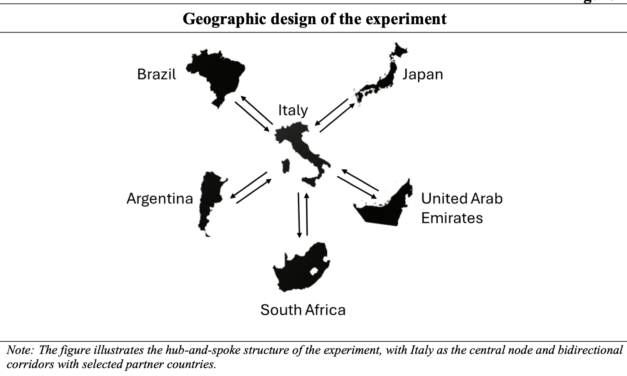
A Bank of Italy study found that stablecoin-based remittances did not offer a systematic cost or speed advantage over traditional payment channels, as fiat on- and off-ramp frictions accounted for most costs and transfer delays.Researchers tested 200 USDC (USDC) remittances across 10 bidirectional payment corridors linking Italy with Brazil, Argentina, Japan, the United Arab Emirates and South Africa, comparing end-to-end costs and settlement times with traditional remittance services. They found that exchange fees and currency conversion made up most of the cost, while blockchain transaction fees represented only a small share.Geographic design of the remittance experiment. Source: Bank of ItalyAcross the stablecoin remittances examined, total costs ranged from 0.3% to nearly 9% depending on the payment corridor, while transfers settled in less than 20 minutes where instant payment systems were available and one to two business days where they were not.Using the World Bank’s reported global average remittance cost of 6.65% as a benchmark, the study found stablecoin transfers were cheaper in most of the payment corridors examined. However, they were less expensive than Wise in only three of seven comparable corridors.Related: Europe should weigh tokenized SEPA payments, Bank of Italy official saysPayment infrastructure remains criticalThe study concluded that investment in domestic instant payment infrastructure could improve the competitiveness of stablecoin-based cross-border payments, finding that settlement times depended heavily on the quality of local payment rails. The authors argued that the biggest gains may come when stablecoins no longer require conversion back into fiat currency, writing:If stablecoins could be spent directly in the real economy, for goods and services, rents, or school fees, without reconversion into local fiat currency, the economic advantages of stablecoin-based transfers would be substantially higher.Regulation shapes remittance efficiencyThe study also found that regulatory design played a major role in determining transfer efficiency. The authors said prohibitionist regulatory regimes failed to fully suppress stablecoin demand and instead pushed users toward offshore platforms and other unregulated channels, while overly restrictive frameworks increased operational complexity for retail users. The findings come as the European Union has implemented its Markets in Crypto-Assets (MiCA) framework and the United States has enacted the GENIUS Act, two regulatory regimes that govern crypto assets and payment stablecoins, respectively.The stablecoin market has grown to about $307 billion, up roughly 16% over the past year, according to DefiLlama data.Magazine: A quantum roadmap would push Bitcoin much higher: Charles Edwards

Čítaj viac

World Cup generated $20B in blockchain prediction market volume: Chainalysis

The 2026 FIFA World Cup drove $20 billion in blockchain-based prediction market volume and $24 million in digital collectible trades, with more than 400,000 wallets participating in blockchain-based betting, according to a report from blockchain analytics firm Chainalysis.The $20 billion figure includes trading before and during the tournament, with bettors placing roughly $5.7 billion in wagers over the five-week World Cup itself. World Cup-related markets accounted for about 63% of all prediction market activity during that period, the report said.According to Chainalysis, users from every continent except Antarctica participated in World Cup prediction markets, with the United States and China generating the highest attributable trading volumes, followed by Canada, Thailand and the United Kingdom.Despite the scale of betting activity, illicit participation remained limited. Chainalysis said fewer than 1% of wallets participating in World Cup prediction markets had ties to illicit actors, though it identified roughly $5.4 million in flows originating from sanctioned entities and other illicit sources.The report also highlighted growing adoption of blockchain-based digital collectibles. Fans traded about $24 million worth of FIFA Collect NFTs during the tournament, while more than 100,000 match tickets were distributed through the platform. Wallets linked to sanctioned entities accounted for less than 0.01% of FIFA Collect users, which Chainalysis attributed in part to the platform’s identity verification requirements.Chainalysis said the findings suggest blockchain will play a growing role in major global events and underscored the importance of compliance measures as platforms attract broader participation.Cointelegraph is committed to independent, transparent journalism. This news article is produced in accordance with Cointelegraph’s Editorial Policy and aims to provide accurate and timely information. Readers are encouraged to verify information independently.

Čítaj viac

Telegram’s Pavel Durov responds to Russia’s terrorism designation

Telegram founder Pavel Durov said Russian authorities designated him a “terrorist” after he refused government demands for mass surveillance and censorship on the messaging platform, responding publicly a day after Russia announced charges against him.In a Telegram post on Thursday, Durov also said Russia had barred him from “publishing information on the Internet,” adding that authorities had “got confused about who can ban whom from the Internet.”Source: Telegram, Pavel DurovThe comments came a day after Russia’s Federal Security Service accused Durov of facilitating terrorist activity, alleging Telegram failed to remove channels used by terrorist groups and Ukrainian intelligence services.The case builds on a criminal investigation Russia launched in February, when regulators accused Telegram of leaving nearly 155,000 channels, chats and bots online despite claims they violated Russian laws covering extremist content, terrorism, drug trafficking and other illicit activity.Related: Pavel Durov says Telegram to roll out native Gram crypto walletDurov’s legal battles extend beyond RussiaThe Russian case adds to Durov’s legal challenges abroad. Durov was arrested in France in August 2024 and remains under judicial investigation over allegations that Telegram facilitated criminal activity by failing to adequately moderate illegal content and respond to law enforcement requests. Durov has denied wrongdoing, arguing that French authorities failed to follow due process in seeking information from Telegram. His arrest also prompted a TON Community-backed campaign that collected more than 9 million signatures on an open letter urging French authorities to release him.French authorities initially allowed Durov to temporarily return to Dubai in March 2025 before lifting his travel restrictions entirely later that year. Telegram is also facing fresh legal pressure in Australia, where regulators this week launched court proceedings alleging the platform failed to remove terrorism-related content.Durov has cast himself as a defender of free speech and digital privacy. In April, he warned the European Union’s proposed age-verification app could pave the way for broader online surveillance. The same month, he blamed alleged tax data leaks for a wave of crypto-related kidnappings in France and said Telegram would leave the country rather than grant authorities access to users’ private messages.Magazine: A quantum roadmap would push Bitcoin much higher: Charles EdwardsCointelegraph is committed to independent, transparent journalism. This news article is produced in accordance with Cointelegraph’s Editorial Policy and aims to provide accurate and timely information. Readers are encouraged to verify information independently.

Čítaj viac

Získaj BONUS 8 € v Bitcoinoch

nakup bitcoin z karty

Registrácia Binance

Burza Binance

Aktuálne kurzy

