

Autor Cointelegraph By Mitch Eiven

Crypto regulation: Does SEC Chair Gary Gensler have the final say?

In a February interview with New York Magazine, Gary Gensler, chairman of the United States Securities and Exchange Commission, said that just about every crypto transaction, with the exception of Bitcoin spot transactions and buying or selling things with cryptocurrency, falls within the jurisdiction of the SEC. 

In the interview, when discussing what types of crypto transactions should be regulated as securities, Gensler didn’t mince words. “Everything other than Bitcoin. You can find a website, you can find a group of entrepreneurs, they might set up their legal entities in a tax haven offshore, they might have a foundation, they might lawyer it up to try to arbitrage and make it hard jurisdictionally or so forth,” Gensler said. 

Gensler continued, “They might drop their tokens overseas at first and contend or pretend that it’s going to take six months before they come back to the U.S., but at the core, these tokens are securities because there’s a group in the middle and the public is anticipating profits based on that group.” 

Gensler contends that the SEC’s jurisdiction over most cryptocurrencies is based on a 1946 Supreme Court ruling in the case SEC v. W.J. Howey Co. According to Investopedia, the W.J. Howey Co. sold citrus groves to Florida buyers. Those buyers would lease the groves back to the company. The company cultivated the trees and sold the oranges on behalf of the Florida buyers. Both would share in the profits. W.J. Howey Co. subsequently failed to register with the SEC, arguing that its transactions were not investment contracts. 

(State Library and Archives of Florida, Public domain, via Wikimedia Commons)

W.J. Howey Co. lost the case when the court ruled that the leaseback arrangements were investment contracts, thus establishing the Howey test wherein four criteria are used to determine whether something constitutes an investment contract: An investment of money, in a common enterprise, with the expectation of profit, to be derived from the efforts of others.

Is Gensler right that most cryptocurrencies meet the Howey test?

Mark Bini, an attorney at Reed Smith, says “no.” Bini is a former state and federal prosecutor who now represents corporations and individuals facing civil and criminal charges of crypto fraud, securities fraud and other crimes.

“I think that the Howey test is not clear, and using this 1946 case about orange groves to decide whether a crypto is a security or not […] I’m not sure that they don’t need to update that,” Bini says. He also finds it surprising that a stablecoin pegged to the U.S. dollar might qualify as a security under the rule since there is no expectation of profit. 

Bini asks, “Would Chairman Gensler say, if the United States launched a digital currency, as they’ve at least thought about doing, let’s say that there was a crypto that was a pure digital dollar, would that be a security?”

Official portrait of SEC Chairman Gary Gensler. (SEC)

Congresspeople Jesús García and Stephen Lynch agree with Gensler. In a recent opinion piece for The Hill, they argue that participants in the crypto ecosystem must “come into compliance with existing securities laws.” 

The lawmakers wrote, “According to the SEC Chair Gary Gensler and recent court decisions, the vast majority of crypto assets are securities because they meet the Howey Test […] An investment contract exists when money is invested in a common enterprise with the expectation of profit resulting from the work of others. We agree with Chair Gensler that nothing about the crypto markets is incompatible with the securities laws.”

With all the media coverage of Gensler’s recent statements, many in the crypto community might think that this is a new position for Gensler. Kevin Werbach, a professor at the University of Pennsylvania who leads the Wharton Blockchain and Digital Asset Project, tells Magazine otherwise. 

“Both Chair Gensler and his predecessor, Jay Clayton, have repeatedly stated that the vast majority of digital assets are issued and purchased primarily for investment purposes and should be treated as securities,” says Werbach. 

Werbach continues, “There are tens or hundreds of thousands of tokens out there — anyone can create one. The real issue relates to the projects that accumulated significant capital through the issuance of tokens. I think it’s fair to say that most of them would meet the Howey test in that issuance process […] But what does that mean today for ongoing trading and use of the tokens?” 

Read also

Art Week
Coldie And Citadel 6.15: The Creator, The Collector, The Curator

Features
The ethics of hiring cheap Filipino staff: Crypto in the Philippines Part 2

Is the SEC regulating by enforcement?

On July 21, the SEC charged Ishan Wahi, a former Coinbase product manager, with insider trading, in addition to Wahi’s brother Nikhil and his friend Sameer Ramani.

From June 2021 to April 2022, Wahi allegedly shared confidential Coinbase information with Nikhil and Ramani, including upcoming token listing announcements. Nikhil and Ramani subsequently purchased and sold 25 crypto assets, at least nine of which, the SEC alleges, were securities. Profits accumulated in the scheme exceeded $1.1 million. 

According to Bini, the crypto community has long claimed that the SEC has been regulating by enforcement, and in this case, the SEC determined what tokens were securities and subsequently charged the defendants with a crime based on those decisions.

On the same day that the SEC and the U.S. Department of Justice announced Wahi’s indictment, Commodity and Futures Trading Commissioner Caroline Pham released a statement lamenting SEC overreach. In her statement, Pham quoted the Federalist Papers, a document published over 200 years ago that focused on counterbalancing branches of government.

Pham also said, “The case SEC v. Wahi is a striking example of regulation by enforcement. The SEC complaint alleges that dozens of digital assets, including those that could be described as utility tokens and/or certain tokens relating to decentralized autonomous organizations (DAOs), are securities.” 

Regarding the commissioner’s statement, Bini comments, “Pham really said, ‘Hey, you’ve overstepped here because there has been no action by Congress.’” 

When asked if the SEC has been regulating through enforcement, as opposed to rulemaking, Werbach tells Magazine, “The securities laws are designed to be technology neutral, so there doesn’t necessarily have to be a rulemaking to determine how they apply to different situations involving digital assets. If the SEC did proceed with rulemaking — there are so many aspects to the digital asset world, and things change so quickly — that many decisions would need to be addressed through adjudication and enforcement.”

Werbach notes two challenges with the SEC’s enforcement strategy: “First, it’s sometimes hard to find consistency in the remedies and the choice of targets. Second, the agency has been reluctant to provide guidance, no action letters, or other paths to separate legitimate from non-compliant firms.” 

Although debate continues about the SEC’s approach to enforcement, there is no doubt that the agency has beefed up resources. In May 2022, the SEC announced that it had added 20 positions to its Crypto Assets Unit, a department responsible for investor protection and cyber-related threats. According to the statement, the unit is part of the Division of Enforcement and will grow to 50 positions. 

Today we announced that we’re bolstering the unit responsible for protecting investors in crypto markets & from cyber-related threats. The newly renamed Crypto Assets & Cyber Unit in the Division of Enforcement will grow to 50 dedicated positions.— U.S. Securities and Exchange Commission (@SECGov) May 3, 2022

The SEC says the unit was established in 2017 and has brought more than 80 enforcement actions resulting in monetary relief exceeding $2 billion, and it will focus on investigating securities violations related to crypto asset offerings and exchanges, lending and staking protocols, decentralized finance platforms, nonfungible tokens and stablecoins.

Gensler believes that it’s all about protecting investors

When asked in his interview if a consumer-facing agency like the SEC is actively trying to discourage retail investors from participating in the crypto sector by delegitimizing crypto institutions, Gensler argued that his primary responsibility is investor protection. 

Gensler said, “I’m in a job where I’m supposed to be merit neutral in terms of what risk investors want to take, but not neutral towards the investor protection — the full, fair, and truthful disclosure you get when you’re investing in a security.”

Investors in the crypto markets are putting their assets at risk in a highly speculative asset class. Today, investors in these markets lack fundamental disclosures—about crypto assets, & about the firms who execute their trades. Read last week’s @SEC_Investor_Ed alert:— Gary Gensler (@GaryGensler) March 27, 2023

García and Lynch concurred, writing, “We agree with Chair Gensler that nothing about the crypto markets is incompatible with the securities laws and that investor protection is just as relevant, regardless of underlying technologies.” 

The two members of Congress take it a step further arguing that existing security laws would force cryptocurrency exchanges, like FTX and others that lack corporate controls, “into compliance” and would protect investors from “bad actors.” 

Bini thinks that the SEC does have a role when it comes to protecting investors, including those in the crypto space, it’s just that Gensler doesn’t have the authority to determine his own jurisdiction on the matter. “I understand the SEC’s mission is to protect investors. That’s a very important mission, no doubt about it […] I think the criticism by the crypto communities is [Gensler] cannot by his own fiat just decide his jurisdiction.”

As bad as Wall Street

Lynch and García argue that if crypto companies complied with existing securities laws, they wouldn’t be able to launder money, misuse customer funds, and engage in other nefarious behaviors. 

The lawmakers wrote, “​​The crypto industry is notorious for attempting to obscure the law by using the courts to challenge attempts at regulation and lobbying for regulatory carve outs that benefit them at the expense of everyday people.” 

García and Lynch cited a recent report from Reuters that alleges Binance, among other transgressions, lobbied the U.S. Department of Justice to try to sidestep enforcement. The CFTC recently sued the exchange’s CEO, Changpeng Zhao, for violations of the Commodity Exchange Act and CFTC regulations. 

Today @CFTCjohnson released a statement in support of the CFTC complaint alleging Binance, affiliated entities, and senior management violated the Commodity Exchange Act and evaded U.S. regulation. Read it here: https://t.co/oi5gTadbBs— CFTC (@CFTC) March 27, 2023

Although they expand the argument beyond a defense of Gesler and the SEC’s actions, they point out that FTX and other crypto stakeholders have “replicated the worst tendencies of Wall Street and Big Tech,” have “recreated many elements of the 2008 financial crisis,” “have subjected investors to incredible volatility,” and have “preyed on consumers.” 

“Policymakers must protect our economy from bad actors by urging the crypto industry to comply with existing laws, invest in solutions that are truly innovative, and create a more inclusive financial system,” they wrote.

What about legislation?

Federal legislation would certainly create guardrails around the SEC and would help determine what federal agencies are tasked with regulating different types of cryptocurrencies. 

Werbach says, “There are some areas, such as the treatment of stablecoins, where there simply isn’t an appropriate existing federal framework, and there are important tax issues that will likely need legislative resolution. The CFTC needs greater legislative authority over spot markets in digital assets. With regard to securities regulation, the SEC could provide more guidance without legislation, but it has declined to do so.”

Bini believes that effective legislation, like a stablecoin bill currently pending in Congress, would make investors feel more confident. 

“It’s unfortunate that there hasn’t been a clear framework by the United States because I think it’s going to provide clarity to the industry. People who want to put money in crypto feel more confident if they feel like there’s a clear framework and that they’re being protected, whether it’s the SEC or the CFTC, or if Congress came up with some new agency that was going to oversee crypto,” says Bini.

Bini adds, “I don’t think that it’s up to him [Gensler] to decide where the SEC reaches in — that should be up to Congress.”

Read also

Features
Can blockchain solve its oracle problem?

Features
Australia’s world-leading crypto laws are at the crossroads: The inside story

Maybe the courts will decide

Since the Howey test, a precedent established by a court decision, is the current method of determining whether something is a security, is it possible that the courts could set a similar precedent for cryptocurrency?

According to Bini, the answer is maybe, perhaps out of the Ripple case that’s playing out in the Southern District of New York. Bini says “that in the absence of Congressional action, you could have a landmark case like this one appealed to the Second Circuit, and then the Supreme Court, and that may provide clarity.”

In December 2020, the SEC filed an action against Ripple Labs alleging that the company and two of its executives raised over $1.3 billion in an unregistered, ongoing securities offering. 

Ripple CEO Bradley Garlinghouse was also charged by the SEC. TechCrunch, CC BY 2.0. (Wikimedia Commons)

Last year, the judge in the Ripple case agreed to consider the fair notice defense, a protection derived from the Due Process Clause in the U.S. Constitution that guarantees a defendant be given fair notice of what constitutes an offense. 

The SEC unsuccessfully tried to quash the motion. Using the fair notice defense, Ripple Labs’ attorneys argued that the company couldn’t have known that Ripple’s XRP token should have been registered as a security with the SEC because the agency never provided adequate guidance about what cryptocurrencies actually qualify as such.

“The Second Circuit or the Supreme Court could endorse the SEC’s approach and note the continued vitality of Howey as applied to digital assets. Conversely, the Second Circuit and/or the Supreme Court could find for Ripple and reject the SEC’s approach. That could provide clarity in this area,” Bini says. 

Irrespective of how this plays out, Gensler’s macro overview of cryptocurrency is clear, and the question remains as to how it might affect his regulatory proclivities. In the interview, he said, “I don’t think there’s much economic use for a micro-currency, and we haven’t seen one in centuries. Most of these tokens will fail, because the question is about these economics. What’s the ‘there’ there?”

Subscribe
The most engaging reads in blockchain. Delivered once a
week.

Mitch Eiven
Mitch is a writer who covers cryptocurrency, politics, the intersection between the two and a handful of other, unrelated topics. He believes that crypto is the future of finance and feels privileged that he has opportunities to report on it.

Čítaj viac

US enforcement agencies are turning up the heat on crypto-related crime

On the evening of Jan. 7, Anatoly Legkodymov, founder of the cryptocurrency exchange Bitzlato, was arrested in Miami. The following day, the United States Department of Justice (DOJ) unsealed a complaint in federal court charging him with “conducting a money transmitting business that transported and transmitted illicit funds.” According to the DOJ, Bitzlato failed to meet U.S. regulatory safeguards, including Anti-Money Laundering requirements. 

Less than a month earlier, former FTX CEO Samuel Bankman-Fried was arrested in the Bahamas. In a statement, U.S. Attorney General Merrick Garland said, “The Justice Department has filed charges alleging that Samuel Bankman-Fried perpetrated a range of offenses in a global scheme to deceive and defraud customers and lenders of FTX and Alameda, as well as a conspiracy to defraud the United States government.”

USA Damian Williams: Earlier this evening, Bahamian authorities arrested Samuel Bankman-Fried at the request of the U.S. Government, based on a sealed indictment filed by the SDNY. We expect to move to unseal the indictment in the morning and will have more to say at that time.— US Attorney SDNY (@SDNYnews) December 12, 2022

Garland stated, “The U.S. Department of Justice will aggressively investigate and prosecute alleged criminal wrongdoing in the financial system and violations of federal elections laws.” But is it really a new day? Will U.S. law enforcement be able to go after alleged crypto criminals at home and abroad?

According to Oberheiden PC attorney Alina Veneziano, who represents executive clients under criminal investigation against U.S. Securities and Exchange Commission subpoenas and DOJ fraud allegations, the answer is yes.

“Attempts to reign in this new, unrestrained industry were inevitable,” Veneziano tells Magazine. She believes that federal government agencies are increasing their investigative efforts toward crypto crime and will utilize all the tools at their disposal — subpoenas, summons and inter-governmental sharing of information.

 “For example, only last year, the SEC increased the size of its Crypto Assets and Cyber Unit in an effort to investigate more fraudulent crypto asset schemes and better protect investors in the crypto markets.” Veneziano also believes the Internal Revenue Service will further enforce U.S. tax laws for cryptocurrencies. 

Former federal prosecutor Grant Fondo also sees an increase in activity. Now a trial attorney and founder of the Digital Currency and Blockchain Technology practice at Goodwin, Fondo believes that this is the result of the current bear market, widespread acceptance of cryptocurrency and the government’s obligatory focus on crime.

“I think anytime there is a course correction and/or an economic event like a crypto winter, that can also increase activity […] When assets go down, people get hurt, and if people are mixing funds and things, it can create problems,” Fondo tells Magazine. Add to that the prolific global adoption of crypto, more people involved and the DOJ’s concern about any asset used for illicit activity, and Fondo sees beefed up enforcement as an inevitability.

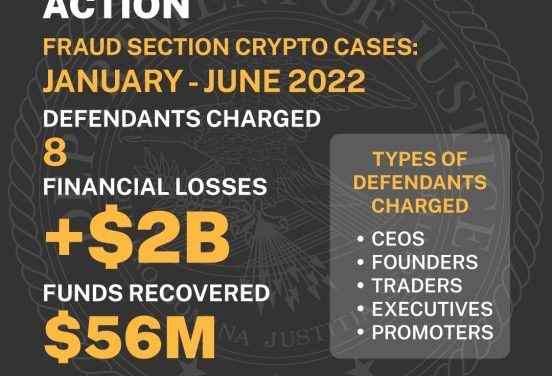
In 2021, the DOJ created the National Cryptocurrency Enforcement Team (NCET) to handle investigation and prosecution of criminal misuse of cryptocurrency. NCET would combine the expertise of the agency’s Money Laundering and Asset Recovery Section and the Computer Crime and Intellectual Property Section. In 2022, the DOJ also created the Digital Asset Coordinator (DAC) Network. Under the leadership of NCET, designated federal prosecutors from U.S. attorney’s offices around the country would be assigned to the DAC Network. Each office’s DAC will be the digital asset subject matter expert and the first, investigative source of information. 

(justice.gov)

What types of crimes аre they going after?

According to a DOJ report submitted to the presidential administration in September, the agency believes that cryptocurrency is the preferred payment method for ransomware and other digital extortion activities. As an example, the DOJ referred to a ransomware attack in May 2021 on the Colonial Pipeline. According to the report, the attack forced the company to shut down a gasoline and jet fuel pipeline for days. This resulted in fuel shortages around the country, including several airports. The attackers demanded and received a ransom paid in Bitcoin. 

The report also says, “Cryptocurrency is used to raise funds for terrorist organizations and other nation state threat actors.” The DOJ states that its largest cryptocurrency seizure disrupted the funding campaigns of ISIS and other terrorist groups. The agency took down a fraudulent ISIS website operation that purported to sell N95 masks and other protective equipment during the height of the COVID-19 pandemic.

The Department of Justice released photo of a group posting a request for donations and claiming to be a Syrian charity, but allegedly sought funds to support “the mujahidin in Syria with weapons, financial aid and other projects assisting the jihad.” (justice.gov)

The Department of Justice released photo of a group posting a request for donations and claiming to be a Syrian charity, but allegedly sought funds to support “the mujahidin in Syria with weapons, financial aid and other projects assisting the jihad.”

Veneziano believes that these crimes are not new — they’ve just adapted to cryptocurrency. “We are likely not looking at the creation of brand new crimes but are instead more likely to see the crypto element incorporated into other offenses, such as crypto tax evasion, crypto theft, unregistered crypto offerings, crypto money laundering, etc. Due to the nature of the blockchain, it is likely to be confined to federal offenses as opposed to state crimes,” Veneziano says.

Fondo suggests that wire fraud is also a big factor. “So, you’ll notice in a lot of the criminal indictments, they allege wire fraud. Wire fraud is agnostic to the type of asset, whether it’s a security, a commodity, whatever — doesn’t matter.” Historically, criminals would use the telephone, aka the wires, to commit fraudulent acts. Today, wire fraud refers to crimes committed using any type of telecommunications technology. According to Fondo, if you move digital assets around using the wires, and you commit fraud, it’s a crime, and most indictments in the crypto space fall into that category. 

For example, in a statement on Dec. 14, 2022, U.S. Attorney for the Southern District of New York Damian Williams “announced charges in two separate indictments against the founders and promoters of two cryptocurrency Ponzi schemes known as IcomTech and Forcount,” both with conspiracy to commit wire fraud. 

U.S. Attorney announces fraud and money laundering charges against the founders and promoters of two cryptocurrency Ponzi schemeshttps://t.co/xyDjz0J4Q0— US Attorney SDNY (@SDNYnews) December 14, 2022

According to the DOJ, victims purchased IcomTech and Forcount investment products using cryptocurrency, cash, checks and wire transfers. They were then given access to an online portal where they could monitor dubious returns. “While Victims saw ‘profits’ accumulate on the schemes’ respective online portals, most victims were unable to withdraw any of these so-called profits and ultimately lost their entire investments.” All the while, IcomTech and Fourcount’s promoters skimmed hundreds of thousands of the victim’s funds, withdrew it as cash and spent the loot on promos for the Ponzi scheme, luxury goods and real estate. 

Subscribe
The most engaging reads in blockchain. Delivered once a
week.

What other agencies are involved?

Venziano believes that collaboration between government agencies on crimes is nothing new and should be expected in the crypto sphere. Venziano says, “Consider a crypto fraud scheme involving a new token. The SEC will be involved if the token is unregistered and satisfies the definition of an ‘investment contract’ under the Howey test,” an analysis based on a Supreme Court decision.

Wally Adeymo, deputy treasury secretary. (treasure.gov)

She continues, “The IRS will also be involved where there is tax evasion or the failure to report crypto sales and dispositions. Further, the DOJ may initiate an investigation where money laundering or other illicit activity is present. There is even a call for greater collaboration from the private sector to combat crypto fraud.” Additional agencies, including the Financial Crimes Enforcement Network (FinCEN), the Federal Bureau of Investigation, Immigration and Customs Enforcement, the Secret Service and the Department of Homeland Security have all participated in cryptocurrency investigations. 

In the Bitzlato case, the DOJ teamed up with the Department of Treasury’s Financial Crimes Enforcement Network. In a joint press conference with officials from the DOJ, Deputy Secretary of the Treasury Wally Adeyemo said that FinCEN is officially identifying Bitzlato as a “primary money laundering concern” in connection with Russian illicit finance. Adeyemo thanked the DOJ “for being such great partners” on this action but also on “going after this ecosystem more broadly.”

Do politics affect who the government investigates?

According to Fondo the answer is yes and no. The DOJ is part of the Executive Branch of government and the president nominates its leader, the Attorney General. The U.S. Senate is tasked with confirming the president’s nominee.“Generally, it is an agency that is agnostic in a sense as to who the president is,” Fondo says. When he was a federal prosecutor, Fondo believed that he was completely immune to whoever was in the White House. On the other hand, whenever national actors are involved, Russia or China for example, Fondo says that a potential case escalates in significance. Since the DOJ gets lots of leads and complaints, so they have to prioritize resources and decide which ones to pursue.

“A case that involves a national actor, stealing trade secrets, stealing assets, funneling assets (to Russia) to fight, say, the war in the Ukraine, that will rise well above something else that’s an otherwise more typical crime. So, in that way, the DOJ is more political.”

Fondo also believes that when there is a national scandal, like Enron, Bernnie Madoff or the fall of FTX, the government is more apt to jump in and get more involved. “When something hits the press, like a major incident, there is more pressure to get charges more quickly,” Fondo says.

Venziano points out that crypto activity isn’t limited by geographic borders and can affect overseas markets in a matter of seconds. “Crypto activity can certainly affect international politics, demanding cooperation between the United States and enforcement agencies in other nations. Take the Bitzlato case as an example. The DOJ received significant operational and informational assistance from other agencies — both domestic and international — including Customs and Border Protection and also EUROPOL and Dutch and Belgian authorities,” Venziano says.

In the U.S., there are no federal laws on the books specifically regulating the use of cryptocurrency. Different regulatory agencies have taken responsibility and have written rules for the oversight of different digital assets. Sooner or later, Congress is expected to move legislation to the president’s desk, formally defining cryptocurrencies and how they are to be regulated.

In the meantime, Fondo believes that the lack of clarity, and even disagreement among regulators, leads to ambiguity that crypto-centric companies struggle with. In essence, it’s hard to follow the rules if you don’t know what they are, especially on the civil, as opposed to the criminal, side of things.

Nonetheless, he believes that the industry has matured in recent years, and “there are a lot of great actors out there trying to do the best they can with regulatory uncertainty, but also trying to meet the demands of the market. But, when there’s a situation, a crime is a crime is a crime. If the government sees something that looks like fraud, it doesn’t really matter what the asset is, and they think it’s significant enough and worthy of chasing, they’ll do it.”

Read also

Features
You don’t need to be angry about NFTs

Features
Toxic Twitter Tribalism: The Fuel Powering the Crypto Rocket?

Mitch Eiven
Mitch is a writer who covers cryptocurrency, politics, the intersection between the two and a handful of other, unrelated topics. He believes that crypto is the future of finance and feels privileged that he has opportunities to report on it.

Čítaj viac

Crypto winter can take a toll on hodlers’ mental health

With so many struggling to maintain emotional well-being during this crypto winter, self-improvement and mental health experts can help navigate the ups, downs and soul-shattering experiences that a long-term bear market can bring.

Mental health professional Elizabeth Sterbenz and wellness thought leader Srikumar Rao discuss with Magazine how to cope with the depreciation of crypto portfolios, move forward and illuminate intuitive happiness. Sterbenz is a licensed psychotherapist in California specializing in individual, couples and financial therapy. Rao is an international speaker and executive business coach with a PhD from Columbia University. He teaches a course at the Kellogg School of Management at Northwestern University that merges Eastern philosophies with modern business practices.

Learn how to ride a tsunami

Rao believes that crypto traders, developers and community members have been hit by a tsunami. They are struggling through a long-term crypto winter that shows no immediate signs of warming. They also celebrated a two-year NFT boom that was quickly followed by a devastating bust.

The community was recently gobsmacked when major figures in the cryptocurrency industry, like Sam Bankman-Fried and Do Kwon, were accused of fraudulent activities, discrediting the industry and harming investors. 

And the hits keep coming. Just weeks ago, the United States Department of Justice and other international authorities took down a Hong Kong-based crypto exchange and arrested its founder in Miami. 

Anatoly Legkodymov, the co-founder and majority shareholder of Bitzlato, a Hong Kong-registered cryptocurrency exchange, has been arrested and charged with allegedly operating Bitzlato as an unlicensed money transmitting business.https://t.co/LBVKyPRkkz— FBI (@FBI) January 18, 2023

Rao believes that the bear market can be used as an opportunity to learn how to surf the top of the tsunami while calmly observing what’s happening below. He says one can achieve this by accepting that winning is not a requirement for happiness. Happiness doesn’t come from making the right trade or a lot of money. According to Rao, that’s a false belief:

“The thought that you have to have something happen in order to be happy, it’s just false. But you believe in it so strongly because you never really thought about it independently. You’ve just been carried on by the mass hysteria.” 

Sterbenz takes it a step further, suggesting it’s unnecessary to go it alone, especially in these tough times. “I think you have to be able to kind of trust, you know, having a good financial adviser. That’s an important part of your team.”

She believes getting sound, objective financial advice will provide peace of mind. Relying on someone else to help assess trades and to help make decisions about overall financial situations provides a feeling of being covered. “You can then set your financial worries aside and focus on your well-being,” Sterbenz says. 

Rao claims it’s also important to recognize that cryptocurrency has no intrinsic value. The value is only what people believe it is. Large numbers of people agree that a particular token has a particular value at a particular time, but the moment people don’t feel that way anymore, the coin ceases to have the same value.

Rao says, “If you accept that up front, before you make the investment, and you say that what could have happened did happen, and it happened when I made the wrong trade, that’s okay. I’ll recover. I’ll move on, and I never really needed this to work out to be happy in the first place.”

A crowd formed outside of the Oregon Trust & Savings after executives announced it was shuttering because it would be unable to pay obligations. Aug. 22, 1907. Source: Wikimedia Commons

How to deal with the crypto corruption shakeout

Many of the crypto community’s worst fears were realized when FTX imploded and its founder was arrested, as well as when Terra crashed and subsequent charges were filed against its former CEO. Uncertainty about the inevitability of stricter federal regulatory efforts further validated those concerns.

Crime is now, undeniably, a part of the crypto ecosystem, just as it is part of the traditional investment arena. That’s a tough pill to swallow, and even meaningful regulatory crackdowns are cause for concern.

Nonetheless, Sterbenz suggests that this is nothing to be ashamed of and doesn’t mean participating in crypto is disreputable or embarrassing. Comparing the situation to those critical of traditional investors after history’s largest Ponzi scheme was exposed, Sterbenz says, “That’s also like saying, like Bernie Madoff, ‘I told you all these stocks were a scam. You should be putting your money in the mattress.’”

According to Sterbenz, it’s important to separate from the bad behavior of unscrupulous characters and simply accept that there will always be bad actors.

Rao believes blaming lousy luck or crypto losses on those bad actors certainly won’t lead to happiness or peace of mind. He says that when the universe, or its participants, doesn’t play by the rules and things go the opposite way, it’s easy to assume the sky is falling. Distress and unhappiness can quickly follow. 

“And you blame it all on an outside force. I am unhappy because so and so did such, and he’s a downright scallywag. And because he’s a scallywag, he’s now being investigated. But, in the meantime, the markets are gone to hell!” Rao says. Instead, he suggests anchoring yourself in the idea that you’re only involved in crypto because that’s where your path is taking you. “Me playing this game is something I do because it’s my path in life, and I’ll enjoy playing the game. I don’t necessarily have to win for it to bring me satisfaction or joy,” Rao says.

Read also

Features
Australia’s world-leading crypto laws are at the crossroads: The inside story

Features
You don’t need to be angry about NFTs

That’s great, but I’m rekt!

According to Rao, traders who have lost it all must accept that they believed something, perhaps all of their lives, that turned out to be disastrously untrue. Happiness cannot be found in a successful trade any more than it can be lost by a bad one.

Rao says, “The thing to do is not beat myself up and shoot second arrows at myself. Simply recognize that this was wrong. It was a sharp cut with a knife, but now that I have received it, I can see how clearly I was wrong. Let me pick up the pieces and not make that same mistake again. Tomorrow is another day, and I don’t have to let today’s residue poison tomorrow.” 

Although it’s not easy, Rao suggests looking at awareness like it’s a flashlight. A flashlight illuminates whatever it shines its light on. “If you illuminate it on the big gains you once had and neglected to sell, and now it’s all gone, and you’re behind where you started, you’re shining the flashlight of your awareness on something that you defined as wrong in your life,” Rao says. That’s an inefficient strategy. Instead, he suggests shining the flashlight on what to do next. “You’re not starving, you’re not being foreclosed and thrown out of the house — or even if you are, nobody’s holding your hands in a vice while they rip your fingernails off,” Rao says.

For those really struggling with severe anxiety or depression, Sterbenz recommends therapy and believes that professional help can be a gateway to personal growth. If one is not experiencing a severe clinical need and therapy isn’t necessary, she suggests focusing on the concept of radical acceptance. 

According to the Berkeley Well-Being Institute, radical acceptance is “accepting what is not under your control and embracing what is happening now in a non-judgmental way.” Radically accepting emotional or physical pain can reduce the suffering they cause. “If you were involved in any of the cryptocurrencies that have been affected by this, you can move forward from there. Other people have also been affected by this. You made the best decision you could at the time,” Sterbenz says. 

Reach out for help 

If crypto traders or holders are experiencing thoughts of self-harm, Sterbenz says, “Get help immediately.” She suggests going directly to a medical professional or calling a trusted friend.

The crypto community has previously shared resources such as international aggregators of suicide hotlines during bear markets when a number of hodlers who were underwater expressed harmful thoughts.

Regarding such thoughts, Sterbenz says, “They do pass. It does not feel like that when you’re in that moment. It does not feel like those two to five minutes are going to end.” Therefore, she believes it’s most important to have people around you who will do the best for you.

Sterbenz also believes that family and friends shouldn’t hesitate to reach out to loved ones who might be considering self-harm. She says that many people think talking about suicide makes it more likely something will happen. “And that is really not true,” Sterbenz says. She recommends directly asking those struggling if they are thinking of hurting themselves. “That’s not gonna make them more likely to do something.”

Lady of Crypto, a trader and Twitter influencer, also advocates for mental health. She tells Magazine, “It was an incredibly tough time in the crypto space, and so many people were affected. I’ve had friends who have struggled, and I’ve seen how people can become shadows of themselves and be pushed to the edge. To see these messages on Twitter really is heartbreaking. No one should ever be in a position where suicide is their only option. I just thought if I kept my inbox open and could make a difference to even one person, it would be worthwhile.”

Subscribe
The most engaging reads in blockchain. Delivered once a
week.

So, where’s the happiness after all?

According to Rao, one can’t look for happiness. It can’t be discovered in a favorite altcoin, and it won’t suddenly appear when Bitcoin finally breaks $100,000. Rao believes that happiness is not something to be sought after. The more one seeks happiness, the more it runs away. Happiness just happens. It’s not an aspirational goal but springs out organically in adopting a certain mindset.

“The mindset you’re gonna occupy as a crushed crypto trader is: Okay, I’ve blown a big chunk of my fortune and net worth away. It’s very unfortunate, but that’s the way the universe went. And I can now cry myself to sleep every night and make matters a whole lot worse, or I can shine the flashlight of my awareness on the fact that I’m still healthy. I’m still whole. I’ve learned a very expensive lesson,” Rao says.

Focus on what to do next. Even if yesterday’s red candles insistently keep trying to grab one’s attention, Rao suggests recognizing this as mental chatter. Instead, focus only on what to do going forward.

Read also

Features
4 out of 10 NFT sales are fake: Learn to spot the signs of wash trading

Features
DeSci: Can crypto improve scientific research?

Mitch Eiven
Mitch is a writer who covers cryptocurrency, politics, the intersection between the two and a handful of other, unrelated topics. He believes that crypto is the future of finance and feels privileged that he has opportunities to report on it.

Čítaj viac

NFT communities greenlight Web3 films: A decentralized future for fans and Hollywood

The traditional film industry is one of the most centralized and traditional of them all. Just a handful of movie studios and streaming conglomerates control the lion’s share of the global film market. But nonfungible tokens (NFTs) and a growing crypto-centric community of enthusiastic filmmakers might just disrupt the industry. Some independent projects offer a glimpse into Web3 filmmaking, while others provide a window into distribution. Decentralized streaming also demonstrates what community-based film development and exhibition might look like in the not-so-distant future. Thanks to the popularity of NFTs, the Film3 ecosystem is about to evolve beyond its embryonic stage. Although the trend is very fresh and a multitude of kinks need to be worked out, keep an eye on this emerging crypto sector as it continues to pick up steam. Start the tapeDuring panel discussions at the Cannes Film Festival in May, director Miguel Faus talked about how he’s using NFTs minted from his short film Calladita to finance a million-dollar feature of the same name. In 2019, Faus produced his short film with fiat using traditional crowdfunding. Today, he’s selling tiered NFT packages to subsidize the feature-length movie. “The intended budget is $950,000. So far, we’ve raised $650,000 all through NFT sales. The goal is for all the funding to come from NFTs,” Faus tells Magazine.Filmmaker Mark O’Connor, also a panel participant at Cannes, introduced his first Web3 distribution model at the film festival: the Stalker Movie Pack, an NFT version of the 1990s-era DVD movie pack. In 2012, O’Connor produced and directed the psychological thriller Stalker. The feature film subsequently won the Underground Cinema film festival and, in 2014, was released on DVD in Ireland. Still, O’Connor wanted the film to be fully independent and opted not to release it internationally. Eight years and a thriving NFT ecosystem later, O’Connor fully controls the intellectual property and believes that this traditionally crowdfunded film “will be the future of how movies are distributed.” Do filmmakers really need decentralized filmmaking?According to O’Connor, it’s all about controlling the intellectual property. Often, Web2 filmmakers find themselves in circumstances where they lose control of their IP. Losing control of the rights to a film also means losing access to its potential profits.O’Connor believes that there is a “waterfall system” currently operating in the industry. “When you release a movie in the traditional way, the cinema will take 70% and then, out of what’s left the distributor takes 15%. Then you have to pay sales agent fees and different fees,” O’Connor says. At the end of the day, a filmmaker with a successful project can often wind up with no share of the profits.Faus tells Magazine that filmmakers often create the IP and do all the heavy lifting, only to become contracted employees temporarily attached to their own projects. “Writer and directors like myself start with an idea, develop a whole project, write a script, do the whole thing, make the movie, direct it, but end up doing all of that as work of hire for a company, or a producer or a financier that is the actual owner of the film, and sometimes that system is not great.” Faus believes that Web3 filmmakers can utilize the power of their communities to finance movies in a decentralized way. When a like-minded community gets behind the project and opts to support it, it greenlights the film. There are no studio executives and no deep-pocketed gatekeepers, Faus adds:“Filmmakers can decide together with their community how the power of owning the IP, and the ownership of the film, is going to be used both financially and strategically.”Where to see a Web3 film?Filmmakers who prefer full control of their IPs require a decentralized space to stream their projects, an independent technical solution that doesn’t milk profit from the movies. According to CEO Mihai Crasneanu, Beem provides exactly that. “You own your own IP. You have the keys to that, so that you don’t have to rely on us,” Crasneanu tells Magazine. Presently, there are just a small handful of online, Web3 streaming and distribution models. According to Crasneanu, Beem was established in 2018, and it isn’t a platform or a destination. It’s essentially an end-to-end toolkit that allows creators, distributors or any content company to become their own platform. “So, that’s why I don’t want to call us a platform because we don’t aim to become a destination by ourselves.” Although Beem still works with Web2 technologies, filmmakers and other creators can use the tools to stream their Web3 content in full HD. Creators can upload their films and do live events and screenings. Beem co-sponsored and livestreamed many of the Web3 panels at Cannes. Creators on platforms such as Beem can use the tools to build their online communities and can generate revenue by charging fans to view films, in fiat or crypto, and can token-gate access for community members who have specific NFTs in their wallets. Beem’s customer isn’t the audience, it’s the content creators, the filmmakers. Dissimilar to the “waterfall system” where the filmmaker is at the bottom of the revenue food chain and is only paid after everyone else, in Web3 spaces, a filmmaker and their community should control all streams of revenue. The artist and production incur one set of fees for distribution and exhibition. Beem takes 15% of paid streams and videos as well as paid live events. It takes 3% of any tips, merchandise sales and NFT sales and/or resales. Filmmakers receive branded space and emails, dedicated domain and custom URLs, access to an admin console and analytics. For a monthly fee, creators can purchase technical support, a custom mobile app, digital rights management, geoblocking (restricting viewers from geographical areas) and watermarking. O’Connor plans to stream Stalker on Vabble. According to Vabble’s Twitter account, the platform hasn’t launched yet and is hosting giveaways and competitions leading to its beta release later this summer. On its website, Vabble brands itself as a “Multi channel streaming entertainment platform for viewers, investors and studios” and plans for a full platform launch within the next two years. What’s in it for the fans?YouTube, Twitter, TikTok and Instagram chat feeds are nothing new for live streaming events, but the opportunity to discuss your favorite film, in real-time, during its premier is unique. O’Connor believes that watching a movie on Web3 is a communal experience. “You can set up a movie club. There can be Q&A after with the directors, and you can comment during the movie. So, there’s all these different features that have come along with Web3 and with crypto. I feel it’s a massive shift in the industry.”O’Connor plans to host community streaming events when Vabble launches. Until then, fans can purchase the Stalker Movie Pack on Rarible. In the coming weeks, community members will begin to receive NFT drops with special features. The first drop will include a movie poster with subsequent drops every few weeks. The Movie Pack includes unreleased posters, a “making of” documentary and non-generative PFP characters called The Stalkers. All the NFTs are individually tradeable, and O’Connor intends to offer free NFTs and premium access drops for years to come. For Calladita token holders, interactions between the community and the filmmaker will happen on Beem before the film premiers. “We’ll take them along for the whole behind-the-scenes ride,” Faus said. For other projects, Crasneanu told Magazine that for casting interviews, location scouting, and costume design, community members could theoretically participate in all the elements of pre-production, production and post. Calladita also offers its NFT holders utilities and perks. A Tier-1 buyer purchases the NFT for 0.18 ETH and receives their name in the credits, a private link to watch the film, access to a private Discord server and governance rights to the film’s DAO. For 6 ETH, Tier-4 NFT holders receive all the previous perks plus an NFT mint pass for an on-set photo, a physical piece of the film’s memorabilia and an avatar in the movie’s credits. Is the industry ready for Film3?Businesswire reported that “the global film and video market is well consolidated, with a small number of behemoth players operating in the market.” Large corporations such as Disney, Comcast, AT&T (Warner Media), Sony Pictures Digital and ViacomCBS control just over 35% of the total market. According to the Motion Picture Association’s 2021 Theme Report, eight of the top 10 most-watched streaming films were viewed on Disney+, while two were seen on Netflix. It’s fair to say that the movie industry is entrenched and centralized. Although it’s hard to imagine Hollywood’s gatekeepers voluntarily relinquishing full control of a filmmaker’s IP, Web3 elements are starting to pepper the industry. Actor and producer Reese Witherspoon’s company, Hello Sunshine, recently inked a deal with NFT powerhouse World of Women to create feature films and TV shows. ☀️ World of Women X Hello Sunshine ☀️This major partnership signs a new beginning for WoW: Feature films, scripted and unscripted TV series, live events, powerful stories ?We couldn’t have dreamed of a better partner than @hellosunshine @ReeseW to bring our vision to life? pic.twitter.com/KUz0V4vqlN— World of Women (@worldofwomennft) February 17, 2022Co-head of Vuele, Cameron Chell tells Magazine that the rights to Anthony Hopkins’ new thriller Zero Contact were purchased by the NFT collectibles platform. According to James Hickey, team lead at Moviecoin, the Web3 streaming platform partially funded Prizefighter: The Life of Jem Belcher starring Russell Crowe. Decentralized Pictures, a Web3 offshoot of Francis Ford Coppola’s American Zoetrope, is actively discovering new talent and funding new projects. The platform’s co-founders include Leo Matchett, a Technology and Engineering Emmy Awards winner, American Zoetrope vice president Michael Musante and Coppola’s son Roman. Also, according to a 2020 Forbes report, baseline Web3 technologies, like “digital IDs, underpinned by blockchain encrypted biometrically verified tech, will be the norm” for the biggest entertainment providers. It is argued that mega-streamers such as Netflix, who lose over $12 billion per year due to password sharing, could benefit financially from digital IDs. Moreover, on April 5, Reuters reported that WarnerMedia’s recently departed CEO Jason Kilar believes the industry’s future is tethered to the blockchain. In a memo to the news outlet, Kilar said, “The future of Hollywood is in the Blockchain.” In a follow-up interview, Kilar told Reuters, “I think that’s [NFTs] going to be a potential wave that’s going to be coming to Hollywood, in the same way that the DVD wave came to Hollywood in the ‘90’s.”If Film3 eventually makes a splash and captures the full attention of all the streaming and studio giants, will they push back against today’s blockchain pioneers? Will they release full control of the artist’s IP and embrace a decentralized future? It’s hard to say, but the Web3 community is undoubtedly hopeful. Crasneanu came to Cannes with limited expectations: “I was expecting a very low level of interest from the traditional filmmakers present at Cannes, and mostly indifference or criticism at best.” But according to Crasneanu, people were more curious, open-minded and open to experimenting. Crasneau tells Magazine that traditional industry members were “eager to discover, to find out what can be done in Web3 with filmmaking, in all stages of film development, production and distribution.”

Čítaj viac

Crypto is changing how humanitarian agencies deliver aid and services

The primary use case for cryptocurrency in most wealthy countries is acquiring it and holding it, trading it, or using it in various other ways to make more money. In the developing world, where access to financial and banking systems is limited or nonexistent, innovative humanitarian organizations are piloting micro-blockchain ecosystems.In the summer of 2021, Hope for Haiti was ready to launch a cryptocurrency pilot program to provide 150 mothers with cellphones, digital wallets and payment cards that use near-field communication technology. Each mom participating in its community nutrition program was set to receive $50 per month in cUSD for six months to spend on family essentials. A select group of local vendors was trained to use the system and poised to accept the cryptocurrency payments. On Aug. 14, a magnitude 7.2 earthquake rocked Haiti’s Tiburon Peninsula, decimating the area.Hope for Haiti had to delay the project and immediately shifted to disaster relief. The organization received thousands in cryptocurrency donations in short order. Skyler Badenoch, Hope for Haiti’s CEO, tells Magazine: “We probably brought in a hundred grand in crypto to support our earthquake relief efforts. Whether it was $50,000 in Bitcoin from Binance Charity. [..] We were getting Ethereum donated to us. We got $10,000 in Dogecoin donated to us. It came from all over.”EMERGENCY APPEAL: Thousands lost lives, property & access to basic needs after the devastating #HaitiEarthquake. We call on our community of #crypto donors to come together & support crucial relief work being done by @HopeforHaitiFL & others on the ground https://t.co/dUZX4n7dJu pic.twitter.com/zVDk8qPXUu— Binance Charity (@BinanceBCF) August 24, 2021Just a year earlier, Sandra Uwantege Hart, who at the time was Oxfam International’s blockchain innovations and cash transfer lead, was preparing to launch a cryptocurrency pilot in the south Pacific Ocean country of Vanuatu. After a successful first effort in the region, Uwantege Hart was hoping to scale Oxfam’s UnBlocked Cash solution fivefold for this ambitious phase-two project.Then, just days before launch, Cyclone Harold slammed into the island nation. The category 5 storm decimated parts of the archipelago, an island chain economically dependent on tourism that was already reeling from COVID-19 lockdowns and an active volcanic eruption. Cyclone Harold hits Vanuatu, after killing 27 in Solomon IslandsIt is a category five storm, the most severe, with 215km/h winds https://t.co/LeWqxUQowa— BBC News (World) (@BBCWorld) April 6, 2020Almost overnight, Oxfam and its local partners brought to scale a blockchain lifeline, originally tested with 200 participants and 27 local vendors, to nearly 5,000 households and 357 vendors. They worked with the local chamber of commerce to issue cell phones to merchants and train them on the UnBlocked Cash system. On the ground, a network of about 15 charitable organizations enrolled affected citizens and managed the system. In a conversation with Magazine, Uwantege Hart says that “It’s almost like the whole idea of a decentralized, distributed model is exactly what worked in terms of how we operated and deployed the system.” She adds:“Let’s decentralize, let’s provide a really good automated tool to deliver assistance and decentralize the way that tool is deployed across multiple organizations in multiple locations concurrently, to make sure that we can scale as quickly as possible.”Uwantege Hart went on to co-found the global technology firm Emerging Impact. Partnering with the Celo Foundation, Kotani Pay and Polish Humanitarian Action, Emerging Impact soon facilitated efforts to integrate DeFi tools into a cash reward program in Kenya. Celo, the donor, built a dashboard to deposit funds directly into Kotani Pay wallets. In the field, Kotani Pay recruited Maasai women to participate in the pilot while Polish Humanitarian Action monitored transparency. According to Uwantege Hart, “I can’t even tell you how much time that saves.” She clarifies further that to make it happen, multiple players from all over came together: “This is between Celo, based in California; Polish Humanitarian Action, based in Poland, with some offices in Somalia; and the implementing partner in rural Kenya, and Maasai women who are building rural infrastructure, building dams to conserve water, so that they can start to increase their agricultural output.”Umoja The experiences gained and lessons learned in these pilots led to the development of Emerging Impact’s Umoja solution, an all-in-one humanitarian assistance suite. One of the first projects to utilize the system was CARE’s digital cash and voucher assistance pilot in Ecuador, initiated in September 2021. CARE Ecuador’s monitoring coordinator, Ronald Pisco, tells Magazine the pilot provides electronic vouchers and NFC payment cards to 250 women who don’t have access to public services.The participants, primarily migrants and refugees from Venezuela, can use the cards to purchase health services, medicine and hygiene products from 10 participating vendors. The cards are loaded with $50 to $100 in cUSD, with the vendors cashing out and converting the stablecoins into local currency on a weekly or monthly basis.CARE USA’s senior director for market-based approaches, Christian Pennotti, tells Magazine that “The end recipients, […] they’re getting handed a card that they can pay for goods and services. [..] They don’t have to download a special wallet. They don’t need a 17-digit-long key.” Although there can be a high technical barrier to entry into the crypto space, such as access to the internet and cell phones and the need for technological literacy — things currently inaccessible to the program’s participants — Pennotti believes this exchange is pretty straightforward for the women who are participating: “On the back end, there’s a whole bunch of really incredible things happening. But in her experience, CARE is able to hand her a card, and she gets what she needs.”CARE wanted to test a blockchain-based, easy-to-use, cashless solution to replace an inefficient paper-based voucher system. According to Pisco, it can take weeks to pay back vendors. CARE staff would have to keep track of all the paper vouchers, collect them and send them back to the office. The process is expensive and time-consuming. Uwantege Hart shares that preliminary metrics from the pilot suggest delivery times have been shaved down by more than 50%. Costs have gone down, and ease of monitoring has gone up.Umoja’s other debut deployment is back on track, as the temporarily delayed Hope for Haiti pilot is currently in progress — and recently doubled in size and scope thanks to Coinbase. According to Badenoch, when Coinbase heard about the pilot just after the earthquake, it contributed $150,000. It saw the project as something that would continue to help victims of the earthquake, long after everyone else had gone home.Badenoch believes that “This is the next iteration of our work in our collaboration with important players in the cryptocurrency and blockchain ecosystem.” He adds further:“We think that it’s going to help us tell the story about the value and the power of cryptocurrency and blockchain technology and the ability of crypto and blockchain to help alleviate poverty.” According to Badenoch, Coinbase’s role in the project is the “difference between piloting something that is temporary help and piloting something that actually shifts the way a household economy functions.” Hope for Haiti integrated Digicel’s mobile cash solution into the cash-out process for participating vendors, which means there is a local off-ramp within Haiti’s financial ecosystem. “That is huge. That is the difference between financial inclusion and giving money,” according to Uwantege Hart.Financial inclusivityUwantege Hart believes that humanitarian aid is ultimately “short-term assistance.” She says that one of the challenges for all humanitarian agencies is how to responsibly transition people from receiving “a bunch of stuff or payments for free” into a scenario more focused on recovery, where they are able to connect the assistance received to regular access to goods or services in their everyday lives.Progression out of poverty, or the risk-prone situation that has exposed them to poverty, is the primary objective. Emerging Impact hopes to eventually segregate wallets, still attaching them to payment cards but also to payment apps and individual savings accounts.Following that same train of thought, CARE’s other crypto pilot worked with village savings and loans associations in western Kenya adversely affected by the COVID-19 pandemic. In Siaya County, a rural area dependent upon agriculture, CARE asked savings group members what they needed to make them whole. According to Pennotti, they all said they needed more funds to sustain current group businesses or startup funds to facilitate income streams generated from new group businesses.Although nearly 85% of the people CARE works with in Kenya are unbanked and don’t have full access to the financial system, many have mobile wallets. Binance’s Blockchain Charity Foundation funded this project by directly depositing BUSD, a stablecoin pegged to the U.S. dollar, into participant’s Trust Wallets. The groups then use those funds to purchase goods and services from local vendors. Helen Hai, executive vice president at Binance and head of Binance Charity, tells Magazine, “Our pilot project working with CARE and village savings and loans associations was new territory for Binance Charity, but one we found hugely exciting because if successful, it would provide a solution for delivering cash assistance and reaching many financially vulnerable people with a much lower cost compared with traditional methods.”She explains how the process works: “All transactions are recorded on the public ledger, which is trackable, immutable and offers 100% transparency to the public.” Hai adds:“Our aim was to promote the economic recovery of VSLA members from the impact of COVID-19 and associated vulnerabilities, through the provision of stablecoins offered via blockchain technology. Crypto education was a key part of the success of this project, which meant we were also able to provide a new skill as well as financial assistance.”According to Pennotti, one of the objectives in Kenya was to understand if the tech would work in these communities. Would it be accepted, and what might the benefits be for CARE and for donors?The other objective was to build institutional awareness around the potential for financial inclusivity. Pennotti was looking for a DeFi project that would help on-ramp these groups to crypto, potentially then taking advantage of staking and other sorts of wealth-generators like yield farming in a way that is accessible. “You don’t have to understand how it all works, just what the financial benefits are,” Pennotti said.

Čítaj viac
  • 1
  • 2

Získaj BONUS 8 € v Bitcoinoch

nakup bitcoin z karty

Registrácia Binance

Burza Binance

Aktuálne kurzy

