Autor Cointelegraph By Martin Young

13 apps removed after researchers uncover Trojan crypto wallet scheme

Research by cyber security firm ESET has uncovered a “sophisticated scheme” that disseminates Trojan apps disguised as popular cryptocurrency wallets.The malicious scheme targets mobile devices using Android or Apple (iOS) operating systems which become compromised if the user downloads a fake app.According to ESET’s research, these malicious apps are distributed through bogus websites, and imitate legitimate crypto wallets, including MetaMask, Coinbase, Trust Wallet, TokenPocket, Bitpie, imToken, and OneKey.The firm also discovered 13 malicious apps impersonating the Jaxx Liberty wallet, available on the Google Play Store. Google has since removed the offending apps, which were installed more than 1,100 times, but there are still many more lurking out there on other websites and social media platforms.The threat actors disseminated their wares through social media groups on Facebook and Telegram, intending to steal crypto assets from their victims. ESET claims to have uncovered “dozens of trojanized cryptocurrency wallet apps,” going back to May 2021. It also stated that the scheme, which it believes is the work of one group, was primarily targeting Chinese users via Chinese websites.Lukáš Štefanko, the researcher who unraveled the scheme, said that there were other threat vectors, such as sending seed phrases to the attacker’s server using unsecured connections, adding:“This means that victims’ funds could be stolen not only by the operator of this scheme but also by a different attacker eavesdropping on the same network.”The fake wallet apps behave slightly differently depending on where they are installed. On Android, it targets a new cryptocurrency that the user may not have previously traded, prompting the user to install the appropriate wallet. While on iOS the apps need to be downloaded using arbitrary trusted code-signing certificates circumnavigating Apple’s App Store. This means that the user can have two wallets installed simultaneously, the genuine one and the Trojan, but poses less of a threat since most users rely on App Store verification for their apps. Related: Hodlers beware! New malware targets MetaMask and 40 other crypto walletsESET advises cryptocurrency investors and traders to only install wallets from trusted sources that are linked to the official website of the exchange or company.In February, Google Cloud unveiled the Virtual Machine Threat Detection (VMTD) system, which scans for and detects “cryptojacking” malware designed to hijack resources to mine digital assets.According to a January Chainalysis report, cryptojacking accounted for 73% of the total value received by malware-related wallets and addresses between 2017 and 2021.

Čítaj viac
Democrat division over crypto isn’t all bad news for regulation

The Biden Administration has just passed an executive order furthering research into crypto assets in view of regulating them, but politicians within the ruling Democrat party remain deeply divided on digital currency.The lack of consensus among Democrats could mean that a progressive regulatory framework for cryptocurrencies could still be a long way off —but also makes it more likely the eventual regulations won’t be too harsh thanks to the work of crypto-friendly representatives. The crypto community is familiar with the names cropping up time and time again in the digital asset debate.On the one side, you have vehemently anti-crypto politicians such as Democrat Senators Elizabeth Warren and Sherrod Brown, and in the pro-innovation camp are the likes of Democrat Congress members Ritchie Torres and Jim Himes.The division runs deep, and political wrangling could further delay any regulatory processes in the United States.Senator Warren recently crafted a bill to restrict crypto exchanges to prevent digital assets from being used for sanctions evasion. However, it has been widely reported that Russia will not switch to cryptocurrencies to circumvent sanctions, even if so individual Russians do. Warren has continued her war on crypto with letters to the Treasury urging further crackdowns on the industry. According to reports, she recently criticized the banking system, adding in reference crypto:“However, substituting an unregulated, unverified system in which scammers and cheats and terrorists mix in with ordinary consumers, and no one can tell who’s on the other side of a transaction is not a safe substitute.”Fortunately, several Democrat lawmakers favor the crypto industry and the innovation it will bring to the U.S. financial system. One such policymaker is New York representative Ritchie Torres who said, “the project of radically decentralizing the internet and finance strikes me as a profoundly progressive cause,” before adding:“You should never define any technology by its worst uses… There’s more to crypto than ransomware, just like there’s more to money than money laundering.”Related: Biden’s executive order promises great things for the crypto industry — EventuallyDemocrat Josh Gottheimer, who represents New Jersey, has pushed plans to regulate cryptocurrencies and stablecoins. Last month, he put forward the Stablecoin Innovation and Protection Act, stating at the time that the “expansion of cryptocurrency offers tremendous potential value for our economy.”Four Democrats put their names to a bipartisan letter sent to the Securities and Exchange Commission on March 16. Gottheimer, and Torres signed of course, along with Florida representative Darren Soto and Massachusetts Congressman Jake Auchincloss.Republican congressman Tom Emmer drafted the letter, which was also signed by three other Republicans, addressing the issue of overburdening crypto companies with excessive reporting requests and increased scrutiny of the industry by the agency.

Čítaj viac

MakerDAO community proposal to replace MKR governance token

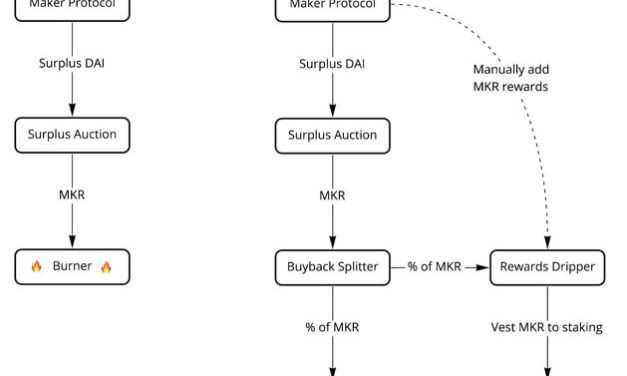
The community behind decentralized stablecoin platform MakerDAO is mulling over a major tokenomics shift that could replace its governance token, MKR.A proposal was made on the MakerDAO forum by community leader “monet-supply” on March 14, outlining an alternative token economic mechanism. If the proposal passes a full governance vote, the protocol could replace its current governance token, MKR, with a new token called stkMKR.There were many responses to the proposal within just a few hours of it being posted, most of which were positive and regarding the technicalities of the solution. From the proposal and discussion stage, it will need to be submitted as a MIP (Maker Improvement Proposal) for a formal vote by MKR holders which usually takes two weeks. The staking proposal addresses some issues and inefficiencies with the current tokenomics model, which operates a “buyback and burn” mechanism. It was suggested by ‘monet-supply’ that there are several drawbacks to the existing mechanism, including a lack of targeted incentives since buyback and burn returns all capital to MKR holders.There is also a “weak crypto narrative” according to ‘monet-supply’ who said that MKR issuance could be put towards improving the protocol. The current system also has limited deterrence against governance attacks or voting manipulation.⚒️ @MonetSupply presented an idea of an alternative token economic mechanism that could supplement the current MKR buyback value accrual system.stkMKR? Read the entire thread:https://t.co/1hEORZTblu— Maker (@MakerDAO) March 14, 2022The proposed solution is a new stkMKR token which would replace MKR as the core governance token of MakerDAO. It would act as a staking or bonding token issued to those who have deposited MKR for governance purposes.“stkMKR will be non-transferable, and represents MKR staked in governance. Staked tokenholders will receive a share of MKR tokens purchased through surplus auctions, so stkMKR will be backed by an increasing amount of MKR over time.”Surplus utilization mechanism. Source: forum.makerdao.com ‘Monet-supply’ said the rewards mechanism has been improved upon, and there will be greater incentives to stake using the new system.MakerDAO allows users to deposit crypto assets as collateral to generate the decentralized stablecoin DAI. This can then be used elsewhere, such as other DeFi protocols or liquidity pools. The DAI is burnt when the “loan” is repaid, and the collateral is withdrawn.Related: Shift toward full decentralization pushes Maker (MKR) price above $4KMKR prices were trading flat on the day at $1,766 at the time of writing, according to CoinGecko. However, the token has dropped 11% over the past fortnight and is currently down 72% from its May 2021 all-time high of $6,292.

Čítaj viac

Short term Bitcoin buyers transition to long term holders: Glassnode

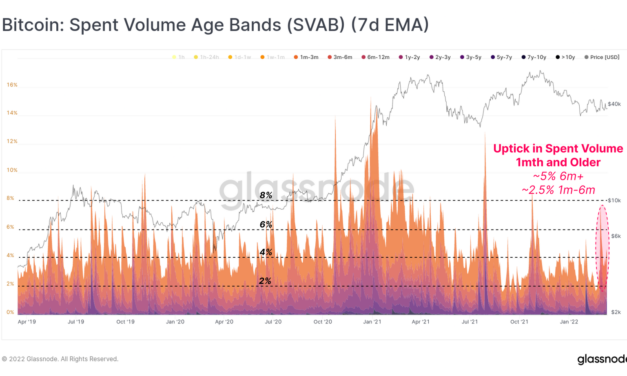
Over the past week, long-term holders of Bitcoin increased their spending to a level that suggests de-risking from the market, but hodling remains the predominant investing strategy.Uncertain macroeconomic headwinds are likely to have precipitated the increase in the sell-offs last week by long-term holders and shaken some short-term holders out of their positions according to data from blockchain analytics firm Glassnode. Last week, coins older than six months accounted for 5% of total spending, which is a level not seen since last November.Short-term holders (STH) who have held coins for less than 155 days continue to decline in number, but not necessarily due to selling. Glassnode suggests that while it is generally more common for STH to sell, the recent decline in STH supply “can only occur when large portions of the coin supply are dormant and crossing the 155-day age threshold, becoming Long-Term Holder supply.”Bitcoin (BTC) accumulation patterns do not suggest bear market behaviors yet as overall sell pressure remains consistent. Also, more than 75% of the BTC circulating supply has been dormant for at least six months despite the recent uptick in selling. Glassnode says this is an indication that investors are still predominantly hodlers.Long-term Bitcoin holders increased selling last week. – GlassnodeGlassnode noted that the sell-offs have been into a relatively strong market that has avoided any significant moves up or down and has remained range-bound for most of this yea. This is thought to be staving off a capitulation event which often comes at the end of a bear cycle. There has not been a significant capitulation since last May when BTC price crashed from $58,771 to $34,977 over the course of a 15-day period according to CoinGecko.The period from the May capitulation event until October marked the last time BTC accumulation resembled bear market behavior.BTC accumulation patterns are still above bear market trends. – GlassnodeThe profit/loss ratio of STH supply is still near the all-time low set in mid-2021. Currently, 82% of STH coins are being held at a loss which Glassnode states is an indication of the later stage of a bear market when savvy investors send their coins to cold storage to lie in wait for the return to positive profit margins.Short-term holders are in near-record losses. – GlassnodeRelated: BTC price struggles below $39K ahead of expected interest rate hike by the FedAs noted in last week’s BTC market update, exchange outflows remain quite high. Coinbase saw its largest outflows in nearly five years last week with 31,130 BTC leaving the exchange. These outflows illustrate Bitcoin’s increasing reputation as a must-have in a modern investor’s portfolio, and a further reluctance to liquidate in a hurry.

Čítaj viac

Blockchain forensics firm finds millions in sanctioned crypto wallet

Blockchain security and forensics firm Elliptic has been working with authorities to expose crypto wallets affiliated with sanctioned individuals or organizations.The United Kingdom-based company has discovered a wallet with “significant crypto-asset holdings” in the millions of dollars that may be linked to sanctioned Russian officials and oligarchs. Speaking to Bloomberg on March 14, Elliptic co-founder Tom Robinson said that crypto could be used for sanctions evasion. However, it has been widely reported and generally accepted now that Russia is very unlikely to pivot to crypto assets to circumvent them.The report did not specify the exact value of the crypto in the wallet it discovered or the nature of the assets it held. Robinson added that the scale of the use of crypto is in question, explaining:“It’s not proving out realistic that oligarchs can completely bypass sanctions by moving all their wealth into crypto. Crypto is highly traceable. Crypto can and will be used for sanctions evasion, but it’s not the silver bullet.”Elliptic has already identified more than 400 crypto services that let anonymous users trade digital assets with rubles. It also connected more than 15 million crypto addresses to Russian-related criminal activity.Robinson added that ruble-related activities on some of these services surged the week before the war broke out. Tornado Cash, which anonymizes Ethereum and ERC-20 transactions, is one such provider that has refused to restrict services or comply with sanctions.“In general, the level of sanction compliance is very high,” Robinson stated in reference to the high profile exchanges such as Coinbase and Binance that have complied with sanction requests from global regulators.Related: Crypto offers Russia no way out from Western sanctionsElliptic has also been tracking crypto donations supporting the Ukrainian humanitarian effort. Its latest update on March 11 at 23.30 UTC revealed that there had been a total of $63.8 million sent to the Ukrainian government and an NGO providing support to the military.Merkel Science has tapped several sources for its report, which shows a much higher figure of $93.6 million in total crypto donations for Ukraine.

Čítaj viac

Získaj BONUS 8 € v Bitcoinoch

nakup bitcoin z karty

Registrácia Binance

Burza Binance

Aktuálne kurzy