
Autor Cointelegraph By Martin Young

Trump earned more from crypto than real estate in 2025, filings show

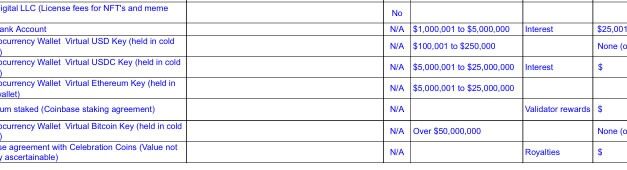
US President Donald Trump’s cryptocurrency ventures generated more income for him in 2025 than real estate or resort businesses, according to his latest financial disclosures. Donald Trump’s annual financial disclosure report was released by the US Office of Government Ethics on Tuesday, revealing more than $1.4 billion in income from crypto-related ventures last year. The filings show Trump has profited substantially from an industry that he’s simultaneously regulating, which critics say creates a conflict of interest. In 2025, his administration pushed pro-crypto policy, a friendlier regulatory environment and executive orders favorable to digital assets, while his family’s ventures generated vast income as crypto markets surged to an all-time high. In a statement to the media, White House Deputy Press Secretary Anna Kelly said Trump had “proudly made the United States the crypto capital of the world.” “Neither the President nor his family has ever engaged – or will ever engage – in conflicts of interest,” she added.Memecoins and WLFI top earners According to the 927-page disclosure, the licensing and sale of memecoins such as Trump Coin (TRUMP) generated the most income for Trump, with about $635 million coming from “royalties” in a “license agreement with Celebration Coins.”Meanwhile, the Trump family’s DeFi platform, World Liberty Financial, was the second-biggest earner, generating about $588 million from “proceeds from token sales.” The disclosure also revealed that Trump earned $197 million from selling equity in a stablecoin venture.Trump’s memecoin income disclosures. Source: US OGEThis combined crypto income dwarfs the second category, real estate and resorts, with the president reporting more than $290 million in income related to revenue from his Mar-a-Lago Club in Palm Beach, Florida, and various golf clubs and resorts he owns. Public Citizen calls for action  The Trump Organization said in a statement that “the breadth and depth of this filing further underscores our ​commitment to transparency,” according to Reuters. “At nearly 1,000 pages, it represents one of the most comprehensive financial disclosure reports ever submitted and demonstrates ​a level of financial ⁠transparency unmatched in presidential history.”Related: Donald Trump has 10 days to decide on housing bill with CBDC banPublic Citizen, a nonprofit consumer advocacy group, called it an “obscene crypto grift” in a statement on Tuesday,“Trump’s personal profit interest has now aligned him with the crypto industry, paving the way for dangerous legislation that will facilitate mass rip-offs and even threaten financial system stability,” said Public Citizen co-president Robert Weissman as he called on Congress to take action.Magazine: Bitcoin slides to $58K, XRP hits $1 but onchain data promising: Market Moves

Čítaj viac

StarkWare unveils Starknet quantum roadmap, says industry has no excuse

Zero-knowledge scaling company StarkWare has released a quantum-resistant roadmap for Starknet, arguing that other chains will remain exposed if the industry is “too stubborn or stupid” to act.In an announcement on Tuesday, Starknet framed its three-phased quantum-resistant roadmap as evidence that the crypto industry has no excuse for remaining vulnerable to future quantum computing attacks. “The tried-and-tested cryptography exists to secure every crypto key in the world, if necessary changes are made, and the only reason anyone will remain vulnerable is if heads remain buried in the sand,” said Eli Ben-Sasson, CEO at StarkWare. Efforts to quantum-proof blockchains are accelerating as some researchers warn that quantum computing could outpace blockchain’s defenses and cryptographically relevant quantum machines could be ready before 2030. The Bitcoin community remains divided on how to approach securing old coins against the quantum threat, while other networks are forging ahead with quantum roadmaps. Ben-Sasson said Starknet can become resistant to quantum attacks by “seizing on its architecture advantage.” Its underlying cryptography is zero-knowledge STARK (Scalable Transparent Argument of Knowledge) proofs, which are “inherently post-quantum safe.”Ben-Sasson said that if Starknet can become quantum-resistant by “seizing on this cryptography,” then anyone else can do it by choosing the right cryptography. “We need to be nimble in blockchain and crypto,” he said.  “There’s an awful irony in the notion that a young industry born from rejecting the way things have always been done is stalling and procrastinating about making changes for quantum security.”Related: Trump signs orders for quantum computer, cryptography upgradesHe added that crypto has an “elliptical illusion,” distorting reality around elliptic-curve cryptography, the current standard for securing blockchains. Believing that this will be quantum resistant is “false confidence” that is leaving the industry “dangerously complacent,” he said. Some migration problems are genuinely hard, involving technical trade-offs, governance decisions, and dependencies that no single team controls, he added, but said: “difficulty is not an excuse for delay.”“The crypto industry shouldn’t need wake-up calls from the White House or anyone else. We should all be acting and seizing on the best cryptography that exists.”Starknet’s three-phase roadmap The first phase involves swapping out some of its current security math (Pedersen hashing) for quantum-resistant versions and adding quantum-resistant signatures. Phase two focuses on migration tooling that quietly upgrades existing smart contracts to the new quantum-safe standard, without forcing developers to manually rebuild apps. Phase three covers dependencies that Starknet cannot resolve alone, which largely depend on Ethereum’s quantum upgrade roadmap. Circle, Ethereum, Solana, Tezos and Algorand have all proposed quantum-proof roadmaps, while the Bitcoin community remains at loggerheads. Magazine: Bitcoin slides to $58K, XRP hits $1 but onchain data promising: Market Moves

Čítaj viac

Sovereign funds see Bitcoin discount as entry point: MidChains CEO

Sovereign wealth funds have been accumulating spot Bitcoin, a sign that Bitcoin’s current price level is becoming attractive to institutional investors, according to MidChains CEO Basil Al Askari.While there has been a slowdown in retail crypto market participation, the opposite is being seen on the institutional and corporate side, Basil Al Askari said on Cointelegraph’s “Chain Reaction” podcast on Monday. “I would be able to confirm that one, at least one, and possibly in the coming weeks, two sovereign wealth funds have been accumulating spot Bitcoin specifically,” he said. A sovereign wealth fund is a state-owned investment fund, typically capitalized by a country’s reserves, so the move signals state-level conviction, not just private speculation. Sovereign wealth funds collectively control more than $13 trillion globally.Al Askari, who heads MidChains, a regulated crypto trading platform focused on retail and institutions based in Abu Dhabi, said this low price point is seen very much as an “entry level for a lot of those mega funds” that have the patience to accumulate over an extended period of time.Basil Al Askari speaking on Chain Reaction. Source: CointelegraphThe potential impact on Bitcoin’s price is not going to be a massive cascade on the market immediately, he said, but it sends “a very clear signal” to other institutions that may be sitting on the sidelines and looking at these larger funds as leaders, seeking a “way to experiment and start to get involved” with Bitcoin.Related: Bullish Bitcoin RSI divergence has analysts calling for 2022-style bear market bottom“I do think this is what will happen, is that over the longer term pAbu Dhabi’s Mubadala Investment Company invested $437 million in BTC via BlackRock’s iShares Bitcoin Trust (IBIT) shares in February 2025, while Bhutan’s Druk Holding and Investments is one of the earliest and most direct sovereign holders of the asset, but it has been selling some this year. ETFs outflow billions as corporates buy the dipCoinbase’s head of institutional strategy, John D’Agostino, told CNBC earlier this month that the dip is being welcomed by institutional investors.“I just got off a plane from the Middle East, and I can tell you that the family offices in the UAE and the government and sovereign funds that are putting the effort into buying this asset class are not unhappy at being able to buy it at a discount,” D’Agostino said.The current situation has been mixed, with sustained US spot BTC exchange-traded fund outflows exceeding $4.1 billion so far this month. Meanwhile, corporate treasuries, primarily Strategy, which has scooped up 3,657 BTC this month, continue to accumulate.Magazine: AI is banking the unbanked in Africa… faster than crypto

Čítaj viac

Excessive AI spending risks global financial consequences, BIS warns

The Bank for International Settlements has warned that artificial intelligence “exuberance” could have major financial consequences, as heavy reliance on debt financing in AI ventures raises the risk of cascading defaults if investor optimism fades.The five largest hyperscalers are set to spend more than $1 trillion on AI-related capital expenditures from 2025 through 2026, and these commitments are outpacing earnings, the Basel-based institution said in its annual economic report released Sunday.“Equity valuations are elevated, particularly for firms at the core of AI development … sustaining such high growth could become increasingly challenging,” the bank said. AI investment enthusiasm has surged with the recent SpaceX IPO and planned public offerings from Anthropic and OpenAI, leading some market observers to draw parallels to previous boom-bust cycles such as electrification exuberance in the late 1920s and the dot-com bubble in the late 1990s.The global economy displayed “surprising resilience” in 2025 despite successive shocks, partly driven by AI investments, the bank said. However, “perils have grown” in 2026, with concerns over the risks of persistent inflation, which rose to a three-year high of 4.2% in the US in May, according to TradingEconomics. The sustainability of AI-related investments, “growing financial vulnerabilities and weakening fiscal positions,” has added to those perils, the BIS report said. “Should inflation rise significantly or AI-led investment turn to a bust, the macroeconomic consequences could be amplified by existing financial vulnerabilities.”Rapid AI boom raises questions about its sustainability. Source: BISIf central banks tighten policy to contain inflation, this could precipitate a “sharp pullback in [AI] asset prices after a prolonged period of exuberant risk-taking,” which could trigger “disruptive macro-financial feedback loops,” the BIS said. “A reversal of AI optimism could likewise have major financial consequences, given AI firms’ rising leverage and growing footprint in credit markets.”A potential flashpoint for systemic riskThe BIS cautioned that a large correction in AI valuations could have more pronounced wealth effects and a “sharper consumption pullback” than in the past, given US market dominance. “Financial stability could also be at risk in the event of an AI bust.” Related: AI agents with crypto could escape and become ‘unstoppable,’ experts warnNick Ruck, director of LVRG Research, told Cointelegraph that the BIS was right to flag the AI investment surge as a potential flashpoint for systemic risk, “as financing has relied on enormous debt and highly leveraged nonbank structures that can rapidly unwind and amplify this cycle into a crisis.”“The current macroeconomic environment is already fragile from being stretched by inflation, record national debt, and disrupted commodity markets, so a bust of the AI capital stack could send shockwaves through an already strained global economy.”The BIS also cautioned about stablecoins, which risk fragmenting the global monetary system and could weaken sovereign monetary control, it said. Chipflation could compound the problemThe AI industry could also become a victim of its own success, as surging semiconductor and memory chip prices, driven by increasing AI data center demand outstripping supply, could compound inflation, which consumers will ultimately have to bear.This phenomenon, known as “chipflation,” is causing prices for devices from smartphones to laptops to climb, Morgan Stanley analysts cautioned earlier in June. In March, BlackRock reported that surging semiconductor prices were “posing upside risks to global goods inflation.” Meanwhile, Apple is already passing costs on to customers by hiking prices. The tech giant announced Thursday that a wide array of products, from iPads to Macs and home devices, would see increases from 18% to nearly 33% due to soaring memory and storage chip costs. Price jumps for DRAM chips defy deflationary price dynamics. Source: BlackRockMagazine: AI is banking the unbanked in Africa… faster than crypto

Čítaj viac

Pioneering zk-rollup Loopring closes DEX, citing lack of adoption

Ethereum’s first zero-knowledge rollup, Loopring, announced Sunday the closure of its decentralized exchange and automated market maker, ending all trading services and halting the relayer effective immediately.In a post on X on Sunday, the team cited three main reasons for the closure: its failure to gain meaningful adoption, a lack of business development skills and being technologically surpassed by modern zkEVM solutions.“To be honest, Loopring never gained meaningful adoption,” the team said. “As the first zk-rollup, we lacked a virtual machine – no composability, no real‑world payment use cases. That limitation kept our ecosystem from growing.”Loopring was a technical pioneer of its time, raising $45 million in a 2017 initial coin offering and helping to prove that scaling Ethereum via zk-rollups was viable. But technology evolves fast in the crypto industry, and it was ultimately surpassed by the more capable successors it helped inspire, such as zkSync, Scroll and StarkNet.The team said they are “engineers at heart,” not business operators, excelling at writing code but never developing the “passion or skills for business development.”“External pressures – including major exchange delistings of LRC in 2026 – only accelerated the inevitable,” they said. The team added that pressure from more advanced competitors, which are fully compatible with Ethereum smart contracts, “while our specialised architecture now feels obsolete,” compounded the decision to gracefully end it, “rather than running a hollow service.”Loopring had already shut down its wallet services in July 2025, citing scaling challenges. Related: Syndicate Labs winds down after 5 years, citing shrinking rollup marketWith the DEX closure, the team said it will be calculating and publishing all final user balances, then distributing funds directly to users’ Ethereum wallets in batches and covering gas fees. Loopring’s total value locked is about $8 million, down almost 99% from the $760 million peak in November 2021, according to L2Beat. Its native token, LRC, has collapsed by a similar amount to $0.01 from its all-time high in the same month of $3.75. Loopring’s total value locked has collapsed over the past five years. Source:L2BeatOne of Loopring’s biggest milestones was a 2021 partnership with GameStop to power its NFT platform, launched the following year. Crypto winter bites deep this yearThe demise of Loopring adds to the growing list of crypto closures this year, as the bear market deepens and previous-cycle narratives no longer apply. More than 60 crypto projects and protocols have already shuttered services in 2026, according to RootData. Some of the more notable ones include a16z-backed decentralized self-custody solution Entropy, app-chain infrastructure protocol Syndicate and AI blockchain platform Yupp.Magazine: Bitcoin slides to $58K, XRP hits $1 but onchain data promising: Market Moves

Čítaj viac

Získaj BONUS 8 € v Bitcoinoch

nakup bitcoin z karty

Registrácia Binance

Burza Binance

Aktuálne kurzy

