Autor Cointelegraph By Martin Young

Thailand government to clear up crypto tax confusion

Thailand is fast-tracking its crypto tax plans as it readies regulations for digital asset traders this month in an effort to provide further clarity on crypto-related activities.The Thai revenue department’s director-general has stated that clear criteria for calculating taxes on crypto trading profits will be finalized this month.The statement comes less than a week after the Southeast Asian country’s government unveiled plans to levy cryptocurrency traders and miners with a 15% capital gains tax.Thai Prime Minister Prayut Chan-o-cha had instructed the revenue department to brainstorm the issue and provide clarification for investors and the public according to a Jan. 11 Bangkok Post article.The department has already been in discussion with the Bank of Thailand, the Securities and Exchange Commission, and the Stock Exchange of Thailand.On Jan. 9 the Thai Digital Asset Association contacted the revenue department seeking clarity on capital gains and withholding taxes according to local media. Association President Suppakrit Boonsat said:“Most cryptocurrency investors are ready to pay tax but are concerned whether their move will violate the Revenue Code,”The concern among some traders is that back taxes or penalties may be applied to profits and trades conducted in previous years. A government spokeswoman said there was no intention to hinder innovation and development in any industry, including fintech but warned that “If we rush to support [crypto trading] without a thorough understanding, there may be a crypto crisis, similar to a financial crisis.”The new tax would only be applicable to profits from traders and miners, not Thai digital asset exchanges, the largest of which are affiliated with commercial banks and billionaire business moguls. Heavy penalties could be imposed on those failing to comply with the new filing requirements. Related: Central bank tells Thai banks not to offer crypto tradingThe move follows a number of Thai central bank warnings to commercial banks and businesses regarding the acceptance of digital assets as payment methods.In December, the Bank of Thailand stated that it would draw up new measures to regulate crypto-related activities for individuals and businesses in what it termed “red lines” for the industry.However, the increased regulatory pressure on the industry goes against the Kingdom’s tourism ministry which aims to attract crypto whales and digital nomads to the country to help revive its pandemic battered tourism sector.

Čítaj viac


Arbitrum network suffers minor outage due to hardware failure

The Ethereum layer 2 network Arbitrum has suffered its second outage in less than five months following a hardware failure.Arbitrum is back online at the time of writing but the team did report some downtime during the late hours of Jan. 9. The timing of the tweets suggests that the network was down for around seven hours.At the time, the Offchain Labs platform reported that it was experiencing some issues with the sequencer which prevented transactions from being processed for the period. We are currently experiencing Sequencer downtime. Thank you for your patience as we work to restore it. All funds in the system are safe, and we will post updates here.— Arbitrum (@arbitrum) January 9, 2022On Jan. 10, Arbitrum released a post mortem explaining what had occurred to cause the brief outage. “The core issue was a hardware failure in our main Sequencer node,” it revealed, adding that backup Sequencer redundancies that would normally take control also failed due to an ongoing software update.The network is designed to fall back to layer 1 Ethereum to process transactions when it has its own Sequencer issues. However, it stated that efforts were made to make sure all transactions were confirmed by the Sequencer before going offline. A total of 284 transactions captured by the Sequencer were prevented from being posted to the Ethereum chain.This was a very minor outage in the grand scheme of things but the team did remind users that the network is still essentially in beta.“The Arbitrum network is still in beta, and we will keep this moniker as long as there are points of centralization that still exist in the system.”The team concluded that it was working on further decentralizing the network with a “twofold path of minimizing Sequencer downtime” that will be deployed in the coming weeks and months.In mid-September, Arbitrum suffered a similar Sequencer outage when a bug caused the system to get stuck after a large batch of transactions was executed over a short time frame.Related: Ethereum layer-two TVL reaches all-time highArbitrum is an Ethereum layer 2 network using Optimistic rollups to batch transactions for faster and cheaper processing. It was launched as Arbitrum One in early September following a massive $120 million funding round.According to layer 2 data platform L2beat, Arbitrum is the most popular layer 2 network at the moment with a total value locked of $2.57 billion giving it a L2 market share of 47%.

Čítaj viac

Vitalik proposes new ‘multidimensional’ Ethereum fee structure

Ethereum co-founder Vitalik Buterin has put his thinking cap on again in an attempt to improve the current fee structure for the network.The proposal titled “Multidimensional EIP-1559” was laid out in a blog post on Jan. 5 in which Buterin noted that different resources in the Ethereum Virtual Machine (EVM) have different demands in terms of gas usage.He added that there are different limits for short-term “burst” capacity as opposed to “sustained” capacity within the EVM citing examples of block data storage, witness data storage, and block state size changes.“The scheme we have today, where all resources are combined together into a single multidimensional resource (‘gas’), does a poor job at handling these differences.”The problem is that channeling all the different resources into a single one leads to “very sub-optimal gas costs” when these limits are misaligned, he added.Buterin outlined his fairly complicated proposed changes with a lot of technical math, but in a nutshell, the proposal offered two potential solutions using “multidimensional” pricing.The first option would calculate the gas cost for resources such as call data and storage by dividing the base fee for each unit of resource by the total base fee. The base fee is a fixed-per-block network fee included in the EIP-1559 algorithm.The second more complex option sets a base fee for using resources but includes burst limits on each resource. There would also be “priority fees” which are set as a percentage and calculated by multiplying the percentage by the base fee.He stated that the drawback to the multidimensional fee structure is that “block builders would not be able to simply accept transactions in high-to-low order of fee-per-gas.” They would have to balance the dimensions and solve additional mathematical problems.Related: Ethereum supply flips briefly into deflation as gas fees spikeIt remains to be seen whether the proposal will be passed since the priority at the moment is the next big upgrade. The Ethereum network is currently gearing up for “the merge” which will dock the Ethereum blockchain with the Beacon Chain and effectively end Proof-of-Work. Testing is already occurring on the Kintsugi testnet and full deployment is expected in the first quarter of this year.EIP-1559 was deployed in August as part of the London upgrade to burn a portion of the transaction fees in order to make gas pricing more predictable. Since it went live, 1.36 million ETH worth approximately $4.7 billion at current prices has been destroyed according to the burn tracker.

Čítaj viac

Ethereum dominates among developers but competitors growing faster

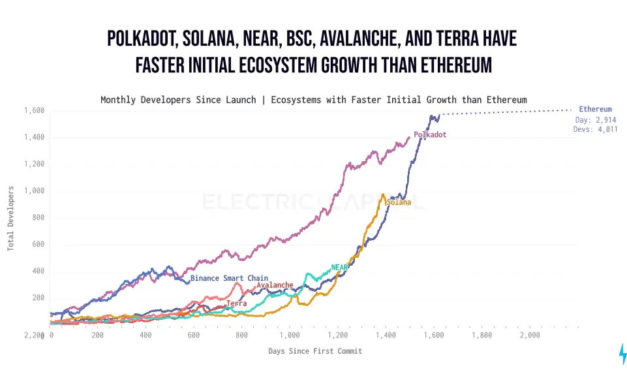
The Ethereum ecosystem still has far more developers than rival networks, but they are catching up with a faster rate of growth.Ethereum competitors such as Polkadot, Solana, and Binance Smart Chain are growing faster in terms of development activity according to crypto research firm Electric Capital which released its findings on the blockchain development ecosystem in a new report on Jan. 6. It revealed that more than 4,000 monthly active open-source developers work on Ethereum — considerably more than the 680 who work on the Bitcoin network. Across all chains, the total monthly active developers measured was more than 18,400 and the record was broken for the number of code commits by new developers in 2021 with more than 34,000.The measurements were gleaned by analyzing around 500,000 code repositories and 160 million code commits, which are changes or updates to the code. The report noted that Ethereum, Polkadot, Cosmos, Solana, and Bitcoin are the five largest developer ecosystems overall.According to the report, Polkadot has around 1,500 developers in total, while Cosmos and Solana are around a thousand each. Other active ecosystems in terms of monthly developers were Cosmos, NEAR which launched an $800 million developer fund in October, Tezos, Polygon, and Cardano each with more than 250 active monthly developers.While Ethereum is still dominant — more than 20% of new Web3 developers joined its ecosystem — rival networks have seen greater growth.“Polkadot, Solana, NEAR, BSC, Avalanche, and Terra are growing faster than Ethereum did at similar points in its history.”Ecosystem dev growth since first commit – Electric CapitalThe report compared the average monthly active developers between Dec. 2020 and Dec. 2021, noting that Solana grew by 4.9 times, NEAR had a 4X growth rate, and Polygon’s monthly developers more than doubled. Cosmos had a 70% increase in average monthly active developers and BSC 80% over the course of 2021.While the development growth figures are impressive for more early-stage projects, Ethereum is still the king. The ecosystem continues to retain the largest network of tools, dapps, and protocols and is 2.8 times larger than its closest rival, Polkadot.Related: ‘We are 50% of the way there,’ says Vitalik on Ethereum’s developmentSolana, Avalanche, BSC, NEAR, and Terra have emerged as DeFi hubs over the past year or so, attracting more developers as adoption increases. DeFi full-time monthly active contributors grew by 64%, and more than 500 new developers contributed code to a DeFi project every month last year aside from January, it reported.

Čítaj viac

Wait and see approach: 3/4 of Bitcoin supply now illiquid

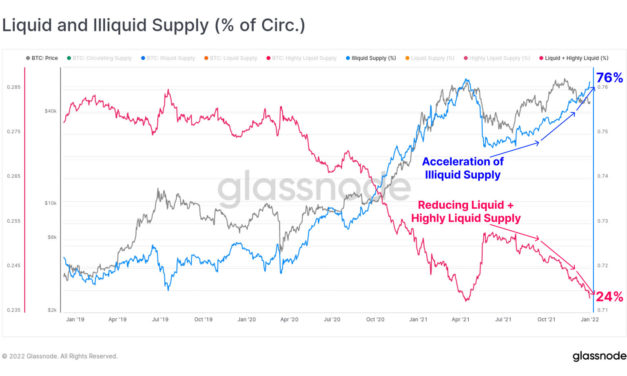
Bitcoin markets have been consolidating since the beginning of the year, but on-chain metrics are painting a more positive picture as more of the asset is becoming illiquid.On-chain analytics provider Glassnode has been delving into Bitcoin supply metrics to get a better view of the longer-term macro trends in its weekly report on Jan. 3.The findings revealed that although the asset has been trading sideways so far this year, more BTC has become illiquid. There has been an acceleration in illiquid supply growth which now comprises more than three quarters, or 76%, of the total circulating supply.Glassnode defines illiquidity as when BTC is moved to a wallet with no history of spending. Liquid supply BTC, which makes up 24% of the total, is in wallets that spend or trade regularly such as exchanges and hot wallets.“We can see that over the final months of 2021, even as prices corrected, there has been an acceleration of coins from liquid, into Illiquid wallets.”The figures suggest that more Bitcoin is being transferred into storage indicating an increase in hodling habits and accumulation. The decline in highly liquid supply also hints that there may not be a major selloff or capitulation event at any time in the near future.BTC liquid and illiquid supply as a percent of the total: GlassnodeThe researchers concluded that these conditions indicate “divergence between what appears to be constructive on-chain supply dynamics, compared to bearish-to-neutral price action.”Related: Just 1.3 million Bitcoin left circulating on crypto exchangesIn the same report, Glassnode stated that the total supply held by long-term holders has plateaued over the past month or so. This suggests that longer-term investors have stopped spending or selling coins and have become hodlers or even accumulators at this stage. “This provides another constructive view of market conviction,” it concluded.The current supply held by long-termers is 13.35 million BTC, a decline of just 1.1% from October’s high of 13.5 million coins. Glassnode defines these long-term holders (LTH) as wallets or accounts that have held their Bitcoin for more than 155 days.

Čítaj viac

Získaj BONUS 8 € v Bitcoinoch

nakup bitcoin z karty

Registrácia Binance

Burza Binance

Aktuálne kurzy