Autor Cointelegraph By Martin Young

Tezos transactions and smart contract activity surge on NFT demand

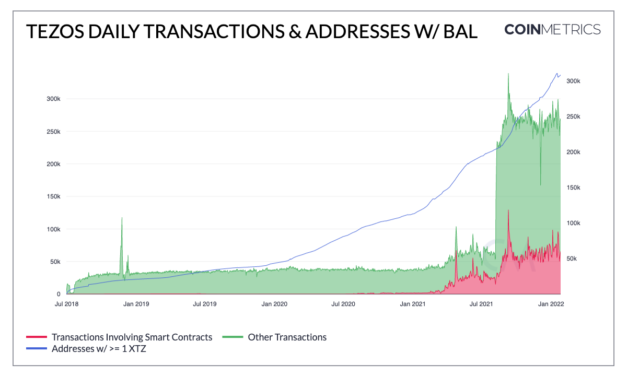
The Tezos network has seen impressive growth over the past 12 months in smart contract addresses and general adoption, primarily driven by non-fungible tokens (NFTs).Activity within the Proof-of-Stake ecosystem has had a spurt of growth recently as it aims to compete with Ethereum for NFT minting and markets.According to Coin Metrics’ “State of the Network” report on Feb. 1, the number of transactions involving smart contracts has surged over the past 12 months to more than 50,000 per day from less than 10,000 per day in January 2021.The report observed that the growth has been driven by NFT platforms such as the generative art platform FX Hash seeing increased interest. Additionally, gaming giant Ubisoft also announced Tezos support for gaming NFTs in December.High Ethereum network fees are driving NFT creators and buyers to alternative networks such as Tezos. The network has a portal for all Tezos-based NFT marketplaces which it claims are “carbon-neutral” with network fees that are “less than a penny.” NFTs have caused controversy due to the environmental issues around minting and trading them on Proof-of-Work networks. Tezos has been widely touted as an alternative to alleviate these concerns. Active addresses on the network are at an all-time high of over 45,000 while active smart contract addresses have tripled from under 200,000 to over 600,000 over the past 12 months. This highlights the growth in NFT and DApps that are using Tezos.The research also measured the total number of daily transactions which it labeled as ‘other transactions’. This figure spiked in August 2021 when the network launched an upgrade cutting block times in half. From a steady 40,000 daily transactions, it surged to over 250,000 and has remained at those levels ever since.Chart – CoinMetricsAccording to the platform’s own tracker, the current daily transaction figure is 309,431, less than a quarter of the daily transactions on Ethereum which is currently 1.17 million according to Etherscan.The report also charted the number of addresses containing more than at least 1 XTZ. This has recently surpassed 300,000, increasing 150% from the same time last year.Related: What is the best marketplace to buy NFTs? Find out now on The Market ReportTezos was launched in 2018 as an ‘energy efficient’ proof-of-stake network that uses a system called ‘baking’ to validate and publish new blocks on the chain.Its native token, XTZ, has gained 6.7% over the past 24 hours to trade at $3.77 according to CoinGecko. XTZ is currently 58.6% below its Oct. 4 all-time high of $9.12.

Čítaj viac


Circle's USDC stablecoin gobbles Tether's market share with 50B milestone

The world’s second-largest stablecoin by market capitalization keeps on growing as it erodes the dominance of the current leader, Tether.The stablecoin landscape is a constantly-shifting dynamic but one trend has become clear over the past year or so — Tether’s dominance is diminishing.Its main rival, Circle, has just reached a milestone of 50 billion USDC in circulation according to CoinGecko and a Feb. 1 tweet by company co-founder and CEO, Jeremy Allaire.50 BILLION USDC (w/ thread below) pic.twitter.com/5FEaPmXjup— Jeremy Allaire (@jerallaire) February 1, 2022Allaire said that while this is a massive number, “it’s the massive growth and ecosystem around it that tells the broader story.” He added that USDC has seen 10,000% growth over the past two years.The total stablecoin supply currently stands at $177 billion, equating to around 9.7% of the total crypto market capitalization. Tether commands around 45% of that total, whereas Circle now takes a 29% share as the gap between them closes. For reference, this time last year Tether had a dominance of 74% with Circle taking just 16% of the stablecoin pie.Circle’s stablecoin market capitalization expanded by 987% in 2021 according to CoinGecko. Comparatively, Tether’s supply saw less than a third of that growth with 275% over the same period. According to the Circle CEO, the stablecoin network saw $2.5 trillion in on-chain transactions and 4.6 million active wallet addresses in 2021 alone. USDC runs on eight different blockchains, is supported by 200 protocols, and can be traded in 180 countries on 34 exchanges. Tether is still the dominant force in the stablecoin ecosystem, but the Goldman Sachs-backed digital payment company Circle is closing in fast. Related: Tether freezes $150 million in USDTAs reported by Cointelegraph on Jan. 19, the USDC supply has already flipped USDT on the Ethereum network. Tether supply is currently split mostly between Ethereum and Tron with around 39 billion and 36 billion USDT on each network respectively and the rest on a handful of others such as Solana, Omni, and Algorand according to its transparency report.On Jan. 31, Circle announced that it had expanded its multi-chain ecosystem by adding support for Dapper Labs’ Flow network.

Čítaj viac

Wonderland co-founder throws in the towel on beleaguered DeFi project

The co-founder of the embattled Wonderland decentralized finance project is preparing to pull the plug following a deeply divided community vote.On Jan. 30, Wonderland co-founder Daniele Sestagalli tweeted that the Avalanche-based reserve currency experiment is coming to an end. He added that the divided community “means that we failed.”The vote to save or wind down the project came after Sestagalli asked former partner and Wonderland treasury head Michael Patryn (who goes by the pseudonym ‘0xSifu’) to step down late last week.Patryn, who has changed his name on a number of occasions, was sensationally revealed on Jan. 27 to be the co-founder of the defunct Canadian crypto exchange QuadrigaCX. He has also been previously convicted of credit card fraud and pleaded guilty to several related offenses in the early 2000s. 1/Wonderland experiment is coming to an end. It is clear from the vote that the community is divided. The core and heart of Wonderland is still the community. If we cannot find agreement on wether to continue or not, it means that we failed.— Daniele never asks to DM (@danielesesta) January 30, 2022There were several active votes on the Wonderland governance forum, however, the vote to wind down the project and return the treasury back to its holders had 55% voting to save it and 45% in favor of disbanding at the time of writing. Sestagalli said that the division has resulted in a single path forward:“The duty of the Team is to enact the will of the token holders. As the vote is so close to 50/50 there is only one path forward, it is to reimburse/unwind.”He added that he is working with the team on a new proposal. However, it was pointed out by those in favor of keeping the project going that the community was not split. They suggested that the token allocation was split, which raised other concerns among the community.I am ready to listen to what you have in mind, so please do not take this as FUD or hate, I just want to correct a point here The community is not split 50-50. The token allocation is. The community as individuals voted overwhelmengly No and against all odds, we eeked out a win pic.twitter.com/nBS3cCRe39— 0x von Bismarck (@0xVonBismarck) January 30, 2022

A number of alternative proposals have been put forward to save the project from going under. These include another ongoing discussion on a potential merger with Wonderland and Abracadabra, a DeFi lending protocol and yield strategy generator.Additionally, on Jan. 31, a lengthy proposal for Wonderland 2.0 was published by members of the community known as “Frogs” suggesting a transition of the existing protocol and treasury to a new DAO structure with a more transparent governance system. Related: Daniele Sestagalli discusses Wonderland’s future after QuadrigaCX co-founder doxThe DeFi imbroglio has had ripple effects throughout the ecosystem with other networks such as Terra also feeling the impacts. The close ties between Wonderland and Abracadabra’s MIM (Magic Internet Money) token have also impacted Terra’s ecosystem since MIM is used for yield farming with the Terra stablecoin, UST.The stablecoin has dipped below its peg recently on Wonderland concerns, and this has had a knock-on effect on LUNA which is used for its price-stabilization mechanism.LUNA prices are currently down 13% over the past 24 hours as investors have been liquidating. Meanwhile, Wonderland’s native TIME token has crashed nearly 60% since the debacle began last week and is now languishing 96% down from its Nov. 7 all-time high of just over $10K.

Čítaj viac

Green shoots? Institutional crypto funds see first inflows in 5 weeks

After five weeks of constant outflows, institutional investment is finally trickling back into crypto funds with BTC the asset of choice and ETH falling out of favor.In its weekly Digital Asset Fund Flows report published on Jan. 24, crypto investment firm CoinShares observed inflows for some institutional products.It is the first time in five weeks that there has been a net positive inflow as $14.4 million re-entered the space with investors buying the dip.The researchers reported that these inflows came during a period of significant price weakness, adding that this suggests investors “are seeing this as a buying opportunity” at current price levels. Capital continued to flow out from CoinShares own BTC fund, however, 21Shares and ProShares registered minor gains. Most of the inflows were for Bitcoin which had $13.8 million for the week. Ethereum was the biggest loser over the period with an outflow of $15.6 million, but the multi-asset products made up the balance resulting in a net overall inflow.CoinShares observed that the current seven-week run of ETH outflows now total $245 million “highlighting much of the recent bearishness amongst investors has been focused on Ethereum rather than Bitcoin.”Analyst Willy Woo also suggested it was early signs that institutional funds are starting to return:Early signs that institutional money is starting to come back in. pic.twitter.com/4P7d3Fmq4I— Willy Woo (@woonomic) January 24, 2022However, the total assets under management for the funds included in the report was $51 billion, its lowest level since early August 2021. The AUM has been depressed due to the falling value of the underlying assets over the past couple of months. There was no change in the world’s largest fund, Grayscale, which has $30.6 billion in AUM according to its latest update on Jan. 25, however, the fund was trading at a record discount of around 30%. Related: Bearish sentiment may soon abate according to Coinshares and Bitcoin metricsAnalysts and traders were looking for entry points following Bitcoin’s bounce and reclamation of $36K as reported by Cointelegraph.The asset plunged to a six-month low of $33K during late Monday trading according to Tradingview but has since recovered solidly with a 10% return to $36,276 at the time of writing. Should spot market momentum continue in this direction, weekly institutional inflows are likely to follow.

Čítaj viac

Ethereum EIP-1559 upgrade launches on Polygon to burn MATIC

The Ethereum upgrade that introduced a partial network fee burning mechanism in August last year has launched on the layer-two scaling network Polygon. Ethereum’s EIP-1559 upgrade shipped with its London hard fork last summer and has been a success in terms of gas price predictability and network fee burning. The upgrade has now launched on the layer-two scaling network Polygon in an effort to improve “fee visibility”. It went live about an hour ago at block 23850000.The Polygon team announced the upgrade date on Jan. 17, following its successful deployment on the Mumbai testnet. The EIP-1559 upgrade introduces the same fee-burning mechanism to Polygon resulting in the destruction of MATIC tokens. It also removes the first-price auction method for calculating network fees which leads to better cost estimations but goes not reduce gas prices.“The burning is a two-step affair that starts on the Polygon network and completes on the Ethereum network.”The team stated that, just like Ethereum, the supply of MATIC is likely to become deflationary with 0.27% of the total supply being burnt every year according to estimations. There is a fixed supply of 10 billion MATIC tokens with 6.8 billion currently in circulation.“Deflationary pressure will benefit both validators and delegators because their rewards for processing transactions are denominated in MATIC,” it added before stating that the upgrade would also reduce spam and network congestion.Despite being a layer-two network, Polygon has suffered from its own gas crisis recently. Earlier this month, Polygon gas fees skyrocketed according to Dune Analytics resulting in some validators failing to submit blocks. The surge in demand was due to a DeFi yield farming game called Sunflower Land which rewarded early adopters before the degens lost interest. Related: Here’s how Polygon is challenging the limitations of EthereumSince going live on Ethereum around six months ago, the upgrade has resulted in the burning of 1.54 million ETH to date according to the burn tracker. At current ETH prices, this works out at around $5 billion. The tracker also predicts that Ethereum issuance will become deflationary by -2.5% per year once “the merge” happens and proof-of-stake becomes the primary consensus mechanism for the network.MATIC prices have dumped 9% on the day in a fall to $2.22 at the time of writing according to CoinGecko.

Čítaj viac

Získaj BONUS 8 € v Bitcoinoch

nakup bitcoin z karty

Registrácia Binance

Burza Binance

Aktuálne kurzy