Autor Cointelegraph By Martin Young

Nvidia hackers selling software unlock for graphics card crypto mining limiters

A hacking group that infiltrated Nvidia servers last month is attempting to sell software that could unlock crypto mining hash rate limiters on the firm’s flagship graphics cards.A South American hacking group going by the name LAPSUS$ claims to have stolen a terabyte of data from Nvidia servers in late February. The group is now offering software in the form of a customized driver to unlock limiters the company has put on its high-end graphics cards.Nvidia stated that it became aware of the incident on Feb. 23, and stated, according to reports on Mar. 2: “We are aware that the threat actor took employee credentials and some Nvidia proprietary information from our systems and has begun leaking it online.”The cybercriminal group has been trying to extort the California-based company through a Telegram channel. In addition to leaking sensitive personal data that it pilfered, the group is offering to bypass limits on Nvidia’s RTX 3000 series graphics cards to enable higher hash rates for Ethereum mining.On March 1, PCMag revealed screenshots from the group’s channel which stated “this leak contains source code and highly confidential/secret data from various parts of Nvidia GPU driver, Falcon, LHR, and such.”LHR refers to “Lite Hash Rate” which is a limiter the company introduced to de-tune its GPUs in 2021 to deter crypto miners from snapping them all up, leaving some for its core market of PC gamers.The hacking group is also attempting to hold Nvidia to ransom with demands that it remove the limiter from all RTX 3000 series cards and make drivers open-source. It has given the company until March 4 to make a decision.Related: Nvidia again limiting crypto mining on its RTX-3060 gaming graphics cardGraphics card prices and availability has been a bane for gamers for the past two years, escalating their angst against crypto miners and the industry in general.High-end GPUs can cost upwards of $1,800 if in stock, and lower-spec models are very hard to come by leading to the emergence of a used-card market where prices for older graphics cards often exceed what they cost originally in certain regions.

Čítaj viac


Billionaire admits he was wrong about Bitcoin as Citadel looks to crypto markets

American multinational hedge fund and financial services company Citadel is poised to enter cryptocurrency markets this year.Speaking on Bloomberg Wealth with David Rubenstein, Citadel founder Ken Griffin commented on the current state of markets in light of recent geopolitical conflicts stating that they are at a “very volatile inflection point.”When the interview turned to digital assets, Griffin who has previously warned the younger generation away from them and said “there’s no need for cryptocurrencies,” revealed that the firm would be engaging in crypto asset markets this year.“It’s fair to assume that over the months to come, you will see us engage in making markets in cryptocurrencies.”Its quite the turnaround from November 2017, when Griffin said: “Bitcoin right now has many of the elements of the tulip bulb mania we saw back hundreds of years ago in Holland.” At the time, when BTC was trading around $10,000, he added “these bubbles tend to end in tears. And I worry about how this bubble might end.”During the Bloomberg Wealth interview Griffin acknowledged that he was wrong to have been in the “naysayer camp” with regard to digital assets. “Crypto has been one of the great stories in finance over the course of the last 15 years,” he stated before adding:“And I’ll be clear, I’ve been in the naysayer camp over that period of time. But the crypto market today has a market capitalization of about $2 trillion in round numbers, which tells you that I haven’t been right on this call.”He said that he was still skeptical but “there are hundreds and millions of people in this world today who disagree with that.” “To the extent that we’re trying to help institutions and investors solve their portfolio allocation problems, we have to give serious consideration to being a market maker in crypto.”Citadel analyzes global markets employing a range of strategies to deliver market-leading investment returns to its capital partners. Griffin wants the firm to encompass crypto assets into these strategies over the coming months.In January, Citadel Securities announced its first outside investment worth $1.15 billion from two prominent crypto venture capital firms Sequoia Capital and Paradigm. Citadel, which currently has around $38 billion in assets under management, was valued at $22 billion following the investments.Related: Citadel Securities takes in $1.15B investment from Sequoia and ParadigmAs recent as November, Griffin remained highly skeptical about cryptocurrencies stating at the time that people are focused on new ideas and that he worried “that some of this passion is misplaced when it comes to cryptocurrencies.”The billionaire investor did go on to tout the properties of Ethereum, however, opining that assets based on Ethereum will eventually replace Bitcoin which has a greater environmental impact.

Čítaj viac

Layer 2 address activity slows, but Arbitrum bucks the trend

On-chain activity for the leading Layer 2 networks has been declining recently, however, the Arbitrum platform is bucking the trend according to recent findings.Blockchain analytics firm Nansen has reported that seven-day activity in terms of addresses for many of the leading networks has been in decline. Only the Ethereum L2 scaling network Arbitrum has shown gains for this metric.According to its Feb. 28 tweet, Arbitrum activity has increased by 12.7% over the past week. It reported that the network has had 46,200 unique active addresses over the past seven days.In the last 7 days, all but Arbitrum’s (+12.7%) on-chain activities have slowed down:#BNB Chain 4.03M#Ethereum 1.99M#Ronin 1.09M#Polygon 854k#Avalanche 269k#Fantom 204k#Arbitrum 46.2k#Celo 29.4k#Optimism 9.52kCheck out their public dashboard links in the pic.twitter.com/BlxkNG35rh— NansΞn (@nansen_ai) February 28, 2022Although the figure is far lower than other chains, it is the only one to have shown an increase in activity for the period. Layer two analytics platform L2beat is reporting that Arbitrum is still the industry leader in terms of total value locked which is just over $3 billion giving it a market share of 54.9%. Defillama reports that the most popular protocol running on the network is the SushiSwap DEX but it also notes a higher TVL figure of just over $4 billion for the Polygon network. Collateral locked on Arbitrum has crept up over the past few days, increasing 5.7% since Feb. 25. Conversely, rival layer two network Optimism has seen a decline in TVL over the same period. Optimism has an 8% L2 market share with a total value locked of $444 million, and address activity has fallen by 17.9% over the past week according to Nansen.Other layer two platforms such as Polygon have also seen declines in terms of activity as reported by Nansen. Polygon has slowed by 10.9% in terms of seven-day active addresses and TVL on the network has fallen 15% over the past fortnight according to DeFillama.Nansen also reported weekly address activity declines of 2.7% and 2.9% for Binance Smart Chain and Ethereum respectively.Related: Blockchain analytics service Nansen to incorporate DeFi protocol ArbitrumThe fall in on-chain activity is likely to be related to cooling demand for decentralized finance (DeFi) as crypto markets have retreated this year. DeFiLlama currently reports that TVL for all listed DeFi platforms is down almost 19% from its all-time high in late November. However, it should be noted that this is likely due to a decline in the prices of underlying assets which has been far steeper than the DeFi TVL drop.It should also be noted that there are large discrepancies in the TVL metric between different analytics platforms (DeFillama and L2beat in this case) so figures should be taken with a pinch of salt. Other indicators supporting the trend include a plateau in the supply of wrapped Bitcoin (wBTC) which is also widely used on DeFi platforms.

Čítaj viac

NY stock exchange owner ICE buys stake in tZero security token platform

The Intercontinental Exchange (ICE) has announced a strategic investment in private digital securities marketplace and crypto asset liquidity platform tZero.ICE, which owns and operates 12 global exchanges including the New York Stock Exchange (NYSE), made the announcement on Feb. 22, however, there was no mention of the terms or details of the investment other than ICE becoming a “significant minority shareholder” in tZero.It did state that as part of the investment, ICE’s Chief Strategy Officer David Goone will join tZero as its new CEO serving on the board of directors.tZero operates a blockchain-based alternative trading system (ATS) upon which companies can list tokenized versions of their stocks. The firm is fully regulated with the Securities and Exchange Commission (SEC) and acts as a broker-dealer in the digital asset space, also offering a number of cryptocurrencies. The platform only offers a handful of tokenized stocks at the moment, one of which is early investor Overstock under the ticker OSTKO.The platform’s target market is financial firms and investors seeking access to a digital marketplace and unique private assets and equities such as cryptocurrencies and nonfungible tokens (NFTs).ICE founder, Chairman, and CEO, Jeff Sprecher, commented on Goone’s appointment stating that he has been a “steward of our problem-solving culture,” before adding:“David’s leadership and his mastery of trading, data, and clearing technology will be a big asset as tZERO begins its next chapter leading the growth and adoption of next-generation market infrastructure.”Goone, who has been with ICE since 2001, brings a lot of experience to the table having developed and managed many of ICE’s product lines during his tenure.ICE is a Fortune 500 firm and leader of global exchanges and clearinghouses that provide financial technology and data services across major asset classes.tZero got off to a rocky start following its security token offering (STO) and numerous investments in 2020. At the time, the fledgling security token platform was still losing money, though this latest investment could provide access to new markets for tZero. Related: Intercontinental Exchange sells Coinbase stake for $1.2 billionAs reported by Cointelegraph on Feb. 15, the NYSE is showing a greater interest in the digital asset space as it filed a patent application for a number of crypto and blockchain-related products and services. These include an online marketplace for trading crypto assets, NFTs, and Metaverse technology such as augmented reality software.

Čítaj viac

On-chain metrics hint at a bearish outlook for Bitcoin

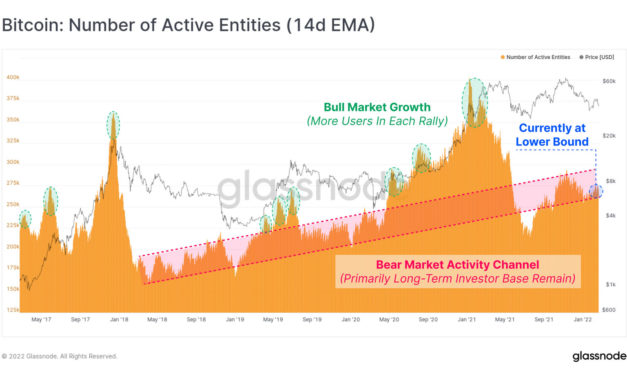
Blockchain analytics provider Glassnode has depicted a bearish scenario for Bitcoin as on-chain metrics suggest increased selling pressure is imminent.In its weekly analytics report on Feb. 21, on-chain metrics firm Glassnode said that Bitcoin bulls “face a number of headwinds,” referring to increasingly bearish network data.The researchers pointed at the general weakness in mainstream markets alongside wider geopolitical issues as the reason for the current risk-off sentiment for crypto assets.“Weakness in both Bitcoin, and traditional markets, reflects the persistent risk and uncertainty associated with Fed rate hikes expected in March, fears of conflict in Ukraine, as well as growing civil unrest in Canada and elsewhere.”It added that as the downtrend deepens, “the probability of a more sustained bear market can also be expected to increase.” Bitcoin is currently trading down 47% from its November all-time high and has been down-trending for the past 15 weeks.A lack of on-chain activity is one of the distinct signals of a bearish Bitcoin market. The number of active addresses or entities is currently at the lower bound of the bear market channel which depicts on-chain activity during periods of sideways or down trending markets, suggesting a decrease in demand and interest.Active on-chain entities: GlassnodeGlassnode reported that around 219,000 addresses have been emptied over the past month suggesting that it could be the beginning of a period of outflows of users from the network.It calculated a short-term holder realized price on an aggregate cost basis which worked out at $47,200 meaning that the average loss at current prices is around 22% for those still holding the asset. “The longer that investors are underwater on their position, and the further they fall into an unrealized loss, the more likely those held coins will be spent and sold.”There were several other measurements of long and short-term on-chain positions culminating in the conclusion that there is a total of 4.7 million BTC currently underwater. More than half of it, or 54.5% is held by short-term holders (less than 155 days), “whom are statistically more likely to spend it,” it added.Related: ‘Coin days destroyed’ spike hinting at BTC price bottom? 5 things to watch in Bitcoin this weekCrypto Twitter has also been awash with bearish sentiment over the past few days and the Bitcoin Fear and Greed Index is currently registering a 20 — “extreme fear”.Not everything will last in crypto.Quick thoughts on the fallout of a bear market:— Jason Choi (@mrjasonchoi) February 21, 2022At the time of writing, BTC prices had fallen 6% over the past 24 hours to trade at $36,738 according to CoinGecko. Bitcoin is now priced very close to its lowest level of 2022, which was just over $35,000 on Jan. 23.On the positive side, on Feb. 19 Cointelegraph reported that the inactive Bitcoin supply is nearing record levels with more than 60% of BTC remaining unspent for at least a year. 3AC co-founder Zhu Su commented that many people that bought BTC in 2017 and 2018 are still hodling, adding “Anecdotally many of these ppl are staying humble this time and buying every month regardless of what else is happening.”

Čítaj viac

Získaj BONUS 8 € v Bitcoinoch

nakup bitcoin z karty

Registrácia Binance

Burza Binance

Aktuálne kurzy