Autor Cointelegraph By Martin Young

‘Cryptojacking’ rises 30% to record highs despite crypto slump: Report

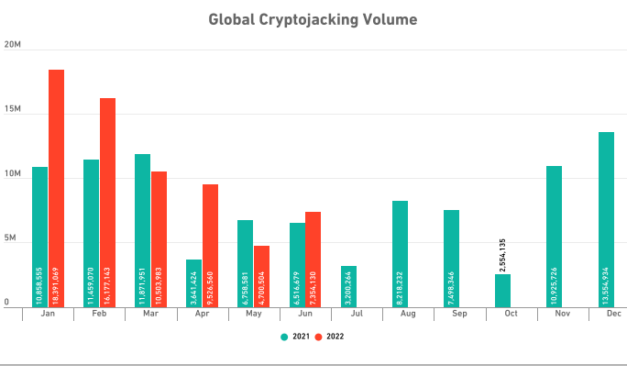
New research shows that despite falling digital asset prices, cryptojacking has reached record levels in the first half of 2022.According to a mid-year update on cyber threats by American cybersecurity company SonicWall, global cryptojacking volumes rose by $66.7 million, or 30% in the first half of 2022 compared to the same period last year.Cryptojacking is a cybercrime whereby malicious actors commandeer a victim’s computer resources by infecting the machine with malware designed to mine cryptocurrencies. It is often executed through vulnerabilities in web browsers and extensions.Source: SonicWallThe report stated that the overall rise in cryptojacking can be attributed to a couple of factors. Firstly, cybercriminals are leveraging the Log4j vulnerability to deploy attacks in the cloud. In December 2021, a critical vulnerability affecting java based logging utility was discovered in the Open Source Library managed by software company Apache. Hackers can exploit it to gain remote access to a system.Secondly, cryptojacking is a lower-risk attack than ransomware which needs to be made public to succeed. Cryptojacking victims are often unaware that their computers or networks have been compromised.Finance sector bewareAttackers also appeared to have changed their preferred targets during the period, moving from the government, healthcare and education sectors to the retail and financial sectors. Cryptojacking attacks targeting the finance sector skyrocketed 269% in the period, more than five times greater than the second highest industry — retail, which saw attacks increase by 63%. “The number of attacks on the finance industry is five times greater than the second highest industry — retail, which used to be at the very bottom of the list,” the researchers noted.Related: Monero’s crypto of choice as ransomware ‘double extortion’ attacks increase 500%The researchers, however, noted that the volume cryptojacking attacks began to fall alongside the crypto markets in the first half of the year, as attacks were becoming less lucrative. They observed a pattern of significantly higher volumes in the first quarter, followed by “cryptojacking summer slump” in Q2. The firm said that based on past trends, Q3 volumes will likely also be low, with attacks likely to pick up again in Q4. This year’s summer decline has also been attributed to a falling in crypto asset prices as markets have shrunk by 57% since the beginning of the year.

Čítaj viac

Binance CEO sues Bloomberg subsidiary alleging defamation

Binance chief executive Changpeng Zhao is suing Bloomberg Businessweek in Hong Kong, accusing the outlet of defamation.On July 25, the Binance CEO, known by the crypto community as “CZ,” sued Bloomberg Businessweek’s Hong Kong publisher Modern Media Company Limited.The filing contained defamation claims which stem from a translated Chinese article that alleged the exchange boss was running a crypto Ponzi scheme. The filing documents claimed that Modern Media published a report that “contained false, malicious and defamatory statements about Zhao and his company, Binance Holdings Limited.”The Chinese edition ran its version of a June 23 Bloomberg article titled “Can Crypto’s Richest Man Stand the Cold?” but was published with the title “Zhao Changpeng’s Ponzi Scheme.”On June 25, CZ commented on the original article, “While most journalists at Bloomberg are good, but this time, it was bad.” On July 25, he said, “Be accountable for your actions.”Bloomberg: hey, we will do a nice profile piece on you, invite you for photoshoots, etc. Then switches the story last minute. Ignore all positive comments they got from 3rd parties. Picked only old negatives. And still puts you on the cover. WTF!? Unprofessional.— CZ Binance (@cz_binance) June 24, 2022Zhao is also suing the publication for using the Ponzi-referencing title in the Chinese edition of Bloomberg Businessweek’s social media accounts to promote the article. The Chinese language article was also distributed in print around Hong Kong on July 7, according to the filings.The filing is a personal suit and has nothing to do with the exchange or company, as confirmed by Binance when Cointelegraph reached out for comment.A motion for discovery was also filed against Bloomberg in the United States for the defamation that came from the original article. It read:“Surprisingly, the Original Article contained several serious and defamatory allegations made against Zhao and Binance that were completely unsubstantiated and were obviously designed to mislead readers into believing that Zhao and Binance have been engaging in illegal or unsavory activities.”Zhao is pursuing a ruling barring the publication from ever republishing the allegedly defamatory statements in Hong Kong. He also wants to see the removal and recalling of the statements along with damages, interest, and costs.According to court documents, Bloomberg partially satisfied some of Zhao’s concerns before the lawsuit was filed by changing the article title to “The Mysterious Changpeng Zhao.”It is also understood that the defamatory social media posts were deleted and physical copies of the translated article had been recalled in Hong Kong.Related: Binance files US lawsuit against Forbes and two cryptocurrency journalistsIt is not the first time Zhao and Binance have sued the media. In 2020, Binance Holdings Ltd sued Forbes Media LLC for defamation but quietly dropped the case the following year. Cointelegraph reached out to Binance representatives for comment but had not heard back at the time of press.

Čítaj viac

Workers in volatile economies most likely to take pay in crypto: Report

Residents in nations with volatile economies are more likely to receive their pay in crypto, according to global hiring platform Deel. In its “State of Global Hiring Report” shared with Cointelegraph on July 21, the firm found that despite the 2022 bear market, crypto represented 5% of all global payments withdrawn from the platform every month, up from 2% in the second half of 2021. Residents in nations with volatile economic situations and currencies were most likely to take their payments in crypto, according to the report. These included countries in Latin America (LATAM) and Europe, the Middle East, and Africa (EMEA).Crypto withdrawals in the LATAM region represented 67% of the total, with EMEA countries at 24%. Those from the North American region represented just 7% of the total for crypto payments. The Asia Pacific region was even lower with just a 2% share of the whole.In terms of asset type, Bitcoin (BTC) remained the crypto of choice, making up 47% of the total. The second choice of digital asset for payments was Circle’s USDC with 29%, followed by Ethereum (ETH) at 14%. Tether’s USDT did not make the list.Deel sourced the data from over 100,000 cross-border worker contracts on the platform between January and July 2022. The firm helps businesses compliantly hire, onboard, and pay people in different countries. It noted that LATAM tops the list of regions hiring internationally.Related: Crypto education can bring financial empowerment to Latin AmericansSurging inflation is a concern for many countries in the Latin American region. Venezuela, Argentina, Chile, Brazil, and Paraguay all have double-digit inflation, according to Trading Economics.Diminishing purchasing power using their own fiat currencies is likely to have influenced the increase in crypto payments to regional workers.

Čítaj viac

Will Ethereum Merge hopium continue, or is it a bull trap?

Ethereum is outperforming the broader cryptocurrency market as the highly anticipated Merge approaches, but the bigger picture is still largely bearish.Ethereum (ETH) has gained a whopping 48% over the past seven days, outperforming its big brother Bitcoin, which has only managed to achieve 19% in the same period. It’s also up 66% from its market cycle bottom of $918 on June 19, reaching its current price of $1549.However, the current Ethereum rally could be a bull trap with the macroeconomic clouds darkening. A bull trap is a signal indicating that a declining trend in a crypto asset has reversed and is heading upwards when it will actually continue downwards. The primary driver of recent momentum for the asset has been linked to announcements regarding its final switch to proof-of-stake, which has been slated for September 19. The Merge will reduce the network’s energy consumption by more than 99%. However, it will not necessarily reduce transaction fees significantly as this will occur when scaling takes place via sharding which is expected sometime next year.On July 19, a Coinbase report on the Merge explained that the next major step, and last dress rehearsal, is the Goerli testnet Merge which has been planned for August 11. Goerli is the most battle-tested Ethereum environment with the most user activity and the closest simulation of the real thing.Is This Me who is Thinking that Ethereum will start the BULL RUN with his Merge ??#eth #Ethereum #ethereum2 #ethereum #Bullish #bullish pic.twitter.com/oSHDKTz6vw— Crypto Diamond (@ImCryptoDimond) July 19, 2022While the major upgrade is the fundamental driver of current Ethereum market sentiment, the asset is still trading down 68% from its November 2021 all-time high. There have also been concerns that a significant amount of ETH may flood the market after the Merge and its release from its staking smart contracts.However, director of research at 21Shares, Eliézer Ndinga, told Cointelegraph that this is unlikely to happen: “The withdrawals of Ether won’t occur until 6-12 months post Merge after the Shanghai upgrade. The withdrawals will be limited to six validators every epoch or ~ 6 minutes to avoid bank runs and keep the network secure.”Related: Ethereum devs confirm the perpetual date for The MergeA recent survey by Finder, conducted before the most recent rally sai there is still a lot of negative sentiment regarding short-term Ethereum prices. The panel of 54 industry experts polled thought ETH would be worth $1,711 by the end of 2022, climbing to $5,739 by 2025, before hitting $14,412 by 2030. However, they also thought it would dump to $675 before the year was out.Finder said there are a couple of macroeconomic factors that could cause this retreat. The U.S. Federal Reserve is expected to hike rates again by 75 basis points during their July 26-27 meeting, which is generally bearish for crypto markets. If Bitcoin takes a dive, Ethereum is sure to follow.Additionally, the U.S. Bureau of Economic Analysis (BEA) will release its advance estimate of second-quarter GDP growth on July 28. Another negative quarter, which is expected, will mean that the country is in a technical recession which is also very bad for risk-on assets such as Ethereum.

Čítaj viac

BTC mining costs reach 10-month lows as miners use more efficient rigs

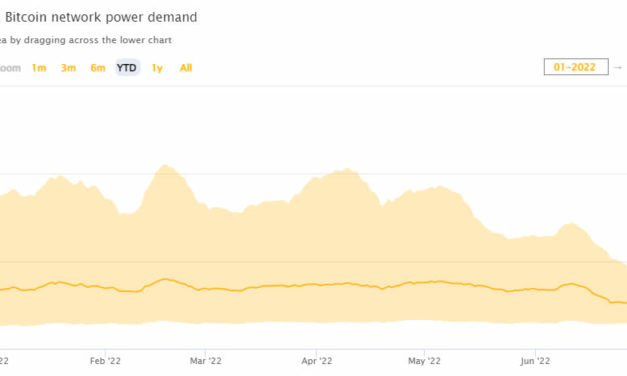
The cost of mining one Bitcoin (BTC) has fallen to ten-month lows as mining hardware becomes more efficient, and difficulty has dropped 6.7% since its May peak.On July 13, strategists from JPMorgan led by Nikolaos Panigirtzoglou told investors that Bitcoin production costs have fallen to around $13,000 from $24,000 at the beginning of June. This is the lowest it has been since September 2021, according to the analysts citing a chart from Bitinfocharts, and comes as mining difficulty has fallen from its May highs of 31.25T to 29.15T. Lower Bitcoin production costs can potentially ease miner selling pressure and improve profitability. However, the strategists were still bearish, stating “the decline in the production cost might be perceived as negative for the Bitcoin price outlook going forward,” according to Bloomberg.They added that the production cost is perceived by some analysts as the lower bound for BTC price range in a bear market. Several analysts have predicted BTC prices to fall to around $13,000, which would align with the 80%+ drawdowns in the previous two bear markets. Bitcoin is currently trading down 70% from its November all-time high.Bitcoin production cost peaked just after the price peaks in April and November 2021 and has fallen back as markets did, so it is correlated but lags price movements.The drop in production cost has been linked to a decline in electricity consumption. Cambridge University’s Bitcoin energy consumption index currently reports that the network’s estimated daily power demand is 9.59 Gigawatts. This is a decline of 33% over the past month and is down 40% from the 2022 peak demand of almost 16 GW in February.Source: Cambridge UniversityAdditionally, a significant number of miners have powered down older, more inefficient mining rigs as they have become unprofitable to operate due to surging energy prices and a collapse in BTC prices.According to Asicminervalue, the Bitmain Antminer E9, just released this month, is one of the most efficient units on the market, with a maximum hash rate of 2.4Gh/s for a power consumption of 1,920 Watts.Related: Bitcoin miners sell their hodlings, and ASIC prices keep dropping — What’s next for the industry?On the flip side, miners have been hit with the double whammy of increasing global energy prices and tanking BTC prices. This has caused mining profitability to slump by 63% since the beginning of the year. Bitinfocharts reports that mining profitability is currently at its lowest levels since October 2020 at $0.095 per day per terahash per second.However, the fall in production cost may prevent a further fall in profitability and could even reverse that trend in the coming months.

Čítaj viac

Získaj BONUS 8 € v Bitcoinoch

nakup bitcoin z karty

Registrácia Binance

Burza Binance

Aktuálne kurzy