
Autor Cointelegraph By Martin Young

Bitcoin may behave more like US Treasury bonds: Bloomberg Intelligence

The latest crypto market research from Bloomberg Intelligence suggests that Bitcoin may start to behave more like United States (U.S.) Treasury bonds and gold, rather than stocks.In its August Crypto Outlook report, penned by Senior Commodity Strategist Mike McGlone and Senior Market Structure Analyst Jamie Coutts, the research unit compared Bitcoin markets to those of gold, bonds, and oil.The authors suggested that macroeconomic influences such as the Federal Reserve’s monetary policies have resulted in similarities in Treasury bond markets and Bitcoin:“Tightening markets and plunging global growth support the Federal Reserve’s shift to a “meeting by meeting” bias in July, which may help pivot Bitcoin toward a directional tilt more like US Treasury bonds than stocks.”They also added that a “dump-following-pump nature of commodities” and receding bond yields suggest an increase in the probability of bonds, gold, and Bitcoin being buoyed as inflation decreases.Is the Flush Done? Booms, Busts and #Bitcoin vs. #Gold, #Bonds, #Oil — Whether the ebbing tide has subsided for most assets is the top binary issue for 2H, and in most scenarios, Bitcoin and Ethereum appear poised to come out ahead. Link to Pdf:https://t.co/iFSCZIULHe— Mike McGlone (@mikemcglone11) August 3, 2022Treasury bonds, often called T-Bonds, are long-term government debt securities issued by the U.S. Treasury Department. They have a fixed rate of return and maturity periods ranging from 20 to 30 years.The report noted that crypto markets reached their greatest-ever discount compared to the 100-week moving average in July. It added that it is “abnormal for Bitcoin to hold much below its 200-week moving average.” BTC is currently trading up 1.2% on the day at $23,1502, having just reclaimed the 200-week moving average, which lies at $22,827.The analysts said that the fact that BTC was 70% below its peak at the start of August but still five times higher than its March 2020 low “shows its potential.”They flagged the $20,000 zone as key support and that they expect a base is building, similar to the $5,000 level in 2018-19.Related: Bitcoin bulls aim for $25K price on Friday’s $510M options expiry The researchers concluded that Bitcoin had been one of the best-performing assets since its inception about a decade ago, adding:“We think more of the same is ahead, particularly as it may be transitioning toward global collateral, with results more aligned with Treasury bonds or gold.”Coinbase research carried out in July indicates that the risk profile of the crypto asset class is similar to that of oil and tech stocks. According to Coinbase chief economist Cesare Fracassi, “the correlation between the stock and crypto-asset prices has risen significantly” since the 2020 pandemic.

Čítaj viac
Tether supply starts to increase after three-month decline

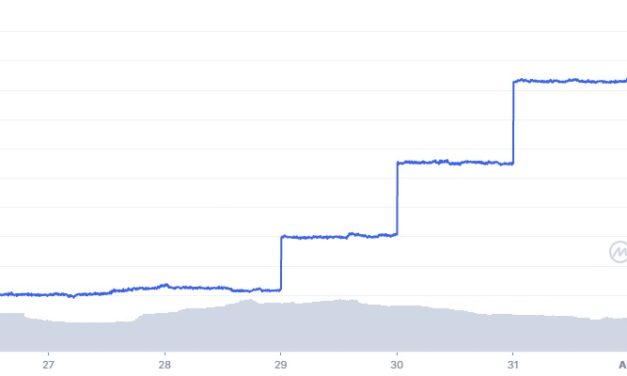
The world’s largest stablecoin, Tether (USDT) has expanded its circulating supply following almost three months of reductions, in what could be a sign the crypto markets are slowly recovering. The first mint in almost three months occurred on July 29, and there have been three more, with the latest on August 2, according to CoinMarketCap. The USDT injections have been small, however, lifting Tether’s market cap by just 0.7% or just under $500 million.USDT market cap 7D – Coinmarketcap.comAccording to the Tether transparency report, there is now 66.3 billion USDT in circulation. This gives the stablecoin a total market share of around 43%.Tether supply reached an all-time high in early May when it topped 83 billion USDT. The collapse of the Terra ecosystem, resultant crypto contagion, and large-scale redemptions forced the company to reduce the circulating supply, which fell 21% to a low of 65.8 billion in late July. This has enabled rival company Circle to increase the market share of its stablecoin USDC, which now commands a 36% slice with a $54.5 billion market cap. As reported by Cointelegraph last month, USDC volume on Ethereum actually flipped Tether’s for a period as the number two stablecoin continues to catch up.Over the weekend, Binance CEO Changpeng Zhao commented on the amount of stablecoins poised to re-enter the markets, stating:“3 of the top 10 are stablecoins, meaning there is a lot of “fiat” sitting sidelines, ready to get back in. If people wanted to get out of crypto, most won’t hold stablecoins.”Stablecoins currently represent 13.6% of the entire crypto market capitalization, which is close to its all-time highest levelsRelated: Circle’s USDC on track to topple Tether USDT as the top stablecoin in 2022A cost of living crisis caused by surging global inflation may have put the brakes on crypto investing and speculation for retail traders. However, those living in countries with extreme inflation levels, such as Argentina, have held onto to USD-pegged stablecoins as a hedge against their own currencies. Tether acknowledged the benefits of holding stablecoins, stating that USDT “allows Argentinians to access a market that is truly global and liberates them from local black markets,” adding that it also “empowers them to hold Tether in ways that cannot be confiscated by the government, unlike local bank accounts.”

Čítaj viac

Blockchain security firm warns of new MetaMask phishing campaign

A cybersecurity firm has issued warnings over a new phishing campaign targeting users of the popular crypto wallet MetaMask.In a July 28 post written by Halborn’s technical education specialist Luis Lubeck, the active phishing campaign used emails to target MetaMask users and trick them into giving out their passphrase. The firm analyzed scam emails it received in late July to warn users of the new scam. Halborn noted that at initial glance, the email looks authentic with a MetaMask header and logo, and with messages that tell users to comply with KYC regulations and how to verify their wallets. However, Halborn also noted there are several red flags within the message. Spelling errors and a fake sender’s email address were two of the most obvious. Furthermore, a fake domain called metamaks.auction was used to send the phishing emails.Phishing is a social engineering attack using targeted emails to lure victims into revealing more personal data or clicking links to malicious websites that attempt to steal crypto.There was also no personalization in the message, the firm noted, which is another warning sign. Hovering over the call to action button reveals the malicious link to a fake website which prompts users to enter their seed phrases before redirecting to MetaMask to empty their crypto wallets.Halborn, which raised $90 million in a Series A round in July, was founded in 2019 by ethical hackers offering blockchain and cyber security services.In June, Halborn researchers discovered a case where a user’s private keys could be found unencrypted on a disk in a compromised computer. MetaMask patched its extension versions 10.11.3 and later following the discovery.However, there was no mention of the new email phishi threat on MetaMask’s Twitter feed at the time of writing.Related: Phishing risks escalate as Celsius confirms client emails leakedLast week, Celsius users were warned of a phishing threat following the leak of customer emails by a third-party vendor employee.In late July, security researchers warned of a new malware strain called Luca Stealer appearing in the wild. The information stealer has been written in the Rust programming language and targets Web3 infrastructure such as crypto wallets. Similar Malware called Mars Stealer was discovered targeting MetaMask wallets in February.

Čítaj viac

Phishing risks escalate as Celsius confirms client emails leaked

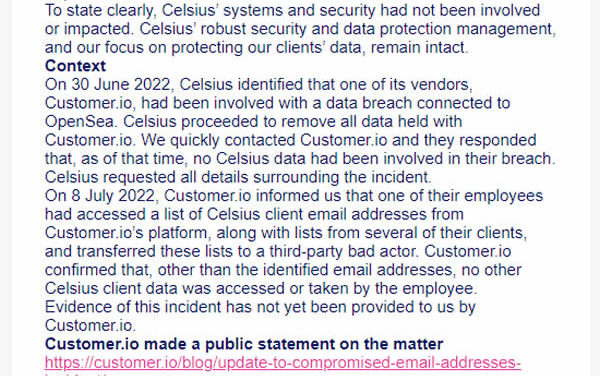
Celsius depositors should be on the lookout for phishing scams after the company revealed some of its customer data had been leaked in a third-party data breach. On Tuesday, Celsius sent an email to its customers informing them that a list of their emails had been leaked by an employee of one of its business data management and messaging vendors. According to Celsius, the breach came from an engineer at the Customer.io messaging platform, who leaked the data to a third-party bad actor.“We were recently informed by our vendor Customer.io that one of their employees accessed a list of Celsius client email addresses,” said Celsius in its email to customers. The data breach is part of the same incursion that leaked OpenSea customer email addresses in June.Announcement from Celsius: “We are writing to let you know that wewere recently informed by our vendorhttps://t.co/452EROQtbc that one of their employeesaccessed a list of Celsius client emailaddresses held on their platform andtransferred those to a third-party.”— Celsians (@CelsiansNetwork) July 28, 2022Celsius has, however, played down the incident stating that it did not “present any high risks to our clients,” adding that they just wanted users to “be aware.”On July 7, Customer.io wrote in a blog post that “We know this was a result of the deliberate actions of a senior engineer who had an appropriate level of access to perform their duties and provided these email addresses to the bad actor.” The employee has since been terminated.The number of emails leaked was not disclosed, nor was the platform to which they were leaked.However, the crypto community has started to warn Celsius users of phishing attacks which usually follow an email data breach.Phishing is a form of social engineering in which targeted emails are sent to lure victims into revealing more personal data or clicking links to malicious websites that installs malware to steal or mine crypto.⚠️ Celsius users should expect phishing emails along the lines of “Verify your wallet to withdraw your funds” that will phish for your SRP/PKey due to thisRemember, your SRP should only be known to you and you only https://t.co/QYuDhEE7aL— harry.eth (whg.eth) (@sniko_) July 28, 2022

A similar data breach in April 2021 saw Celsius customers reportedly targeted by a fraudulent website claiming to be the official Celsius platform. Some received SMS and emails prompting them to reveal personal information and seed phrases.At the time, the company reported that hackers had gained access to a third-party email distribution system it uses. Related: Email server breach sees Celsians targeted by phishing attacksPerhaps the most famous crypto data breach was from hardware wallet provider Ledger, which had its servers hacked in 2020. The spewing of thousands of customers’ personal details on the internet resulted in untold losses and even physical threats for many victims, yet the company refused to compensate them. Celsius email to customers on July 26.

Čítaj viac

Up in smoke: Artist Damien Hirst to burn 4,851 paintings in NFT project

The United Kingdom’s reportedly richest living artist, Damien Hirst is set to burn thousands of his paintings as part of a year-long nonfungible token (NFT) project called “The Currency.”Starting in September, visitors to Hirst’s private London museum will be able to view some of his 10,000 oil paintings depicting unique dots he created in 2016 and linked to NFTs in 2021.Buyers of the $2,000 floor-priced NFTs were given the option to keep the token or trade it for the physical painting. The original artwork will be burnt for those who chose to keep the NFT version. The deadline for the decision was July 27, with nearly half of the collectors, 4,851 wanting their paintings burned for digital edition NFTs, while 5,149 collectors opted to trade their NFTs for physical versions.The CurrencyThe year is over boom that was quick! and we have all had to decide: NFT or physical? The final numbers are: 5,149 physicals and 4,851 NFTs (meaning I will have to burn 4,851 corresponding physical Tenders). pic.twitter.com/xCUJ0gviZ0— Damien Hirst (@hirst_official) July 27, 2022The art will be torched daily during the run of the event beginning on September 9, culminating in its closure during the London Frieze Week event in mid-October, when the remaining paintings will go up in smoke. Commenting on the outcome on Wednesday, the 57-year-old artist said:“I believe in art and art in all its forms but in the end I thought f**k it! this zone is so f**king exciting and the one I know least about and I love this NFT community it blows my mind.”Hirst previously told The Art Newspaper that the project “touches on the idea of art as a currency and a store of wealth.”The initial sale and subsequent secondhand resales have been handled by NFT marketplace Heni. According to Heni, sales surged in August and September 2021 when the project launched. The Currency became the top collection in OpenSea NFT rankings on August 15. However, volumes have slumped in recent months with the broader crypto market crash.The maximum price for a piece was $176,779, with the average buyer spending $21,078. The most recent sale was on July 28 for $8,708 USDC, bringing the total sold for the collection to $89.3 million.Related: Square Enix to launch FF7: Nifty Newsletter, July 20–26Hirst commented that “I still don’t know what I’m doing, and I have no idea what the future holds, whether the NFTs or physicals are going to be more valuable or less,” adding that even after one year, he felt “the journey was just beginning.”Damien Hirst was declared the UK’s richest artist in 2020, with a net worth of more than $380 million.

Čítaj viac

Získaj BONUS 8 € v Bitcoinoch

nakup bitcoin z karty

Registrácia Binance

Burza Binance

Aktuálne kurzy