
Autor Cointelegraph By Marcel Pechman

Profit taking and Bitcoin consolidation give bears an opportunity to take control

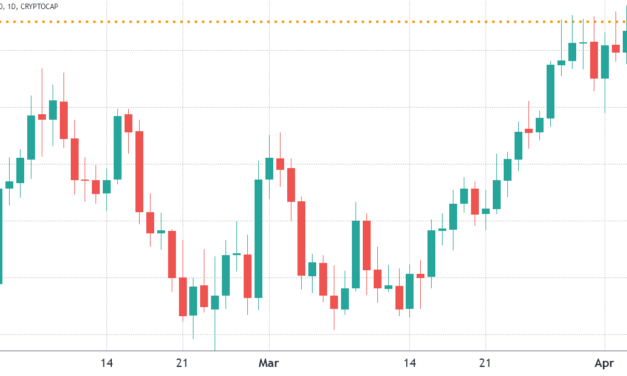
The total crypto market capitalization reached its highest close in three months on April 3 at $2.23 trillion, but the performance between March 28 and April 4 was a mere 1.9% gain. During this time, Bitcoin (BTC) presented a 2.6% negative performance, although that was more than offset by the gains from altcoins.Total crypto market cap, USD billion. Source: TradingViewWhile Ether (ETH) and Binance Coin (BNB) gained less than 3% over the past seven days, a handful of mid-capitalization altcoins managed to rally 20% or higher.On April 1, the Bitcoin network difficulty reached an all-time high at 28.587 trillion. The indicator correlates to the computational power required to mine BTC blocks, currently at an estimated hash rate of 201.8 exahash per second (EH/s). However, on the same day, the United States Securities and Exchange Commission officially disapproved the application for the ARK 21Shares Bitcoin exchange-traded fund (ETF). The regulator argued that the Cboe BZX Exchange had not met the requirements of listing a financial product under its rules of practice as well as those of the Exchange Act.Comparing the winners and losers provides skewed results because the top-3 coins had a slightly negative impact.Weekly winners and losers among the top 80 coins. Source: NomicsZilliqa (ZIL) rallied 56% after reports that it will launch a metaverse-as-a-service platform in April. According to a press release, Zilliqa’s Metapolis is being built using the 3D real-time Nvidia Omniverse. Nvidia is a $684 billion Nasdaq-listed graphic processing (GPU) producer.Aave (AAVE) gained 38% after the release of Aave v3, announced on March 16. The new features aimed to provide greater capital efficiency, increased security and cross-chain functionality. The non-custodial liquidity protocol allows users to lend, borrow or stake their assets to earn yield from their holdings.Synthetix (SNX) rallied 28% after its Debt Pool Synthesis deployment was scheduled for April 7. Currently, the decentralized finance protocol operates debt pools across two Ethereum chains: the mainnet and layer-2 scaling solution Optimism. By transitioning into an “Optimism-native protocol,” the application will merge its pools to maximize liquidity.Apecoin (APE) faced a natural correction after a 60% gain between March 21 and March 28, as the firm behind it raised $450 million in a funding round led by Andreessen Horowitz. Yuga Labs, the creator of the Bored Ape Yacht Club (BAYC), launched APE as a governance and utility token that allows its holders to oversee and manage the so-called ApeCoin DAO.The Tether premium shows slight discomfortThe OKX Tether (USDT) premium is a good gauge of China-based retail trader crypto demand. It measures the difference between China-based peer-to-peer trades and the United States dollar.Excessive buying demand tends to pressure the indicator above fair value at 100%, and during bearish markets, Tether’s market offer is flooded and causes a 4% or higher discount.Tether (USDT) peer-to-peer vs. USD/CNY. Source: OKXThe Tether reached 99.2% on April 2, its lowest level since January 26. While this is far away from retail panic selling, the indicator showed a modest deterioration over the past week.The lack of retail demand is not especially concerning even as the total cryptocurrency market capitalization surpassed $2 trillion and the indicator is down 19% since Dec. 2021.Futures markets show mixed sentimentPerpetual contracts are currently reflecting mixed sentiment. As shown below, the accumulated seven-day funding rate is slightly positive for Bitcoin, Ether, Solana and XRP. This data indicates higher demand from longs (buyers), but it is far from excessive. For example, Solana’s positive 0.20% weekly rate equals 0.8% per month, which should not be a concern for most futures traders.Accumulated perpetual futures funding rate on April 4. Source: CoinglassOn the other hand, Terra (LUNA) showed slightly more demand from shorts (sellers) and the absence of Tether demand in Asia signals a lack of confidence from traders. The total market capitalization rallied 26% in three weeks, from $1.67 trillion to $2.1 trillion on April 4. Yet, derivatives indicators show no sign of improvement, so there’s a lack of trust from investors. Until the sentiment improves, the odds of a negative price correction remains high.The views and opinions expressed here are solely those of the author and do not necessarily reflect the views of Cointelegraph. Every investment and trading move involves risk. You should conduct your own research when making a decision.

Čítaj viac
Here’s how pro traders use Bitcoin options to profit even during a sideways market

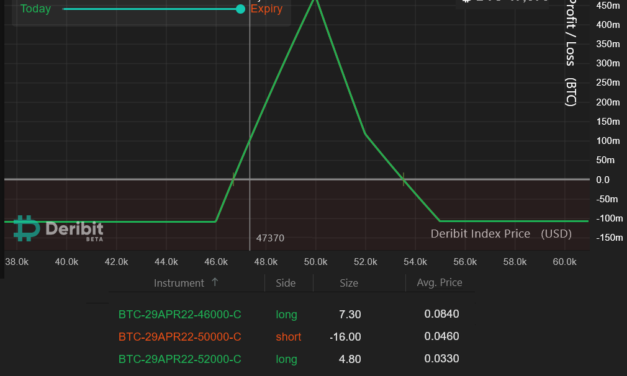
Bitcoin (BTC) price swings might be impossible to predict, but there is a strategy frequently used by pro traders that yields high returns with minimal cost.Typically, retail traders rely on leveraged futures positions which are highly susceptible to forced liquidations. However, trading Bitcoin options provide excellent opportunities for investors aiming to maximize gains while limiting their losses. Using multiple call (buy) options can create a strategy capable of returns six times higher than the potential loss. Moreover, these can be used in bullish and bearish circumstances, depending on the investors’ expectations.The regulatory uncertainty surrounding cryptocurrencies has long been a significant setback for investors and this is another reasons why neutral market strategies have drawn traders’ attention since Bitcoin’s rally stagnated near $47,000 on March 30.How to profit in a sideways marketThe long butterfly strategy allows a trader to profit even if Bitcoin’s price remains flat. However, it’s important to remember that options have a set expiry date. This means the desired price outcome must happen during a specified period.The Bitcoin options were set for the April 29 expiry, but this strategy can also be used on Ether (ETH) options or a different time frame. At the time of writing, Bitcoin was trading at $47,370 and although the costs will vary, their general efficiency should not be affected.Profit / Loss estimate. Source: Deribit Position BuilderThe suggested bullish strategy consists of buying 7.3 BTC call (buy) options with a $46,000 strike to benefit from a price increase. Meanwhile, selling 16 BTC call (buy) options at 50,000 creates a negative exposure above that level. The trader should buy 4.8 BTC worth of $52,000 call options and 3.9 BTC at $55,000, balancing out the risk above this price.The gains can be four times higher than the potential lossAs the estimate above shows, any outcome between $46,700 (down 1.5%) and $53,500 (up 12.9%) yields a net gain. The best possible outcome happens at $50,000 and results in a 0.47 BTC net gain. Meanwhile, this strategy’s maximum loss is 0.11 BTC if the price on April 29 trades below $46,000 or above $55,000.The allure of this butterfly strategy is the trader can secure gains that are 6 times larger than the maximum loss. Overall it yields a much better risk-reward versus leveraged futures trading, considering the limited downside.This options strategy trade provides upside even if Bitcoin’s price remains flat and the only upfront fee required is 0.11 BTC, which also reflects the maximum loss.The views and opinions expressed here are solely those of the author and do not necessarily reflect the views of Cointelegraph. Every investment and trading move involves risk. You should conduct your own research when making a decision.

Čítaj viac
AVAX traders anticipate a new ATH even as Avalanche DApp use slows

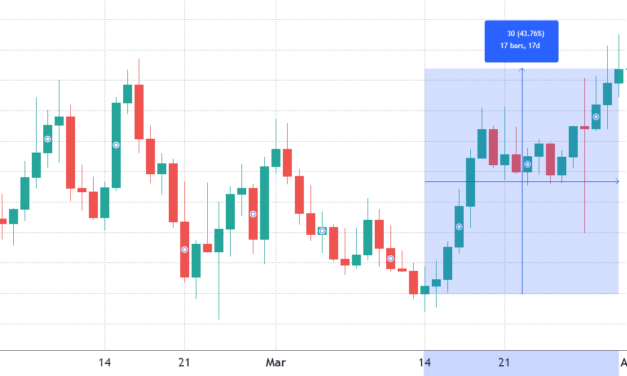
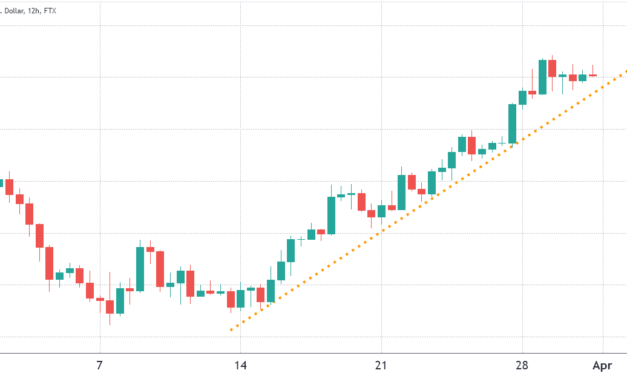
Avalanche (AVAX) jumped 43.8% between March 14 and March 31 to a $97.50 daily close, which is the highest level since Jan. 5. This layer-1 scaling solution uses a proof-of-stake model and has amassed $9 billion in total value locked (TVL) deposited on the network’s smart contracts.AVAX token/USD at FTX. Source: TradingViewSubnet adoption propels the recent price rallySome analysts attribute the rally to Avalanche’s incentive program to accelerate the adoption of subnets which was announced on March 9. According to the Avalanche Foundation, subnets enable functions that are only possible with “network-level control and open experimentation.”The program will allocate up to four million AVAX, worth roughly $340 million, to fund decentralized applications focused on gaming, non-fungible tokens (NFTs) and financial applications (DeFi).Wes Cowan, managing director of DeFi at Valkyrie Investments, added that “Avalanche’s subnet with KYC infrastructure, will be a massive step forward for institutional adoption.”Even with the good news, AVAX price is still 33% below its $147 all-time high and the token holds a $26.3 billion market capitalization. As a comparison, the market cap of Terra (LUNA) stands at $38.1 billion, and Solana (SOL) has a $43.8 billion total value.Avalanche is also Ethereum Virtual Machine (EVM) compatible and it is not plagued by the $15 average transaction fees and network congestion that impact the Ethereum network.Related: Traders predict $3,800 Ethereum, but multiple data points suggest otherwiseThe use of Avalanche’s smart contracts is in declineAvalanche’s primary DApp metric started to display weakness in March after the network‘s TVL dropped below 94 million AVAX.Avalanche Total Value Locked, AVAX. Source: DefiLlamaThe chart above shows how Avalanche‘s DApp deposits peaked at 132.9 million AVAX on March 14, but drastically declined to the lowest level since Jan. 3. In dollar terms, the current $9 billion TVL is 24% below its $12.2 billion all-time high in December 2021.Meanwhile, Terra’s TVL increased by 116% between January and March 2022, reaching $19.8 billion. Similarly, Waves’ smart contract deposits increased from $730 million to $4.5 billion in the same period.To confirm whether the TVL drop in Avalanche is troublesome, one should analyze DApp usage metrics. Some DApps, such as games and collectibles, do not require large deposits so the TVL metric is irrelevant in those cases.Avalanche DApps 30-day data. Source: DappRadarAs shown by DappRadar, on April 1 the number of Avalanche network addresses interacting with decentralized applications declined by 16% versus the previous month. In comparison, the Solana network faced a 6% user increase, while Ethereum declined by 11%.Even though Avalanche’s TVL has been hit the hardest compared to similar smart contract platforms, there is solid network use in the decentralized finance (DeFi) segment. The above data suggest that Avalanche is losing ground versus competing chains. Given that AVAX rallied 43.8% in 17 days, some holders might feel uncomfortable if the decentralized application network continues to post weak TVL and DApp usage data.The views and opinions expressed here are solely those of the author and do not necessarily reflect the views of Cointelegraph. Every investment and trading move involves risk. You should conduct your own research when making a decision.

Čítaj viac
Traders predict $3,800 Ethereum, but multiple data points suggest otherwise

Investors tend not to complain about a price rally, except when the chart presents steep downside risks. For example, analyzing Ether’s (ETH) current price chart could lead one to conclude that the ascending channel since March 15 is too aggressive.Ether price at FTX, in USD. Source: TradingViewThus, it is only natural for traders to fear that losing the $3,340 support could lead to a retest of the $3,100 level or a 12% correction down to $3,000. Of course, this largely depends on how traders are positioned along with the Ethereum network’s on-chain metrics.For starters, the Ethereum network’s total value locked (TVL) peaked at ETH 32.8 million on Jan. 23 and has since gone down by 20%. TVL measures the number of coins deposited on smart contracts, including decentralized finance (DeFi), gaming, NFT marketplaces, social networks, collectibles and high risk.Moreover, the Ethereum network’s average transaction fee bottomed at $8 on March 16 but has recently increased to $15. Thus, one must evaluate if that reflects a lesser use of decentralized applications (DApps) or users benefiting from layer-2 scaling solutions.Ether’s futures premium shows little excitementTraders should analyze Ether futures market data to understand how professional traders are positioned. The quarterly contracts are whales and market makers’ preferred instruments because they avoid the fluctuating funding rate of the perpetual futures.The basis indicator measures the difference between longer-term futures contracts and the current spot market levels. The Ether futures annualized premium should run between 5% to 12% to compensate traders for “locking in” the money for two to three months until the contract expiry. Ether 3-month futures annualized premium. Source: Laevitas.chThe current 6% Ether futures basis sits slightly above the minimum threshold for a neutral market. An annualized futures premium below 5% is deemed bearish, while numbers above 12% indicate bullishness.This data tells us that pro traders are far from excited but in the past couple of months, there was a 4% or lower basis rate, which reflected bearish sentiment. Thus, there has been an improvement, but not enough to cause an excessive demand from buyers.To exclude externalities that might have influenced derivatives data, one should analyze the Ethereum network’s on-chain data. For example, monitoring the network use tells us whether actual use cases support the demand for Ether.On-chain metrics raise concernsMeasuring the number of active addresses on the network provides a quick and reliable indicator of effective use. Of course, this metric could be misguided by the increasing adoption of layer-2 solutions, but it works as a starting point.7-day average of active addresses on Ethereum. Source: CoinMetricsThe current 593,260 daily active addresses average is a 2% increase from 30 days ago, but it’s nowhere near the 857,520 seen in May 2021. Data shows that Ether token transactions are not showing signs of growth, at least on the primary layer.Traders should proceed to DApp usage metrics but avoid exclusive focus on the TVL because that metric is heavily concentrated on lending platforms and decentralized exchanges (DEX), so gauging the number of active addresses provides a broader view.Ethereum network 30-day DApps activity. Source: DappRadarEthereum DApps saw an average monthly 11% decrease in active addresses. Overall, the data is disappointing because the smart contract network was specifically designed to host decentralized applications. As a comparison, the DApps on the Polygon network gained 12% while Solana (SOL) saw a 6% user increase. Unless there is decent growth in Ether transactions and DApp usage, the $3,340 daily close support will probably unwind.The views and opinions expressed here are solely those of the author and do not necessarily reflect the views of Cointelegraph. Every investment and trading move involves risk. You should conduct your own research when making a decision.

Čítaj viac

Bitcoin derivatives metrics favor a move to $48K, but only after a lower support retest

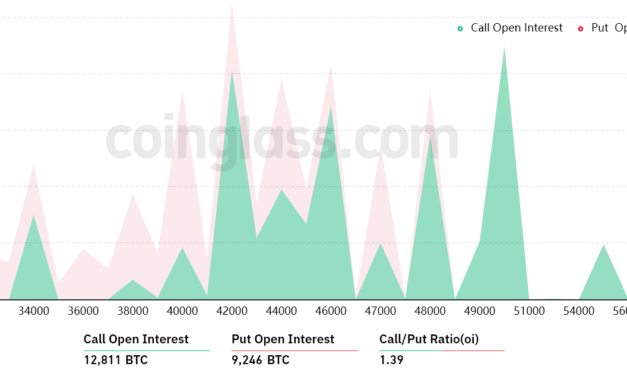
Bitcoin (BTC) saw an 11% gain in the past week after the $46,000 resistance finally broke after 82 days. Many crypto pundits argue that Terraform Labs CEO Do Kwon has played an important role in the price change, but is yet to be determined.A Bitcoin address thought to belong to Terra has now amassed almost $1.5 billion in BTC following a $139 million purchase on March 29. TerraUSD (UST), an algorithmic stablecoin, aims to acquire up to $10 billion worth of BTC to back its “dollar” reserve.On the macroeconomic side, there have been mixed feelings. The United Kingdom’s Consumer Price Index increased by 6.2% year-on-year, which is above the 5.9% consensus. However, in the United States, the opposite effect occurred as durable goods orders showed a 2.2% decrease.The current reading is the highest U.S. inflation in 40 years and interest rates near zero provide a bullish environment for scarce assets, including Bitcoin. Bitcoin is discounted compared to hard assetsConsidering that the S&P 500 is only 4% below its 4,819 all-time high, Bitcoin’s recent strength should not come as a surprise. Bulls came in stronger after the call (buy) option instruments dominated the April 1 options expiry, and bears were caught off guard after Bitcoin price stabilized above $47,000 on March 30.Bitcoin options aggregate open interest for April 1. Source: CoinGlassA broader view using the call-to-put ratio shows a 39% advantage to Bitcoin bulls because the $605 million call (buy) instruments have a larger open interest versus the $435 million put (sell) options. However, the 1.39 call-to-put indicator is deceptive because most bearish bets will become worthless.For example, if Bitcoin’s price remains above $47,000 at 8:00 am UTC on April 1, only $80 million worth of those put (sell) options will be available. That effect happens because there is no value in the right to sell Bitcoin at $45,000 if it’s trading above that level.Bitcoin bulls aim for a $385 million profitBelow are the three most likely scenarios based on the current price action. The number of options contracts available on April 1 for bulls (call) and bear (put) instruments varies depending on the expiry price. The imbalance favoring each side constitutes the theoretical profit:Between $44,000 and $46,000: 3,000 calls vs. 2,650 puts. The net result is $120 million favoring the call (bull) instruments.Between $46,000 and $48,000: 7,900 calls vs. 1,700 puts. The net result favors bulls by $290 million.Between $48,000 and $49,000: 9,350 calls vs. 1,300 puts. The net result favors the call (bull) instruments by $385 million.This crude estimate considers the call options used in bullish bets and the put options exclusively in neutral-to-bearish trades. Even so, this oversimplification disregards more complex investment strategies.For instance, a trader could have sold a call option, effectively gaining a negative exposure to Bitcoin above a specific price. Unfortunately, there’s no easy way to estimate this effect.Bitcoin bulls need a small pump above $48,000 to score a $385 million profit on April 1. On the other hand, the best-case scenario requires a 3% price drop from the current $47,200 to reduce their loss to $120 million.Bitcoin bears had $580 million in short positions liquidated between March 26 and March 30, according to data from Coinglass. Therefore, bulls should continue to display strength by keeping Bitcoin price above $47,000 heading into April 1’s options expiry.The views and opinions expressed here are solely those of the author and do not necessarily reflect the views of Cointelegraph. Every investment and trading move involves risk. You should conduct your own research when making a decision.

Čítaj viac

Získaj BONUS 8 € v Bitcoinoch

nakup bitcoin z karty

Registrácia Binance

Burza Binance

Aktuálne kurzy