
Autor Cointelegraph By Marcel Pechman

Bitcoin bears tighten their grip on BTC now that $40K is the new resistance level

Bitcoin (BTC) remains below $40,000 for the third consecutive day and the most likely source of the volatility is the worsening condition of traditional markets. For instance, the S&P 500 is down 5% since April 20 WTI crude price dropped 9.5% in seven days, erasing all of the gains accrued since March 1.Meanwhile, China has been struggling to contain its worst outbreak of Covid-19 despite strict lockdowns in Shanghai and according to Timothy Moe, chief Asia-Pacific equity strategist at Goldman Sachs, “it’s no surprise, and it makes all sorts of logical sense that the market should be concerned about the Covid situation because that clearly is impacting economic activity.”Investors were driven away from risky assetsAs the global macroeconomic scenario deteriorated, investors took profits on riskier assets, causing the U.S. Dollar Index (DXY) to reach its highest level in 25 months at 101.8.The cryptocurrency mining business also faced regulatory uncertainties after the United States House of Representatives member Jared Huffman and 22 other lawmakers requested the Environmental Protection Agency to assess whether crypto mining firms were potentially violating environmental statutes on April 21.Despite Bitcoin’s 4-day price 10% correction to $38,200 on April 25, most holders choose to stay hands-off, as confirmed by on-chain data from Glassnode. The proportion of the supply dormant for at least 12-months is now at all-time highs at 64%. Thus, it is worth exploring whether the recent price rejection impacted the mood of derivatives traders.Derivatives markets show bearish Bitcoin tradersTo understand whether the market has flipped bearish, traders must look at the Bitcoin futures’ premium (basis). Unlike a perpetual contract, these fixed-calendar futures do not have a funding rate, so their price will differ vastly from regular spot exchanges.A trader can gauge the market’s bullishness level by measuring the expense gap between futures and the regular spot market.Bitcoin 3-month futures basis rate. Source: Laevitas.chFutures should trade at a 5% to 12% annualized premium in healthy markets. Yet, as displayed above, Bitcoin’s basis moved below such a threshold on April 6 and is currently at 2%. This means futures markets have been pricing in bearish momentum for the past couple of weeks.To exclude externalities specific to the futures instrument, traders should also analyze the options markets. For example, the 25% delta skew compares similar call (buy) and put (sell) options. This metric will turn positive when fear prevails because the protective put options premium is higher than similar risk call options. Meanwhile, the opposite holds when greed emerges, causing the 25% delta skew indicator to shift to the negative area.Bitcoin 30-day options 25% delta skew. Source: Laevitas.chIf option investors feared a price crash, the skew indicator would move above 8%. On the other hand, generalized excitement reflects a negative 8% skew. The metric shifted bearish on April 7 and has since kept above the threshold level.Related: Bitcoin sets up lowest weekly close since early March as 4th red candle loomsTraders will resist eventual price pumpsAccording to derivatives indicators, it is safe to say that Bitcoin pro traders became more uncomfortable as Bitcoin tested the $39,000 support. Of course, none of the data can predict whether Bitcoin will continue to downtrend, but considering the current data, traders are overcharging for downside protection. Consequently, any surprise price recovery will be questioned.The views and opinions expressed here are solely those of the author and do not necessarily reflect the views of Cointelegraph. Every investment and trading move involves risk. You should conduct your own research when making a decision.

Čítaj viac
Here's how Ether options traders could prepare for the proof-of-stake migration

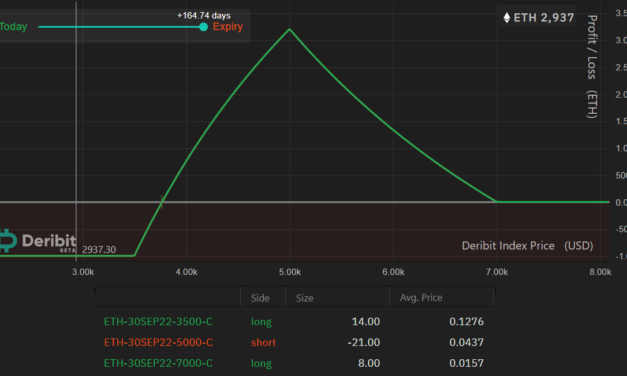
Ethereum’s long-awaited transition away from proof-of-work (PoW) mining has recently suffered another delay and is expected to occur in the second half of 2022.Ethereum developer Tim Beiko stated on April 13 that “it won’t be June, but likely in the few months after. No firm date yet, but we’re definitely in the final chapter of PoW on Ethereum.”An automated increase in mining difficulty designed to make PoW mining less attractive is set to become active around May. Known as the “difficulty bomb,” it will eventually make blocks “unbearably slow,” forcing the upgrade to a proof-of-stake (PoS) network.Such news might have negatively impacted Ether’s (ETH) price, but it creates an immense opportunity for those betting on the efficiencies and potential gains of faster and cheaper transactions.Even though one could use futures contracts to leverage their long positions, they risk being liquidated if a sudden negative price move occurs ahead of the network upgrade. Consequently, pro traders will likely opt for an options trading strategy like the “long butterfly.”By trading multiple call (buy) options for the same expiry date, one can achieve gains 3.2 times higher than the potential loss. An options strategy allows a trader to profit from the upside while limiting losses.It is important to remember that all options have a set expiry date, and as a result, the asset’s price appreciation must happen during the defined period.Using call options to limit the downsideBelow are the expected returns using Ether options for the Sept. 22 expiry, but this methodology can also be applied using different time frames. While the costs will vary, the general efficiency will not be affected.Profit / Loss estimate. Source: Deribit Position BuilderThis call option gives the buyer the right to acquire an asset, but the contract seller receives (potential) negative exposure. The “long butterfly” strategy requires a short position using the $5,000 call option.To initiate the execution, the investor buys 14 Ether call options with a $3,500 strike while simultaneously selling 21 contracts of the $5,000 call. To finalize the trade, one would buy 8 ETH contracts of the $7,000 call options to avoid losses above such a level.Derivatives exchanges price contracts in ETH and $2,937 was the price when this strategy was quoted.Trade ensures limited downside with a possible 3.2 ETH gainUsing this strategy, any outcome between $3,770 (up 28%) and $7,000 (up 139%) yields a net profit — for example, a 40% price increase to $4,112 results in a 1.1 ETH gain.Meanwhile, the maximum loss is 0.99 ETH if the price is below $3,500 on Sept. 22. Thus, the “long butterfly” is a potential gain of 3.2 times larger than the maximum loss.Related: Altcoin Roundup: Analysts give their take on the impact of the Ethereum Merge delayOverall, the trade yields a better risk-to-reward outcome than leveraged futures trading, especially when considering the limited downside. It certainly looks like an attractive bet for those expecting the PoW migration sometime over the next five months. It is worth highlighting that the only upfront fee required is 0.99 ETH, which is enough to cover the maximum loss.The views and opinions expressed here are solely those of the author and do not necessarily reflect the views of Cointelegraph. Every investment and trading move involves risk. You should conduct your own research when making a decision.

Čítaj viac
Is Bitcoin 'cheap' below $40,000? BTC derivative metrics are mixed

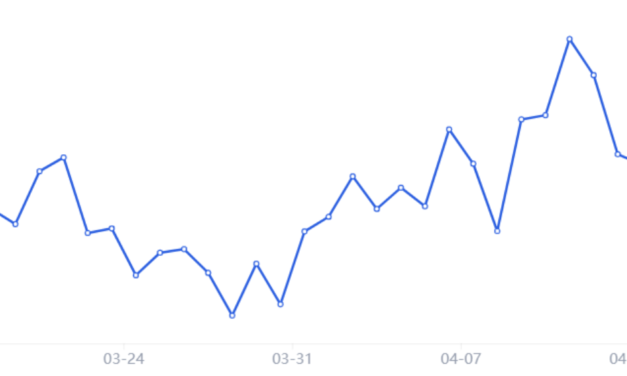
Bitcoin (BTC) dipped below $40,000 support on April 18, and the two-week 15% correction was enough to prompt predictions of $30,000 prices in the near term. Meanwhile, regulatory uncertainties continue to be a key concern for investors, including the failed European Know Your Customer (KYC) and Anti-Money Laundering (AML) proposed rules for ”unhosted” private wallets. For instance, exchanges started to demand additional information on their users just last week, causing some discomfort to traders.Europe regulation “near miss” brings distressThe European Union Parliament’s Committee on Economic and Monetary Affairs voted on March 14 to ban or restrict proof-of-work-based crypto assets, but the proposed amendment was postponed.More recently, in an email notification to users on April 13, the Bitstamp cryptocurrency exchange informed its customers about the ongoing policy upgrades on the platform, with the exchange seeking additional info. Bitstamp now requires users to provide information like nationality, place of birth and tax residency, in addition to documents proving annual income and the origin of their crypto.On April 14, the Nonprofit group Coin Center called the Securities and Exchange Commission’s (SEC) March 18 Amendments Regarding the Definition of “Exchange” an “unconstitutional overreach.” If the proposal becomes an SEC rule, decentralized platforms would likely be urged to register as exchanges.Not everything has been negative for the sector, however, as more crypto-friendly names are about to join the United States government. On April 15, U.S. President Joe Biden announced his intention to nominate law professor Michael Barr as the central bank’s vice chair for supervision. Barr was on the advisory board of Ripple Labs from 2015 to 2017 before serving as the Treasury Department’s assistant secretary for financial institutions under former President Barack Obama.But to get a clearer picture of how traders are positioned, there’s no better tool than analyzing Bitcoin derivatives’ metrics. Margin traders are increasingly bullishMargin trading allows investors to borrow cryptocurrency and leverage their trading position, thus potentially increasing returns. For example, one can buy cryptocurrencies by borrowing Tether (USDT) to enlarge exposure.On the other hand, Bitcoin borrowers can only short the cryptocurrency as they bet on its price decline. Unlike futures contracts, the balance between margin longs and shorts isn‘t always matched.OKEx USDT/BTC margin lending ratio. Source: OKExThe above chart shows that traders have been borrowing more USD Tether recently, as the ratio increased from 13 on April 14 to the current 17. The higher the indicator, the more confident professional traders are with Bitcoin’s price.It is worth noting that the 20 margin lending ratio reached on April 11 was the highest level in six months, indicating bullishness.Bitcoin options show fear sentiment is prevailingHowever, it became difficult to anticipate the market’s next move since Bitcoin started to drift sideways near $40,000 last week. Still, the 25% delta skew is a telling sign whenever arbitrage desks and market makers overcharge for upside or downside protection. The 25% delta skew compares similar call (buy) and put (sell) options. The metric will turn positive when fear is prevalent because the protective put options premium is higher than similar risk call options.Bitcoin 30-day options show 25% delta skew: Source: Laevitas.chIf traders fear a Bitcoin price crash, the skew indicator will move above 8%. On the other hand, generalized excitement reflects a negative 8% skew.As displayed above, we entered the 8% “fear” mode on April 8 after 30 days ranging in a neutral area. Bitcoin had already dropped below $43,000 when the 25% delta skew indicator shifted to bearish sentiment.Despite the negative indicator from Bitcoin options, margin trading data suggests that these arbitrage desks and market makers seem confident that the sub-$40,000 dip will reverse. The OKX margin lending rate showed pro traders increased their bullish bets after a 15% BTC price rally in 14 days, which should be comforting for those currently underwater. Regardless, there is no reason to ignore the bearish put options trading at a premium. It signals that the odds of a price crash are still substantial. Consequently, sometimes the best trade is to do nothing, sit tight and wait for more clarity in price action.The views and opinions expressed here are solely those of the author and do not necessarily reflect the views of Cointelegraph. Every investment and trading move involves risk. You should conduct your own research when making a decision.

Čítaj viac
Bitcoin bulls need to reclaim $41K ahead of Friday’s $615M BTC options expiry

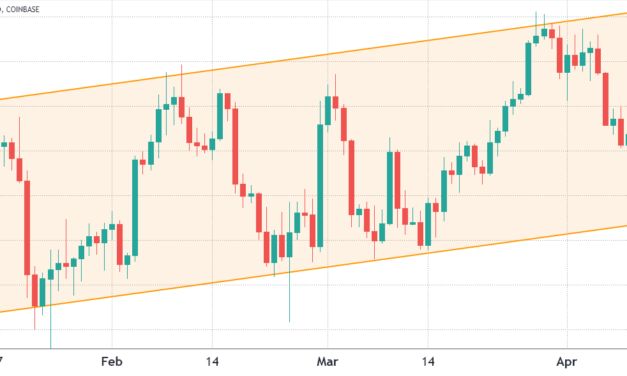
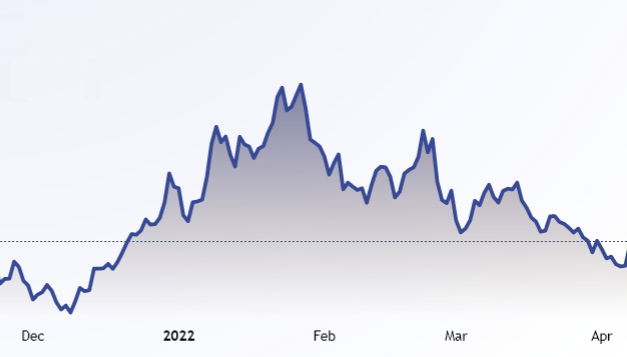
Over the past three months, Bitcoin’s (BTC) daily closing price fluctuated between $35,050 and $47,550, which is a 35.7% range. Although it might seem excessive, this is not unusual, especially considering BTC’s 68% historical annualized volatility. Bitcoin/USD 1-day chart at Coinbase. Source: TradingViewThe relief rally that came after the April 11 dip below $40,000 followed the U.S. Consumer Price Index (CPI) report that announced 8.5% for March, the highest since 1981. Meanwhile, in the United Kingdom, the CPI jumped to 7%, a 30-year high.For these reasons, cryptocurrency traders are increasingly concerned about the ability of the U.S. Federal Reserve rate hikes expected throughout 2022 to contain inflationary pressure. If the global economies enter a recession, investors will likely move away from risk-on asset classes like cryptocurrencies.Moreover, the Bitcoin price correction was costly to leverage traders because the aggregate liquidations reached $428 million at derivatives exchanges.Bulls placed their bets at $50,000 and aboveThe open interest for the April 15 options expiry in Bitcoin is $615 million, but the actual figure will be much lower since bulls were overly-optimistic. These traders might have been fooled by the short-lived pump to $48,000 on March 28 because their bets for Friday’s options expiry extend beyond $50,000.Bitcoin’s recent downturn below $41,000 took bulls by surprise and only 18% of the call (buy) options for April 15 have been placed below that price level.Bitcoin options aggregate open interest for April 15. Source: CoinGlassThe 1.21 call-to-put ratio shows the dominance of the $335 million call (buy) open interest against the $280 million put (sell) options. Nevertheless, as Bitcoin stands near $41,000, most bullish bets are likely to become worthless.If Bitcoin’s price remains below $42,000 at 8:00 am UTC on April 15, only $62 million worth of these call options will be available. This difference happens because a right to buy Bitcoin at $42,000 is worthless if BTC trades below that level on expiry.Bulls aim for $43,000 to balance the scalesBelow are the four most likely scenarios based on the current price action. The number of options contracts available on April 15 for call (bull) and put (bear) instruments varies, depending on the expiry price. The imbalance favoring each side constitutes the theoretical profit:Between $39,000 and $41,000: 950 calls vs. 5,400 puts. The net result favors the put (bear) instruments by $180 million.Between $41,000 and $42,000: 1,500 calls vs. 3,950 puts. The net result favors bears by $100 million.Between $42,000 and $43,000: 1,850 calls vs. 3,300 puts. The net result favors the put (bear) instruments by $60 million.Between $43,000 and $45,000: 2,700 calls vs. 2,800 puts. The net result is balanced between call (buy) and put (sell) options.This crude estimate considers the put options used in bearish bets and the call options exclusively in neutral-to-bullish trades. Even so, this oversimplification disregards more complex investment strategies.For example, a trader could have sold a put option, effectively gaining positive exposure to Bitcoin above a specific price, but unfortunately, there’s no easy way to estimate this effect.Related: Mark Yusko explains the real problem with Fed policy — and why Bitcoin matters.Bears will try to pin BTC below $41,000Bitcoin bears need to pressure the price below $41,000 on April 15 to secure a $180 million profit. On the other hand, the bulls’ best case scenario requires a push above $43,000 to neutralize any impact.Bitcoin bulls had $180 million leverage long positions liquidated on April 10 and April 11, so they should have less margin required to drive the price higher. With this said, bears will undoubtedly try to suppress BTC below $41,000 ahead of the April 15 options expiry.The views and opinions expressed here are solely those of the author and do not necessarily reflect the views of Cointelegraph. Every investment and trading move involves risk. You should conduct your own research when making a decision.

Čítaj viac

Ethereum derivatives data shows pro traders are bearish, but for how long?

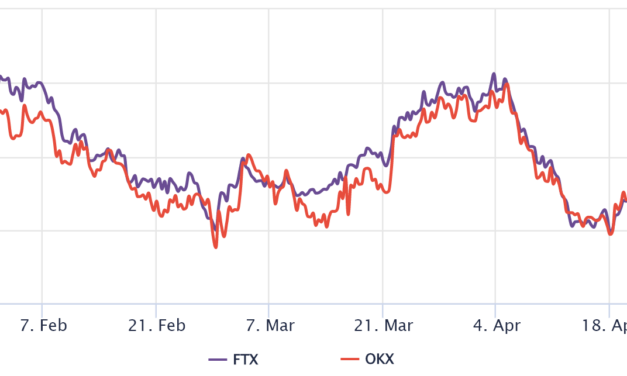
Ether (ETH) lost the critical $3,000 psychological support level on April 11 after a 16% weekly negative performance. Bulls were definitively caught by surprise as $104 million in leveraged long futures got liquidated on April 11. Ether’s downturn also followed a decline in the total value locked (TVL) in Ethereum smart contracts. Ethereum network TVL in ETH. Source: Defi LlamaThe metric peaked at 40.6 million Ether on Jan. 27, and has since dropped by 22%. This indicator could partially explain why Ether could not withstand the adversity brought by Bitcoin’s (BTC) 13% weekly negative move. However, the leading altcoin has catalysts of its own because Ethereum developers implemented the network’s first-ever “shadow fork” on April 11. The testnet update created an area for developers to stress-test their assumptions around the network’s complex shift to proof-of-stake. More importantly, one needs to analyze how professional traders are positioning themselves and there’s no better gauge than derivatives markets.The futures premium is back to bearish levelsTo understand whether the current bearish trend reflects top traders’ sentiment, one should analyze Ether’s futures contracts premium, also known as a “basis.” Unlike a perpetual contract, these fixed-calendar futures do not have a funding rate, so their price will differ vastly from regular spot exchanges.A trader can gauge the market sentiment by measuring the expense gap between futures and the regular spot market. A neutral market should present a 5% to 12% annualized premium (basis) as sellers request more money to withhold settlement longer.Ether 3-month futures premium. Source: laevitas.chThe above chart shows that Ether’s futures premium stood above the 5% neutral threshold between March 25 and April 6, but later weakened to 3%. This level is typically associated with fear or pessimism because futures market traders are reluctant to open leveraged long (buy) positions.Long-to-short data confirms worsening conditionsThe top traders’ long-to-short net ratio excludes externalities that might have impacted the longer-term futures instruments. By analyzing these whale positions on the spot, perpetual and futures contracts, one can better understand whether professionals effectively become bearish.Exchanges’ top traders Ether long-to-short ratio. Source: CoinglassFirstly, one should note the methodological discrepancies between different exchanges, so the absolute figures have lesser importance. Yet, since April 5, there has been a considerable decline in the long-to-short ratio of every major derivatives exchange.Data signals that whales have been increasing their bearish bets over the past week. For instance, the Binance whales held a 1.05 long-to-short ratio on April 5, but gradually reduced it to 0.88. Furthermore, the OKX top traders moved from a 2.11 favoring longs to the current 1.35. Related: Kava turns bullish as Ethereum Co-Chain launch initiates push toward EVM compatibilityAre investors and users abandoning the network?From the perspective of the metrics discussed above, there might not be an indicator pointing to extreme bearishness but the futures basis rate and the top traders’ long-to-short ratio worsened over the past week.Furthermore, the TVL in Ethereum smart contracts signals a decline in use. The constant delays in the proof-of-stake migration could be pulling investors’ attention away and driving decentralized finance (DeFi), gaming, and nonfungible (NFT) projects to competing networks. In turn, traders have been focusing their attention on more promising altcoins and consequently diminishing the demand for Ether.The views and opinions expressed here are solely those of the author and do not necessarily reflect the views of Cointelegraph. Every investment and trading move involves risk. You should conduct your own research when making a decision.

Čítaj viac

Získaj BONUS 8 € v Bitcoinoch

nakup bitcoin z karty

Registrácia Binance

Burza Binance

Aktuálne kurzy