Autor Cointelegraph By Marcel Deer

What is a gold-backed token and how does it work?

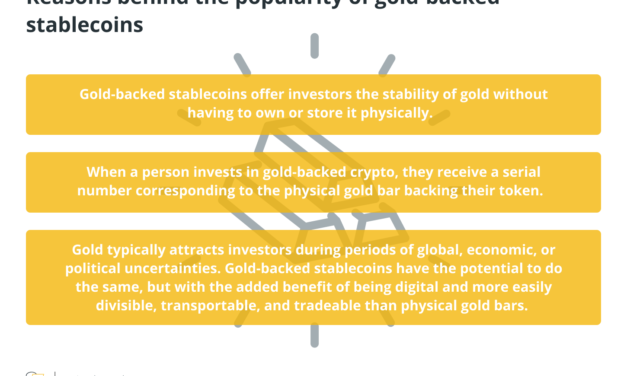
What is a gold-backed cryptocurrency?A gold-backed cryptocurrency is a type of digital currency that is backed by physical gold. The currency’s value is based on the current market price of gold and can be used for transactions just like any other type of cryptocurrency.Some cryptocurrencies are backed by gold in order to tie the derivative asset (crypto) to a tangible asset (gold), thereby preventing excessive fluctuations in price. Thus, gold-backed cryptocurrency is often more stable than other digital currencies. This is because the price of gold is generally less volatile than the prices of other assets, such as stocks or cryptocurrencies.Gold-backed cryptocurrency can also be used as a hedge against inflation. If the price of gold rises, the value of the currency will also increase. This could protect investors from losing money if the price of other assets, such as stocks, were to fall.Gold-backed cryptocurrencies can be bought and sold on exchanges just like any other type of cryptocurrency and can also be used to purchase goods and services online. People who invest in gold-backed cryptocurrencies enjoy increased returns from the pricing of gold and can redeem tokens in exchange for gold.How does a gold-backed token work?The physical gold used to back a certain cryptocurrency is held in gold reserves. These reserves are held by custodians, typically banks or third-party institutions. As for the specific backing ratio, it can vary depending on the cryptocurrency. For example, some are backed 1:1 (1 token to 1 gram of gold) with physical gold, while others may be backed by a fraction of an ounce.The main advantage of investing in a gold-backed cryptocurrency is that it provides stability and security. Gold has been used as a form of currency for centuries, and its value has generally remained steady over time. As such, the value of gold-backed crypto will not fall below the value of gold, making it a relatively stable investment option. Plus, these cryptocurrencies’ values can (and sometimes do) rise higher than the value of gold.Most gold-backed tokens are ERC-20 standard tokens, built on the Ethereum blockchain. This means they can be stored in any wallet that supports ERC-20 tokens. These tokens can also be traded like mainstream cryptocurrencies using crypto exchanges.Are there any gold-backed stablecoins?Yes, there are gold-backed stablecoins. Technically, gold-backed cryptocurrencies are a stablecoin “variant,” given that stablecoins are cryptocurrencies backed by assets that exist in the real world.Examples of real-world assets that back stablecoins are government-issued fiat money, commodities and gold. Stablecoins are named as such because their value is pegged or tethered to that of an underlying, more stable asset. So, for example, a United States dollar-backed stablecoin’s price would rise and fall along with the price of the U.S. dollar.Some of the most well-known stablecoins are the USD Coin (USDC) and Tether (USDT), both pegged to the USD. Gold-backed stablecoins are preferred because:Tether gold (XAUT) is a gold-backed stablecoin and is the same Tether token behind USDT. Launched in 2020, Tether gold is currently the largest gold-backed stablecoin in the market. XAUT represents one troy ounce of gold on a London Good Delivery bar. The gold is held in a company-controlled Swiss vault.On top of gold, Tether gold also grants access to traditional financial assets like exchange-traded funds (ETFs). Token holders can check the amount of gold they own on Tether’s look-up website, which provides information on the gold bars these token holders own.The Tether gold token can be held on an Ethereum-based wallet as an ERC-20 token, as well as on the TRON blockchain as a TRC-20 token. The minimum purchase for Tether gold is 50 XAUT or 50 troy ounces of gold.Who issues gold-backed tokens?For a cryptocurrency to be gold-backed, it must be issued or created by a company that owns and stores physical gold in vaults. For example, DigixGlobal, a Singapore-based company, is behind the popular Ethereum token, DigixGlobal (DGX).DigixGlobal makes investing in gold more accessible by offering fractional tokens. As such, investors can accumulate gold in small amounts and manage their holdings in real time, as well as participate in exchange-traded funds. The physical gold backing DGX tokens are held in Singapore at the Safe House Singapore vault and in another vault in Canada.One DGX equals one gram of gold, with a minimum purchase amount of $0.50 for gold-backed tokens, $50 to $600,000 for gold bars, and $150 for ETFs. The cryptocurrency is backed by 100-gram Swiss gold bars from refineries such as Metalor, Valcambi and Produits Artistiques Metaux Precieux.Another example of a gold-backed cryptocurrency is Paxos Gold (PAXG), offered by the New York-based firm Paxos Trust Company. Each PAXG is backed by one fine troy ounce of London Good Delivery gold, stored in Brink’s vaults in London.The token is an ERC-20 token, and can be traded, stored and transferred much like any other Ethereum-based token. Paxos requires a minimum purchase of $20 for PAXG tokens and does not have any maximum limit.What are some of the benefits of investing in gold-backed tokens?The major advantage of investing in gold-backed tokens is that, unlike physical gold, they are digital and can be divided into smaller parts, making them readily transportable, easily transferable and relatively more affordable.Another key benefit is that since gold-backed tokens are pegged to the price of gold, they will maintain their value even when other cryptocurrencies are crashing. This makes them a good investment during volatile periods in the cryptocurrency market.Lastly, some gold-backed tokens also offer additional features and benefits, such as access to traditional financial assets like ETFs. Crypto ETFs track the price of digital tokens and are traded daily, allowing investors to further diversify their portfolios. Are there any drawbacks to investing in gold-backed tokens?One of the main risks associated with gold-backed tokens is that they are still a relatively new concept. As such, there is no guarantee that these tokens will maintain their value or that the companies backing them will be able to meet their obligations.Another risk to consider is that, since gold-backed tokens are pegged to the price of gold, they will go down in value if gold prices crash. Although such a phenomenon can be considered rare, it is still a possibility that investors should be aware of.Furthermore, certain gold-backed cryptocurrencies have trouble with low liquidity. This can be attributed to a limited investor base due to a lack of trading on crypto exchanges, making it difficult to buy or sell these tokens when one wants to.Finally, accounting for the actual gold may not be as transparent and clear-cut as accounting for digital currencies, which blockchain technology inherently protects. As such, ascertaining whether or not the physical gold exists and if its storage is secure can be a matter of trust for some investors.Purchase a licence for this article. Powered by SharpShark.

Čítaj viac


What is CeDeFi, and why does it matter?

Among the advantages of CeDeFi are lower fees, better security, accessibility, speed and lower cost. CeDeFi’s innovative approach to decentralized banking enables users to trade CeDeFi crypto assets without requiring a centralized exchange. This implies that users may transact directly with one another, removing the need for an intermediary. Among CeDeFi’s major advantages is lower fees. CeDeFi transactions cost lower than those on comparable platforms since there are fewer middlemen involved, especially on networks that are not Ethereum-based.  Ethereum has very high gas fees, for instance, with DEX transactions running into hundreds of dollars. It also often causes network congestion issues, leading to delays. Binance CeDeFi, on the other hand, has much lower fees and accelerates transactions by allowing users to accept fees in a few seconds. Another notable advantage is improved security. Hackers will find it far harder to break into the CeDeFi network than they will with traditional banking systems because of the network’s decentralized structure. In addition, CeDeFi is incredibly accessible as anyone who has an Ethereum wallet can make use of the CeDeFi protocols. It lowers entry barriers for less experienced users and enables them to explore more about DeFi by presenting verified trade options vetted by multiple criteria, including KYC, fees and more. Financial transactions conducted through CeDeFi can also be handled considerably faster than those performed through traditional financial systems. This is because CeDeFi doesn’t need to wait for approval from a third party, which can often take several days to weeks. CeDeFi technologies are also more flexible than conventional financial systems, allowing them to be altered to meet the needs of each user. For instance, the automated yield portfolio (YAP) strategy by Midas diversifies portfolio risk by exposing investors to a variety of assets without the burden of buying separate crypto assets. Most significantly, YAPs go through monthly rebalancing at no extra expense to investors to maximize profits.  By securing profits from better-performing assets while reinvesting in the underperforming assets, this rebalancing enables Midas to take advantage of market fluctuations in the hope of providing steady portfolio growth over the long term. Furthermore, as projects and tokens are evaluated and audited thoroughly by CeDeFi exchanges, safer transactions are possible. CeDeFi provides more privacy than conventional payment systems because its decentralized network makes it harder for outside parties to track user transactions.

Čítaj viac

Market correction vs. bear market: Key differences explained

A market correction is a short-term price pullback after the price has risen too quickly. A market correction is a sharp but short-lived price decline in response to an overbought or overvalued market. In other words, a “pullback” from the recent highs allows the market to digest the gains and reset for another higher leg. Generally, when the market drops 10% or more after coming from a recent high, it’s considered a market correction. However, the 10% figure isn’t a hard-and-fast rule. Some corrections are a 3% drop; others can drop as much as 20%. Market corrections of 5% to 10% are more common in cryptocurrency. Corrections almost always occur when the economy is expanding, as investors become overconfident and push asset prices too high, which sets the stage for a “reversion to the mean” as corrections bring prices back to more realistic levels. How often do market corrections happen? Stock market corrections usually happen every two years, but since the crypto market is more volatile, price corrections tend to occur more frequently. There is no definite timetable for crypto market corrections. As such, price corrections can occur in days, weeks or months. Occasionally, cryptocurrency market corrections can happen in a matter of hours. Cryptocurrency prices are driven by several factors — all of which contribute to its overall market volatility. Hence, it can be challenging to pinpoint the exact time frame of a market correction.

Čítaj viac

A step-by-step framework to evaluating crypto projects

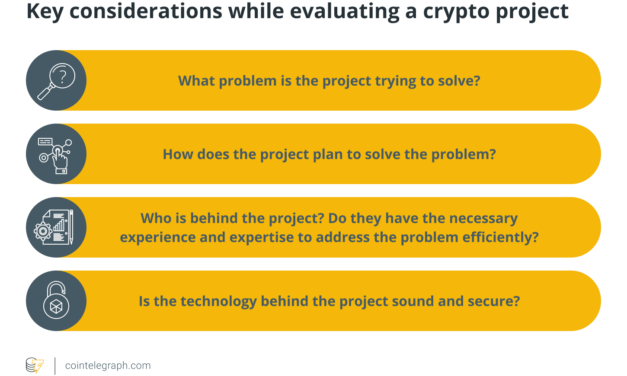
When it comes to cryptocurrencies, you need to consider a few key factors before you decide whether to invest. Whether you’re just beginning to get on the ground floor of new crypto projects or are looking to expand your portfolio, it’s helpful to have an evaluation framework handy for crypto projects. This article will explain a step-by-step framework to assist you in evaluating various crypto projects. How do you evaluate a crypto project?During your analysis of a crypto project, it’s important to examine the different aspects of the project to make an informed investment decision. You should generally veer away from making impulsive decisions based on emotions, as this could lead to financial loss. Mull over the following aspects instead:These are just some of the questions you need to ask during your cryptocurrency evaluation. We’ll discuss them in greater detail throughout this guide, which will give you a framework for evaluating crypto projects.By the end, you should have a pretty good sense of what to look for — and how to make an informed investment decision. Remember that there is a lot of speculation in the crypto world. So, do your research before you begin investing.How do I research a new crypto project?There are a couple of platforms that can help you find high-quality crypto projects to invest in, such as Binance Launchpad, OK Jumpstart and Gate.io Startup. These are all initial exchange offering (IEO) platforms, which provide their users with opportunities to invest in startup blockchain projects. There are also initial coin offerings (ICOs), which are fundraising mechanisms for crypto projects. However, it’s important to note that ICOs are generally considered riskier than IEOs. This is because ICOs are hosted on a cryptocurrency project’s website, making them a more fertile ground for fraudsters and scammers.IEOs, on the other hand, are launched on exchange platforms like the ones we mentioned previously. They are generally more secure because most startups that submit their projects to these platforms undergo a vetting process before they are allowed to launch their token sales.However, even when going through an IEO platform, you should still conduct independent research. Doing so will help you to determine whether a project is the right investment opportunity for you and if it’s something you can invest in long-term.How to evaluate a blockchain project?Generally, here’s what you should consider when looking at the main aspects of a crypto project:The vision of the projectWhen evaluating a crypto project, it’s important to ensure that it has a strong and achievable vision. In crypto, there’s such a thing as “vaporware,” which often refers to projects with all the bells and whistles — but are unlikely to get off the ground. When evaluating a crypto project, be wary of those that seem too cool and promise too much without having a solid plan or foundation to back it up.Visionaries in the industry come up with many groundbreaking project ideas, but only a few are ever feasible or practical enough to be implemented.Background and teamAnother key thing to consider is the team behind the project. This is important because, at the end of the day, it’s the people working on a project that will make it successful (or not). When looking at the team, consider things like:The team members’ experience;Their history and level of expertise in the crypto space; andHow cohesive the team is.The above factors will give you some insight into whether a team is strong and likely to make their project successful. Quality of the white paperThe white paper is a document that typically outlines everything you need to know about the project, including the vision, the problem it intends to solve, the solution, the tokenomics and more.Related: What is Tokenomics? A beginner’s guide on supply and demand of cryptocurrenciesA good white paper will be well-written and easy to understand without being too technical. It should also be clear about the problem the project aims to solve and how the solution will work. If a white paper is vague or uses too many obscure terms you don’t understand, it may not be worth your time (and money) to invest in that project. If you don’t have the time or patience to go through multiple white papers, you can also check out the projects’ litepapers. These are abridged versions of white papers but are just as informative.Potential market and use casesWhen considering a project, it’s also important to consider the potential market and whether there is a need for the solution the project is offering. For example, if a project is trying to solve a problem that doesn’t exist or has already been solved by another project, then it’s unlikely the project will make a dent in the crypto space.It’s also important to think about the potential use cases for a project. For example, if a project is trying to solve a problem that concerns only a small group of people, then the market for that project will be very limited.TokenomicsTokenomics refers to the economic model of the project and how the token will be used within the ecosystem. For example, if a token is only being used as a means of payment, then its value will likely fluctuate along with the market. However, if the token is being used to power a decentralized application (DApp), then the tokenomics will be more complex, and its value will be more stable. It’s important to understand the tokenomics of a project before investing, as it can give you some insight into the potential value of the token.Potential for growthGrowth potential refers to the likelihood of the project increasing in value over time. For example, if a project has a strong team, a good roadmap and a solid tokenomics model, then it’s likely that the project will grow in value over time. Researching a project thoroughly before investing is important, as many factors can affect its growth potential.The productThe product refers to the actual solution the project is offering. Again, it’s important to ensure the product is actually needed and that it solves a real problem. Take Ethereum (ETH), for example, which was built based on the need for a platform that could support smart contracts and expand the capabilities of blockchain technology.Solana (SOL), on the other hand, is a blockchain that uses proof-of-history, a unique consensus mechanism. Built on the premise that an “internal clock” can greatly benefit transaction speed, Solana succeeded in becoming one of the best blockchains when it comes to transactions per second.Community tractionCommunity traction refers to the level of interest and engagement the project has generated in its community. A good way to gauge community traction is by looking at the number of social media followers, blog subscribers and forum posts. The more active the community, the more likely the project will be successful.It’s also important to consider the quality of the community, as opposed to just the quantity. For example, a project with a large number of social media followers but very few active users is likely not as strong as a project with a smaller number of social media followers but an active user base.Market capitalizationMarket capitalization is the total value of all the tokens that have been mined. It’s a good way to gauge the overall size of a project. In the case of crypto that isn’t mined, the market cap can also refer to the total value of a company’s shares. It’s a good indicator of asset stability, given that crypto can be volatile. Generally, cryptos with larger market caps tend to be more stable than those with smaller market caps. The platformA project’s platform refers to the underlying technology the project is built on. For example, Ethereum is built on the Ethereum blockchain, while BNB is built on the BNB Smart Chain (BSC). Each platform has its own advantages and disadvantages, and it’s important to research a project thoroughly before investing. For example, Ethereum is the most popular platform for building DApps, while BSC is designed to offer high performance and low fees.Transparency Transparency refers to the level of information that the team makes available to its community. A transparent team will regularly communicate with its community and provide updates on the project’s progress. A non-transparent team, on the other hand, will be secretive and withhold information from its community. It’s important to invest in projects that are transparent, as it’s a good sign that the team is confident in the project and willing to be open about its progress. Additionally, it will keep you safe from various scams like rug pulls.Related: Crypto rug pulls: What is a rug pull in crypto and 6 ways to spot itThe roadmapThe roadmap should outline a project’s business plan and give you some insight into how the team plans to execute its vision. A good roadmap will be well-thought-out and realistic, with clear milestones that the team plans to achieve. It should also be updated regularly to reflect its current status. If a roadmap is outdated or unrealistic, then it’s likely that the project won’t be successful.

Čítaj viac

How to build a passive income stream from cloud mining?

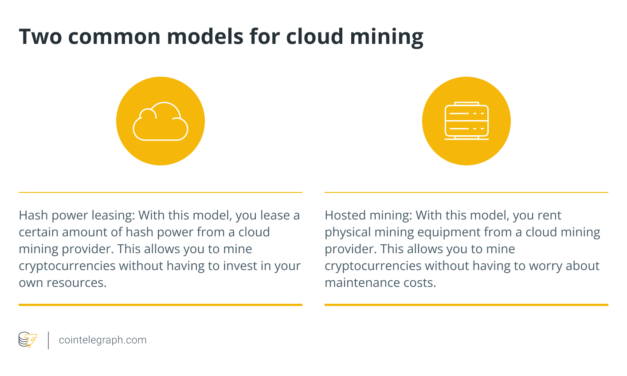
Cloud mining is the process of mining cryptocurrency without the direct use of mining equipment or hardware. The process allows users to mine Bitcoin or altcoins without having to manage their own resources.Related: What is an altcoin? A beginner’s guide to cryptocurrencies beyond BitcoinIn traditional crypto mining, cryptocurrency is produced through a computational process. Miners need to solve complex mathematical problems using mining hardware to be rewarded with coins. The process of cloud mining is similar, but instead of using their own resources, miners rent or buy resources from a service provider.As more players entered the cryptocurrency scene, mining became more complex, requiring more computing power. For this reason, many people who used to mine crypto using their own hardware now find it unsustainable due to high electricity costs and the wear and tear on their hardware. Cloud mining has therefore become an attractive option.How does cloud mining work?In cloud mining, third-party providers rent out computing power to miners. This means miners don’t have to invest in their own resources, which generally requires a large upfront investment. Cloud mining also removes the need for miners to maintain and update their own equipment.How it works is that the service provider buys or builds a mining rig and then rents out the hashing power to miners. The cryptocurrency mined is then sent to the miner’s wallet. In most cases, the service provider will also offer a mining-as-a-service solution, which allows miners to outsource the management of their mining equipment.As for the mining process itself, it’s pretty similar to how cryptocurrency mining works. Transactions are verified and added to a blockchain, thereby creating new coins. Each time a transaction is validated and added to the blockchain, a new block is created. Miners are then rewarded with crypto by adding verified blocks to the chain.Many cloud mining websites offer cloud services for miners. Among these are StormGain, BeMine and ECOS. Most cloud mining sites take a small portion of your earnings as commission. Some platforms, like ECOS, offer monthly plans with no commission.Cloud mining models and typesThere are two common models for cloud mining:Both of these models have their advantages and disadvantages. It’s important to choose the right model for your needs before getting started with cloud mining.Hashing power leasingHashing power leasing is a popular model for cryptocurrency cloud mining. With this model, you lease a certain amount of hashing power from a cloud mining provider, so you can mine cryptocurrencies. The advantage here is that you do not have to invest money to set up your own mining rig.The mining provider provides rented cloud computing power from a mining farm, which means you also don’t have to worry about the upkeep of mining equipment. All you need to do is pay for the hashing power you want to lease, and you can start mining.A miner has to register for an account with a cloud mining provider and provide certain details during signup. These include details such as the hashing power needed, as well as their desired contract period. Hashing power is determined by the amount of mining power you need. It’s important to choose the right amount of hashing power, as this will determine how much you’ll be paying for the service.A hash refers to the mathematical function used to mine cryptocurrencies. The hash rate is the speed at which a miner can complete this function. This means you’ll need to pay more for a higher hash rate. However, a higher hash rate also means you’ll be able to mine more cryptocurrencies.The contract period is the length of time for which you want to lease hashing power. Most providers offer short-term and long-term contracts.Hosted miningWith hosted mining, miners rent physical equipment from a cloud mining provider. Since the cloud mining hardware will be located in your home or office, you’ll need a good internet connection. You also have to ensure it’s in good working condition for mining by providing adequate cooling and ventilation.One of the advantages of this model is that you don’t have to worry about the cost of maintaining the mining equipment. However, a downside is that it can be quite noisy. Keep this in mind if you’re planning on setting up a hosted mining rig in your home.You’ll also have to shoulder the electricity costs when using this model. However, many hosted mining providers offer discounts if you opt for a longer contract. In addition, the replacement of old equipment won’t be at the cost of the miner. A provider will typically replace it at no extra cost, provided the equipment was used responsibly and not damaged due to improper use.Many miners go this route because they want better control of their mining rigs without needing to spend thousands of dollars on brand new equipment.Cloud mining for earning passive incomeCloud mining can be a great way to earn passive income. This is because you can mine cryptocurrencies without putting much effort. Additionally, you can typically reinvest your earnings into the cloud mining service to increase your hashing power or lease more resources.Cloud mining may be a good option if you are looking for a way to build a passive income stream from cryptocurrency mining. Just be sure to research and understand the costs involved in cloud mining before getting started.Those who want to mine Bitcoin for passive income, for example, can use a platform like StormGain to do so.StormGainStormGain is a good example of a cloud mining service that allows miners to earn passive income by mining Bitcoin. All users have to do is download their application, register and start mining. They charge reasonable commissions and have low trading fees as well. How much you earn will depend on your mining speed, as well as the trading volumes reached:ECOSECOS is another trusted cloud mining provider. It supports Bitcoin mining and offers a wide range of flexibility when it comes to cloud mining contracts:ECOS also has a wallet and exchange, so interested miners only need to sign up for an account and download the ECOS mobile app to start mining. Mining contracts range from 24 months to 50 months.Advantages of cloud miningThere are several advantages of cloud mining that make it an attractive option for miners:You don’t need to be tech-savvy: You don’t need to be a tech expert or cryptocurrency guru to start cloud mining. All you need is an internet connection, a computer and a good understanding of the cryptocurrency you wish to mine.You can start small: You can start with a small investment and gradually reinvest your earnings to increase your hashing power. You can also spread your investments out across different cryptocurrencies to mitigate risk.Sense of security (through contracts): When you lease hashing power, you typically sign a contract. This means the provider is legally obligated to give you the agreed-upon amount of hashing power. This gives miners a sense of security, as they know they won’t be cheated out of their money.Cloud mining disadvantagesCloud mining also has its drawbacks, which you should be aware of before getting started:Risk of scams: There have been some scams associated with cloud mining, so ensure you only invest in reputable services.Crypto volatility: Cryptocurrency prices are volatile, and cloud mining may not always be profitable. Be sure you understand the risks before getting started.Limited control: When you lease resources from a cloud mining provider, you don’t have complete control over the operation. This can be a risk if the provider is not reputable.How to start crypto cloud mining?If you’ve decided that cloud mining is right for you, there are a few things you’ll need to get started:A computer with an internet connection: You’ll need a computer or other device with an internet connection to access your cloud mining account.An account with a cloud mining service: You’ll need to create an account with a reputable cloud mining service provider. Bitcoin or other cryptocurrencies: To mine cryptocurrency, you’ll need to have some Bitcoin or other cryptocurrency to begin with. You can use this to pay for your resources or reinvest them into your operation.A crypto wallet: You’ll need a cryptocurrency wallet to store your mined coins. Be sure to choose a wallet that supports the coin you wish to mine.Is cloud mining profitable?This depends on a number of factors, including the type of mining you’re doing, the cryptocurrency you’re mining and the size of your operation. The fees and commissions charged by your cloud mining service provider will need to be factored in as well.So, can you make money with cloud mining? Yes, typically, you can expect to earn more from cloud mining than you would from traditional mining. This is because you’ll save a lot of money since you do not have to purchase expensive hardware, cooling and ventilation equipment. You’ll also save on electricity and maintenance costs.

Čítaj viac

Získaj BONUS 8 € v Bitcoinoch

nakup bitcoin z karty

Registrácia Binance

Burza Binance

Aktuálne kurzy