Autor Cointelegraph By Luke Huigsloot

Ether staking could trigger securities laws — Gensler

Ethereum’s upgrade to proof-of-stake may have placed the cryptocurrency back in the crosshairs of the Securities and Exchange Commission (SEC).Speaking to reporters after the Senate Banking Committee on Sept. 15, SEC chairman Gary Gensler reportedly said that cryptocurrencies and intermediaries that allow holders to “stake” their crypto may define it as a security under the Howey test, according to The Wall Street Journal. “From the coin’s perspective […] that’s another indicia that under the Howey test, the investing public is anticipating profits based on the efforts of others,” WSJ reported Gensler as saying. The comments came on the same day as Ethereum’s (ETH) transition to proof-of-stake (PoS), meaning the network will no longer rely on energy-intensive “proof-of-work” mining and instead, allows validators to verify transactions and create new blocks in a process that involves “staking.”Gensler said that allowing holders to stake coins results in “the investing public anticipating profits based on the efforts of others.” Gensler went on to say that intermediaries offering staking services to its customers “looks very similar — with some changes of labeling — to lending.”The SEC has previously said they didn’t see ETH as a security, with both the Commodity Futures Trading Commission (CFTC) and the SEC agreeing that it acted more like a commodity. The SEC has been keeping a close watch on the crypto space, particularly those that it alleges are securities. The regulator has been embroiled in a case against Ripple Labs concerning the launch of the XRP token. The SEC has also pushed firms offering crypto lending products to register with them, including a $100 million penalty directed at BlockFi in February for its failure to register high-yield interest accounts that the SEC considers securities.Gabor Gurbacs, director of digital assets strategy at American investment firm VanEck, tweeted to his 49,300 followers that he had been saying for over six years “that POW to POS transitions can draw regulatory attention.”To be clear, I am not saying that ETH is necessarily a security because of its proof model, but regulators do talk about staking in the context of dividends which if one feature of what securities laws call a “common enterprise”. There are other factors in the Howey test too.— Gabor Gurbacs (@gaborgurbacs) September 15, 2022Gurbacs went on to clarify that regulators refer to rewards from staking as dividends, which is a feature of the Howey test.Related: Crypto developers should work with the SEC to find common groundThe Howey Test refers to a Supreme Court case in 1946 where the court established whether a transaction qualifies as an investment contract. If it does, then it would be considered a security and is covered by the Securities Act of 1933.

Čítaj viac

Celsius bankruptcy judge gives the nod for independent examiner probe

A federal judge overseeing crypto lender Celsius’ bankruptcy case has given the green light for the motion to appoint an independent examiner to investigate aspects of Celsius’ business.In an order dated Sept. 14 from the United States Bankruptcy Court of the Southern District of New York, the order notes that the examiner’s investigation will look into Celsius’ digital assets, tax payment procedures, the current status of its mining business, following calls for greater transparency. The examiner will also look into why there was a change in account offerings in April, resulting in some customers being moved from the Earn Program to Custody Services while others were moved to a “Withhold Account.” The U.S. Trustee had previously referred to a lack of transparency around these accounts, with customers unaware of who holds what account and why. This may be important given Celsius had asked the court to return assets to “custody clients,” but not its “earn-and-borrow” clients.A motion to appoint an examiner originally came from an Aug. 18 filing from the United States Trustee handling Celsius’ bankruptcy proceedings, citing “significant transparency issues” surrounding Celsius’ business operations.However, BnkToTheFuture CEO Simon Dixon said the scope of the examiner’s investigation was pared down since the motion was initially filed so that Celsius doesn’t run out of money.He also noted that Celsius Network CEO Alex Mahinsky would need to provide information on his withdrawals from the platform before the freeze.CELSIUS HEARING LIVE; @CelsiusUcc legal council going over the examiner motion & reducing the scope so that @CelsiusNetwork doesn’t run out of money. They said @Mashinsky to provide information on his withdrawals from the platform before the freeze.— Simon Dixon (Beware Impersonators) (@SimonDixonTwitt) September 14, 2022The latest order also outlined that the scope of the investigation could be expanded if deemed necessary, but would require consultation with Celsius and the official committee of unsecured creditors. Celsius will be required to produce all documents the examiner “reasonably deems relevant to perform the Investigation, though Celsius will have grounds to reject a request, which would then be decided by the courts. Related: Celsius CEO plans to restructure firm to focus on crypto custody: ReportOnce the identity of the examiner has been approved, they will have seven business days to produce a work plan and budget. The court will then have seven days to approve these, after which the examiner will have 60 days to complete their investigation.Celsius filed for Chapter 11 bankruptcy and froze withdrawals in July. Since then some depositors have been told their funds will be released, but most are still unable to access their assets with no guarantee they will ever receive them.It seems as though the Examiner will be very busy once they are appointed, with Dixon also tweeting that the U.S. Trustee already has forty parties ready to be interviewed.CELSIUS HEARING LIVE; @CelsiusUcc legal council opposed to Trustee takeover as they think it may lead to liquidation which is undesirable. Examiner preferred. US Trustee has 40 parties ready to interview for examiners next week.— Simon Dixon (Beware Impersonators) (@SimonDixonTwitt) September 14, 2022

Čítaj viac

The 'launch of a rocket' — Observers on the future of Ethereum post-Merge

The Ethereum Merge is set to occur later today with the energy-efficiency focused transition expected to have a major impact on crypto investment and adoption, experts say. Speaking to Cointelegraph in the lead up to the Merge, StarkWare president and co-founder Eli Ben-Sasson noted that the Ethereum Merge will be the “first step in a process that will lead to exceedingly widespread adoption of Ethereum.”The immediate importance of the Merge is the dramatic effect on energy consumption.The Merge is expected to see Ethereum’s energy cut by 99.95% compared to its current Proof-of-Work (PoW) consensus mechanism, which requires large amounts of energy to be used in a competition to solve arbitrary mathematical puzzles.“I think of the Merge like the development of the first solar fields,” added Ben-Sasson.“We saw that we can slash the environmental impact of electricity production. We didn’t say ‘problem solved,’ but rather that if we’re generating electricity with less pollution, it’s time to double down on efforts to use the power more sparingly.”Excited to never have to hear about “ommer blocks” again.(ok fine I know “ommer” was meant to be a gender-neutral replacement for “uncle”, but come on, it just *sounds* like an insult for people who meditate)Oh, and saving electricity. That’s cool too.— vitalik.eth (@VitalikButerin) September 14, 2022Ben-Sasson believes the end result where the general population uses blockchain-based apps in many different areas of life, “and as naturally as people use smartphone apps today.”CEO of crypto exchange Coinjar, Asher Tan says the Merge is set to change the narrative around crypto more broadly, pointing out that it’s incredibly rare for a tech sector to “execute such a drastic reduction in their energy intensity.””We believe that people are underselling the significance of the post-Merge 99.95% drop in energy usage,” noted Tan. It makes the Ethereum network far more publicly palatable and opens the door for investors and companies that had remained crypto-agnostic due to its carbon footprint.Despite optimism about Ethereum’s transition, there is still debate on whether the Merge has already been factored into Ether (ETH) price or not. Charmyn Ho, head of crypto insights at crypto exchange Bybit, says their analysts have concluded there is “no consensus” amongst institutional investors or market makers regarding short-term trading around The Merge, but will instead be more likely to accumulate ETH and become hodlers.Related: Only 10 hours to the Ethereum Merge: Here’s what you need to knowMeanwhile, most within the Ethereum “bubble” don’t appear to be concerned over whether the Merge will be a success or not. Ethereum Co-Founder Joseph Lubin told Bloomberg yesterday he believes the transition will result in very little disruption to developers and users, and will be “as smooth as if your iPhone or laptop has upgraded its operating system overnight.”StarkWare’s Ben-Sasson also sees the transition being a smooth one, suggesting the “Ethereum Foundation has prepared so meticulously for this moment, and inspires lots of confidence,” noting: “It will be a significant mark of success when the first block is produced by proof of stake. But this is like completing the launch of a rocket — we still have the rest of the journey ahead of us, which will pose its challenges.”Lubin suggests that in his opinion, this is the third most important event in the crypto space, behind only the development of Bitcoin and Ethereum.

Čítaj viac

Delphi Labs shifts research focus to a new crypto ecosystem… and it’s not Ethereum

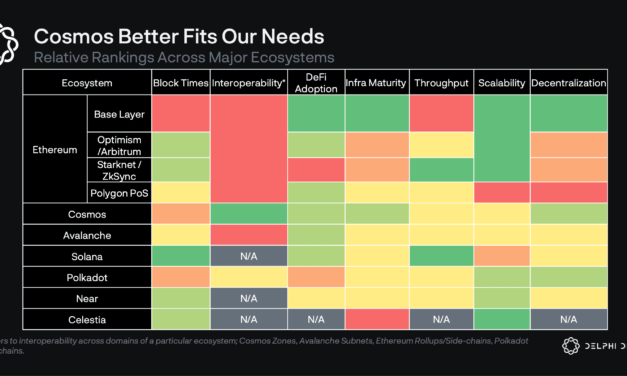
Crypto research firm Delphi Digital has shifted the focus of its research and development (R&D) protocol arm Delphi Labs to the Cosmos ecosystem. Delphi Labs is Delphi Digital’s protocol R&D arm, with a team of around 50 aimed at incubating “Web3 primitives.” The R&D arm had previously been focused on researching and developing protocols on Terra but was forced to look into other ecosystems following its collapse in May. Delphi Digital is an independent research and investment firm founded in 2018 that provides institutional-grade analysis of the digital asset market, which launched its Labs wing in 2021. In a lengthy report published on Sept. 8, Delphi Digital said its team analyzed a range of different blockchain ecosystems to determine which was the most suitable for its needs, particularly in relation to decentralized finance (DeFi), but ultimately decided on the Cosmos ecosystem.In the 3 months since the Terra collapse, the Delphi Labs team has been hard at work figuring out what we see as the future of DeFi, what platform best facilitates this, and ultimately where we should best focus our builder efforts going forwardhttps://t.co/7mZAkKc8XK— Delphi Digital (@Delphi_Digital) September 8, 2022Describing it as “an ecosystem of interoperable blockchains,” Delphi Labs decided Cosmos was the best ecosystem to focus its R&D on. It pointed to Cosmos’ ability to benefit from an increasing number of app chains and cross-chain interoperability as major positives.The firm also outlined speed, chain liquidity, decentralization, cross-chain interoperability, technical maturity, and code portability as key factors in its decision to back Cosmos, despite the fact that the ecosystem is somewhat lacking compared to competitors such as Ethereum. Delphi Digital suggested that despite Ethereum hosting the majority of DeFi apps, the speed and cost of using the Ethereum base layer is the main drawback of the blockchain, resulting in a poor user experience.Related: Why interoperability is the key to blockchain technology’s mass adoptionThe report noted that rollups allow Ethereum to overcome this problem but sees interoperability between chains and outages or latency issues as major issues.Polygon (MATIC), Optimism (OP), Starknet (STARKNET), Cosmos (ATOM), Avalanche (AVAX), Solana (SOL), Polkadot (DOT), Near (NEAR), and Celestia (CELT) were all compared within the report, with Cosmos scoring the highest overall. 

Čítaj viac

Aave devs look set to receive $16.3M via retroactive funding

The DAO behind the decentralized finance (DeFi) platform Aave has accepted a proposal to reward members from Aave Companies with $16.28 million in retroactive funding for their role in the development of Aave Protocol V3.Voting for the proposal began on Sept. 6, and at the time of writing has already passed 667,000 votes in favor of the funding, more than doubling the 320,000 required. The vote is set to end on Sept. 8.According to the initial proposal, which was first pitched on Aug. 10, the Aave Request for Comment (ARC) seeked “retroactive funding” for work in developing the V3 protocol. The $16.28 million consists of $15 million for work performed by the developers over the course of more than one year and $1.28 million for costs paid to third-party auditors. The money will be given to members of the firm behind the popular DeFi protocol, Aave Companies.The funding will be made up of a combination of AAVE tokens, Dai (DAI), Tether (USDT), USD Coin (USDC), alternative stable assets (e.g. Frax stablecoin), and higher volatility assets (e.g. Synthetix) following the passing of the proposal.While the origins of the retroactive public goods funding model are unclear, it was popularized following a collaborative post on Medium between Vitalik Buterin and Ethereum scaling solution firm Optimism on  Jul. 21, 2021.The post argued that the “retroactive public goods funding” model provides an incentive for developers to work on projects by allowing them to get paid after the project is completed and can be based on the value it provides.The core principle behind the concept is that “it’s easier to agree on what was useful than what will be useful.” Vitalik suggests in the post that it can be difficult in the beginning phase of a project to get it off the ground, with donations and grant money being insufficient to incentivizee developers.According to blockchain data provider Nansen, the Aave DAO has seen a huge drop in the value of its liquid assets throughout the crypto winter, down from over $800 million in April to around $378 million at the time of writing.Despite this, the community has overwhelmingly voted in favor of the retroactive funding request, with community members suggesting “Aave Companies did tremendous work and should be paid for that.”Some community members however took issue with the lack of transparency in the proposal, with one member stating in the comments: “I support the proposal, but would wish for as much transparency as possible to raise the bar for any other retroactive proposal in the future.”

Čítaj viac

Získaj BONUS 8 € v Bitcoinoch

nakup bitcoin z karty

Registrácia Binance

Burza Binance

Aktuálne kurzy