Autor Cointelegraph By Luke Huigsloot

Israeli crypto exchange receives capital markets license in country first

Israeli-based crypto exchange Bits of Gold became the first crypto firm in the country to receive a license from the Capital Markets Authority according to social media posts from the company on Sept. 18.As a result of attaining the license, Bits of Gold will be able to store digital currencies through secured custody in a “Bits of Gold Wallet” they have been working on for some time. It will also start providing a service that enables banks and other financial institutions to connect to its digital asset services.In a public statement, Bits of Gold said that the license is the next step in their mission to make the world of digital currencies more accessible to the Isreali public “in a simple and secure manner.”Authorities in Israel have been putting restrictions on cash payments in the country as it tries to combat illegal activity and drive a transition to digital payments within the country.Despite that, institutional adoption in the country has been slow with Isreali banks having been very unfriendly towards crypto and blocking services until recently, citing Anti-Money Laundering (AML) issues.In 2017 the Israeli Supreme court ruled that local bank Leumi was legally allowed to refuse service to Bits of Gold, with the bank claiming that Bitcoin’s nature made it impossible for them to follow ALM requirements.The Supreme Court’s position had changed by 2019 however, when it ruled that Leumi could not block Bits of Gold’s account based on regulatory concerns, and in doing so set a precedent for other cryptocurrency firms.The enforcement of new AML regulations by the government in Israel further opened the path to co-operation between banks and the crypto industry. The development also set a requirement that crypto companies must be licensed, although companies that applied for one were given a permit to temporarily continue their operations.Related: Coinbase enters the Netherlands with central bank approvalAnother barrier to institutional adoption in Israel is its taxation laws. The country was recently ranked as the third worst country for crypto taxation according to a report released by crypto analytics firm Coincub on Sept. 8.According to Coincub, sales of crypto is generally subject to a capital gains tax of up to 33% in Israel and if the investing activity is deemed to be business related, it is subject to income tax up to 50%.While the Capital Market, Insurance and Savings Authority had already granted the first Israeli crypto license to infrastructure firm Hybrid Bridge Holdings earlier this month, the license that Bits of Gold received represents the first one given to an active broker.

Čítaj viac


Rep. Warren Davidson: Stablecoin bill has 'outside chance' of finalizing this year

There is a small chance the U.S. House of Representatives could pass the bill to regulate stablecoins by year-end, though it’s more likely it will pass in the first quarter of 2023, says U.S. Congressman Warren Davidson. According to a Thursday report from Kitco, Davidson made the remarks at the Annual Fintech Policy Forum on Sept. 22, where he suggested: “There’s an outside chance we find a way to get to consensus on a stablecoin bill this year.”The “stablecoin bill” seemingly refers to draft legislation aimed at “endogenously collateralized stablecoins” which came to light this week — and would place a two-year ban on new algorithmic stablecoins such as TerraUSD Classic (USTC).However, Davidson went on to say that while “there’s a chance we get to yes on stablecoins this year,” it’s something that can be achieved by the first quarter of 2023. “If we don’t, it’s something that I think we can get to with a Republican majority in Q1 next year,” he said. Davidson is widely seen as crypto-friendly and has previously introduced the “Keep Your Coins” bill which aimed to protect self-custodied crypto wallets from U.S. government control.A number of bills aimed at regulating stablecoins have been introduced in the U.S., such as the one that was introduced on Feb. 15 this year by U.S. Rep. Josh Gottheimer.The Director of the Consumer Financial Protection Bureau (CFPB), Rohit Chopra, also reportedly spoke at the event and believes that stablecoins have the potential for widespread adoption, noting: A stablecoin, riding the rails of a dominant payments system or a mobile OS, I think that could create ubiquity very quickly.Chopra added that if stablecoins do see this kind of rapid adoption, they could have a serious impact on global financial stability.Related: 3AC founders reveal ties to Terra founder, blame overconfidence for collapseThe CFPB director also suggested that Washington may be neglecting other areas of fintech development due to its intense focus on crypto in recent months.The forum was attended by financial giants such as Bank of America, Visa and Mastercard and was reportedly aimed at fostering discussion between executives and policymakers as to how they can work together to ensure developing technologies help businesses, consumers and the economy.The current draft bill for stablecoins is being negotiated between House Financial Services Committee Chair Maxine Waters and the committee’s top Republican, Rep. Patrick McHenry.

Čítaj viac

JPMorgan CEO calls crypto 'decentralized Ponzi schemes'

While testifying before United States (U.S.) lawmakers, JPMorgan Chase CEO Jamie Dimon referred to himself as a “major skeptic” on “crypto tokens that you call currency like Bitcoin,” labeling them as “decentralized Ponzi schemes.”Dimon was asked what keeps him from being more active in the crypto space during an oversight hearing held by the House Financial Services Committee on Sept. 21. Dimon emphasized that he sees value in blockchain, decentralized finance (DeFi), ledgers, smart contracts, and “tokens that do something,” but then proceeded to lambast crypto tokens that identify as currencies.Asked for his thoughts about the draft U.S. stablecoin bill, Dimon said he believes that there is nothing wrong with stablecoins that are properly regulated and that the regulation should be similar to what money market funds are subject to.Dimon has once described Bitcoin as a “fraud” and has reiterated in the past he has no interest in backing the sector on a personal level. He has softened his stance on crypto on occasion, once highlighting that it can serve important use cases at times such as cross-border payments. Despite Dimon’s views on the cryptocurrency space, JPMorgan has been pushing into the blockchain technology space. The financial giant launched its own in-house stablecoin — JPM Coin in October 2020 — the first cryptocurrency backed by a U.S bank, which was aimed at increasing settlement efficiency.A week after rolling out the coin, the bank launched a new business division dedicated to blockchain technology called Onyx. Since then the Onyx platform has been utilized by large institutional customers for round-the-clock global payments. JPMorgan also became the first major bank in the Metaverse following the opening of its virtual lounge in the blockchain-based world Decentraland in February. The move followed a report that was released by the firm which referred to the Metaverse as a $1 trillion opportunity.JPMorgan has been hiring new staff to push into the blockchain and crypto space, most recently announcing on Sept. 9 that it has hired former Microsoft executive Tahreem Kamptom to be its senior payments executive. Kamptom is expected to help JPMorgan explore blockchain tech given his Linkedin bio shows he has worked on crypto-related payment methods.Related: ‘Most of crypto is still junk’ and lacks use case — JPMorgan blockchain headDuring the hearing, the lawmakers also asked other top U.S bank CEOs whether they had plans to finance crypto mining. Citigroup CEO Jane Fraser, Bank of America CEO Brian Moynihan, and Wells Fargo CEO Charles Scharf all suggested that their banks had no intentions of doing so.

Čítaj viac

Intellectual property has an awkward fit in Web3 decentralization — Lawyers

Intellectual property (IP) rights will continue to be a growing area of tension within Web3 and NFTs, as IP rights often rely on a single “identifiable entity,” while Web3 is more often decentralized. Speaking to Cointelegraph, David Kappos, a partner at Cravath, Swaine & Moore LLP said that IP is traditionally “owned by an identifiable entity, which makes it necessarily centralized from a legal viewpoint.”Kappos suggested that the tension between IP and decentralization does not have a clear solution, asking “how does a DAO really own the IP of the protocol it is supposed to govern?”Over the last year, there have been several lawsuits against NFT projects alleged to be violating IP, copyright, and trademarks. When asked about third parties creating digital artworks or wearables of branded products, Kappos suggested that “an unlicensed implementer in a Web3 environment should refrain from creating a wearable that is confusingly similar to a brand owned by a third party — the same as in the real world.”One such example is digital artist Mason Rothschild being sued by French luxury group Hermès for creating ‘Metabirkins’, an NFT collection inspired by the group’s famous Birkin bags.In August, NFT company Yuga Labs released a new IP rights agreement for its CryptoPunks and Meebit collection, offering all CryptoPunk and Meetbits holders to use their NFTs for commercial or personal purposes. Related: NFTs and intellectual property, explainedNathanael Lim, co-founder of Web3 media start-up Avium said this was a positive step for users, but the real change is that the market will be noticing IP rights more. In August, venture capital firm Andreessen Horowitz (A16z) announced a set of six licenses tailored to NFTs based on the Creative Commons license, Lim suggests that these are mainly improvements on the Creative Commons licenses released twenty years ago, and have helped clarify some of the confusion people have had about the licenses by updating the more relevant parts, but more innovation needs to occur within the space.Both Lim and Kappos were speakers at IP Week @ SG 2022, a global conference organized by the Intellectual Property Office of Singapore (IPOS).

Čítaj viac

Ethereum may now be more vulnerable to censorship — Blockchain analyst

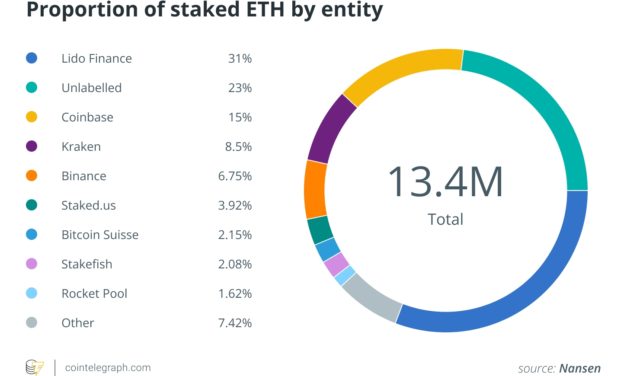
Ethereum’s upgrade to proof-of-stake (PoS) may make it more vulnerable to government intervention and censorship, according to the lead investigator of Merkle Science. Speaking to Cointelegraph following the Ethereum Merge, Coby Morgan, a former FBI analyst, and the Lead Investigator for crypto compliance and forensic firm Merkle Science expressed his thoughts on some of the risks posed by Ethereum’s transition to PoS. While centralization issues have been broadly discussed leading up to The Merge, Moran suggested the prohibitive cost of becoming a validator could result in the consolidation of validator nodes to the bigger crypto firms like Binance, Coinbase, and Kraken.In order to become a full validator for the Ethereum network, one is required to stake 32 Ether (ETH), which is worth around $47,000 at the time of writing. A pre-Merge report from blockchain analytics platform from Nansen earlier this month revealed that 64% of staked ETH is controlled by just five entities.Source: NansenMorgan continued to say that these larger institutions will be “subject to the whims of governments in the world,” and when validator nodes identify sanctioned addresses they can “be slashed rewards and then eventually kicked off the system,” with businesses prevented from interacting with them. Either you will comply and you will siphon off that sort of interaction […] or you run the risk of being fined, being scrutinized, or potentially being sanctioned yourself.Vitalik Buterin spoke about this risk in an Aug. 18 developer call, suggesting one of the forms censorship could take is validators choosing to exclude or filter sanctioned transactions. Vitalik went on to say that as long as some validators do not comply with the sanctions, then these transactions would eventually be picked up in later blocks and the censorship would only be temporary.On Aug. 8 crypto mixer Tornado Cash became the first smart contract sanctioned by a U.S. government body.Related: Rep. Emmer demands an explanation of OFAC’s Tornado Cash sanction from Sec. YellenIn reaction, various entities have complied with the sanctions and prevented the sanctioned addresses from accessing their products and services.The development has had a large effect on the Ethereum community, with EthHub co-founder Anthony Sassano tweeting on Aug. 16 that he would consider Ethereum a failure and move on if permanent censorship occurs.I want to be very clear on this:If the Ethereum base-layer ends up engaging in *permanent* censorship then I will consider the Ethereum experiment a failure and I will move on.Thankfully, I believe the Ethereum community is strong enough to fight off base-layer censorship.— sassal.eth (@sassal0x) August 16, 2022

Čítaj viac

Získaj BONUS 8 € v Bitcoinoch

nakup bitcoin z karty

Registrácia Binance

Burza Binance

Aktuálne kurzy