Autor Cointelegraph By Luke Huigsloot

Russian stablecoin usage surged after Ukraine invasion: Report

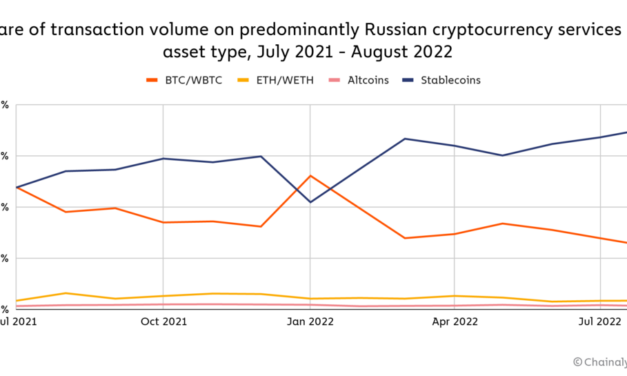
A new report from blockchain analytics firm Chainalysis has shown a surge in stablecoin usage in Russia following the Russian invasion of Ukraine, which has since seen sanctions and inflation impacting the country. Released on Oct. 12, the report revealed that the share of stablecoin’s transaction volume on primarily Russian services increased from 42% in January to 67% in March following the invasion and has continued to increase since.An anonymous expert on regional money laundering speaking to Chainalysis suggested that Russia’s removal from the cross-border system SWIFT is likely to see crypto being utilized for cross-border transactions, with stablecoins likely to be the preferred medium of exchange due to their price stability. Share of transaction volume on predominantly Russian crypto services by asset type, from July 2021 to August 2022. Source: Chainalysis.The report also suggests that some of the surge in stablecoin usage is likely due to ordinary Russian citizens trading the Ruble for stablecoins in order to protect the value of their assets, amid high levels of inflation since the war began.“While some of that may be due to businesses embracing cryptocurrency for international transactions, it’s also likely that some of the increase is due to ordinary Russian citizens trading for stablecoins in order to protect their assets’ value, as we discussed previously,” the report noted. Related: Dapper Labs suspends Russian accounts after new EU sanctionsMeanwhile, Chainalysis also noted in its finding that Eastern Europe had the highest share of risky crypto activity compared to any other region worldwide over the last year.18.2% of cryptocurrency activity in the region is either “risky” or “illicit,” with Eastern Asia the next highest at 15% and Sub-Saharan Africa coming in third, though the latter had by far the largest share of illicit activity involving cryptocurrency. The firm defined risky activity as any transaction that involves an address associated with a risky entity, such as exchanges with low or no Know-Your-Customer (KYC) requirements. Meanwhile, illicit activity is defined as transactions associated with a known criminal entity.Share of risky and illicit crypto activity for different regions from July 2021 to June 2022. Source: Chainalysis.Recent developments relating to crypto could further increase this number. The European Union recently banned crypto payments from Russians to European wallet providers, which could drive more cryptocurrency users to use lesser-known exchanges with no KYC requirements in order to get around the sanctions.The report noted that crypto being used to work around sanctions means there needs to be more discussion on improving the effectiveness of sanctions but also highlighted the positive role crypto has had in facilitating donations to the Ukrainian cause, placing the current figure at over $65 million.In prior research, Chainalysis noted that the prevalence of Russian cybercriminals was driving significant ransomware and cryptocurrency-based money laundering activity, noting: “In particular, we’ve historically seen an outsized amount of ransomware and crypto-based money laundering in Eastern Europe, with the latter supported by a large ecosystem of risky cryptocurrency businesses.”

Čítaj viac
Blockchain.com gets regulatory nod from Singapore’s central bank

Crypto exchange Blockchain.com has become the latest crypto company to secure preliminary approval from Singapore’s central bank to provide Digital Payment Token services in the city-state.Blockchain.com’s regulatory approval follows hot on the heels of Coinbase, which revealed it had received the same “in-principle” approval from the Monetary Authority of Singapore (MAS) on Oct. 11.If officially approved, Blockchain.com would join the likes of companies already licensed for digital Payment Token services including crypto exchanges DBS Vickers and Independent Reserve, digital payment solution provider FOMO Pay, and crypto-friendly payments application Revolut, among others. Blockchain.com CEO and co-founder Peter Smith commended the country’s regulators for creating a “transparent regulatory process” to foster innovation, stating: “Blockchain.com commends the Monetary Authority of Singapore on its transparent regulatory process that prioritizes crypto industry oversight while allowing innovation to thrive.”It is not the first company to make a positive reference to the straightforward regulatory environment in Singapore for crypto companies. Recently, digital asset platform Anchorage Digital co-founder and president Diogo Mónica pointed to Singapore’s strong regulatory environment and the emergence of a crypto hub as its motivation to choose the city-state as a “jump point” into the Asian markets.Mónica also highlighted, in contrast, the lack of regulatory clarity in the United States as a major issue, suggesting that even if a company understands what rules govern an asset, it can be difficult to determine which of the 15 regulators they need to engage with.Related: Why Singapore is one of the most crypto-friendly countriesIn August 2021, crypto exchange Independent Reserve was one of the first of 170 global competitors to receive preliminary approval for the DPT license.CEO Adrian Przelozny also made a positive reference to the transparency of Singapore’s regulatory environment, noting at the time: “A well-regulated environment will benefit both investors and crypto industry stakeholders. With tailormade rules for the crypto industry, Singapore currently has the clearest and most detailed licencing requirements of any jurisdiction in Asia”Przelozny suggested the license grants “will continue to put Singapore in pole position as the leading financial hub in Asia.”

Čítaj viac

Blockchain.com gets regulatory nod from Singapore’s central bank

Crypto exchange Blockchain.com has become the latest crypto company to secure preliminary approval from Singapore’s central bank to provide Digital Payment Token services in the city-state.Blockchain.com’s regulatory approval follows hot on the heels of Coinbase, which revealed it had received the same “in-principle” approval from the Monetary Authority of Singapore (MAS) on Oct. 11.If officially approved, Blockchain.com would join the likes of companies already licensed for digital Payment Token services including crypto exchanges DBS Vickers and Independent Reserve, digital payment solution provider FOMO Pay, and crypto-friendly payments application Revolut, among others. Blockchain.com CEO and co-founder Peter Smith commended the country’s regulators for creating a “transparent regulatory process” to foster innovation, stating: “Blockchain.com commends the Monetary Authority of Singapore on its transparent regulatory process that prioritizes crypto industry oversight while allowing innovation to thrive.”It is not the first company to make a positive reference to the straightforward regulatory environment in Singapore for crypto companies. Recently, digital asset platform Anchorage Digital co-founder and president Diogo Mónica pointed to Singapore’s strong regulatory environment and the emergence of a crypto hub as its motivation to choose the city-state as a “jump point” into the Asian markets.Mónica also highlighted, in contrast, the lack of regulatory clarity in the United States as a major issue, suggesting that even if a company understands what rules govern an asset, it can be difficult to determine which of the 15 regulators they need to engage with.Related: Why Singapore is one of the most crypto-friendly countriesIn August 2021, crypto exchange Independent Reserve was one of the first of 170 global competitors to receive preliminary approval for the DPT license.CEO Adrian Przelozny also made a positive reference to the transparency of Singapore’s regulatory environment, noting at the time: “A well-regulated environment will benefit both investors and crypto industry stakeholders. With tailormade rules for the crypto industry, Singapore currently has the clearest and most detailed licencing requirements of any jurisdiction in Asia”Przelozny suggested the license grants “will continue to put Singapore in pole position as the leading financial hub in Asia.”

Čítaj viac

BTC to outperform ‘most major assets’ in H2 2022 — Bloomberg analyst

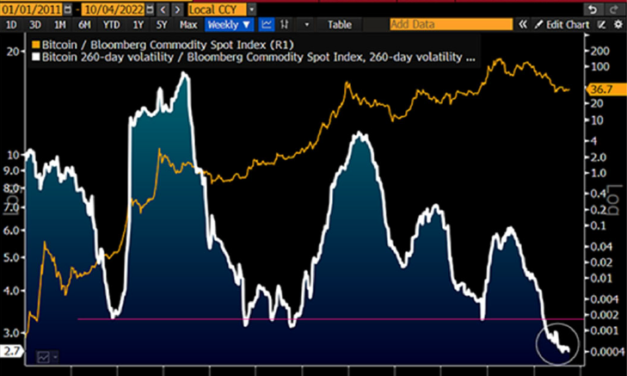
Senior commodity strategist at Bloomberg Intelligence, Mike McGlone, stated October has historically been the best month for Bitcoin (BTC) since 2014, averaging gains of about 20% for the month, and that commodities appearing to peak could imply that Bitcoin has reached its bottom.In an Oct. 5 Bloomberg Crypto Outlook report, McGlone says while the rise of interest rates globally is putting downwards pressure on most assets, Bitcoin is gaining the upper hand when compared with commodities and tech stocks like Tesla, with the report noting:“When the ebbing economic tide turns, we see the propensity resuming for Bitcoin, Ethereum, and the Bloomberg Galaxy Crypto Index to outperform most major assets.”McGlone notes that Bitcoin has its lowest ever volatility against the Bloomberg Commodity Index, which tracks the price movements of global commodities such as gold and crude oil, and suggests that historically Bitcoin volatility is more likely to recover as compared to commodities when the crypto heads to new highs.Bitcoin vs BCOM and Bitcoin 260 day volatility vs BCOM 260 day volatility. Source: Bloomberg Crypto OutlookMcGlone suggested the second half of 2022 could see Bitcoin “shift toward becoming a risk-off asset, like gold and US Treasury’s,” following low volatility throughout September and a potential peak in commodity prices.In the past, Bitcoin has been highly correlated with tech stocks, with its volatility making it a risky asset that traders are likely to sell in an environment where investors are looking to reduce risk.Related: 5 reasons why Bitcoin could be a better long-term investment than goldKaiko Research data released on Oct. 4 supports the notion that Bitcoin may be transitioning to acting more like “digital gold,” with Bitcoin’s correlation to gold hitting its highest level in more than a year at +0.4 following a strengthening of the United States dollar as interest rates rise.Bitcoin’s correlation with gold over the last 12 months. Source: KaikoA correlation of +1.0 means that the movement between two different assets is synonymous, for example a 10% increase in gold would be matched by a 10% increase in Bitcoin should the two assets have a correlation of +1.0.

Čítaj viac

Web3 gaming still a long way from mainstream adoption: Survey

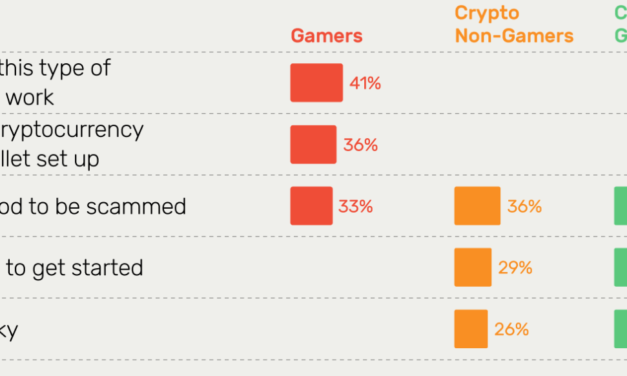
A new survey commissioned by blockchain entertainment provider Coda Labs suggests that despite the huge amount of money being poured into Web3 gaming, traditional gamers are still yet to warm up to crypto or NFTs and have little interest in Web3 games. According to the survey, gamers pointed to practical barriers as their main reason for shying away from Web3 games, with gamers often not knowing how they might work and lacking a blockchain wallet.The survey found that only 12% of non-crypto gamers have tried Web3 games, while just 15% of those yet to try were interested in doing so in the future. The survey pointed to play-to-earn (P2E) as the most recognized term associated with Web3 games, and crypto earnings as the most commonly perceived benefit of playing them.When these two factors are considered in tandem, the findings reinforce what many industry players have been saying recently — that gamers are more interested in playing a “fun game” than the tokenomics associated with many Web3 games. Respondents’ perception of the main challenges associated with Web3 games. Source: Coda Labs.The survey data suggests that those who had played Web3 games ended up being positive about them, with traditional gamers giving them a rating of 7.1 out of ten while gamers who are active within the crypto space rated them at 8.3.Speaking to Cointelegraph last week during Asia Crypto Week, the executive president of the Asia Blockchain Gaming Alliance (ABGA), Kevin Shao suggested the focus on the P2E and NFTs aspect of blockchain games may be what is holding back mainstream adoption of GameFi.Shao believes the release of “triple-A” titles like Phantom Galaxies and Big Time can help shift gamers’ perspective of Web3 games away from the P2E features and onboard people who are looking to play games purely for fun.Related: Blockchain gamers surge as users attempt ‘stacking crypto’ — DappRadarConducted throughout June 2022, the survey saw responses from 6,921 people across five different countries. To be eligible to participate in the survey, the respondent needed to play video games at least twice per month, have used a crypto wallet, traded via a decentralized exchange, or traded an NFT in the last 30 days.The survey was conducted by data creation platform WALR, which is a member organization of the Market Research Society and complies with its Code of Conduct.

Čítaj viac

Získaj BONUS 8 € v Bitcoinoch

nakup bitcoin z karty

Registrácia Binance

Burza Binance

Aktuálne kurzy