Autor Cointelegraph By Luke Huigsloot

Blockchain.com partners with Visa to offer crypto debit card

Crypto exchange Blockchain.com has partnered with Visa to launch a crypto card, available to only U.S. residents initially, which allows users to pay using their crypto or cash balance wherever Visa debit cards are accepted.In an Oct. 26 announcement, Blockchain.com revealed that there would be no sign-up or annual fees, no transaction fees, and users would earn 1% of all purchases back in crypto.In a Yahoo Finance interview, Blockchain.com CEO Peter Smith said the card already had 50,000 signed onto a waiting list, noting: “There’s still a lot of demand for crypto products, but you’re seeing that demand shift away from trading and more towards folks that are interested in using DeFi, using their balances.”Following the announcement, Visa’s head of crypto, Cuy Sheffield, pointed out that worldwide acceptance is necessary for crypto adoption to continue to grow. The card is powered by California-based payments company Marqeta, which helped develop crypto finance firm Swipe’s crypto visa card in September 2020. The announcement follows news that Visa has partnered with crypto exchange FTX to roll out a debit card to 40 countries on October 7.Related: Japan’s International Payments System will test plastic cards for CBDCMasterCard partners with BitOasisOn Oct. 25, Visa’s main competitor Mastercard signed onto a strategic partnership with BitOasis, the leading crypto platform in the Middle East and North Africa (MENA), to launch a series of crypto card programs designed to facilitate the adoption of digital assets in the region. BitOasis customers will be able to link their wallets to the new card and convert crypto into fiat to enable the use of Mastercard’s global merchant network, with the card expected to launch in early 2023.The co-founder and CEO of BitOasis, Ola Doudin, sees a huge potential for adoption within the area, noting:“We continue to witness sustained demand amongst our customers for crypto to be integrated into, and relevant, for their daily lives. Research tells us that 47% of the Middle East population now believe crypto is the future of money.”The partnership follows a $30 million Series B funding round from BitOasis which closed in October 2021. The funding facilitated the expansion of its Dubai-based platform into MENA.

Čítaj viac


Voyager customers could recover 72% of frozen crypto under FTX deal

Customers of bankrupt crypto lender Voyager Digital may be able to recover 72% of the value of their accounts under a tentative deal with FTX US, according to court documents. However, United States bankruptcy judge Michael Wiles during a court hearing said the tentative sale would not be final until it receives the approval of Voyager’s creditors and he approves the bankruptcy payout plan, saying during the court hearing:“If the plan falls apart, there’s no part of this agreement that survives.”There is also the inclusion of a clause called a “fiduciary out” that allows Voyager to cancel the deal with FTX should any offers be presented that offer a better outcome for creditors. The clause is often included in bankruptcy cases, allowing companies to consider higher offers until the sale is finalized to ensure creditors get the best deal possible.Voyager had previously hinted that its customers may eventually transition to the FTX platform after the exchange had secured the winning bid on Sept. 27 at a valuation of approximately $1.4 billion following a two-week bidding process. The tentative plan from FTX would enable all priority claims to be paid out in full, and allow other account holders to recover approximately 72% of the value of their accounts, which have been frozen since Jul. 1.Related: Voyager Digital won’t sue its executives for incompetence, will claim insurance on themThe figure doesn’t include funds it may recoup as part of its claim against Three Arrows Capital (3AC) after the crypto hedge fund had defaulted on its loan repayments to Voyager.Any additional funds received as part of this claim will allow Voyager account holders to recover a greater percentage of their frozen accounts.Voyager had filed for chapter 11 bankruptcy on Jul. 4 due to liquidity issues following the default of crypto hedge fund Three Arrows Capital.Voyager said the bid from FTX US was made up of the fair market value of its crypto holdings as of a to-be-determined date, which as of Sept. 26 is estimated at $1.3 billion, as well as additional consideration of at least $111 million.

Čítaj viac

4,400 disgruntled investors are hunting for Terra's Do Kwon

Members of a 4,400-strong Discord group called the “UST Restitution Group” (URG) have been attempting to track down the whereabouts of Terra co-founder Do Kwon.Members of the group, seemingly out of frustration at the lack of results from law enforcement agencies, are scouring the internet for clues and sharing them with the group in an attempt to track down Kwon. Members have suggested that he could be residing in places such as Russia, Dubai, Azerbaijan, or even on a yacht.Their continuing efforts come despite authorities in South Korea taking significant steps to bring Kwon to justice, with a Seoul court issuing a warrant for his arrest on Sep. 14 and Interpol having reportedly issued a “Red Notice” to law enforcement worldwide on Sept. 26 in response to the warrant.URG was originally formed on May. 16 as a chatroom for Terra ecosystem investors and to help launch lawsuits on behalf of its members to recover funds lost from TerraClassicUSD (USTC), the so-called stablecoin that depegged from the U.S. dollar.One member of URG, Kan Hyung-suk, will soon be traveling to Dubai according to an Oct. 19 report from the Financial Times, a city where many from the group believe Kwon is hiding. Another member from the URG was reported as saying:“Dubai is friendly to crypto, very international (he would not stand out), and has limited extradition treaties in place. It would seem like the best fit for the 3-5 hour timezone shift apparent in the data.”Hyung-suk is a 26-year-old software engineer and a former employee of Terraform Labs, the company behind the development of the Terra blockchain, and has been a member of the URG since May 26. Kwon, who became a controversial figure in the wake of the Terra ecosystem implosion, has maintained claims he is not “on the run” and is fully cooperating with all government agencies in communication with him.Related: South Korean foreign ministry orders Do Kwon to return his passportKwon was interviewed on Oct. 19 by Laura Shin, a crypto-journalist and host of the Unchained podcast, who asked him a range of questions relating to current news stories. Speaking on his current whereabouts, Kwon suggested that he moved from Singapore following the Terra crash due to privacy and personal security concerns, saying as an example that his apartment was broken into, and stated:“It’s not in the interest of being on the run or something like that, that I don’t want to disclose where I live. It’s just that every time the location where I live becomes known, it becomes almost impossible for me to live there.”A spokesperson from Terraform Labs maintains the charges against Kwon are “highly politicized”, and that South Korean prosecutors have expanded the definition of financial securities in response to public pressure. Kwon echoed this sentiment during his interview with Shin.

Čítaj viac

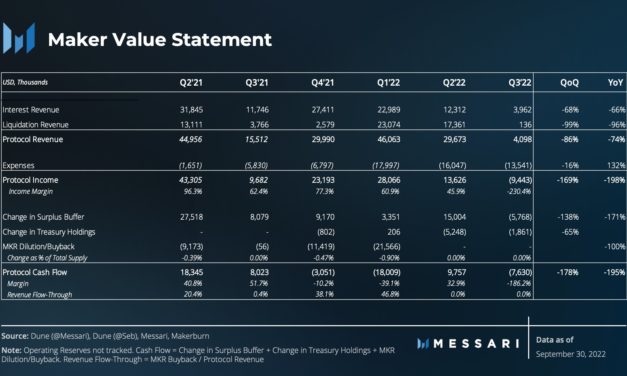
MakerDAO revenue tumbles 86% on Ether and Wrapped BTC woes

MakerDAO, the governing body of the Maker Protocol has seen its revenue plummet in the third quarter of 2022, caused by a fall in loan demand and few liquidations, while expenses have remained high. According to an Oct. 13 tweet by Johnny_TVL, a Messari analyst and co-author of “The State of Maker Q3 2022,” the decentralized autonomous organization saw its revenue plunge to just over $4 million in Q3, down 86% from the previous quarter. One of the results of this has been MakerDAO’s first quarter of net income loss since 2020.MakerDAO value statement as of September 30, 2022. Source: MessariThe Messari senior research analyst has pointed to few liquidations and weak loan demand as the reasons for the drop in revenue.Its two biggest earners, Ether (ETH) and Wrapped Bitcoin (wBTC), have performed poorly in the last quarter, with revenue from ETH-based assets falling 74% and revenue from BTC-based assets falling 66%.Borrowers use these cryptocurrencies as collateral for loans of the Dai (DAI) stablecoin, providing some security from the volatility often seen within cryptocurrency markets at the cost of interest paid on the loans.Maker quarterly revenues by collateral token. Source: MessariThe analyst has also pointed to a fall in the collateral ratio of MakerDAO, suggesting the ratio has fallen to 1.1 from 1.9 at the same time last year. However, “expenses are not so elastic” said the analyst, with the report showing that expenses have remained high in the quarter at $13.5 million, falling only 16% from the previous quarter.Related: Nexo-labeled address withdraws $153M in Wrapped BTC from MakerDAOMeanwhile, MakerDAO has recently taken steps to increase the return on assets it holds as collateral, having commenced a proposal to invest $500 million in treasuries and bonds. MakerDAO believes this will provide the protocol with low-risk additional yield. One other positive for MakerDAO was the growth in Real World Asset (RWA) backed loans, which now accounts for 12% of its total revenue after it successfully rolled out its largest RWA backed loan to Huntingdon Valley Bank (HVB) in the third quarter of 2022.The loan, which involved the creation of a vault with 100 million Dai, constitutes a new collateral type in the Maker Protocol which can help it generate additional revenue through vault stability fees associated with maintaining the vault and minting DAI.HVB is still able to benefit from this integration as it allows the bank to effectively increase its legal lending limit, and MakerDAO hopes that if all goes smoothly other banks will follow behind HVB.

Čítaj viac

FASB guidelines could 'smooth the way' for broader crypto adoption

The United States Financial Accounting Standards Board (FASB)’s decision to allow companies to use “fair value” to account for their crypto holdings could be seen as another step toward the wider institutional adoption of cryptocurrency. During a meeting on Oct. 12, the FASB board made the decision to require entities to measure crypto assets at “fair value.”The board’s decision is “tentative” at this stage, and could be changed at future board meetings when they continue to weigh their options.The decision, if approved, will allow companies to update their balance sheets regularly with the fair value of crypto assets rather than referring to digital assets such as Bitcoin (BTC) as “intangible assets,” where companies were required to measure assets at their lowest price during a reporting period.The previous treatment of digital assets resulted in large impairment losses on balance sheets even if their positions were currently in the green, with firms being unable to regularly update the value of their holdings if the value were to increase.Anthony Tuths, principal of KPMG’s Alternative Investment Tax practice said the guidance could be bullish for broader mainstream crypto adoption, adding it is likely to go into effect in 2023. “FASB has just cleared the way for new accounting guidance which will allow most cryptocurrencies to be accounted for at fair value. When this guidance goes into effect (likely in 2023) it will greatly help smooth the way for broader mainstream adoption.”Tuths added that not all digital assets would qualify for the new accounting treatment however, with NFTs, asset backed tokens, and similar tokens still subject to the previous guidelines.Crypto tax firm CoinLedger’s director of strategy Miles Brooks said the new FASB decision is “long overdue.” The U.S. standard-setter had declined to consider new accounting rules for crypto until May. 11, when board members decided to add the project to its technical agenda after an increase in market capitalization of crypto assets made the matter more urgent.Brooks continued to say the new FASB standards will allow companies to more accurately report their current crypto holdings within their financial statements. Related: Colorado is accepting crypto for tax payments — it could be a mess or a shining exampleCompanies and investors have been seeking clarity on the accounting standards for crypto for years, for example the California Society of Certified Public Accountants (CalCPA) urged the FASB to treat crypto more like foreign currency all the way back in 2019.

Čítaj viac

Získaj BONUS 8 € v Bitcoinoch

nakup bitcoin z karty

Registrácia Binance

Burza Binance

Aktuálne kurzy