Autor Cointelegraph By Luke Huigsloot

BlackRock CEO: FTX Token caused downfall, but tech still revolutionary

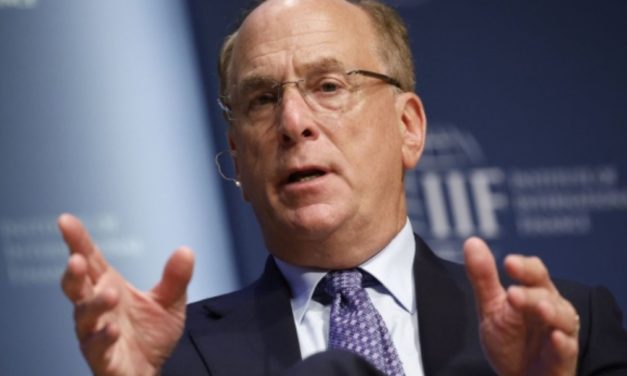
The CEO of the worlds largest asset management firm, BlackRock, believes that the reason why FTX failed is because it created its own FTX Token (FTT), which was centralized and therefore at odds with the “whole foundation of what crypto is.”Larry Fink, who serves as chairman and CEO of the $8 billion investment company — made the remarks during New York Times’ 2022 Dealbook Summit held on Nov. 30, and added that despite his belief that FTX’s own-created token caused its downfall, he believes that crypto and the blockchain technology which underpins it will be revolutionary.BlackRock CEO Larry Fink speaking at the 2022 DealBook Summit. Source: New York Times.Centralized exchange tokens, such as Binance Coin (BNB) and fellow exchange Crypto.com’s Cronos (CRO), account for over $57 billion of the $862 billion total crypto market cap. Fink suggested that he was still skeptical of these tokens and believes “most of these companies [controlling the tokens] are not going to be around.”Later in the interview with New York Times’ journalist Andrew Sorkin, Fink said that while he sees Exchange Traded Funds (ETFs) as being the cause for the previous evolution of investing, he believes that tokenization will be behind the next, noting:“I believe the next generation for markets, the next generation for securities, will be tokenization of securities.”He then elaborated on some of the potential benefits of tokenization, suggesting that it would change the investing ecosystem, as rather than trusting banks, “instantaneous settlement” would be possible on distributed ledgers that show every owner and seller of securities. “Think about instantaneous settlement [of] bonds and stocks, no middlemen, we’re going to bring down fees even more dramatically,” he explained. Related: Sam Bankman-Fried confronted over the fall of FTX in live interviewFink admitted that BlackRock had a $24 million investment in FTX, but refused to speculate on allegations that they and other venture capital firms such as Sequoia Capital had failed to do the proper due diligence on FTX.”Right now we can make all the judgment calls that it looked like there was some misbehavior of major consequence […] if you look at the Sequoia’s of the world they’ve had unbelievable returns over a long period of time, I am sure they did due diligence.”BlackRock has been an active investor in the crypto industry since 2020. Its latest move was revealed on Nov. 3, in which it announced it would be managing USD Coin (UDSC) issuer Circle’s reserve fund. Meanwhile, on Sept. 27, it announced the launch of an ETF giving investors exposure to 35 blockchain-related companies.

Čítaj viac
Bankruptcy court told FTX and Alameda owe BlockFi $1B… but it's complicated

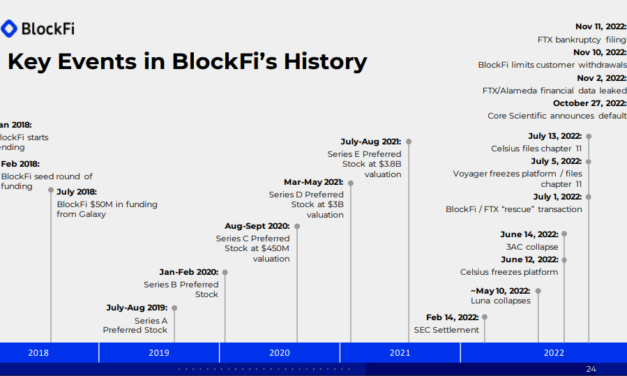
A lawyer for BlockFi told the first day hearing of its bankruptcy proceedings that the crypto lender has $355 million stuck on FTX and that the collapsed exchange’s sister company Alameda Research has defaulted on a $680 million loan.BlockFi filed 15 motions on Nov. 28 which were approved by the court in the first day hearing on Nov. 29, including the redaction of personal details of its 50 largest creditors, and the appointment of Kroll Restructuring Administration as its claims and noticing agent — the same firm chosen by FTX for its chapter 11 bankruptcy case.In a message emailed to worried clients, BlockFi noted that the approved motions allow it to continue “core operations” during the restructuring process, and also to continue to pay its employees and independent contractors. BlockFi estimates that its wages bill is around $5.8 million per month, and that it owed around $1.5 million in wages when it filed the motion on Nov. 28.The message to clients said that BlockFi’s “singular focus” throughout the proceedings is “maximizing value for all clients and other stakeholders.” According to a Nov. 29 CNBC report, BlockFi’s attorney, Joshua Sussberg, also added in the hearing that BlockFi plans to reopen withdrawals to customers at an unspecified time, and he was optimistic that the firm will be able to salvage the business after the restructuring.While FTX and Alameda owe BlockFi around $1 billion, the state of financial obligations is made more complicated by the $400 million line of credit extended to BlockFi by FTX US on Jul. 1.According to BlockFi, which cited the FTX collapse as the reason for its woes, it still owes $275 million to FTX US in a deal which it claims was agreed to by 89% of its shareholders.The funds were provided to BlockFi after it was caught up in the contagion caused by the collapse of Terra’s stablecoin on May 10. BlockFi revealed that the loan is set to mature on Jun. 30 2027 and has an interest rate of 5%.Related: Bitcoin shrugs off BlockFi, China protests as BTC price holds $16KAdditionally, on Nov. 28 BlockFi sued a holding company of Bankman-Fried’s called Emergent Fidelity Technologies, seeking collateral that Emergent had pledged to pay on Nov. 9 which includes shares in the online brokerage Robinhood. The next hearing is set to be held on Jan. 9. Timeline of BlockFi’s history. Source: First Day Hearing Presentation.

Čítaj viac

Digital assets could add $40B a year to Aussie GDP: Tech Council report

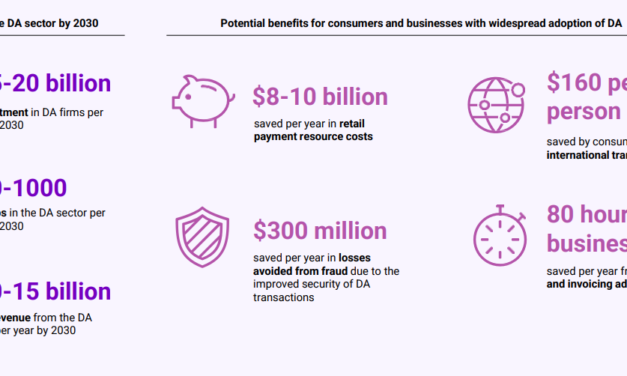
Up to $40 billion a year (AU$60 billion), could be added to Australia’s national GDP with the right regulatory framework and could lead to enormous cost savings for consumers and businesses according to a new report.The Nov. 29 Digital assets in Australia report was commissioned by the Tech Council of Australia (TCA), one of the country’s technology industry advocacy groups, and written by technology consulting firm Accenture, which outlined a number of potential benefits the growth of the digital assets sector in Australia could deliver, stating: “Digital assets (DA) have the potential to transform our lives offering significant time and cost savings to individuals and businesses”The report estimates digital assets — such as cryptocurrencies, stablecoins, tokens, and Central Bank Digital Currencies (CBDCs) — could deliver an “80% reduction in retail payments costs by 2030,” save Australian businesses 200 million hours per year by automating tax compliance and administration, and a further 400,000 hours in preparing documents for business loans.Potential economic and social benefits of the digital assets sector in Australian dollars. Source: Digital assets in Australia 2022 report.It also points to potential savings for consumers of almost $2.7 billion per year (AU$4 billion), or $107 (AU$160) per person, if they use digital assets for international transactions while suggesting that an instant settlement of business transactions could be hugely beneficial for the 4,000 businesses that fail each year due to cash flow issues.Decentralized Autonomous Organizations (DAOs) are referred to in the report as a way to build public trust by making decisions, transactions, and procedures “automated and transparent,” with all members of the organization granted equal rights through the issuance of utility tokens.It also mentions that to fully unlock the potential of DAOs, the government needs to clarify the legal status of DAOs including the liability implications for its members after participants of the Ooki DAO were charged by American regulators.The report estimates “up to 100% of payments” could be facilitated by digital assets if a retail CBDC is introduced, pointing to the rapid uptake of retail CBDCs in other countries such as the e-krona in Sweden. On Sept. 26, the Reserve Bank of Australia (RBA) — Australia’s central bank — released a whitepaper detailing the minting and issuance of an Australian CBDC, called the eAUD, which would be issued as a liability to the RBA. The pilot project is set to commence in 2023.Related: Bitcoin is the king of crypto brand awareness for Aussies: ReportThe report aims to help the government regulate the sector in a way that enables innovation while protecting consumers, and follows a promise from a spokesperson of Australian Treasurer Jim Chalmers — prompted by the downfall of FTX — that regulations would be coming in 2023 which aim to protect investors while still promoting innovation. According to a Nov. 14 report from the Australian Financial Review (AFR), 30,000 Australian investors and 132 companies have funds locked up with FTX.

Čítaj viac

Independent research verifies GBTC's 633K Bitcoin: So why won't Grayscale?

With digital asset management firm Grayscale refusing to provide proof of reserves for its Grayscale Bitcoin Trust (GBTC), an independent analyst has spent days combing through the blockchain to independently verify its holdings.The OXT Research analyst, Ergo, used on-chain forensics to confirm that as of Nov. 23 that the GBTC owns approximately 633,000 Bitcoin (BTC) held by its custodian, Coinbase Custody.The Grayscale G(BTC) Coins Part 2In this analysis we use additional on-chain forensics to CONFIRM the approximate 633k BTC balance held by G(BTC) at Coinbase Custody.Which begs the question, why does Grayscale refuse to disclose their on-chain holdings? https://t.co/lj7KH5thIf pic.twitter.com/pGMzgomFCp— ∴Ergo∴ (@ErgoBTC) November 23, 2022Since the collapse of FTX, there has been increasing pressure on other exchanges and digital asset managers to prove they hold the funds they claim. A GBTC collapse, or liquidation of its holdings, would be a serious black swan event. Concerns have been heightened due to Grayscale’s relationship with embattled crypto lender Genesis Global Trading, given both are subsidiaries of venture capital firm Digital Currency Group.The independent verification of its holdings will give some level of confidence to investors of the product and the industry as a whole, and follow Coinbase attesting to the holdings earlier in the week. Ergo announced they were looking into the holdings of GBTC in a Nov. 20 tweet after Grayscale cited security concerns as their reason for withholding on-chain proof of reserves on Nov. 18.Knowing that most of the assets had recently been transferred from Grayscale’s previous security provider Xapo to Coinbase Custody, Ergo was able to use public data and chain forensics to attribute a balance of about 317,705 BTC in 432 addresses to likely GBTC custody activity.Related: Bitcoin price still due $12K dip, says trader as ETF guru backs GBTCTo find the rest of the BTC held by GBTC, Ergo had to “scan the blockchain” in order to find additional addresses which fit the profile of those they originally found, and notes that while the analysis “certainly includes false positives and negatives,” the addresses they found contain holdings of BTC nearly identical to what GBTC claim to have.Announcing they had confirmed the holdings, Ergo added: “Which begs the question, why does Grayscale refuse to disclose their on-chain holdings?”Twitter user Skyquake-1 offered a possible answer, having dug up GBTC’s Securities and Exchange Commission (SEC) filing from January 2017, which states that the custodian “may not disclose such [public] keys to the Sponsor, Trust or any other individual or entity.”Turns out it was part of the $GBTC prospectus. They’re simply not allowed to tell you lolhttps://t.co/8inudjBWUe pic.twitter.com/WxlWjjAkmP— illiquidity providoooor (@skyquake_1) November 22, 2022

Ergo has received praise from many in the in the community, including crypto research firm Delphi Digital’s Ceteris, who retweeted the analysis and added:“Ergo is a treasure”The Twitter community has been a constant source of insight into the crypto industry, particularly since the fallout of FTX, and has even received praise from Coinbase CEO and co-founder Brian Armstrong and Elon Musk for their efforts.

Čítaj viac

WEMIX token plunges 70% after it's delisted by Korean exchanges

South Korea’s largest crypto exchanges have announced they will delist WEMIX (WEMIX) — the native token of gaming company Wemade’s blockchain platform Wemix — alleging the firm provided “false information” in response to an investment warning it was issued.Bithumb, Upbeat, Coinone, Korbit and Gopax — which are part of a collective called the Digital Asset eXchange Alliance (DAXA) — announced on Nov. 24 that they would terminate contract support for WEMIX, with trading set to end on Dec. 8.In the investment warning issued Oct. 27, DAXA alleged that there was considerably more WEMIX in circulation than Wemix had disclosed, and Wemix had pledged to work with DAXA to alleviate these concerns.After news of the decision to delist broke, WEMIX Communication released a statement claiming it had sincerely responded to requests and concerns raised by DAXA and corrected a number of issues where they believe the circulating supply had been overstated the group, adding:“The WEMIX team does not acknowledge or agree with the unreasonable decision made by the Digital Asset eXchange Alliance (DAXA)… It is crucial to note that the Foundation has not circulated a single WEMIX more than what we have officially disclosed thus far.”The price of WEMIX plummeted following the news, and at the time of writing is down 70.8% with a current price of $0.476.The CEO of Wemade Henry Chang has reportedly invested his monthly salary into the WEMIX token eight times, including purchasing 18,928 WEMIX Classic with October salary this year. Wemade is best known for its hit franchise The Legend of Mir which peaked at over 200 million sign ups and includes one of the world’s most popular blockchain games, Mir 4. It announced on Nov. 2 that it had raised $46 million from Microsoft, and asset management firms Kiwoom Securities and Shinhan Asset Management. Chang said at the time:“Wemade and Wemix will continue to exert efforts to attract more capital and actively invest to build the global digital economy platform.”Related: The rise of mobile gaming shared a lot in common with crypto gamingWemade also announced a plan to release a new economy platform which combines non-fungible tokens (NFTs) and decentralized autonomous organizations (DAOs).While South Korea is one of the biggest gaming markets and blockchain adopters in the world, the country has banned play-to-earn (P2E) blockchain games.Since being elected on Mar. 10 in a tight race, crypto-friendly President Yoon Suk-yeol has hinted that the ban could be lifted and is looking to grow the virtual asset market by overhauling “regulations that are far from reality and unreasonable.”

Čítaj viac

Získaj BONUS 8 € v Bitcoinoch

nakup bitcoin z karty

Registrácia Binance

Burza Binance

Aktuálne kurzy