Autor Cointelegraph By Keira Wright

Kiss this: You can buy Gene Simmons’ Las Vegas mansion with crypto

Rock legend Gene Simmons says he will accept crypto payments for the sale of his $13.5 million mansion in Las Vegas.The iconic bassist and co-lead singer of Kiss will accept payments in or a combination of Bitcoin, Ethereum, Litecoin, Uniswap, Polkadot, Aave or Try.Finance according to hard rock news site, Blabber Mouth. Listing broker Evangelina Duke-Petroni from Berkshire Hathaway Home Services told the Las Vegas Review-Journal in a Feb 1 interview that any potential crypto payment for the property would have to be “verified through closing costs, including taxes and commissions.” The three-level mansion sprawls across over 11,000 square feet in the Ascaya luxury community overlooking the Las Vegas skyline. Rock legend @GeneSimmons is selling his home in Henderson’s Ascaya community for $13,500,000 and says he will accept cryptocurrency as payment.Bitcoin, Ethereum, Litecoin, Uniswap, Polkadot, Litecoin, Aave, Try — or a combination of those. pic.twitter.com/HlTHZkrJfX— Las Vegas Locally (@LasVegasLocally) February 2, 2022Although Duke-Petroni didn’t provide any further clarification, she did add the property will “be paid in a currency that’s recognized by traditional standards.”Simmons describes himself as an “outspoken proponent of cryptocurrency.” He said: “It is the future of money, and it just makes sense to offer interested parties the option of using cryptocurrency to purchase the estate.”The Demon has been bullish on the crypto scene for quite some time now. Back in 2017, the Israeli-American musician alluded to his interest in Bitcoin during an interview with The Street. He also made headlines back in 2020 with some elusive comments on a tweet from Gemini co-founder Cameron Winklevoss, suggesting that he was working on making crypto more accessible. I will. I am. https://t.co/GQJMpDUYCH— Gene Simmons (@genesimmons) September 15, 2020

On Feb 1 2021, Simmons tweeted confirming he owned both Ripple (XRP) and Dogecoin (DOGE). Six days later, returned to Twitter to share that he had bought even more DOGE, and yet again on Feb 19 claiming he had purchased $300,000 worth of Cardano (ADA). The rock star has also shared that he owns $300,000 worth of Ether (ETH), and $300,000 worth of Binance Coin (BNB). However, some members of the crypto community appeared skeptical of Simmon’s rapid fire crypto endorsements. What happened to DOGE coin? wasn’t that your favorite coin some days ago?— Jaime Cornejo (@Realkaisser) February 19, 2021

Related: Coinbase CEO reportedly buys LA mansion for $133MSimmons originally purchased the property for $10.8 million in May 2021, before listing it for sale at $14.95 million in Oct, not even half a year later. He’s not the first celebrity to accept crypto payments for his home. Back in June 2021, DJ David Guetta put his luxury $14 million apartment on Miami Beach up for sale and was accepting payments in BTC and ETH at the time.

Čítaj viac

Jack Dorsey: Diem was a waste of time, Meta should’ve focused on BTC

Twitter founder Jack Dorsey said that Meta’s failed cryptocurrency project Diem was “wasted effort and time,” and it should have focused its efforts on “making Bitcoin more accessible for everyone.”MicroStrategy CEO Michael Saylor interviewed Dorsey on Tuesday at his company’s “Bitcoin for Corporations 2022” conference about how corporations could integrate and use Bitcoin (BTC).Dorsey said that although Facebook probably started Diem for “the right reasons,” it should’ve used an open-ended protocol like Bitcoin rather than attempting to create its own currency. “This whole thing with Libra and then Diem, I think there’s a ton of lessons there,” Dorsey told Saylor. “Hopefully they learned a lot, but I think there was a lot of wasted effort and time.” His criticism of Twitter’s more popular and successful social media counterpart should perhaps come as no surprise. Since stepping down from his role as Twitter CEO in Nov last year, Dorsey has since made is clear that he plans to make Bitcoin the focus of his new company, Block (formerly known as Square.) Block allows users to purchase Bitcoin through mobile payments service, Cash App. “Those two or three years or however long it’s been could’ve been spent making Bitcoin more accessible for more people around the world.”Dorsey added that making BTC more accessible would also benefit many of Meta’s products, specifically referring to Facebook Messenger, Instagram and WhatsApp. “We have this open network right now. And it’s usable. It’s not accessible to everyone, but it’s usable. The easier we make it, the faster we make it, the more approachable we make it, it’s going to better everything. Including everything Facebook intended to do with Libra.”In 2019, Facebook (now branded as Meta Platforms) released the white paper for Libra, its long-awaited crypto-based financial infrastructure project today. However, following a slew of regulatory hurdles and bad PR that forced the project to rebrand to Diem in Dec 2020, it ultimately came to an untimely end. Related: Zuckerberg’s Diem reportedly weighing sale after stablecoin plans falterMeta officially announced it would be selling Diem’s intellectual property and other assets to Silvergate Capital Corporation on Jan 31 2022 for the aggregate value of $182 million, officially handing over the ropes yesterday on Feb 1.On Jan 12, a Cash App upgrade integrated the Bitcoin Lightning Network, allowing faster and cheaper BTC transfers using the layer-two (L2) payments protocol.

Čítaj viac

Bitcoin Network Transaction Volume Surpasses American Express: Research

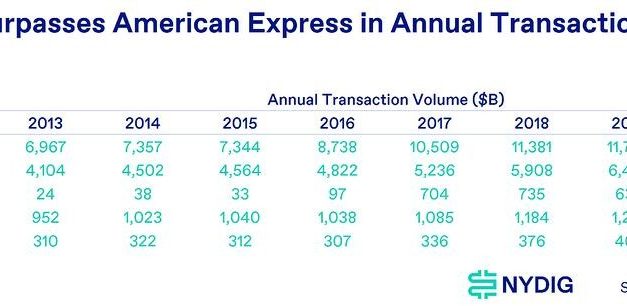
New research has found that the annual transaction volume on the Bitcoin network surpassed that of some well-known card networks, such as American Express (AmEx) and Discover, during 2021. The NYDIG Research Weekly’s Jan. 29 report stated that Bitcoin processed $3 trillion worth of payments during 2021, placing it above popular credit card networks American Express ($1.3 trillion) and Discover ($0.5 trillion).The report authors, NYDIG Global Head of Research Greg Cipolaro and Research Analyst Ethan Kochav, also found that the Bitcoin network had settled more transaction volume in Q1 2021 than “all credit card networks combined for the entire year.”“This is astonishing growth, in our opinion, for a payment network that just had its 13th birthday,” they wrote. American Express issued its first card in 1958, and Discover in 1985.However, the Bitcoin network still has a way to go before catching up to Visa and Mastercard, which processed $13.5 trillion and $7.7 trillion in transactions, respectively. It also should be noted that the study only looked at the $USD value of transaction volume, rather than the actual number of transactions. Therefore, it’s likely that most of the BTC transactions were simply users purchasing, swapping, and selling their BTC rather than using it to pay for anything. While Bitcoin’s growth in transaction volume has not always been linear year-to-year, Cipolaro and Kochav said that it has “kept up at a torrid pace when looking at 5-year compound annual growth rates.”“At the end of 2021, transaction volumes have been growing by nearly 100% annually over the past 5 years.”In Nov. 2021, a Blockdata report estimated that the Bitcoin network could potentially match the dollar value transferred on Mastercard’s network by as early as 2026. It also found that the Bitcoin network already processes more volume by dollar value than PayPal.According to the report, the Bitcoin network processed about $489 billion per quarter in 2021, which is greater than PayPal’s $302 billion. Related: Bitcoin overtakes PayPal on value transferred, sets sights on Mastercard: ReportThe measure of Bitcoin transaction volumes doesn’t report the raw volume of on-chain transactions, but rather “relies on statistical analysis by data providers (such as Glassnode) to remove transactions without economic substance.”The report includes “intra-entity transactions,” which are transactions between addresses within the same wallet or owned by the same organization. For example, this might apply to a crypto exchange that is frequently moving Bitcoin around between different addresses. So, in other words – the $3 trillion figure should perhaps, be taken with a pinch of salt.

Čítaj viac

Yield Guild Games Raises $1.45M for Philippine Typhoon Relief

Yield Guild Games (YGG) has raised $1.45 million to support people affected by December 16’s Typhoon Odette in the Philippines, with nearly $1 million already dispersed to people in need.The funding was used to purchase essential goods like medicines, power generators, and canned food, which were turned over to the Philippine Army and Navy and non-profits to distribute among affected communities. There is still about $458,000 worth of crypto and tokens that have been donated to the relief fund but they have yet to be converted to fiat currency for deployment, according to a representative from YGG. Our Transparency Report for Typhoon #OdettePH relief efforts is up! @yieldguild raised $1.45M and has so far disbursed a total of $992K to date. Meanwhile, our direct financial assistance program has helped 3K+ households begin to rebuild ❤️ https://t.co/GMdu8OjfxP — YGGPilipinas (@YGGPilipinas) January 31, 2022The Filipino division of the play-to-earn gaming guild “YGG Pilipinas” announced the relief operation a day after Typhoon Odette hit the country, quickly raising $110,000 in a number of crypto tokens including SLP, AXS, ETH, WETH, and USDC by the end of the day. Getting close to the 6,000,000 peso ($110K) mark in crypto donations. We’ll continue to raise funds all throughout the weekend while we find and assign key community leaders in each affected city. #OdettePH https://t.co/HgKjzw3h7v— YGGPilipinas (@YGGPilipinas) December 17, 2021

YGG Pilipinas Country Manager Luis Buenaventura led the initiative. He explained to Cointelegraph that the Philippines represents the largest portion of the YGG community, so Odette was close to their hearts. “We’re Filipino-led; many of the senior staff reside here in the Philippines and indeed the largest portion of the global play-to-earn community is based here, which is why so many of the play-to-earn projects came out to contribute to the cause when they saw the extent of the typhoon damage.”“Our community is as important to us as our core team, and many of them were either driven from their homes or have been living without running water or power for a month now,” he said, adding that many staff members were living in areas badly affected by the typhoon. Aside from funds collected by the YGG community, a number of others in the broader Web3 community also got involved. Co-founder of NFT play-to-earn game Axie Infinity Jeffrey “Jihoz” Zirlin donated 1,000 AXS ($55,400) to the relief fund on Christmas day. He said:“As we work together to help our brothers and sisters in the Philippines recover and rebuild, we remember that this is what our community is about.”YGG co-founder, Gabby Dizon, said that the relief effort showed the power and unity of the Web3 gaming community. “This is our testimony that we are more than just a community of gamers,” he said.Meanwhile, players of the play-to-earn game DeFi Kingdoms (DFK) also voted to donate a total of $500,000, with the developer team chipping in an additional $250,000. Related: 40,000-member players guild raises $6M to make P2E gaming easierSince some of the people who were affected by Odette needed cash more urgently than relief goods, YGG also launched an aid project “Crypto Ayuda” to send cash aid to individuals who needed direct assistance. Recent estimates claim that Typhoon Odette affected around 9 million people, with nearly 325,000 remaining displaced to date. The Typhoon damaged over 50,000 homes and $260 million worth of agricultural goods.

Čítaj viac

Tusk Ventures CEO: Don't repeat social media mistakes with Metaverse regulations

Tusk Ventures CEO and founder Bradley Tusk says that the failure to regulate cryptocurrency and social media effectively in the United States is a “really good lesson for how we should handle the Metaverse.”In a Feb. 1 interview on CNBC’s “Closing Bell,” Tusk urged U.S. policymakers to “get ahead” of the Metaverse and implement regulations sooner rather than later. “Typically speaking, our policy has been that we wait for technology to be introduced to gain market fit and traction [before introducing regulation].” However, “It’s very hard to do that retrospectively,” he said. “We know the Metaverse is coming — it’s already here in some ways. We know it’s got all the problems of the internet, probably times five or ten. So why don’t we think about it now, and get ahead of it?”He echoed this sentiment in a Mirror blog post uploaded the same day, writing: “The problems we have regulating technology companies now will be reproduced and amplified in the Metaverse. You think policing state-sponsored disinformation is hard on Facebook and Twitter? Wait until you try it in 3-D.”He also stated that while policymakers are unable to develop specific regulations for the Metaverse until they have a better sense of what’s coming, they should start by looking at cryptocurrency and social media. How do you think appropriate regulation can be put in place for something that is not yet defined or well understood? I understand the desire to get it “right” but I don’t think regulation is beneficial, especially at this stage. A plan to educate policymakers though, sure.— Adam Sternbach (@adamsternbach) January 31, 2022“We can avoid making the same mistakes we did with Facebook, Instagram, Twitter, and social media generally if we can develop an intellectual framework for regulating the Metaverse now.”Crypto regulation is becoming an increasingly hot topic in the hallways of the U.S. Securities and Exchanges Commission (SEC). According to a Jan. 19 report by Cornerstone Research, the SEC has launched a total of 97 actions against crypto organizations since 2013, 20 of which happened in 2021 alone.Despite the continued calls from some congresspeople and industry players for a more coherent and consistent regulatory framework when dealing with cryptocurrency, Tusk told CNBC that policymakers’ inaction had left citizens without basic protections. “We don’t have basic rights about who owns what data, how can we transfer it, how can we take it down. Those are all basic things that I think at this point we have a right to expect our government to handle. And when the Metaverse comes, it’s just going to be that much more extreme.”Related: US congressman calls for ‘broad, bipartisan consensus’ on important issues of digital asset policyTusk was an early investor in Uber, Lemonade, and Coinbase. During 2009, he served as the campaign manager for media oligarch Michael Bloomberg in his bid to be re-elected as the Mayor of New York City. He also has acted as the Deputy Governor of Illinois, an early political advisor to Uber, and the Communications Director for U.S. Senator Check Schumer.

Čítaj viac

Získaj BONUS 8 € v Bitcoinoch

nakup bitcoin z karty

Registrácia Binance

Burza Binance

Aktuálne kurzy