Autor Cointelegraph By Keira Wright

Deadmau5 and Portugal The Man release single as 1M NFTs in bid to go platinum

Dance music star Deadmau5 and Grammy award-winning indie rock band Portugal The Man (PTM) have teamed up to release one million copies of their new single “This is Fine” as nonfungible tokens (NFTs). The single was released on Deadmau5’s (whose real name is Joel Zimmerman) label, Mau5trap with the aim to have the single be the first NFT to go platinum.The artists minted one million units on the NEAR protocol blockchain and released them on marketplace Mintbase. A quarter of a million units were available for purchase during Art Basel’s “Miami Beach” art show on Dec. 2. We are excited to welcome @deadmau5 @portugaltheman to Miami for #ArtBasel and the exciting launch of their “platinum” #NFT music project on @Mintbase with @nearprotocol— Mayor Francis Suarez (@FrancisSuarez) December 2, 2021The remaining singles will be sold as a mix of single units and bundled units, each with unique attributes. The bundled unit prices are still yet to be determined. The announcement promised “multiple metaverse integrations and rewards coming for collectors of this NFT,” but provided no additional details. mau5 x @portugaltheman “this is fine” now available at @mintbase 😀 https://t.co/qvfGeLAWVC pic.twitter.com/EXPXIONcbl— Goat lord (@deadmau5) December 2, 2021

According to guidelines from The Recording Industry Association of America (RIAA), a certified platinum sale is one million units. It remains unclear whether the song will go platinum even if all one million copies are sold due to its unconventional method of release. Each NFT is being sold for 0.25 NEAR per piece, or around $2.20 – similar to the price of an iTunes download in the pre-stream years. In addition to the single, each NFT also features unique artwork by Wooden Cyclops, the art director of PTM. He collaborated on the artwork with Smearballs, the artist behind the Deadmau5’s characters in his music videos “Monophobia,” “Drama Free” and “Pomegranate.” NFT + Poster To celebrate the NFT song collab drop from @portugaltheman x @deadmau5 get instructions to get an 18×24 poster signed by John Gourley from Portugal the Man and myself #woodencyclops #portugaltheman #deadmau5 #OpenSeaNFT https://t.co/P7RsWBGT14 pic.twitter.com/gNFw0LnIlh— Wooden Cyclops (@WoodenCyclops) December 2, 2021

Related:Snoop drops ‘Decentralized Dogg’ NFT like it’s hotDeadMau5 is not new to the NFT game. In Dec 2020, Zimmerman partnered with augmented reality artist Sutu create NFT In Titan’s Light — a 30-second audio-reactive artwork loop paired with a section of the deadmau5 track SATRN.A month later in Jan 2021, he partnered with digital artist Mad Dog Jones to release two NFT art collections on the Winklevoss-owned Nifty Gateway. In the same month, PTM launched its crypto token “PTM Coin” on the ETH-based Rally Network. The token grants fans exclusive access to events and perks.

Čítaj viac

5 year study: Can token rewards improve HIV patient outcomes in Africa?

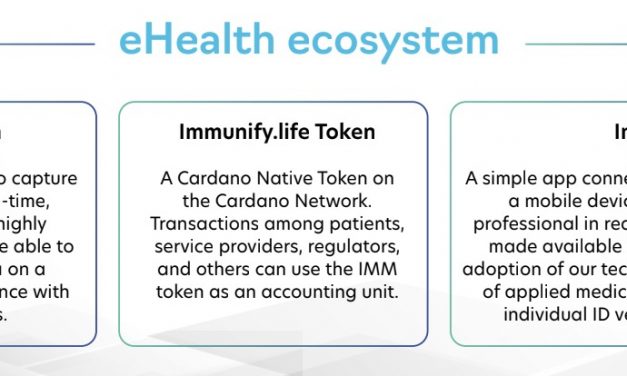
A groundbreaking five-year study into whether crypto token incentives can improve health outcomes for patients with HIV/AIDS will be launched in Kenya by the end of the year.On Nov 1, the blockchain-powered healthcare ecosystem Immunify.Life and the Masinde Muliro University of Science and Technology (MMUST) announced they had secured the approval needed from an ethics committee and the national commission to launch the study.Together they will conduct a five-year study on HIV/AIDS starting before the end of 2021 in the Kakamega County region of Kenya, before extending throughout the rest of the country.The first major project of this collaboration is a groundbreaking study in #HIV/#AIDS to investigate the effectiveness of incentives and paperless tracking systems on HIV treatment adherence and treatment outcomes in low socio-economic settings in Kenya.— Immunify.Life (@ImmunifyLife) December 1, 2021MMUST will use Immunify.Life’s blockchain technology to collect and analyze patient data to help improve the outcomes of HIV treatments. It will evaluate whether patients have better treatment outcomes if they are incentivized with token rewards for health-positive behaviors identified by project sponsors like NGOs and government institutions. Immunify.Life CEO Guy Newing told Cointelegraph: “The program we are testing will offer token incentives to encourage lapsed patients to present at the clinic for their treatment.”Patients and doctors will be rewarded with Immunify.Life’s native ERC-20 IMM token. He added these could be offered for “completing a prescribed course of antibiotics for Tuberculosis,” and to incentivize, “HIV patient returning regularly to the clinic for their check-up and treatment.” Newing said that health care workers will also be rewarded for positive behaviors such as “correctly filling out consultation records, ordering a certain number of tests for Tuberculosis, or completing medical education.”Every patient who uses the platform is issued a nonfungible token (NFT) health ID that captures key medical data, like vaccination records. This data is then transferred to a digital registry to enable remote medical supervision and real-time data access for medical professionals. The study’s sample size is 600 patients. Half will receive the token incentivization, and the other half will act as controls and will not receive token rewards. The patients will be monitored over six months and will receive active treatment and monitoring on a monthly basis.The study will also track the efficacy of using paperless healthcare tracking systems in a low socio-economic area.Source: Immunify.LifeNewing said that, “Critical Medical data treatment data can be captured in real time, time stamped and secured; it can’t be hacked or changed.” The platform will initially use a second-layer solution on Ethereum using Polygon, with long-term plans to bridge to Cardano.Aside from the token rewards provided by sponsors, patients will also financially benefit from the sale of anonymized medical data. Immunify.Life is currently conducting a private round for Strategic and Institutional investors before its initial DEX offering (IDO) which is planned for early 2022. “Patients will be empowered to take control of their data and share in the financial rewards. The system is funded by fees charged to organizations who fund and deliver the healthcare.”In addition to work in HIV in Kenya, Immunify.Life is applying its blockchain technology in two other therapeutic areas, COVID-19 & Opioid addiction. Related: How Blockchain Will Revolutionize HealthcareKenya is home to around 1.5 million people with HIV according to the 2020 UNAIDS report. While 70% of these patients undergo treatment, there are present difficulties around tracking, access, program design, and data collection. Many people diagnosed with HIV are unable to continue with treatment. In some areas, the number of ‘lapsed’ patients can reach up to 40%, according to Immunify.Life. This includes pregnant women, who can pass on the virus to their child during birth.

Čítaj viac

Lummis says Fed is 'violating the law' with Wyoming blockchain bank delays

Republican senator for Wyoming Cynthia Lummis has argued that the Federal Reserve is “violating the law” by delaying the processing of applications from crypto-native banks to receive accounts at the central bank.In a Nov. 30 op-ed for the Wall Street Journal, Lummis claimed that the Fed was treating the Special Purpose Depository Institutions (SPDIs), also known as ‘blockchain banks’, in her home state unfairly. She called on her Republican colleagues to withhold support for Fed chair Jay Powell who was reappointed by President Biden on Nov. 23.In Feb. 2019, Wyoming state legislature approved SPDIs to serve businesses unable to secure banking services from the Federal Deposit Insurance Corporation (FDIC) due to their dealings with crypto. In 2020, two Wyoming SPDIs Kraken and Avanti received their bank charters. Shortly after, they applied for master accounts with the Federal Reserve Bank of Kansas City. Their applications are yet to be approved. The state has been in discussions whether SPDIs should be considered banks under federal law. In the article, Lummis claimed that SPDIs should, “without a doubt,” be considered banks under federal law and that “Wyoming checked every box.” She added that SPDIs meet the standard set by Congress in the Federal Reserve Act for what constitutes a bank. She said that “in fact the Fed is violating the law by delaying” issuing the SPDIs approval, citing federal courts which have stated that the Fed “has a duty to give payment system access to all banks and credit unions conducting legal activities.”Related: ‘Thank God for Bitcoin,’ Cynthia Lummis says on US debt limit raiseOn Oct. 7, Lummis filed documents revealing that she had purchased an unknown amount of Bitcoin (BTC) on Aug. 16 worth somewhere between $50,001 and $100,000. Lummis made the purchase less than two weeks after she and other senators attempted to gain support for a pro-crypto amendment into President Joe Biden’s infrastructure bill.

Čítaj viac

In 2013, Wired destroyed the key to 13 BTC now worth $760K… to make a point

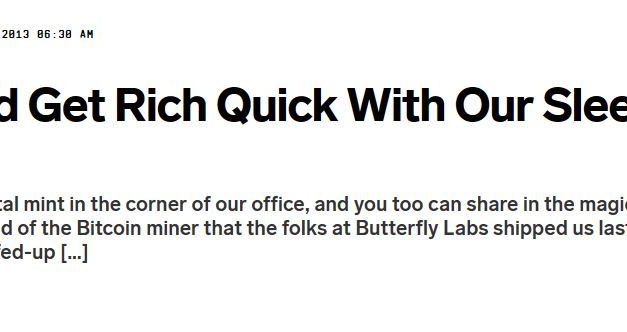
There has been no shortage of people and institutions that woefully underestimated the potential of cryptocurrency. Among the ranks of once-were Bitcoin naysayers is Wired, which destroyed the private key to a Bitcoin (BTC) wallet holding 13.34623579 BTC back in 2013 in order to make the point the cryptocurrency was nothing more than an “abstraction.” The Bitcoin in the inaccessible address is now worth $761,000.Author Robert McMillan, who now is a reporter with the Wall Street Journal, set up a Butterfly Labs Bitcoin mining rig in the corner of his office at Wired to see what all the fuss was about. And at the conclusion of his little experiment, he was far from impressed. Full marks for being early, null points for wise choices.“The world’s most popular digital currency really is nothing more than an abstraction,” he wrote. The journalist deliberated on what to do with the Bitcoin at the time, initially considering donating them to charity. “But in the end, the answer was obvious,” he wrote, adding, “We’re destroying the private key used by our Bitcoin wallet.”“That leaves our growing pile of Bitcoin lucre locked away in a digital vault for all eternity — or at least until someone cracks the SHA-256 encryption that secures it.”At the time, the Butterfly Labs ASIC was churning out an average of 2 BTC every 10 days. Wired noted in the article that 2 BTC was worth about $220 at the time. Now, they’d be worth about $57,000 each, or $112,000 for the pair — an increase of around 51,000%. In 2013, it took an average of 13 hours to mine 1 BTC using an ordinary PC. By 2014, that time had grown to 23 days. In 2021, it would take 10 years to mine 1 BTC, according to the New York Times. Even back in 2013, however, Bitcoin mining difficulty had been increasing exponentially. McMillan complained that it had become about 10 million times harder to win the Bitcoin mining “lottery” since 2009. Related: Bitcoiner loses almost $100K of BTC in wallet transfer bungleReddit user u/leMartinx highlighted the article in a post on Wednesday, writing that the whole debacle shows “how we have come a long way from 2013.” But many other users weren’t so forgiving, such as u/Cappy2020, who commented, “Serves them right for being so arrogant,” adding, “Even if you thought Bitcoin was just ‘daydreaming,’ at least hold onto it in the off chance that you could, maybe, be wrong.”Meanwhile, u/BakedPotato840 wrote:“It’s not surprising to find posts from the past to have this opinion on Bitcoin. The real ones who deserve criticism are the people who still have these opinions today.”

Čítaj viac

Získaj BONUS 8 € v Bitcoinoch

nakup bitcoin z karty

Registrácia Binance

Burza Binance

Aktuálne kurzy