Autor Cointelegraph By Keira Wright

‘1 in a billion’: Second tiny miner solves a block

In an astonishing turn of events, two lucky miners from the Solo CK mining pool have defied all odds and added a new block on the Bitcoin blockchain in the same week. On Monday, a tiny miner successfully solved a block with a modest hash rate capacity of 126 terahashes per second (TH/s). Bitcoin mining expert and member of the Bitcoin Mining Council Hass McCook told Cointelegraph at the time that the odds of this happening were 1 in 1,400,000.But according to a Jan 13 tweet from Solo admin Con Kolivas, another miner from the same pool was able to solve a block with a capacity of only 116 terahashes per second (TH/s) — even less than the first miner. That’s likely to be just one to three mining rigs, depending on the equipment used. Kolivas added that the new miner joined the pool less than two days ago, “presumably in response to the other lucky block solver.”“They’ve been astronomically lucky in solving a block solo in that time,” he wrote.“This is insane luck at work, and a very unusual event.”’Insane luck’ might even be an understatement. McCook told Cointelegraph that the odds of this happening are so unlikely, he is unsure of how to even mathematically calculate them. He suggested that the odds of such a small miner succeeding once was one in a million, so two successes just a few days apart would be at least one in a billion.Related: Tiny Bitcoin miner defies massive odds to solve a valid blockWhen the first miner successfully solved a block, McCook said that: “To say this is very rare is an understatement.”Each of the miners, who may have been mining on just one or two machines, will take home 6.25 Bitcoin (BTC) ($266,000) for their efforts.

Čítaj viac
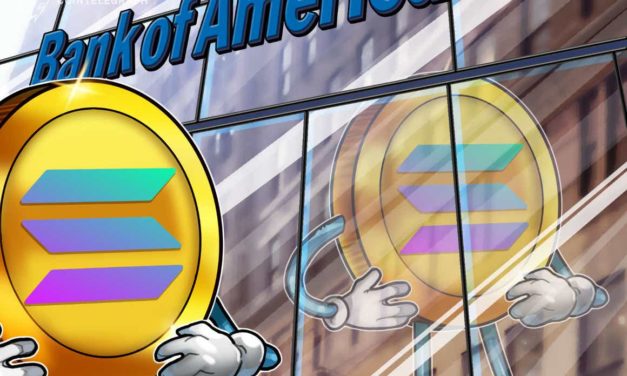

Solana could become the 'Visa of crypto': Bank of America

Bank of America digital asset strategist Alkesh Shah has predicted that Ethereum competitor Solana could become the “Visa of the digital asset ecosystem” in a Jan 11 research note. The Solana network launched in 2020, and has since grown into the fifth largest cryptocurrency with a market capitalization of $47 billion. An order of magnitude faster than Ethereum, it has been used to settle over 50 billion transactions and mint over 5.7 million non-fungible tokens (NFTs). Critics however argue its speed comes at the cost of decentralization and reliability but Shah thinks the benefits outweigh the drawbacks:”Its ability to provide high throughput, low cost and ease of use creates a blockchain optimized for consumer use cases like micropayments, DeFi, NFTs, decentralized networks (Web3) and gaming.”He went on to suggest that Solana is taking a slice of Ethereum’s market share due to its low fees, ease of use, and scalability while Ethereum may be relegated to “high-value transaction and identity, storage and supply chain use cases,” wrote Shah, as quoted by Business Insider“Ethereum prioritizes decentralization and security, but at the expense of scalability, which has led to periods of network congestion and transaction fees that are occasionally larger than the value of the transaction being sent.”Visa processes an average of 1,700 transactions per second (TPS), but the network can theoretically handle at least 24,000 TPS. Ethereum currently handles around 12 TPS on mainnet (more on layer twos), while Solana boasts a theoretical limit of 65,000 TPS. Shah concedes that, “Solana prioritizes scalability, but a relatively less decentralized and secure blockchain has tradeoffs, illustrated by several network performance issues since inception.” Solana has experienced more than its fair share of network performance issues over the past months, such as withdrawal issues most recently confirmed by Binance on Jan 12, reports of delayed performance across social media on Jan 7 and what appeared to be a DDos attack on Jan 5, although Solana denied this was the case.Related: Decentralized and scalable exchange leverages Solana for an improved trader experienceThis came less than a month after a previous attack on Dec 10, with reports of network congestion caused by mass botting associated with an initial Dec offering (IDO) on Solana-based decentralized exchange platform, Raydium. In an interview with Cointelegraph on Dec. 22, Austin Federa, head of communications at Solana Labs, said that developers are currently working to address the network’s issues, specifically in relation to improving transaction metering.“Solana’s runtime is a new design. It doesn’t use EVM [Ethereum Virtual Machine] and a ton of innovation was done to ensure that users have the cheapest fees possible, but there’s still work to be done on the runtime.”

Čítaj viac

Jack Dorsey announces Bitcoin Legal Defense Fund

Former Twitter CEO and founder Jack Dorsey has announced plans to create a “Bitcoin Legal Defense Fund” with Chaincode Labs co-founder Alex Morcos and Martin White, who appears to be an academic at the University of Sussex.The announcement was sent on a mailing list for Bitcoin developers, bitcoin-dev, at 00:13:45 UTC on Jan. 12 from an email address appearing to belong to Dorsey. Cointelegraph reached out to the board members to confirm the email’s legitimacy but did not immediately receive a response.The announcement stated the fund will help provide a legal defense for Bitcoin developers, who are “currently the subject of multi-front litigation.” an email to the bitcoin dev mailing list from @jack explaining the Bitcoin Legal Defense Fund pic.twitter.com/y1XY3XG0IR— Zack Voell (@zackvoell) January 12, 2022“Litigation and continued threats are having their intended effect; individual defendants have chosen to capitulate in the absence of legal support,” the email stated, referencing open-source developers who are often independent and therefore susceptible to legal pressure. “We propose a coordinated and formalized response to help defend developers.”The announcement went on to describe the Bitcoin Legal Defense Fund as a “nonprofit entity that aims to minimize legal headaches that discourage software developers from actively developing Bitcoin and related projects.” “The main purpose of this Fund is to defend developers from lawsuits regarding their activities in the Bitcoin ecosystem, including finding and retaining defense counsel, developing litigation strategy, and paying legal bills,” it stated.Initially, the fund will include volunteers and part-time lawyers for developers to “take advantage of if they so wish,” although, the email also states that “the board of the Fund will be responsible for determining which lawsuits and defendants it will help defend.”“At this time, the Fund is not seeking to raise additional money for its operations but will do so at the direction of the board if needed for further legal action or to pay for staff.”According to the email, the fund’s first project will be to take over the existing defense of Ramona Ang’s “Tulip Trading Lawsuit” against developers including Ira Kleiman for alleged misconduct over access to a BTC fortune. Related: Nano Foundation Sponsors Legal Fund To Provide BitGrail Hack Victims With RepresentationDorsey, who stepped down as Twitter CEO at the end of Nov 2021, is a long-time proponent of Bitcoin. It remains unclear whether Dorsey left the social media firm to focus on Square’s plans to develop a decentralized Bitcoin exchange. On Nov. 19, the decentralized exchange project called tbDEX released a white paper detailing its plans to create a message protocol designed to facilitate trust relationships without relying on a federation to control access.

Čítaj viac

Tiny Bitcoin miner defies massive odds to solve a valid block

A single Bitcoin miner from the Solo CK mining pool has defied the odds after successfully adding a new block on the Bitcoin blockchain, taking home 6.25 BTC ($266,000) for their efforts. The lucky miner, who may have been mining on just one or two machines, solved a block with their modest hashrate capacity of 126 TH/s. According to a Jan 11 tweet from Solo admin, Dr. Con Kolivas it’s equivalent to about 0.000072% of the total Bitcoin (BTC) network hashrate — which is 175,000,000 TH/s (175 EH/s). Bitcoin mining expert and member of the Bitcoin Mining Council (BMC) Hass McCook told Cointelegraph that he has never heard of anything like it, adding that “to say this is very rare is an understatement.”“Usually, having 0.000072% of the hashrate means that, on average, Solo CK will win 0.000072% of the blocks, or, about 1 in 1,400,000,” he explained. “Everything in Bitcoin is probabilistic, even transaction settlement. The more confirmations you have on your tx, the less likely it will be reversed.” Related: How to mine Bitcoin: A beginners guide to mine BTCAccording to McCook, the miner could’ve been using a single machine. “The Antminer S19 is a 110TH/s machine, so Solo CK could have even been mining with just one overclocked rig! More likely it was 5 or 6 Antminer S9 units. Either way, it could very easily be a home miner,” he said. A machine’s hashrate refers to how many hashes, or mathematical equations, it can solve per second. On average, a new BTC block is mined every ten minutes. Dr. Con Kolivas estimated the chances weren’t quite so high,  with a 1 in 10,000 chance of finding a block per day with that hasbut added the miner probably wouldn’t repeat the feat. “For the miner involved it’s a once in a lifetime chance,” Kolivas wrote. “It’s usually larger miners that solve blocks statistically but there is no reason even the smallest miner can’t solve one.”He noted a small miner in his pool had solved a block about one year ago.

Čítaj viac

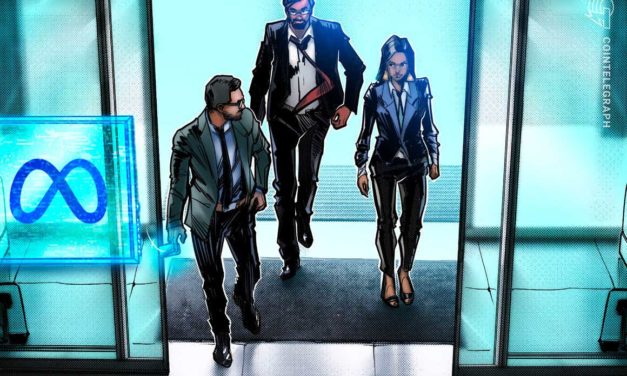
Meta poaches staff from Microsoft and Apple for Metaverse plans

Employees from Microsoft and Apple are jumping ship to join Meta Platforms as the company sets its sights on creating the Metaverse. According to former employees of Microsoft quoted by the Wall Street Journal, around 100 people have ditched the tech giant’s augmented reality team over the past year to join Meta Platforms. They claim that Meta has been particularly focused on snapping up people who have worked on Microsoft’s HoloLens augmented reality (AR) headsets. According to the WSJ, Linkedin profiles show that more than 70 people who were part of Microsoft’s HoloLens team have left the project over the past year, with more than 40 of them taking on new positions at Meta. Microsoft’s first mover advantage in the AR space makes its employees valuable assets to Meta. Microsoft announced its HoloLens project more than five years ago in 2016, with the technology developing into one of the world’s most advanced headsets. Apple is attempting to counteract an employee exodus to Meta by offering lucrative stock options and bonuses worth between $50,000 and $180,000, according to a report by Bloomberg. In late Dec 2021, the company offered the bonuses to a group of engineers in silicon design, hardware and some software operations workers. Facebook’s push to become MetaMeta Platforms was formerly known as Facebook until a major rebranding exercise in Oct 2021, signalling the company’s growing ambitions beyond social media. Its virtual reality hardware business “Reality Labs” has been hard at work in the months since, successfully creating a prototype of its virtual reality “haptic gloves” in mid-Nov 2021. Announcing @Meta — the Facebook company’s new name. Meta is helping to build the metaverse, a place where we’ll play and connect in 3D. Welcome to the next chapter of social connection. pic.twitter.com/ywSJPLsCoD— Meta (@Meta) October 28, 2021Despite these early successes, the centralized Meta’s attempts to dominate the Metaverse has led to no shortage of criticism in the wider community, which includes leaders in the crypto, NFT, blockchain and GameFi spaces. Some crypto leaders such as Hodl Asset’s Jenny Ta have suggested that Mark Zuckerberg shouldn’t be the one to lead Facebook into the Metaverse at all, given his history regarding data mining, privacy and content policies. “In order for him to have a clean slate for Meta, he must step down and he must have a new CEO to run it,” she said in a November interview with Cointelegraph.Both Microsoft and Apple have had their sights set on the Metaverse for quite some time. In early Nov. 2021, Microsoft announced a slew of Teams updates and upgrades to its Xbox gaming console, along with a new product called “Dynamics 365 Connected Spaces.”The metaverse is here, and it’s not only transforming how we see the world but how we participate in it – from the factory floor to the meeting room. Take a look. pic.twitter.com/h5tsdYMXRD— Satya Nadella (@satyanadella) November 2, 2021

“The Metaverse enables us to embed computing into the real world and to embed the real world into computing,” Microsoft CEO Satya Nadella said at the time. “What’s most important is that we are able to bring our humanity with us, and choose how we want to experience this world.”

Čítaj viac

Získaj BONUS 8 € v Bitcoinoch

nakup bitcoin z karty

Registrácia Binance

Burza Binance

Aktuálne kurzy