Autor Cointelegraph By Judith BannermanQuist

New York-based forex broker Oanda launches crypto trading services in the US

New York-based multi-asset trading services Oanda has launched a new cryptocurrency trading service in the United States. This latest addition, developed in partnership with regulated blockchain infrastructure provider Paxos Trust Company, is designed to give investors easy access to crypto alongside their existing forex portfolios in a secure environment. The collaboration will enable U.S.-based investors to spot-trade cryptocurrencies on Paxos’s itBit exchange through Oanda’s mobile platform, the broker said. Investors will be able open and fund trading accounts, as well as access major cryptocurrencies such as Bitcoin (BTC) and Ether (ETH). According to Oanda, users will benefit from the company’s long track record in the forex and derivatives markets. Oanda’s partner Paxos is a regulated blockchain infrastructure provider that uses technology to tokenize, trade and settle assets. Paxos builds enterprise blockchain solutions for companies like PayPal, Interactive Brokers, Meta, Mastercard, MercadoLibre, Nubank, Bank of America, Credit Suisse and Societe Generale. Gavin Bambury, thechief executive officer of Oanda, said the partnership with Paxos gives his firm a regulated partner in which to grow its crypto offerings.Oanda executive Jessica Bestead said the decision to offer crypto trading services was “in response to the needs of active traders,” a sign that more market participants were looking to gain exposure to digital assets. Related: Mobile bank N26 launches cryptocurrency trading with Bitpanda partnershipFounded in 1996, Oanda claims to be first company to share exchange rate data free of charge on the Internet, launching a forex trading platform that helped pioneer the development of web-based currency trading five years later. In recent years, platforms offering foreign exchange trading and other traditional assets have broadened their services to include crypto. As reported by Cointelegraph, major U.S. trading platform Interactive Brokers entered the crypto market in mid-2021 to capitalize on the growing demand. Former forex brokers from Jeffries Financial Group also launched a new crypto exchange for institutional investors.

Čítaj viac
USDC adoption is lagging outside of the United States: Coinbase

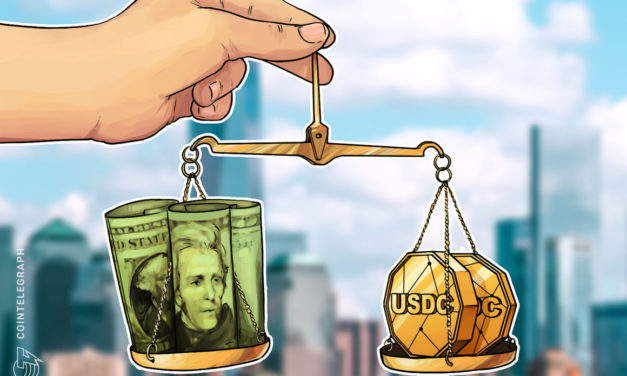
United States-based cryptocurrency exchange Coinbase says the adoption of USD Coin (USDC) has been “more conservative” outside of the U.S., which it believes is a result of international currency conversion fees.In an Oct. 20 statement, the exchange said there is currently three times more USDC bought with U.S. dollars as compared to other currencies.“Currently, 3x more USDC is bought with USD versus non-USD currencies. In part this is because, outside of the US, users usually have to pay fees in the process of converting their local currency into USDC, and this is a barrier to broader international adoption.”The U.S. dollar-pegged cryptocurrency is currently the second-largest stablecoin by market capitalization under Tether (USDT). Coinbase said it sees the utility of stablecoins such as USDC benefitting residents in countries requiring a coin that doesn’t fluctuate in value, is highly accessible and gives access to decentralized finance (DeFi). The exchange said it is aiming to “build more on-ramps for users to access USDC,” and will be waiving fees for all customers who buy or sell USDC using any fiat currency.In 2018, Coinbase along with payments technology company Circle partnered to create the Centre Consortium to develop USDC, which currently is the second-largest stablecoin behind Tether and the fourth-largest cryptocurrency in terms of market capitalization.Related: Acting US FDIC head cautiously optimistic about permissioned stablecoins for paymentsStablecoins such as USDC are seen as a cheaper and faster alternative compared to traditional remittance systems for sending value between parties. A recent report by Chainalysis shows the use of stablecoins for remittances as a key factor driving crypto adoption in Latin America.The move by Coinbase is the latest in efforts to increase the adoption of USDC, in September, Circle announced it would roll out the stablecoin across five additional blockchains including Polkadot, Optimism, Near, Arbitrum and Cosmos.

Čítaj viac

Celestia Foundation raises $55M for modular blockchain architecture

Celestia Foundation announced on Oct. 18 that it had raised $55 million in a funding round led by Bain Capital Crypto, Polychain Capital, Placeholder, Galaxy, Delphi Digital, Blockchain Capital, NFX, Protocol Labs, Figment, Maven 11, Spartan Group, FTX Ventures, Jump Crypto, and angel investors; Balaji Srinivasan, Eric Wall, and Jutta Steiner.Celestia is building a modular blockchain architecture with the hope of solving challenges inherent when deploying and scaling blockchains. The company suggested that it intends to build infrastructure that will make it easy for anyone with the technical know-how to deploy their own blockchain at minimal expense. The company indicated that its modular blockchain architecture will focus on improving scalability, shared security, and sovereignty issues, making it easier for developers to freely choose their own execution environments, such as EVM, Solana VM, and more. In addition, it claimed that its specialized chains are less constrained, and break the rigidity of monolithic chains into flexible components, promising greater scale, security, and decentralization.Mustafa Al-Bassam, co-founder of Celestia said:“Web3 cannot scale within the constraints of a monolithic framework. We envision a blockchain ecosystem with modular data availability layers and execution environments that all integrate together. We believe modular blockchains are the next generation of scalable blockchain architectures.”Projects within Celestia’s current ecosystem include Eclipse, Constellation, dYmension, and 26 projects from Celestia’s fellowship — a program that supports and mentors modular builders.In May, Celestia launched its testnet, Mamaki, with an upgrade scheduled for late October 2022. Related: M31 Capital launches $100M in Web3 investment fund with $50M in commitmentsDespite the ongoing crypto winter, venture capitalists appear to have an insatiable appetite for the Web 3 industry. According to Cointelegraph Research, venture firms invested $14.67 billion into the sector in the second quarter of 2022, effectively matching first-quarter commitments.

Čítaj viac

Aptos Foundation airdrops 20M tokens to its early testnet users

Layer-1 blockchain company Aptos Foundation announced on Oct 18 that it had rewarded its early network participants with free APT tokens. 1/ The Aptos Foundation has provided early network participants with APT tokens. If you are eligible to claim, you will receive an email from airdrop@aptosfoundation.org in the next few hours.— Aptos (@AptosFoundation) October 18, 2022The foundation shared that it had allocated an estimated 20 million APT tokens, representing 2% of its initial total supply of 1 billion APT, to about 110,235 eligible participants. The airdropped tokens had an estimated value of about $200–$260 million USD based on the token’s market price at the time the drop took place.According to the blockchain company, eligibility for the airdropped tokens was based on two categories: “Users who completed an application for an Aptos Incentivized Testnet” and users who minted “an APTOS: ZERO testnet NFT.” Only the original minters of these NFTs were eligible, not the current or secondary owners of the NFTs. The company shared that Aptos tokens could only be claimed via the official Aptos Community page with additional information provided in the eligibility email sent out by the company. They cautioned users to exercise extreme caution and only trust official sources and channels to avoid being defrauded. Aptos Foundation’s first airdrop to its community members comes at a time when the project has been under much scrutiny by members of the crypto community on Twitter. Related: Court partially denies Aptos Labs’ motion to dismiss Glazer’s $1 billion lawsuitSolana Blockchain developer Paul Fidika, who had allegedly worked on Aptos staking, claimed in a series of tweets that the project had “Dodgey tokenomics” and “Fake POS.”1. Dodgey tokenomics. The FTX / Coinbase / Binance tokens going on sale tomorrow are already owned by the exchanges and are already staked (I think???) However these exchanges are marketing as if these tokens are being sold by the community (which is impossible—there was no ICO)— Paul Fidika | OpenRails.dev (@PaulFidika) October 18, 2022

Aptos was created by former Meta employees Mo Shaikh and Avery Ching, both of whom were involved in Mark Zuckerberg’s failed Diem blockchain project. Diem wound down ​​in February of this year, with Meta selling its intellectual property and other assets.In July, Aptos closed a $150 million funding round co-led by venture studios FTX Ventures and Jump Crypto, with additional participation from Andreessen Horowitz, Apollo, Franklin Templeton and Circle Ventures. According to Bloomberg, the funding round more than doubled the startup’s valuation, which was over $1 billion as of March.

Čítaj viac

Food companies secure trademarks to enter metaverse

A number of food companies have recently begun to position themselves within the Web3 ecosystem by filing trademark applications for the Metaverse and nonfungible tokens (NFTs). Licensed trademark attorney Mike Kondoudis shared in a tweet that Kraft Foods Group had filed a trademark for its iconic hot dog-shaped Weinermobile on Oct. 12. The filing revealed that the brand plans to expand into NFTs, digital tokens, virtual goods, NFT marketplaces, virtual food, drink and restaurants. Kraft has applied to trademark the iconic Weinermobile!The October 12 filing claims plans for:NFTs + Digital TokensNFT MarketplacesVirtual Foods + Drinks + RestaurantsOnline Stores for NFTs + Virtual Goods#NFT #NFTs #Metaverse #Web3 #Oscarmayer #Wienermobile pic.twitter.com/u5At9xxMIw— Mike Kondoudis (@KondoudisLaw) October 17, 2022The trademark application suggested that Kraft Foods Group also has plans to operate a virtual restaurant, as well as feature virtual goods for home delivery in both real and virtual worlds.On Oct. 6, the popular food brand and fast food chain, In-N-Out Burger filed a similar trademark application with plans to operate an online retail store featuring virtual goods; namely, food, beverages and merchandise associated with the brand for use in online virtual worlds. IN-N-OUT BURGERS has filed a new trademark application claiming plans for:NFTs + NFT-backed mediaVirtual foods + drinksRetail stores for virtual goodsNFT + Digital token exchanges…and more#NFTs #Metaverse #Web3 #Burger #Innout pic.twitter.com/R52Ev7Sd6z— Mike Kondoudis (@KondoudisLaw) October 11, 2022

According to the trademark application, In-N-Out Burger plans to provide, “temporary use of online non-downloadable software for users to access, transmit, exchange and establish ownership of virtual goods, blockchain tokens, nonfungible tokens, digital media, digital files, and digital assets in the field of food, beverages, restaurants, and merchandise.”Related: McDonald’s starts to accept Bitcoin and Tether in Swiss townOn Oct. 10, Mike Kondoudis also reported that Del Monte Foods had filed eight trademark applications for its underlying brands “Del Monte” and “The Del Monte Sheild,” with plans to create NFTs, NFT-backed media, online virtual marketplaces, virtual restaurants, stores, foods and drinks. Del Monte Foods has filed 8 trademark applications for▶️ DEL MONTE ▶️ The Del Monte ShieldThe applications claim plans for✅ NFTs + NFT-backed media✅ Online virtual marketplaces✅ Virtual restaurants, stores, foods + drinks… and more!#NFTs #Metaverse #Web3 pic.twitter.com/ziyLB5zBCM— Mike Kondoudis (@KondoudisLaw) October 10, 2022

The trademark application also disclosed that Del Monte Foods intends to expand into the Web3 software space. According to the application, the brand will produce “software for uploading, transmitting, publishing, storing, managing, verifying, authenticating, and communicating digital currency, crypto-collectibles, digital tokens, digital files, images, sound recordings, video recordings, virtual objects, and virtual products and services.” In September, Cointelegraph reported that the number of U.S. trademarks filed related to cryptocurrencies, nonfungible tokens (NFTs), Web3 and the Metaverse has grown exponentially within the past year.

Čítaj viac

Získaj BONUS 8 € v Bitcoinoch

nakup bitcoin z karty

Registrácia Binance

Burza Binance

Aktuálne kurzy