
Autor Cointelegraph By Joseph Hall

A third of Americans to buy Bitcoin by end of 2022, says Ric Edelman

Bitcoin bull and founder of Edelman Financial Engines Ric Edelman has made some promising predictions about the future of the seminal cryptocurrency.In an interview on CNBC program ETF Edge on Jan. 10, Edelman said:“We’re already at a quarter of that number with 24% of Americans owning Bitcoin. It won’t be that much of a stretch for it to get to one-third. Bitcoin is becoming more and more mainstream. People are hearing about it everywhere–it isn’t going away.”While 2022 got off to a rocky start, In his view, governments corporations, foundations, pension funds are investing in BTC: “there is major institutional involvement.”As the author of soon-to-be-released “The Truth about Crypto,” Edelman is a long-standing crypto proponent. In 2019, he described Bitcoin as the first “genuinely new asset class” in 150 years, and back in December 2018, he recommended that investors load up on the orange coin. In a follow-up interview with CNBC yesterday, he lamented that while he has predicted a Bitcoin spot exchange-traded fund (ETF) for the past seven years, he’s convinced that by 2023, there will be spot ETF approval. Similar to U.S. Securities and Exchange Commissioner Hester Peirce’s thoughts on the matter, Edelman articulates that the SEC is running out of excuses to say no:“A lot of the concerns the SEC has have been resolved by the industry through their own maturity, innovation and development. I am confident that we will see the SEC say yes because there is no legitimate reason for them not to.”Matthew Hougan, chief investment officer at Bitwise Asset Management agreed with him in the second interview. Related: Crypto mainstream adoption: Is it here already? Experts answer, Part 1Hougan stated that there would be even more investor protections and a better product thanks to the “cumulative weight of the evidence that will force them to move forward with approval.” Consumer protection provided by an SEC-run ETF is the cherry on top of a slick product. ETF speculation aside, Edelman is clairvoyant about the banality of Nakomoto’s invention in the future. He summed it up succinctly; Bitcoin is “going to be as common in the next couple of years as any other portion of a portfolio.”

Čítaj viac
Wall Street still not convinced on Bitcoin $100K this year: JPMorgan survey

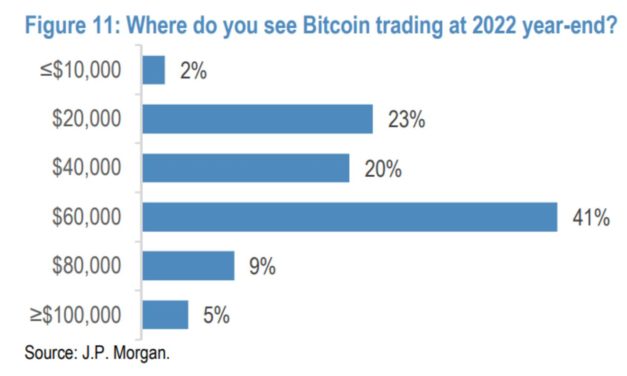
One of the world’s largest investment banks has its Bitcoin (BTC) price predictions ready for 2022. In a recent poll, JPMorgan Chase asked its clients “where do you see Bitcoin trading at 2022 year-end?” Just 5% said they saw the digital coin reaching $100,000, and 9% saw it breaking previous all-time highs, reaching over $80,000. The bank is known for its wealthy client portfolio. While some BTC bulls may welcome the news that 14% of JPMorgan’s clients expect at least a 2x, it’s not the fireworks the crypto market is accustomed to.On balance, however, the survey is generally positive. Most clients (55%) see BTC trading at $60,000 or above at the end of the year, with only one quarter expecting prices to slide from the recent lows of $40,000.“I’m not surprised by Bitcoin bearishness,” said Nikolaos Panigirtzoglou, the author of the research note who works as the managing director for London at JPMorgan. He continued: “Our Bitcoin-position indicator based on Bitcoin futures looks oversold. The coin’s fair value is between $35,000-$73,000, depending on what investors assume about its volatility ratio versus gold.”The group, which has over $2.6 trillion assets under management, is increasingly involved in the crypto space, particularly since its own token launch, JPM Coin in 2019. Part of the Big Four of American investment banks, it has been educating its customers and investors on the pros and cons of Bitcoin since July 2021. Related: Arcane Research releases its crypto predictions for 2022While its cards remain close to its chest, in September last year JPMorgan’s CEO, Jamie Dimon softened his stance on Bitcoin. He shared that Bitcoin could 10x in a matter of five years, but he still won’t buy any. It’s in contrast to fellow billionaires Ray Dalio and Bill Miller, who suggest anything from 1% to 50% is a reasonable BTC allocation. Amidst growing institutional adoption and calls for $200,000 in 2022 from other funds such as Fundstrat Global Advisors, it begs the question. Are JPMorgan Chase clients on the money, or are the Wall Street execs and other wealthy individuals decidedly bearish?

Čítaj viac

Morocco is number one for Bitcoin trading in North Africa

Estimates from Triple A, a Singaporean cryptocurrency provider and aggregator, state that 0.9 million people, or roughly 2.4% of Morocco’s total population, currently own cryptocurrency. That puts the kingdom as the top country in North Africa and in the top 50 holders of cryptocurrency population percentage, just ahead of Portugal.Data from Useful Tulips — a platform that tracks peer-to-peer BTC trading across the globe — confirms the trend. The Kingdom of the West, as it’s known locally, has been the runaway North African leader for BTC trades in the past year, pipped by only Saudi Arabia when weighing up the entire Middle East and North Africa region. Unfortunately for crypto enthusiasts, there has been no change in crypto laws in recent years. According to Morocco’s Foreign Exchange Office, it will not support a “hidden payment system that is not backed by any financial institution.” While the law came into being in 2017, the ban has not stymied adoption and as the data shows, Moroccan crypto enthusiasts continue to circumvent the ruling.Nearby, the Egyptian pound is gaining on the Moroccan Dirham for BTC trades. On the 30 day period, UsefulTulips shows that Egypt is $20,000 short of catching Morocco. It remains illegal to trade BTC and crypto in Egypt, but even if a tiny percentage of its 102 million population and $360 billion GDP engage in the “illicit” activity, it will move the needle. To bolster Morocco’s orange-tinted future, Harmattan Energy is set to build one of Africa’s largest wind farms. The purpose of the 900MW behemoth wind site set in Dakhla, the Sahara region, is to “power blockchain computing.” As Bitcoin mining and trading is currently outlawed the group cannot openly purport Bitcoin mining. Related: Africa’s crypto market has grown by more than 1,200% since 2020: ChainalysisNonetheless, as Cointelegraph reported on the project’s call to tender in 2018, selling at least 20% of its electricity output back to the Moroccan government could be a workable solution. First results are expected from Harmattan at the end of quarter one this year. Elsewhere, in April 2020, Binance added support for crypto purchases using the Moroccan dirham via a third-party platform, Simplex. It works the same way that Naira purchases for BTC work in Nigeria. It’s not quite as easy to buy BTC on Binance as it is in the nearby UAE, which has a direct fiat on-ramp, but it’s a promising start.Time will tell whether Moroccan lawmakers backtrack on banning Bitcoin. As it stands, Morocco will continue to lead the charge in North Africa even though it remains an underground activity.

Čítaj viac

Block job postings reveal Jack Dorsey's Bitcoin plans

In two recent job postings on LinkedIn, Jack Dorsey’s Block (formerly Square) revealed the group’s plans to develop “the next generation of mining ASIC,” and make a hardware wallet for the next 100 million Bitcoin (BTC) users.The two roles are based in the Block’s headquarters in San Francisco and were added to the job posting platform in the past 24 hours. For the role of the custom digital design lead, the candidate will help “silicon validation of the ASIC and its prototype.” An ASIC is a small machine dedicated to Bitcoin mining and is considered the best option for Bitcoin network security. The new job posting confirms that Block sets out to develop purpose-built ASICs for BTC mining.The second career is for the hardware wallet’s global fulfillment and logistics lead. At the job’s core is “bringing easy-to-use, reliable self-custody to a global audience.” Ultimately, Block seeks to distribute its hardware wallets to over 100 countries.The news aligns with Dorsey’s announcements made in 2021. Back when Block was called Square, Dorsey Tweeted that “Square is considering building a Bitcoin mining system based on custom silicon and open source for individuals and businesses worldwide.” Further back in July, Square claimed to be developing an ‘assisted custody’ BTC hardware wallet. It appears the plans are now coming together. Block is the holding name for Square, CashApp, Spiral, Tidal and TBD54566975. Tidal music streaming service aside, each company is dedicated to furthering Bitcoin adoption and economic empowerment. Across the Block’s suite of companies, there are 650 jobs available across destinations around the world. For Block, there are several live listings for state public policy leadership positions across the United States as well as the two aforementioned product-related roles.Since stepping down as CEO of Twitter, Jack has been vocal in his support for Bitcoin while outspoken in his opposition to Web3 –sometimes with varying results. Following a series of well-aimed tweets, he was stuck between a block and a hard place after he tweeted that VCs own Web3. Andreessen Horowitz, CEO of his eponymously named VC firm, swiftly blocked him.However, he is also winning over NBA stars including NBA champion Andre Iguodala and Klay Thompson who will receive some of their salaries in Bitcoin using Block’s Cash App. 

Čítaj viac

Spanish lawmaker sees opportunity amid Kazakhstan’s Bitcoin mining collapse

Deputy for the Spanish Ciudadanos political party María Muñoz has proposed a bill to make Spain a Bitcoin mining hotspot following the internet shutdown that caused a mining outage in Kazakhstan.The lawyer and economist Muñoz was steadfast in her support of Spain as a Bitcoin (BTC) destination, in a tweet on Friday: “The protests in Kazakhstan have repercussions all around the world but also for Bitcoin. We propose that Spain positions itself as a safe destination for investments in cryptocurrencies to develop a flexible, efficient and safe sector.”A two-page open letter accompanied the tweet directed at the Spanish Congress of Deputies. First, Muñoz highlighted the significance of the protests and the government’s response which used “all the strength of the police and the army,” before the government switched off the internet to the largest Central Asian economy. She cited a Cambridge Centre for Alternative Finance study that put Kazakhstan as the second-largest Bitcoin miner worldwide, contributing an estimated 20% of the hash rate in the second half of 2021. The government’s decision to effectively pull the rug out from under Kazakhstan’s Bitcoin miners caused the hash rate to plummet a reported 13.4%.These events inspired pertinent questions for the pro-Bitcoin lawmaker:What information does the Spanish government have on the impact of the Kazakhstan internet blackout on the Spanish crypto mining industry? Will the government take measures to attract investors and miners fleeing the Kazakhstan mining industry? What data does the government have regarding the energy efficiency of Bitcoin and the growth of the mining industry?A proven proponent for the Bitcoin network, her party Ciudadanos, or “Citizens,” proposed a national strategy on cryptocurrencies in October last year. Her party seeks to position Spain as a pole for investments into cryptocurrencies from the European Union and the world — and Bitcoin mining could be the catalyst. As Bitcoin hash rate fluctuations have shown time and again, mining infrastructure is not geographically restricted. China’s mining ban, for example, was to the benefit of Kazakhstan and Kosovo. Alan Konevsky, chief legal officer at PrimeBlock, explained last year’s mining changes to Cointelegraph: “Mining companies including those that relocated after the China regulatory changes, set up in countries like Kazakhstan and Kosovo because the cost of electricity is much cheaper than in North America.”This was shown in Kazakhstan’s growing hash rate in 2021. However, in a premonition to what could take place in Spain, Konevsky goes on to explain: “If mining becomes a complete non-starter in these countries, we could see miners relocate. This industry is mobile, to a point — but as it matures it requires stability, including stable political climate and stable inputs, including energy.”Muñoz hopes that Spain harbors these Bitcoin-friendly factors. However, one of BTC’s biggest headwinds may be political. Her tweet inspired ridicule from rival Green party member Ernest Urtasun, a European Parliament member. Labeling her proposal a “bad joke” in a tweet, he said BTC mining is “an environmental aberration.” Muñoz and her Citizens party clearly have their work cut out.

Čítaj viac

Získaj BONUS 8 € v Bitcoinoch

nakup bitcoin z karty

Registrácia Binance

Burza Binance

Aktuálne kurzy