Autor Cointelegraph By Joseph Hall

Bitcoin miner Rhodium set for IPO, valued at $1.7 billion

The first IPO for the crypto industry in 2022 comes from a Texas-based Bitcoin (BTC) mining company, Rhodium Enterprises.In an SEC filing made last week, Rhodium plans to offer 7.69 million shares at $12-$14 each in an initial public offering (IPO). Trading under the ticker “RHDM” on Nasdaq, 56.8 million class A and 67.5 million class B shares will be released, ultimately valuing the company at just shy of $1.7 billion. Rhodium is a cryptocurrency technology company that uses proprietary tech and liquid cooling technology to self-mine Bitcoin. Their goal is to be the most sustainable and cost-efficient producer of Bitcoin in the industry.The company joins a growing list of US-based companies that mine Bitcoin. Over the past three years, Marathon, Bitdeer Technologies, Riot Blockchain, and Bit Digital listed on stock exchanges such as NASDAQ.According to the filing, Rhodium currently runs 125 megawatts (MW) of mining power capacity at its first Texas site. 33,600 Bitcoin miners are running, churning out a total combined hash rate capacity of approximately 2.7 EH/s.Following the IPO and a raise of $100 million capital, it will run a second site in Texas where they “expect to develop 225 MW of additional capacity.” By the end of 2022, the company will effectively more than double its current capacity. Bearing in mind that the average cost per BTC in 2021 was about $47,000, their electricity cost basis is staggering: Our infrastructure platform allows us to mine Bitcoin at a significantly lower cost compared to the industry average. For the period from January 1. 2021, to September 30. 2021, our average electricity cost to produce one Bitcoin was approximately $2,507.Related: Mr. Wonderful plans to invest in mining company stocksTexas continues to carve out a reputation as a Bitcoin mining-friendly state. In quarter four of 2021, Senator Ted Cruz commented that Texas should use Bitcoin mining to capture wasted natural gas while the Electric Reliability Council of Texas (ERCOT) anticipated that Texan Bitcoin mining power demands could jump 5 times by 2023.Rhodium takes advantage of Texas’ “independent power market and abundance of low-cost renewable energy resources,” and pro-Bitcoin business environment. Given the company’s experience with liquid-cooling technology and efficiency; for tiny Bitcoin miners seeking to solve valid blocks, it just got a bit harder. 

Čítaj viac
Crypto job posts on LinkedIn rocketed 395% in 2021

It wasn’t just a bull run for prices last year. Careers in crypto outstripped price action in 2021, as crypto job searches soared by 395% in the United States alone according to LinkedIn.Crucially, the crypto industry outpaced the wider tech industry, which also saw remarkable development, almost doubling its number of job listings. However, at 98% growth, the tech industry dwindles in comparison to crypto jobs, which gained by a whopping 395%.Furthermore, no industry was safe from “crypto-ization” in 2021. The LinkedIn News post offered valuable insight into crypto influencing other industries: While most of the job postings were in software and finance, other industries are also seeing a rise in demand for crypto talent. These include professional services like accounting and consulting, as well as the staffing and computer hardware sectors.For 2022, the growth trend looks set to continue. The biggest exchanges in crypto are brimming with job posts; Coinbase has over 250 openings, Kraken over 300, and the world’s most active exchange, Binance, lists more than 600 job posts. For Bitcoiners and Bitcoin (BTC) Maxi’s there’s a new resource, Bitcoiner jobs. A service dedicated to helping connect Bitcoiners with Bitcoin-only companies, it now offers almost 100 Satoshi-approved careers.For those who are unable to switch jobs into crypto, a wider HR trend is crypto remuneration. The Mayors of New York and Miami announced that they would take a portion of their pay in BTC in 2021, while a total of seven NFL players have chosen crypto over cash salaries to date.Related: 3x NBA champion Andre Iguodala becomes the latest athlete to receive salary in cryptoNonetheless, while the crypto career switch appears to be gaining traction, the LinkedIn audience is not convinced. Most comments on the LinkedIn post were from bewildered onlookers wondering why crypto has value; and one aggrieved copywriter remonstrated the industry’s scammy nature. Plus, given that Bitcoin price action has yet to impress in 2022, the crypto industry may struggle to sustain such high human resources growth levels. In the 2018 bear market, several cryptocurrency companies laid off staff. In sum, BTC activity needs to pick up to continue to support job creation.

Čítaj viac

UK 3rd for ETH ownership as crypto adoption grows 1% in December: Survey

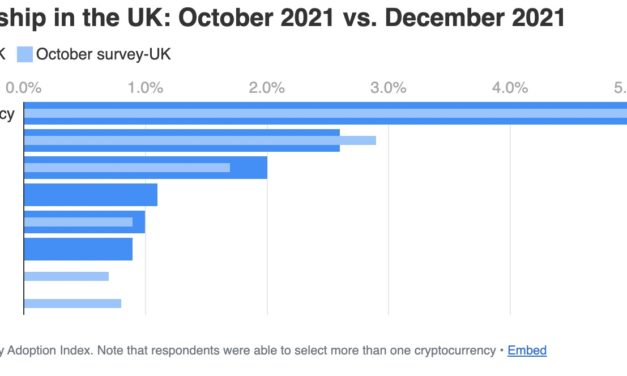
British crypto enthusiasts were busy consolidating and rebalancing during the last gasp of 2021. Finder.com surveyed 2,013 internet users in the United Kingdom in December 2021 with varying results.Since the last survey conducted in October 2021, U.K. crypto ownership crept up by 1 percentage point from 5.2% to 6.1%, while Ether (ETH) dominance continues to manifest.Coming in at third place, just behind Singapore and Australia, the U.K.’s Ether ownership among crypto holders consolidated at 32.9%, with XRP the third-most widely held crypto, at 17.4%. Curiously, interest across the 27 countries that Finder.com surveyed shows that the global average adoption rate for Ether decreased from 28.2% in October to 24.4% in December. U.K. ETH holders are holding the line, while the world’s ETH ownership declines.There are no prizes for guessing the U.K.’s most popular cryptocurrency. Bitcoin (BTC) takes first place at 42.8%, but it is also showing weakness. While a 42.8% figure almost reflects the Bitcoin dominance ratio, it has plummeted from highs of 56.7%. The overall cryptocurrency market dipped considerably in December, while analysts’ predictions missed the mark for a $100,000 BTC in 2021. The overriding crypto sentiment has been bearish since BTC first wicked to $42,000 in early December. It appears the macro bearish trend is reflected in the U.K.’s crypto behavior. Some selling and portfolio rebalancing took place in the run-up to the new year. Bitcoin ownership dipped; Solana (SOL) climbed to 15% ownership; and Dogecoin (DOGE) made a 1% gain. Curiously, Bitcoin ownership slipped across the board worldwide. Only one country saw an increase in its percentage of Bitcoin ownership from October to December, as Australia’s BTC dominance grew to 72.7%. It was also the country with the highest proportion of crypto owners holding Bitcoin worldwide. Related: Bitcoin payments decline as other cryptocurrencies growIn line with Cointelegraph’s reporting in October last year, emerging markets continue to show the strongest indicators of bubbling cryptocurrency adoption. Russia, Colombia, the Philippines and India were in the top five for growth in crypto ownership in December. Detailed statistics and insights are expected later this month. The U.K., however, is dragging its feet for crypto growth rates, trending upward by a mere 1%. While it is still positive, the global growth average for crypto ownership blossomed by 4.3%, putting the U.K. in the bottom five of the countries surveyed.

Čítaj viac

Battle of the bots: WTF token launch drains 58 ETH

Fees.wtf is a simple service that shows Ether (ETH) users their lifetime spending amount on Ethereum blockchain transactions by measuring gas. You plug in your wallet address on its website, and it tells you how much gas you spent. The project released its WTF token in an airdrop Friday. Essentially, users were able to claim WTF tokens as well as a “Rekt” nonfungible token (NFT) for 0.01 ETH. The Rekt NFT grants lifetime access to the pro version of Fees.wtf.According to its Discord announcement, the initial launch planned to offer 100 million WTF, and the “circulating supply will be the main attraction in the tokenomics.” However, it didn’t quite go as planned. Following frantic trading behavior between bots in the opening hours of the airdrop, one bot ran off with a reported 58 ETH, or $180,000. According to Etherscan, 58 ETH was drained from the Wrapped ETH (wETH) and WTF liquidity pool. Social media channels were quick to respond because many airdrop participants lamented losing thousands of dollars in ETH. The WTF team chimed in two hours after the airdrop to calm their ranks:“Immediately on launch there was only a tiny bit of liquidity and there were ape bots that were chucking in 100s of ETH into a pool with an ETH or two of liquidity. They also had high slippage and ended up being sandwiched by the other bots which essentially drained all their ETH.”Basically, within five minutes of the token launch, poor liquidity pool management from the WTF developers left the liquidity pool exposed. As there was low liquidity, bots were able to manipulate the price of WTF to then sell for wETH. The bots battled it out until one winner took home the pot. In effect, the bot stole from users who provided liquidity to the pool, trying to claim their WTF tokens and Rekt NFT. The victor managed to send an “ultra-fast transaction at 3,000 Gwei,” making a 6x return on their initial investment. The WTF team sent out another Discord update two hours after the airdrop, stating, “The core contracts are all fine, this was a war on Uniswap.” The team added, “We hope no one was affected by it.” However, as has become a common occurrence in airdrops of late, many users lost a lot of money. The price graph of the token since launch paints a thousand words. The initial spike shows the bot activity swiftly followed by a 10x loss in value. The official WTF Discord group is brimming with users sharing stories of losing money. Some are “shaking” with rage, while death threats and lawsuit claims are rife.One Etherscan transaction points to one user losing 42 ETH, or $135,000, for 0.000044170848308398 WTF, effectively $0.01.Related: Recounting 2021’s biggest DeFi hacking incidentsAs daylight dawns on the project, some Twitter users have called out the project as a Ponzi scheme. The referral element to the project is spurious. Referrers of the WTF project claim 50% on fees “to make wtf go viral,” while the WTF team earns 4% from each transfer. In total, the WTF team claimed almost half a million United States dollars in token transfer fees in a little over eight hours.Twitter user Lefteris Karapetsas didn’t mince his words: Summing up.WTF “team” made an app any dev can do in 1 hourSlapped a token + ponzinomics on itAnons aped without thinking and lost ETH in gas and claim feesTeam has so far made 116 ETH + 6,168,806 WTF. Roughly around $855,665 and this is getting bigger by the second— Lefteris Karapetsas | Hiring for @rotkiapp (@LefterisJP) January 14, 2022The WTF project states merely that the supply of tokens is “deflationary” and that 40 million WTF tokens will go to its treasury. There is not a great deal of detail regarding the token distribution. Twitter user Meows.ETH concluded their Twitter thread with a zen approach to the controversial project launch: “If you were fortunate enough to claim a big amount of $WTF and cash it out for a profit, be happy. Unless you’re attempting to bot the initial liquidity, don’t FOMO into buying a newly launched altcoin with high slippage.”

Čítaj viac

Bitcoin hash rate jumps to ATH as Jack Dorsey confirms Block's mining system

Bitcoin (BTC) hash rate has returned to all-time highs despite losing a key hash rate contributor. Meanwhile, amid lackluster price action, Block CEO Jack Dorsey confirmed the creation of an open Bitcoin mining system.The BTC space continues to surprise and bewilder critics and fanatics alike. Kazakhstan, the network’s second most important BTC mining country, experienced an internet blackout last week due to civil unrest. However, the hash rate faltered no more than 13.4% before regathering to reach all-time highs.As shown in the below data from Glassnode, with the price checking into the $42,000 range yesterday, the mean hash rate hit 215 million terahash per second.Bitcoin miners continue to show resilience and as Fidelity Digital Assets observed, the network is even “more widely distributed around the world.” Cointelegraph previously reported that Block would develop open-source Bitcoin mining systems in 2022 due to job postings on Linkedin. Yesterday, Jack Dorsey confirmed the hunch, retweeting comments made by Thomas Templeton, a general manager at Block. In the Twitter thread, Templeton addressed issues relating to the availability, reliability, performance, and products pertaining to BTC mining. In sum, Block’s goals for BTC mining are the following: “We want to make mining more distributed and efficient in every way, from buying, to set up, to maintenance, to mining. We’re interested because mining goes far beyond creating new bitcoin. We see it as a long-term need for a future that is fully decentralized and permissionless.”Related: Jack Dorsey announces Bitcoin Legal Defense FundBuilding a BTC mining system “out in the open” and alongside the community is no mean feat. Econoalchemist, an established home BTC miner and BTC magazine contributor, tweeted that developing products in open source would “build trust where no reputation exists currently and also might shift consumer expectations in that direction.”Ultimately, Block’s mining solutions may pave the way for more DIY miners to enter the space. It seems the sky’s the limit for the hash rate. Well, at least until the next 2016 blocks when the network difficulty resets.

Čítaj viac

Získaj BONUS 8 € v Bitcoinoch

nakup bitcoin z karty

Registrácia Binance

Burza Binance

Aktuálne kurzy