Autor Cointelegraph By Joseph Hall

Bitcoin Lightning Network growth capacity plateaus at 3,400 BTC

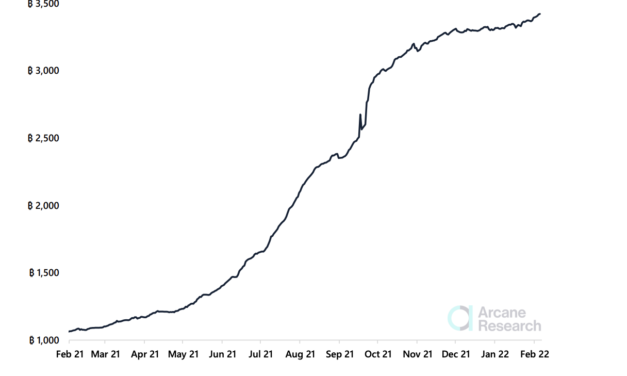
Following an exponential climb in capacity over 2022, the Bitcoin (BTC) Lightning Network made a lackluster start to the new year. According to a report by Arcane Research, growth in the Lightning Network capacity, or the number of BTC locked up in channels, has stuttered. The Lightning Network surged from 1,000 to 3,000 BTC in just 8 months in 2021, striking the 3,000 BTC mark in mid-October. While the network continues to strike all-time highs, growth grinds down. The total BTC locked in the network is peaking just shy of the 3,500 BTC mark, sparking debate and discussion on social media. As a quick refresher, the Lightning Network is one answer to the scalability issue that plagued the Bitcoin protocol. Lightning allows instant and super low-cost off-chain transactions; however, it requires Bitcoin to be locked up in payment channels distributed across lightning nodes. Lightning Network activity soared in 2021, primarily thanks to El Salvador onboarding a whole country and Twitter integrating Bitcoin Lightning tipping. In an October report, Arcane Research predicted that there would be 700 million Lightning Network users by 2030.So why has growth slowed in 2022? Bitcoin Lightning Network+ Twitter account stated that platforms such as Umbrel (an easy to set up node and lightning node service), sent initial growth to the moon. Naturally, due to S curve growth, it would have to plateau. Danny Scott, CEO and Co-Founder at CoinCorner, the UK’s leading lightning exchange, told Cointelegraph:“I don’t think we’re seeing growth of the Lightning Network plateauing at all. We saw a major growth spike due to last year’s news and growth would now appear to be more organic.”S-curve adoption plateaus to one side, he notes that “December is a holiday period for many around the world and often when the Bitcoin industry slows down.”Rene Pickhardt, co-author of the “Mastering the Lightning Network” book, explained that the slowdown in growth could actually be a good thing for Bitcoin. He Tweeted:“Given the fact that node count can only grow with channels and that the channel growth is limited by storage constraints in Bitcoin, we might only have a very short period of time with exponential growth. After that, we will be at best linear.”Looking forward, lightning may strike twice for the second layer Bitcoin solution. A wealth of updates and news may spark further growth, such as the American mobile payment service Cash App which rolled out Lightning Network integration to its circa 30 million users.Indeed, better UX and easy lightning integration for existing apps and exchanges might be the shock that the network needs. Danny sheds light on the situation:“Once we introduced “Lightning Addresses” (eg. Danny@CoinCorner.io) to make it easier for our customers to receive Lightning payments we have seen an incredible uptick in usage.”The Arcane Research paper agrees with CoinCorner that the Lightning Network could be entering a new growth phase; the best could be yet to come. 

Čítaj viac


Trader builds Bitcoin 'buy the dip' bot, outperforms DCA

While a bullish backdrop emerges in February, spare a thought for the traders trying to time the market. One savvy trader by the name of Samjhill on Reddit has built a trading tool that outperforms dollar-cost-averaging (DCA) for buying Bitcoin (BTC). DCA is the strategy in which investors buy a small amount regularly regardless of price fluctuations. It works in contrast to traders keen to get the lowest entry, timing the dip to perfection and avoiding “catching a falling knife.”The aptly named “Buy the Dip Bot” aims to “get the best price for a given asset by using a limit strategy.” Inspired by another Redditor who suggested a manual limit-buy-order strategy for getting the best price entry, Sam took the idea one step further, coding up a dip buying bot.The bot places limit orders at several intervals below the current price and if an order gets executed or canceled, it starts again. Using tech from AWS, Python, Lambda, DynamoDB and React.JS while hosted on Github, the cost to run is low, “about $5 per month.”While the bot has been beavering away since December, it hit a maiden milestone yesterday. Reaching profitability versus regular dollar-cost averaging, “the price-per-coin advantage is about (cheaper) 5-10% right now, which you could also think of as getting that much more coin for your money,” Sam told Cointelegraph.The bot runs a backtesting library to work out the best entry points for the limit buys. A complex process, the work paid off, culminated in a “winning strategy.”Related: TokenBot helps crypto traders build social communities and monetize market knowledgeWhen asked by Cointelegraph if he would recommend the bot as opposed to regular DCA, Sam replied it depends on where you are in your BTC journey:“For people just starting out, regular DCA probably makes more sense, since your goal is probably to stack as many coins as possible. For those later in their journey, they might have a decent stack already and want to minimize increasing their cost basis, and so might benefit more from this.”Sam, who first learned of Bitcoin around 2013, added that he is doing both DCA and the limit strategy “to get a more even curve of coin growth.”While the future is currently Bitcoin orange for the trading bot, Sam built the system for easy integration with other coins. Ethereum (ETH) features on the Github page, and Sam hints he may roll out other coins to production.

Čítaj viac

Google Cloud to detect crypto-mining malware on virtual machines

It’s a shot in the arm for Google Cloud users at risk of cryptocurrency mining attacks. The Google Cybersecurity Action Team (GCAT) has created a threat detection service to shield “poorly configured” accounts that attackers use to mine cryptocurrency. In a blog post, Google Cloud announced the Virtual Machine Threat Detection (VMTD) release in its Security Command Center (SCC) area. A means of scanning compute engines in Google Cloud, the VMTD successfully detects threats, including crypto-mining malware used inside virtual machines. Crypto-mining malware attacks, sometimes called “cryptojacking,” are an ongoing nuisance in the industry. While browser-based cryptojacking activity spiked in the 2019 bear market, cloud-based crypto mining continues to beleaguer the space. Cointelegraph reported in November last year that of 50 analyzed incidents relating to compromised Google Cloud Protocols, 86% were related to crypto mining. The Google “Threat Horizons” report highlighted hackers may seek to hijack GPU space to mine crypto as it is a “cloud resource-intensive for-profit activity.” Upon receiving the data, the Google Cybersecurity Action Team sought to remedy the situation, building better protections for its virtual machine users. The result is VMTD, a program that provides agentless memory scanning to help detect threats like crypto-mining malware. As well as delivering protections from coin mining, the VMTD also secures users from data exfiltration and ransomware. Ransomware attacks flourished in 2021, reaching highs in April 2021. Some commentators suggest that the rise in ransomware attacks went hand in hand with crypto’s meteoric rise; regulators and industry players have made efforts to blunt the malpractice.Related: Crypto miner in Texas shuts down 99% of operations as winter storm approachesRegarding crypto-mining malware attacks, Google has made a concerted effort to stem the onslaught of malicious actors taking advantage of unknowing internet users’ CPU power and electricity in order to mine cryptocurrencies. In 2018, over 55% of businesses were reportedly affected worldwide, including Google’s Youtube.The VMTD will steadily integrate with other parts of Google Cloud over the coming months, benefitting further Google Cloud users.

Čítaj viac

Bitcoin SegWit adoption lags among major exchanges: Glassnode

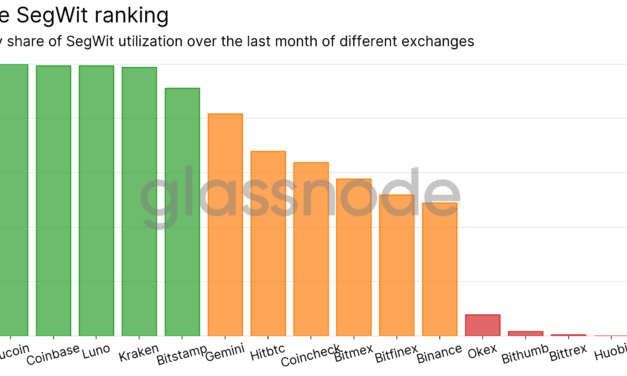
SegWit has come a long way since its first appearance during the 2015–2017 blocksize war. However, despite its relative success as a Bitcoin upgrade, crypto exchanges including Binance and Gemini are still not committed to using SegWit addresses for sending Bitcoin (BTC). Implemented in 2017, Segregated Witness (SegWit) is a soft fork upgrade that separates “witness” data from the base transaction. In an “explain like I’m five” kind of way, SegWit allows for a safer and faster Bitcoin, making scaling the network easier. While most exchanges and individuals were quick to upgrade their infrastructure to take on SegWit, reaching the 50% mark for Bitcoin transactions in 2019, the largest exchange, Binance, has been dragging its feet. Glassnode’s report states that Binance “​​had trivial SegWit adoption rates of only 10% up until the end of 2021.” However, it has finally “made an earnest effort to push SegWit adoption near the end of 2021.” Its adoption rate is currently at 50%, paling in comparison to Coinbase and FTX at 100%.Altogether, crypto exchanges consume roughly 40% of Bitcoin block space. Crucially, however, Coinbase and Binance make up the lion’s share of block space, responsible for “25% of consumed block space” last month. If leaders such as Binance, or large players such as Gemini fail to fully adopt SegWit, Bitcoin will struggle to reach its true scaling potential. Tomer Strolight, editor-in-chief at Swan Bitcoin, illustrates the argument: “The fee savings provided by SegWit (and also batching and Taproot) will inevitably lead to their near-universal use. These have succeeded already in vastly reducing congestion and lowering fees. Ironically, however, their success to date means that we may have to wait until fees become a problem again to give the late adopters the kick in pants they need to fully switch.”Glassnode’s report also shares a more accurate measure for reading SegWit adoption, SegWit utilization. When applied to single entities, such as exchanges, it provides a more detailed picture.Of the 18 major exchanges that Glassnode investigated, one-third are bona fide SegWit supporters at over 90% adoption levels. The second third — including Binance — are taking their best shot at adopting SegWit, ranging from 50% to 80%, while the final six are still using Bitcoin addresses beginning with the number 1, rather than SegWit’s 3. Related: 88% of all BTC transfers are overpaying transaction feesHere is the graph detailing the exchange SegWit ranking: It’s unlikely that the laggard exchanges will upgrade to Taproot, the most recent Bitcoin soft fork, any time soon. As Strolight points out, we might have to wait until fees rise before they wake up.

Čítaj viac

US bobsledder feels the Bitcoin rhythm and orange pills his fans

Olympic bobsledder Johnny Quinn is the latest sports celebrity to swallow the orange pill. In a Twitter thread, he shared his best of Bitcoin (BTC) education while welcoming the Bitcoin class of 2022. As a Class of 2021 #Bitcoin-er, I would like to unofficially-officially welcome the Class of 2022. Buckle up for a legacy impacting journey. First things first: it is critical that you to develop a proper framework regarding #BTC. Attached is your required reading list. Thread — U.S. Olympian Johnny Quinn (@JohnnyQuinnUSA) February 2, 2022As well as instructing his fans to digest his reading list, “no excuses. Get it done,” Quinn said that “under no circumstance do you take orders from the mainstream. They are confused.” He backed his statement with a swathe of media reports and headlines from September 2017 onwards showing large institutional players such as Visa, JPMorgan and Goldman Sachs making a U-turn on Bitcoin. The most potent 180-degree switch is Jamie Dimon’s JPMorgan. From the CEO lambasting Bitcoin in 2017, the world’s largest investment bank now promotes Bitcoin as an investment vehicle: Exhibit A – SEE PICTURESource (top): https://t.co/eAEnUZtSRmSource (bottom): https://t.co/VdbpUUO2JK pic.twitter.com/p9fjURpyNl— U.S. Olympian Johnny Quinn (@JohnnyQuinnUSA) February 2, 2022

In a word to the wise, the Olympian also suggested avoiding “moon-boys.” Typically cryptocurrency YouTubers and influencers, moon-boys encourage risky trading techniques in the pursuit of Lamborghinis, or more recently, showing off a nonfungible token to their followers. Instead, Quinn suggested:“Dollar cost averaging your Bitcoin position with a long time horizon (not using leverage) is the play.”Quinn joins a budding list of Bitcoiner sports bros. From NFL stars and NBA champions taking their annual salaries in Bitcoin to humble Bedford football (soccer) club putting “Bitcoin at its heart,” the competitive world of sports is a hotbed for Bitcoin adoption. Related: Touchdown! Goal! Knockout! Crypto and sports collide in 2021Quinn began tweeting about Bitcoin in early 2021, completing one of Michael Saylor’s “Bitcoin for everybody” online courses in Autumn last year. He has since become a vocal supporter of Bitcoin while indubitably overlapping with self-promotion. The Twitter thread by “Coach Quinn, Bitcoin Class of 2021” was well received by the Bitcoin Twitter community, as well as his 19,000 followers. Cory Swan, founder of United States-based Swan Bitcoin, retweeted the thread, saying it’s a “great thread for Newcoiners!”

Čítaj viac

Získaj BONUS 8 € v Bitcoinoch

nakup bitcoin z karty

Registrácia Binance

Burza Binance

Aktuálne kurzy