
Autor Cointelegraph By Joseph Hall

Counterfeit NFTs result in marketplace shutdown: Experts weigh in

“Rampant” issues relating to minting counterfeit nonfungible tokens, or NFTs, have forced popular platform Cent to halt some operations.Founded in 2017, Cent kicked off as a “social network and informal platform for creative experimentation.” In 2020, the team also launched an NFT platform called Valuables to mint and auction iconic tweets. Jack Dorsey’s first tweet, “just setting up my twttr,” sold for $2.9 million on the platform in March last year. On February 6th, the platform ceased NFT trading due to “a spectrum of activity” that “shouldn’t be happening.”Cameron Hejazi, co-founder of Cent told Cointelegraph:“People in this space tend to cry ‘caveat emptor’ or ‘buyer beware’ but protecting creators from those who might steal or abuse their work — and protecting buyers from potential fraud— is very important.”Hejazi told Reuters that the issue was threefold. Firstly, the sale of unauthorized NFT copies, second, the sale of stolen content converted into NFTs, and finally, the sale of NFT sets that resemble securities.Amidst NFT money-laundering concerns, the first NFT seizure in a UK VAT fraud case and even NASA wading in with its criticisms of the space, NFTs have had a rough start in 2022. Umberto Canessa Cerchi, CEO of Kryptomon, an NFT Play-To-Earn blockchain game shared that while growing reputational concerns are a concern for the industry, it is not enough to put off potential first time NFT buyers. He told Cointelegraph that among first-time buyers:“Most of them will end up buying a fake, and then when they find out about it, they will declare all NFTs ‘scams,’ and that’s bad for the industry.”Cerchi shared that “consumer protection laws” may improve the situation and better education would “prevent the industry from becoming a victim of fraud.”Related: YouTube sees ‘incredible potential’ in NFT video sales despite backlash threatPhil Gunwhy, Partner and Brand Strategist at Blockasset.co, the first athlete-verified NFT sports platform, is optimistic about the future for NFTs and regulation. He told Cointelegraph:The problem with fake listings is correlated directly to how marketplaces do not regulate the listings that appear. There are many marketplaces that do now allow users to upload and create NFTs on the fly and instead only allow verified listings.”He added that “developing relevant regulations” could be challenging in the short term, but there is “an expectation that this will trickle down to the NFT ecosystem.” As the U.S. Treasury takes aim at money laundering and NFTs, there could be further scrutiny to come. Ultimately, Hejazi hopes to “open an industrywide conversation around this issue” to root out offenders. 

Čítaj viac
Redditor stashes away BTC worth $100 for 100 years in public library

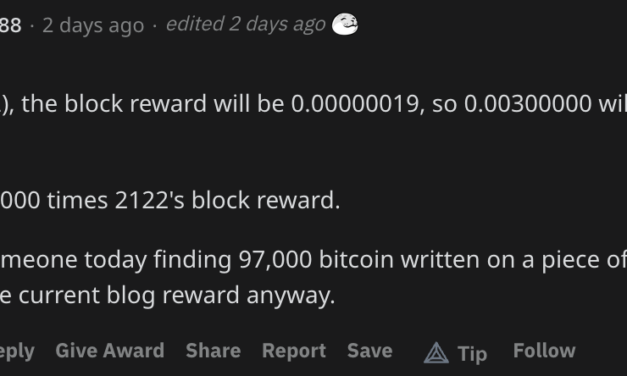
There’s never a dull day in Bitcoin (BTC) land. Despite that markets calling for a lull, the creative Bitcoin community always has cause for amusement. Yesterday, a Redditor by the name of Optimal-Dentistador (henceforth, OD) queried the longevity of the Bitcoin network with a time-lapse challenge.In a post made to the Bitcoin subreddit, OD “wrote a letter and also put the private keys for $100  worth in BTC.” In private communication with Cointelegraph, they disclosed they “put 0.003 BTC on a new address, put the private and public key together with the letter in the envelope, and here we are.”The life-long experiment was inspired by recent events put on by the public library in OD’s city–which will remain secret at OD’s request. They told Cointelegraph that in their cit:“There was an event where you could write something like a letter, poetry or a diary which will be stored for 100 years. If you write some personal info on the envelope, they will try to find some living relatives to give them.”OD decided to put “something special” in the time capsule, namely the public and private key details to 0.003 BTC, roughly $100 at today’s rate. They told Cointelegraph, “I will tell my family about this,” however, OD also jokes they may “eventually forget this whole thing, who knows what will happen in the next decades.”The Reddit community was quick to note that while 0.003 BTC may be a trifling sum in 2022, it could be considered a market-moving amount in one hundred years: OD was quick to joke that in today’s world, it’s a bit like finding the “Bitfinex hack amount of money” in a letter. The Department of Justice recently seized $3.6B as part of the debacle associated with crypto exchange Bitfinex. Related: Reddit is testing out NFT profile pics, but ‘no decisions have been made’Given that the letter will not be opened until 2022, one Redditor, “fontinuos” commented that it’s “sad to think every single of us will be dead and won´t see the outcome.” OD agrees that while it’s a fun experiment, ultimately the outcome is “a grim feeling.” Still, the meme value is strong, and OD’s offspring may enjoy riches. OD signed off to Cointelegraph saying, “see you in 2122, the ultimate diamond hands :)”

Čítaj viac

Bitmain signs 500MW joint venture with sustainable BTC miner Merkle Standard

Beijing-based Bitmain has partnered with a United States-based sustainable Bitcoin miner, Merkle Standard, which will contribute capital investment, expertise and parts.  As part of the joint venture, Bitmain will contribute to the development of up to 500 MW of clean digital mining infrastructure at Merkle Standard’s hydro-powered facilities in Eastern Washington. Bitmain is a household name in the Bitcoin (BTC) ecosystem, famed for the Antminer brand, the name behind popular Bitcoin ASIC miners the S9 and S19. Merkle Standard claims to be a carbon-conscious BTC miner, keen to become ​​net carbon negative by year-end. Merkle Standard will install up to 150,000 Bitmain mining machines thanks to the venture.Ruslan Zinurov, CEO of Merkle Standard, told Cointelegraph that the partnership with Bitmain will “catapult our growth plan of building one of North America’s largest sustainable digital asset mining platforms.” In a further commentary, Josh Zappala, chief strategy officer at Merkle Standard, underlined the benefits BTC mining brings to the social fabric of local communities. With aspirations to become one of the area’s largest employers, the joint venture will introduce “35–50 full-time jobs to the site,” while “supporting local business.” He told Cointelegraph:“Due to the flexible characteristics of the data center’s power load, we are suited to be the ideal power consumer for our power providers and look forward to providing additional support to the community.”No strangers to scrutiny, Merkle Standard’s move reflects the trend of BTC miners worldwide upping their ESG credentials. The Bitcoin Mining Council boasted a sustainable energy mix of 58.5% in the fourth quarter of 2021, while miners in Norway are even using waste heat to dry out lumber. Related: Intel to reveal new energy-efficient Bitcoin mining ASIC at next ISSCCAccording to the press release, data center development has entered the first phase of production at the Merkle Standard mothership in Eastern Washington. The 225MW site will expand to 500MW by the second quarter of 2022. The new equipment, including Bitmain’s S19J Pro, S19 XP, and S19+ hydro miners will come online in Eastern Washington, although Merkle Standard nods towards “various expansion locations” in 2022. Ultimately, the joint venture is one part of CEO Zinurov’s vision to “achieve industry-leading power efficiency.”

Čítaj viac

Sustainable Bitcoin miner uses waste heat to dry wood

Norway is a bastion for renewable energy management in Europe. As much as 99% of Norway’s energy derives from hydropower while the grid often enjoys a green energy surplus. But for Norway’s largest data center and Bitcoin (BTC) miner, Kryptovault, using regenerative hydropower to attempt to solve valid Bitcoin blocks was not enough. At the Hønefoss Bitcoin mining operation, which employees have aptly named “the Cathedral” due to its vast and cavernous expanse, the hot air generated by Bitcoin mining rigs is recycled and used to dry out chopped logs.Kjetil Hove Pettersen, CEO of Kryptovault, told Cointelegraph that Norway is an “ideal location for mining” and that alongside the log-drying operation, seaweed drying operations will kick off in the first half of 2022.According to Pettersen, Norway has a lot of “trapped” energy, pointing out to a much higher production compared to consumption as well as a limited capacity to transfer the excess energy:“This translates to very low energy prices and we can ‘rescue’ that trapped energy rather than letting it go to waste.”It would appear that the withdrawal of electricity subsidies from Bitcoin mining farms in 2018 has not affected the Scandinavian country’s status as a sought-after destination to mine cryptocurrency. The Guardian newspaper, which typically asserts Bitcoin mining energy-FUD, flipped the narrative while reporting on Kryptovault’s operation. Their article considered “can Bitcoin be sustainable?”Svein Bjerke, General Manager at the timber company that receives the dry logs, answers that question. In a video, Bjerke says that drying wood with waste heat from Bitcoin mining is the “most environmentally friendly way to do this.”Moreover, the secondary benefits of Bitcoin mining branch out to more than the environment. Over time, Hønefoss grid customers are actually better off due to the presence of Kryptovault’s energy-hungry process. Grid fees–like trees–are hacked down year after year because the local area’s total energy consumption increases. The more energy is used, the more prices come down over the long term. The company estimates that circa 2 million Euros is saved due to “Kryptovault’s existence in our grid.” Nonetheless, the route to mining 100% green and renewable Bitcoin has not been easy. Numerous challenges face miners in Norway, including:“Project and engineering perspectives to financial challenges, involving banks, tax and regulatory compliance. Just the step of setting up a bank account when working in this industry can be a large challenge today.”Related: EU securities regulator calls for proof-of-work crypto mining banUnphased, these hiccoughs are unlikely to hinder Kryptovault’s vision to transform clean energy into Satoshis. Pettersen says he “can’t think of any better industrial use-cases than what we are doing.” When asked by Cointelegraph if Kryptovault would consider mining other cryptocurrencies in the future, Pettersen jokes, “for us, Bitcoin is the name of the game.”

Čítaj viac

Bitcoin business in France: Regulation, education and cash buy frustration

Jimmy Chambrade and Aurore Galves Orjol, co-founders of Bitcoin-lyon, first heard about Bitcoin (BTC) in 2014. Around that time, their close friend and now business partner, Bruce, mined Bitcoin using his laptop. However, it took three years and a face-melting bull run before the pair could set aside the time to engage with the technology.Fast forward to 2017, and Chambrade and Galves Orjol had just returned from an around-the-world trip. Although ready to return to the world of work, they would rather avoid the traditional “nine-to-five” fiat lifestyle, or the “métro, boulot, dodo” (subway, work, sleep) routine as it’s known in France.They began investigating Bitcoin and the cryptocurrency space, attending crypto meetups and testing out the tech. Their research and curiosity led to the creation of Crypto Lyon. As their first foray into the world of crypto, Crypto Lyon is a catch-all community for crypto enthusiasts in France’s third-most populous city.They’re not “Lyon” about BitcoinOn a deeper level, though, something about Bitcoin twigged during their encounters with fellow crypto enthusiasts — the pair was hooked. It could have been the philosophy behind Bitcoin, but the privacy, self-sovereignty and pseudonymous elements were also compelling, particularly for Chambrade. Either way, it soon became clear that working in Bitcoin was a fait accompli.Galves Orjol noted that before committing to Bitcoin:“It’s important to get to grips with the entire crypto ecosystem. We examined the world of crypto through the eyes of individuals and later an association. We developed and deployed smart contracts, hosted events for traders, and mixed with developers and analysts. Ultimately, though, the path led to Bitcoin.” They met and engaged with a host of crypto-curious and crypto-obsessed individuals in France before opening the bureau for Bitcoin-lyon in 2019. Initially, Bitcoin-lyon was a space for customers in Lyon to buy over-the-counter Bitcoin. However, “being profitable purely through the sale of Bitcoin on margin was tricky. Competing with the likes of Coinbase, Kraken and Binance was not enough,” Galves Orjol explained. The business soon developed a budding consulting operation, particularly useful for francophones new to Bitcoin.Galves Orjol details that a lot of their dealings with the consultancy space revolve around the “blockchain not Bitcoin” confusion, a term and trend first coined by OG Bitcoiner Parker Lewis. In essence, entrepreneurs are often drawn to “blockchain,” the technology that’s now ironically world-renowned thanks to Bitcoin. But because Bitcoin receives bad press, entrepreneurs are put off building on Bitcoin and are thus pulled away from the real revolution.“The lion’s share of our working day is speaking to clients about blockchain technologies, and more often than not, they realize that the killer app is the Bitcoin blockchain. Often, their big project doesn’t need a blockchain, it needs Bitcoin!”The Crypto Lyon association lives on as Bitcoin-lyon grows into a one-stop shop for all things Bitcoin. Whether Lyonnais wish to buy, sell, learn about or integrate Bitcoin payments into their businesses, the team working at Bitcoin-lyon is on hand to provide Bitcoin educational and consultative tools. Bitcoin-lyon also takes advantage of a considerable unique selling point: It is the only Bitcoin vendor in France that accepts cash for crypto.Regulation, regulation, regulationAn exceptional case among the Bitcoin vendors in France, customers of Bitcoin-lyon can swap their euro bills for Bitcoin. Galves Orjol and Chambrade were granted the license “by jumping through each and every hoop established by the AMF [L’autorité des marchés financiers],” France’s Anti-Money Laundering (AML) organization.Indeed, French regulatory laws concerning Bitcoin are harsher than Zinedine Zidane when he’s all riled up. Know Your Customer (KYC) is required from amounts of just 1 euro. In practice, it means that an 18-year-old with 50 euros in their pocket thanks to a generous birthday gift must disclose their name, address and contact details to buy a petite amount of Bitcoin.A mere 100 miles away, in neighboring Switzerland, customers can buy 900 euros of Bitcoin a day — no questions asked. Chambrade laments France’s overbearing rules for crypto, “Regulations are killing us. In 10 years’ time, there will not be a Bitcoin vendor left in the country.”To make matters worse, compliance and AML requirements dictate that transactions must be traced. The combination of traceability and regulation stymies the ease of doing Bitcoin business:“Compliance is expensive for Bitcoiner companies in France, whereas nearby in Switzerland, the rules are far more relaxed. Sometimes, we are not able to accept customers’ money here in France because we are very careful with AML and KYC laws. Yet we know that when we finish speaking with what could have been our customer, they can drive for one hour to buy Bitcoin without the same restrictions in Geneva.”The situation is exacerbated by the French government’s treatment of Bitcoin businesses. Whereas “blockchain-focused” projects receive wild investments and incentives, Bitcoin-related projects in France are hamstrung by regulation. The country’s widely lauded “La French Tech” startup scene has still not accredited a Bitcoin startup despite the relative success of companies such as StackinSat. The well-known French crypto unicorn Ledger is an exception, but it started out as a hardware company in Paris. Chambrade explained:“Ledger hit a critical mass for revenue and customers in hardware before it turned to software and retail avenues. Plus, hardware and R&D is a well-funded area of industry in France.”Speculation vs. accumulationAs Bitcoin-lyon is the only physical retail outlet for Bitcoin in France, its clientele reflects the growing trends and demographics of Bitcoin buyers in the region. Broadly speaking, there are two clearcut groups of buyers: those in it for the technology (accumulators) and those in it to get rich (speculators).There are those “who want to buy it now and sell it once it does a 4x,” Chambrade explained, and there are “those that have a real need for Bitcoin.”Worth noting is that while French crypto regulations are strict, French tax laws are tighter still. A whopping 30% tax is imposed on all crypto sales for any profit over 300 euros. It pales in comparison to the United Kingdom’s 14,000-euro tax-free limit. Over in Switzerland, it’s a different ballpark: There is zero tax on personal crypto gains.Notwithstanding, the rise of nonfungible tokens (NFT) has enticed a growing number of speculators into the space. The “get-rich-quick” crowd often calls for appointments at Bitcoin-lyon to shill their next big NFT, assuming that Bitcoin is somehow required in their plan.Similarly, the flavor-of-the-month altcoin, “whether it’s Solana, Cardano or DOGE that’s mooning; it often leads to phone calls from potential clients who just want to buy the next big thing.”Often, investors are simply impatient to part with their money. Galves Orjol sighed, “People don’t even understand what they are trying to buy.”Chambrade is frank with these kinds of requests. First, he sets up a consultation to explain Bitcoin. He patiently illustrates the properties and history of Bitcoin, underlining the risks associated with any kind of crypto investment.Following the consultation, if the customers are still keen to buy NFTs or altcoins, Chambrade helps them to set up a wallet to receive Bitcoin and shows them how to swap for Ether (ETH), Solana (SOL) or otherwise.Bitcoiners in LyonGalves Orjol noted that the prosaic “crypto bro” demographic has been improving over the years. Currently, their customers are about 70% male, 30% female. The stand-out age group is 35- to 55-year-olds. They tend to have some disposable income and a desire to understand the technology and represent one basket among the “accumulators.”Common convincing arguments to orange pill this demographic are the rising prices in France (inflation sits at around 5%–6%) as well as wealth diversification strategies. Plus, these people have worked and lived through the 2007–2008 financial crisis in which banks’ predatory lending and malpractice crippled the global economy. In this context, Bitcoin is the life raft.At the graying end of the demographic spectrum, there are internet-phobic, savvy pensioner customers. This group is keen to protect its wealth in “digital gold.” While the older generations may struggle to set up a Bitcoin wallet, “they understand money on a deeper level than younger people,” said Chambrade.For example, the over-60s have lived through two periods in history where the French franc (the former national currency) lost purchasing power, so they understand what a devaluing currency means for wealth preservation.The current macroeconomic background is enough to convince them that a currency with a fixed supply is a good hedge. Plus, they’ve seen money die, such as when the euro took over as the national and, indeed, Europe-wide currency in 1999.Remittance is a beret good ideaFinally, there is the remittance camp of Bitcoiner customers: immigrants, expats or francophone diasporas who want to send money abroad cheaply and simply.At the foot of the alps, Lyon is an economic engine and metropole with high employment rates. It’s an increasingly attractive destination for jobseekers traveling from the Maghreb (Algeria, Libya, Mauritania, Morocco and Tunisia), as well as France’s former colonies, from Haiti to Djibouti.Chambrade illustrates the situation, telling the story of the Algerian truck driver who transports and sells construction materials in Algiers. The trucker keeps Bitcoin “in his pocket” as opposed to bags of cash because it’s safer. If he were to transact with cash, he’d have to keep thousands of Algerian dinars on his person, which just isn’t worth the risk.He said, “Although Bitcoin is still illegal in certain Maghreb countries, as long as you’re not winding up the authorities and, provided the sums aren’t astronomical, you can use Bitcoin without a hitch.”Moreover, Bitcoin is an outlet that sidesteps the “monopoly money” risk. Sadly present in many African countries, but most well-known to Venezuela, currencies become monopoly money when hyperinflation takes over. Traders are forced to use stacks and stacks of cash to do business as the money devalues faster than ink can dry on the freshly printed notes.Finally, for those without banking services, Bitcoin enables a certain level of financial freedom. And with the rise of the lightning network on Bitcoin, transactions from a fraction of a penny and up can be sent instantly and globally at a negligible cost. Customers can come in, set up a wallet, and easily send Satoshis to family members based in Africa or in developing countries around the world.At home in Lyon, the footprint for merchants accepting Bitcoin and Bitcoin Lightning payments services is swelling. Bitcoin-lyon’s payment solution for merchants and e-commerce retailers has opened up the Bitcoin economy in the city.Currently, there’s a barber, a few bars, a Lyonnais-style restaurant known locally as a “bouchon,” a T-shirt seller and an IT store. While the bull market ebbs and flows, the rendezvous list for new businesses is expanding every week.

Čítaj viac

Získaj BONUS 8 € v Bitcoinoch

nakup bitcoin z karty

Registrácia Binance

Burza Binance

Aktuálne kurzy