Autor Cointelegraph By Joseph Hall

Madeira ‘embraces’ Bitcoin and how the president met Michael Saylor

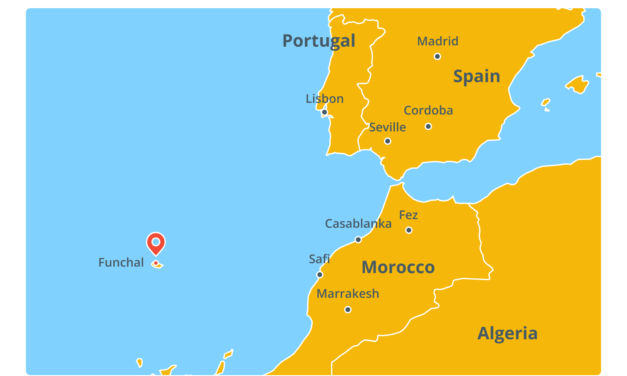
The tiny Portuguese island of Madeira has “adopted” Bitcoin (BTC) — but what does that mean? The announcement made during the Bitcoin Miami Conference in 2022 has spurned confusion and misinformation.The President of the Regional Government of Madeira, Miguel Albuquerque, hopped onto the stage in April to announce that he believes in the “future of Bitcoin,” and that he would work to “create a fantastic environment for Bitcoin.” However, the details remained unclear. Cointelegraph spoke to André Loja, a Madeiran entrepreneur who spearheaded the plan to bring Bitcoin to the archipelago in the Atlantic ocean to find out how Bitcoin is shaping the islands’ development.The island of Madeira exploded onto the Bitcoin world map on April 7, when Samson Mow proudly announced that Madeira “will be adopting Bitcoin.” Upon the announcement, news outlets around the world reported that Madeira had adopted Bitcoin as legal tender. However, this was not the case. Loja explained to Cointelegraph that prior to Samson Mow’s announcement, Loja would have preferred to use the phrasing “Madeira is embracing Bitcoin.”“We embrace it, we support it. We are not ‘adopting’ Bitcoin because adopting looks like we were making it legal tender when it’s already de facto legal.”Indeed, in Madeira and across Portugal — 1,000 km northeast of the island — there is zero tax on Bitcoin capital gains. That means any disposal, spending, or use of Bitcoin does not need to be declared to tax authorities by the island’s 250,000 people.Loja orange-pilled the president of Madeira just a few weeks prior to the conference, sharing his vision for Bitcoin as not only a means to attract foreign investment, but to “protect my island from the fiat system.” By happenstance, Albuquerque came to visit Loja’s coworking space — one of the few places that accept Bitcoin in Madeira — and Loja jumped at the opportunity to share his passion for Bitcoin. Madeira was kneecapped by the COVID-19 pandemic as critical tourism revenue fell off a cliff. Loja, therefore, presented a Bitcoin future to the president as a means to diversify and restructure Madeira’s economy, among other advantages. Albuquerque was reportedly  open to the idea, so Loja quickly sought the help of Bitcoiners around the world, including Daniel Prince, a renowned Bitcoin podcaster; Jeff Booth, the author of The Price of Tomorrow, and even Michael Saylor, CEO of Microstrategy. Within weeks, the Bitcoiner all-star team had contacted the organizers of Bitcoin Miami 2022 to organize the president’s appearance on stage. Ultimately, having the head of state of an autonomous region endorse Bitcoin was an opportunity too big to miss. Upon landing in Miami, Loja and Albuquerque were invited to Saylor’s flashy Miami villa, “with the yachts and everything,” Loja jokes. While Loja had already orange-pilled the president, the conversation with Saylor was on another level:“Michael Saylor sat down with president Albuquerque and well […] It was more like he sat down with his head!”Saylor told Albuquerque that “you need to focus on Bitcoin. Everything else is garbage.” A conversation the president is unlikely to forget, the seminar was sufficient preparation for him to step on stage in front of 25,000 Bitcoin enthusiasts. Loja explained that the announcement that Madeira is adopting Bitcoin would “kickstart an intention” for Madeira to become an island in which Bitcoin prospers alongside the people. For Loja, who has already translated popular Bitcoin books into Portuguese, “It starts with education: the most important thing.”Loja (far right), President Albuquerque (center with book) and Knut Svanholm (far left) in Madeira in May 2022. Source: LojaIndeed, Loja cut his teeth during the bear market of 2018. A passionate educator, Loja works closely with other educators in the space, such as Knut Svanholm,  author of Bitcoin: Everything Divided by 21 Million, to teach the principles of sound money: “I have a lot of ideas, from kindergarten to schools to adults workshops — and to bring people from outside the island. The association will have the best people as consultants.”To this end, Loja is founding the Sound Money Foundation, a Bitcoin education center in Madeira. The center has support from Samson Mow and Jeff Booth, among others, and seeks to help locals to better understand cryptocurrency from a young age. Accompanying the education drive and the focus on improving “financial literacy,” Loja’s hometown also lures Bitcoin companies with attractive fiscal incentives. At the International Business Center, companies pay just 5% business tax, a highly competitive rate. Portugal was already a budding hub for individual Bitcoiners, but companies could now reap benefits Related: Bitcoin, Bukele and a bevy of central bankers meet in El SalvadorFurther down the road, Loja plans for the autonomous government of Madeira to mine Bitcoin with leftover renewable energy — as the island has abundant wind and sunlight — and even carry out “a multi-signature wallet for the government to work with Bitcoin financially.”Madeira’s international business center. Source: ibc-madeira.comAs a result, the government would take full custody of the Bitcoin it mines by taking control of the private keys. Loja highlighted that the electrical power grid is a standalone “public company,” so any Bitcoin mined by the grid would go into government multi-sig wallets.In essence, Madeira’s approach to Bitcoin goes above and beyond the lauded legal tender status. From public sector Bitcoin mining to education to state-run multi-sig wallets to having Michael Saylor on speed dial, the island is slowly steering towards a Bitcoin future. Unsurprisingly, Loja’s holistic approach to the island “embracing” Bitcoin has a low time preference.  

Čítaj viac
Bitcoin, Bukele and a bevy of central bankers meet in El Salvador

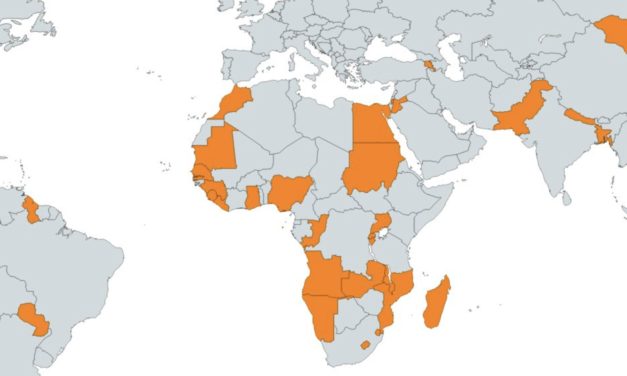
This week, 44 central bankers from developing countries around the world are attending a conference in El Salvador to discuss financial inclusion, financing for small and medium-sized businesses and Bitcoin (BTC). Central bank delegates from Ghana to Burundi, Jordan to the Maldives and Pakistan to Costa Rica arrived in San Salvador for the conference upon El SalvadorPresident Nayib Bukele’s invitation. Delegates’ countries marked in orange. Source: TwitterOrganized by the Alliance for Financial Inclusion, a global policy leadership alliance, and in partnership with El Salvador’s central bank, the conference will run for three days. In a tweet, the head of El Salvador central bank, Douglas Rodríguez, shared:“El Salvador is proud to receive representatives from 44 central banks and financial authorities to learn about the implementation of Bitcoin and policies to promote Financial Inclusion.”Rodríguez’ superior, President Bukele, shared that he was “planting seeds” among the 44 delegates while tweeting a group photo of the leaders:Planting seeds in 44 countries.3 days to go…#Bitcoin is good for the world pic.twitter.com/eOwhJZQ4RX— Nayib Bukele (@nayibbukele) May 16, 2022The team behind the Bitcoin Beach project was also in attendance, on-hand to educate the central bankers. Bitcoin Beach, El Zonte, was the birthplace of the Bitcoin Law, a grassroots movement that led the first nation to adopt Bitcoin. Nicolas Burtey, co-founder of Galoy Money — the company that built the Bitcoin Beach wallet — said, “After spending a day with those central bankers, I can say: still a lot of education to do.” Burtey continued:“[The] vast majority have no idea of the potential of bitcoin. But with El Salvador adopting Bitcoin, they now have a reason to dive into it.”Burtey and his team spent the day speaking with central bankers, showing them how to use Bitcoin Lightning wallets and send payments. Progress was fast — so fast, in fact, that Burtey tweeted: “We can’t onboard the central banks fast enough to #bitcoin with the BTCBeachWallet.”Photos of the event beggar belief, with central bankers studiously learning how to send payments and create wallets. Central bankers lining up to get help downloading and using Bitcoin Beach Lightning wallet pic.twitter.com/CWupR1Td4K— Bitcoin Beach (@Bitcoinbeach) May 16, 2022

At present, only two countries around the world have recognized Bitcoin as legal tender: El Salvador and recently the Central African Republic, which was subsequently scolded by African central banks for adopting cryptocurrencies. Related: El Salvador’s central bank accepts Qredo’s registration to provide crypto servicesFor some commentators, such as Dan Tapiero of investment fund 10T holdings, who memorably told Cointelegraph during an interview, “I don’t have cash,” El Salvador’s financial inclusion conference is momentous. He insinuates that the United States might need to catch up:  #Bitcoin…The first truly global global macro investment of all time……with El Salvador leading?!!32 central banks, 44 countries flying to El S.Emg countries leading adoption.First time US not ahead in financial and technological innovation.https://t.co/XKOURSJ2SA pic.twitter.com/mF8GaBezDW— Dan Tapiero (@DTAPCAP) May 17, 2022

For hardcore Bitcoiners, nonetheless, the opportunity to make a joke about the event was just too great. Gigi, a Bitcoin writer and author of Bitcoin book 21 lessons, tweeted “If they keep using Bitcoin they wont be central bankers much longer!”

Čítaj viac

80,000 Bitcoin gone: What’s left in Luna’s reserve wallet?

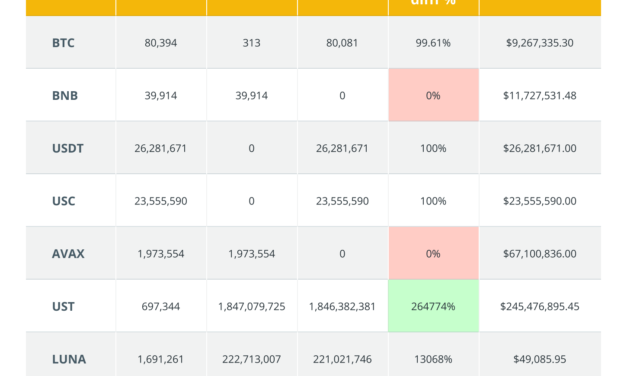
The Luna saga continues. In a Twitter thread, the team behind the failed algorithmic stablecoin UST and the token LUNA shared precisely how much Bitcoin and crypto assets they had disposed of.The Luna Foundation Guard (LFG) also shared a promise to “compensate remaining users of UST, smallest holders first,” with the remaining assets.In summary, 80,081 Bitcoin (BTC) or 99.61% of the Bitcoin that LFG guarded, has exited the fund. The group confirmed a sale of “33,206 $BTC for an aggregate 1,164,018,521 $UST” in a tweet. The remaining 47,188 BTC is not accounted for, while 313 BTC remains in reserve.Interestingly, LFG has not sold a single Binance Coin (BNB) or Avalanche (AVAX), holding circa 40,000 and 2,000,000 of each token, respectively. The below graphic makes clear the remaining tokens in the LFG reserve: The reason behind the disposal and sale of cryptocurrency in the LFG reserve was to support the health of the Terra ecosystem:2/ Consistent with its non-profit mission & focus on the health of the Terra ecosystem, beginning on May 8, when the price of $UST began to drop substantially below one dollar, the Foundation began converting this reserve to $UST.— LFG | Luna Foundation Guard (@LFG_org) May 16, 2022The counterparty that the group used has not been named. Cointelegraph experts have compiled an analysis on the Terra ecosystem implosion, questioning the “long-term viability of algorithmic stablecoins.” The current makeup of the LFG reserve is the following:LFG Reserve Balance Breakdown. Source: https://dashboard.lfg.org/Related: LUNA meltdown sparks theories and told-you-sos from crypto communityMeanwhile, crypto enthusiasts with staked LUNA tokens should see LUNA returned to their wallets in the next 20 days. However, it will be worth less: LUNA’s price has fallen over 99% since its highs, currently sitting at $0.0002. What was once a $50 billion ecosystem now has a total reserve balance of $82 million, prompting popular crypto influencer Cobie to simply respond to the thread with: “Bruh.”

Čítaj viac

Bitcoin mining in Norway gets the green light as the proposed ban rejected

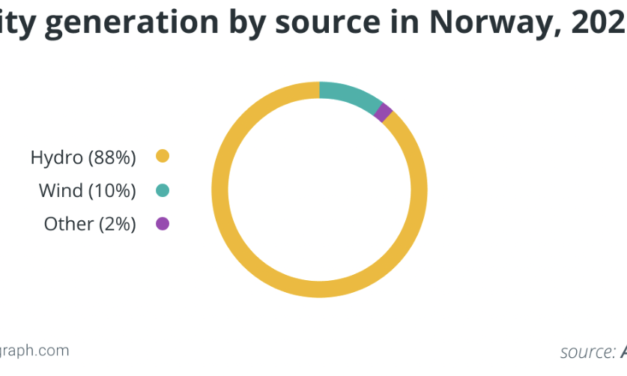
There’s Nor-way they can ban Bitcoin (BTC) mining in Norway now. That’s according to a majority vote passed by the Norwegian parliament on May 10.The proposal to ban Bitcoin mining in Norway was first suggested in March this year by the Red Party (Norway’s communist party.) In this week’s vote, the proposal was overturned as only Norway’s left-leaning parties, including the Socialist Left Party, the Red Party and the Green Party would support a ban on cryptocurrency mining.Jaran Mellerud, an Analyst at Arcane Research and a Cointelegraph confidant shed light on the developments: “The vote these parties lost was against banning large-scale Bitcoin mining overall.”“Having lost this vote, these political parties will likely make one more attempt at increasing the power tax specifically for miners, which is now their only tool left in the toolbox for making life difficult for miners.”Contrary to the political parties’ efforts, Bitcoin mining companies in Norway have thrived in recent years. Norway now contributes as much as 1% to the global Bitcoin hash rate, taking advantage of 100% renewable energy in the Land of the Midnight Sun.Norwegian Mellerud added that “Bitcoin-hostile political parties in Norway have been trying to force bitcoin miners out of the country by implementing a higher power tax rate specifically for miners or even attempting to ban mining.”Luckily, they haven’t been successful, and this decision by the government to not ban bitcoin mining should be the latest nail in the coffin for their attempts to get rid of the industry.Cointelegraph previously reported that Norway is a “green oasis” for Bitcoin mining, boasting abundant hydropower and low energy prices, particularly in the north. In mid-northern and northern Norway, the cost per kilowatt-hour is 0.12 Norwegian Krone ($0.012), a highly competitive rate internationally, or “extremely cheap,” Mellerud told Cointelegraph.Related: Water great idea! Bitcoin mining heats this swimming poolThe article from Norwegian news E24 reported that “ordinary households, companies and the public sector pay an electricity tax of 15.41 øre ($0.015) per kilowatt-hour,” however, in some cases the “mining industry has a reduced electricity tax.” Mellerud concluded that “an increase in the power tax specifically for miners is now much less likely.” Meanwhile, Bitcoin is slowly entrenching into the Norwegian financial landscape as retail interest in cryptocurrencies swells and TradFi companies have dipped their toes into BTC investments in the country.

Čítaj viac

Untethered: Here’s everything you need to know about TerraUSD, Tether and other stablecoins

The crypto winter could be claiming more casualties among the stablecoin camp. The de-pegging of TerraUSD (UST) on Tuesday triggered market sell-offs, and now Tether (USDT) appears to be losing its footing, having slipped against the U.S. dollar.The algorithmic stablecoin UST is, as the name implies, algorithmically backed. LUNA, the ecosystem’s corresponding token, has sunk over 95% since Tuesday, while UST continues to languish around the $0.50 mark.Cointelegraph’s resident experts shared their explanations for why UST crashed in a special edition of “The Market Report” yesterday. The plan for Terraform Labs’ algorithmic stablecoin continues to roll out, but UST is still struggling.[embedded content]Data from Cointelegraph Markets Pro confirmed that various stablecoins have shown greater volatility than usual: USDT, the world’s largest stablecoin, traded under $0.99, Gemini Dollar (GUSD) exceeded $1, and USD Coin (USDC) also appreciated.Paolo Ardoino, chief technology officer of Bitfinex and Tether, shed some light on the difference between asset-backed stablecoins and their algorithmic counterparts in a conversation with Scott Melker:“If you want to do an algorithmic stablecoin, for example, it has to be 300% backed by solid assets, solid crypto assets — not 105%, or 110%, or even less. […] That does not make sense.”Ardoino shared that for UST to work, it would need 3x the investment, or over $50 billion:  More sauce https://t.co/w51pFcLJey— Paolo Ardoino (@paoloardoino) May 12, 2022In earlier tweets, Ardoino reminded crypto enthusiasts that “Tether is honoring USDt redemptions at 1$” as he spread calm among the industry. For crypto veterans such as Whale Panda, the distinction between stablecoins is clear cut: the Tether FUD (fear, uncertainty and doubt) is “peak fud”:People confusing $USDT and $UST and panicking.People don’t understand the difference between an under collaterized algorithmic stablecoin and a backed stablecoin.Panic dumping $USDT for $USDC and plain old $USD.Peak fud time.Warning: this post will attract “Tether truthers”— WhalePanda (@WhalePanda) May 12, 2022

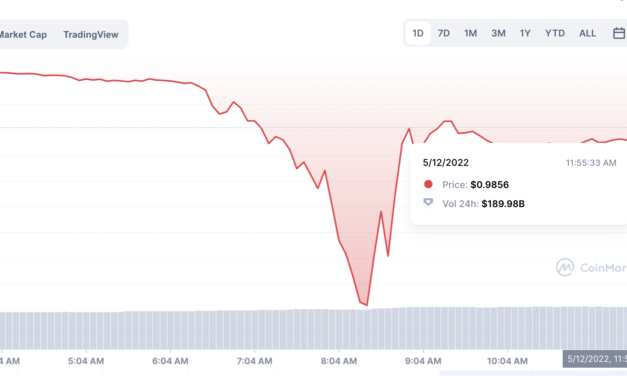
The price of USDT has recovered from its very brief dip to $0.95 this morning, but it still has yet to reach dollar parity. In recent developments, Tether plans to move 1 billion USDT from Tron to Ethereum and Avalanche. This will not change the total supply of Tether, the company said in a tweet. Tether dipped to $0.95 at 8:15 am UTC. Source: CoinMarketCap Samson Mow, CEO of Jan3 and a hyperbitcoinization pioneer, also rallied the troops behind USDT: USDt isn’t going to lose its peg. Know when players are just trying to induce panic.— Samson Mow (@Excellion) May 12, 2022

Related: Ether whales get busy as transactions hit highest point since JanuaryCastle Island Ventures’ Nic Carter made light of the stablecoin saga, joking about a stablecoin event he is set to attend:might be a bad time… but are we still doing this next week? pic.twitter.com/JyjbpagK8a— nic carter (@nic__carter) May 11, 2022

USDT has recovered to within two basis points of a dollar at the time of writing. Plus, an article shared by the Tether team explained that they’re “on track to process $2 billion today.” Danger averted.

Čítaj viac

Získaj BONUS 8 € v Bitcoinoch

nakup bitcoin z karty

Registrácia Binance

Burza Binance

Aktuálne kurzy