Autor Cointelegraph By Joseph Hall

Kraken CEO defends listing LUNA 2.0: ‘Bitcoin traders don't pay the bills’

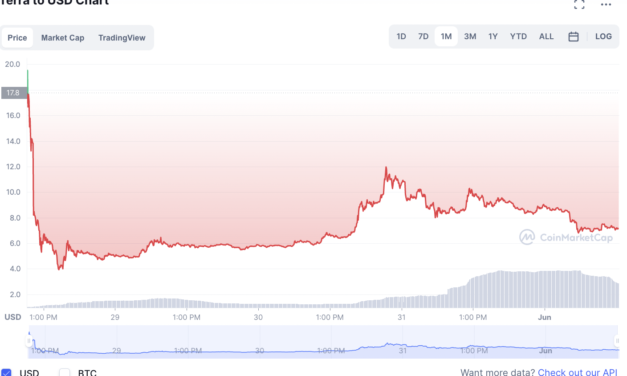
The crypto winter has emotions running high. Kraken CEO Jesse Powell came under fire for his defense of listing the new LUNA, also known as LUNA 2.0, which seeks to bring the original LUNA — now known as Luna Classic (LUNC) — and TerraUSD — now known as TerraUSD Classic (USTC) — back from the dead.Respected names in the crypto industry such as Nic Carter of Castle Ventures spoke out against the decision, while in a separate tweet thread, Powell lashed out at short-seller Jim Chanos, who had built a large short against Coinbase, Kraken’s biggest competitor. Carter simply tweeted “why” to the official Kraken Twitter account that announced the listing of the new LUNA. Client demand. There’s a weird dynamic with exchanges. Switching cost is low and people tend to want to do everything all in one place for capital efficiency/synergies/convenience. Not supporting 1 coin people demand could cost you the entire account. Listing isn’t an endorsement— Jesse Powell (@jespow) May 30, 2022The world’s fourth-largest crypto exchange, Kraken lists over 160 cryptocurrencies. The list grows every month, from Bitcoin (BTC) to Filecoin (FIL) to the second iteration of LUNA, which currently sits 164th on its price index. The first Terra collapse wiped out circa $50 billion, causing suicide hotlines to be pinned to the Terra subreddit, while legal documents reveal Terraform Labs founder Do Kwon liquidated two branches and an entire company days before the crash.Related: Exchanges back ‘Terra 2.0 revival plan’ via airdrops, listing, buyback and burningThe project was then hard-forked and relaunched with little to no recompense for impoverished investors. An airdrop, for example, did not go how the developers intended, as tokens were unevenly distributed. The new LUNA has since slid from highs of almost $20 to less than $8, despite a 90% spike in price driven by a Binance airdrop.Price chart for LUNA showing the Binance pump on May 30. Source: CoinMarketCapPowell cites that “client demand” motivated the listing of LUNA. Rohan Grey, an assistant professor of law at Willamette University, called Powell out on the move, arguing that eBay does not allow fraudsters to remain on the e-commerce platform, so why should crypto exchanges allow Terra a seat at the table? The comment was a quip to Powell’s claim about Kraken:“We’re a marketplace, like eBay. BTC< >BTC traders don’t pay the bills.”Powell has previously shown a decisive side to his operations, recently closing Kraken’s global headquarters because “San Francisco is not safe.” However, when it comes to money and Kraken, “We try to be as asset-agnostic as possible,” he tweeted. “Fiat and most stocks are garbage but where’s the outrage? Revenue from these other coins pays for all the security, pro-BTC lobbying and marketing.”In a separate Twitter thread, Kraken defended the future of crypto exchanges. In a Crypto Critics Corner podcast, Chanos — an American investment manager — detailed the short he had built up against Coinbase, America’s largest crypto exchange. For Powell, there will be a “paradigm shift over the next 10 years,” and crypto exchanges will come out as winners. Legacy “fees” are still there, hidden or moved. Crypto brokerage is just one service that is powered by a gigantic stack of infrastructure that replaces like 20 other middlemen and ancillary businesses. Revenue diversity will grow with adoption, paradigm shift over next 10 years.— Jesse Powell (@jespow) June 1, 2022

Infighting and Twitter spats aside, for those seeking signal among the war of words, Powell shared his investment preferences for picking Bitcoin, investing in exchanges, or both: Personally, I’d want to own both. Exchanges are sort of a bet on the whole space growing.— Jesse Powell (@jespow) June 1, 2022

Kraken did not immediately respond to Cointelegraph’s request for comment.

Čítaj viac

Crypto knocking on the WEF's door: The view from Davos

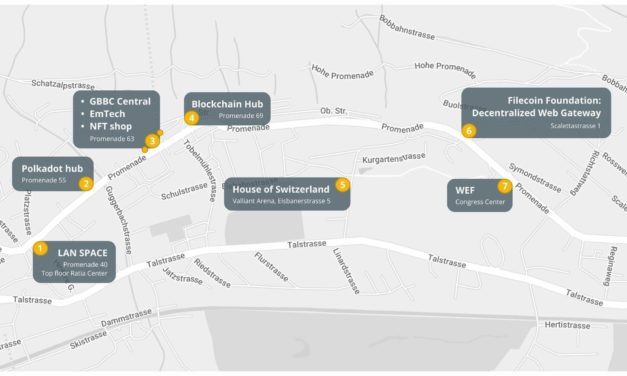
The spectacle that is the World Economic Forum (WEF) came to a close in Davos, Switzerland on Friday, May 27. Nearly 3,000 people from over 110 countries took planes, trains and helicopters to the highest town in Europe to lobby leaders and push and query the WEF agenda.And, while the war in Ukraine took center stage during the WEF, climate change played the hero and economic recovery was the damsel in distress. Meanwhile, blockchain and cryptocurrency featured as — at the very least — a supporting role.As Soramitsu CEO Makoto Takemiya described during a Global Blockchain Business Council (GBBC) panel taking place on the WEF promenade, the industry bigwigs and “financial elites” amassed in Davos. The WEF 2022 had “barbarians” at the gate in the form of crypto and blockchain enthusiasts. This was the first in-person WEF since the onset of the COVID-19 pandemic and the presence of blockchain companies many participants was large. All down the Davos boulevard, shops and cafes temporarily transformed into showrooms for corporations and big business while the crypto companies stuck out.Alex Fazel, chief partnership officer at Swissborg told Cointelegraph that “back at WEF 2018, there was only one major pro-crypto event and numerous other talks were stressing the dark sides of crypto.” In 2022, world leaders and monetary disruptors rubbed shoulders at the Crypto House, the Blockchain Hub, Polkadot Hub, LAN Space, the NFT Shop, GBBC Central and the Filecoin Foundation — which had converted a former Catholic church into a crypto conference hall. Conspicuous at best, crypto was hard to miss. Map of the Davos blockchain locations for the WEF.Even the WEF itself now features a dedicated website for blockchain technology. Plus, bankers openly discussed digital currencies during a panel on the WEF main stage. In a video interview with Cointelegraph in Davos, Brad Garlinghouse, CEO of Ripple Labs, explained that while crypto used to be a dirty word, the trendline is now “positive.” Garlinghouse told Cointelegraph that the “presence of crypto is dramatically different.[embedded content]Swissborg’s Fazel summed up the bubbling crypto sentiment as newbies and nocoiners (those yet to invest in crypto), took their first steps into the space. “There was more attendance at the Web3 pavillions than Web2 like Meta:”“During WEF 2022, on top of dozens of crypto conferences, events and parties, the crypto space occupied between 10–20% of the entire promenade across the private sector, excluding the governmental pavillions.”Ultimately, when the CEO of MasterCard features on a blockchain panel perched next to Bank for International Settlements researchers and crypto enthusiasts to openly debate the demise of SWIFT, as well as the dawn of central bank digital currencies (CBDCs), it’s clear that digital currencies have made the mainstream. For Thierry Aryz Ruiz, CEO of AgAu, blockchain as a focal point of the WEF goes without saying: The issue revolves around how the world’s elite manages the innovation. Ruiz told Cointelegraph, “with CBDCs and increasing regulation, we may see darker applications of Blockchain as a tool of control.”Daniela Barbosa, general manager at Hyperledger and a WEF veteran, agrees with Ruiz. The WEF is certainly smitten with blockchain technology. However, she also posits that we shouldn’t be “scared” of CBDCs. Barbosa decodes the sentiment in an upcoming Cointelegraph Youtube interview. Subscribe here.Daniela Borbosa, general manager of Hyperledger and Cointelegraph.  Cryptocurrencies such as Bitcoin (BTC) are hatched out of a desire to separate money from the state — not embolden fiat money. Yet, the WEF, blockchain and crypto are increasingly entangled. Ruiz expanded on the point: “Great minds bump into each other, genuinely with good intentions” at the WEF. In view of looming regulatory concerns, however, he shares “they can also pave the road to hell if left unchallenged.” Ruiz signals a note of caution:“The pandemic has evidenced that too often, people sacrifice their freedom in exchange for a false sense of security. We shall never forget that such a trade likely results in the loss of both.”On regulation, during a decentralized finance (DeFi) panel discussion moderated by Cointelegraph, Sam Yim, 1inch network adviser and former banker, explained that regulation is a speeding train. “Either you climb onboard or you step out of the way.” For good or bad, regulation of the crypto space is coming.On the upside, regulation may reassure the curious and the coy about the rigidity and longevity of the space. Indeed, for some WEF attendees, it was the first time they interacted with crypto. At the Cointelegraph farewell party held in partnership with Polygon, Davos coin stole the show. Partygoers could spend Davos coins at the bar, enjoying a “seamless checkout experience,” thanks to a pilot project pioneered by Ammer technologies.Whether regulation impedes or stimulates growth, the theme that Bitcoin and crypto is for everyone permeated through. In an all-women panel hosted by Cointelegraph editor-in-cheift Kristina Lucrezia Cornèr, questions such as “Bitcoin creator Satoshi Nakamoto, who remains pseudonymous, could very well be a woman” were raised. For some WEF attendees, proximity to power and to the regulators attending the WEF could gain the upper hand. Nas Daily, Youtuber, social media influencer and a recent crypto convert, told Cointelegraph that he wanted to be at the WEF to be close to regulators. Related: UN agency head sees ‘massive opportunities’ in crypto: WEF 2022“The true influencers are here. They’re not on your Instagram newsfeed,” he told Cointelegraph. He shared his Bitcoin investment strategy with Cointelegraph which began in March — taking his Youtube channel along for the ride. In all, whether crypto is the “barbarians” at the gate, a future tool for the WEF’s disposal or a means for economic empowerment for all, the view from Davos is that crypto is here to stay. When the WEF returns to its usual wintry service in January 2023, regulation will likely be the burning issue. The question is, what face will it wear?

Čítaj viac

UN agency head sees 'massive opportunities' in crypto: WEF 2022

The United Nations is smitten with distributed ledger technology (DLT). In a conversation with Cointelegraph at WEF 2022, United Nations International Computing Centre (UNICC) director Sameer Chauhan explained the “massive opportunities” he sees in cryptocurrencies.[embedded content]A former traditional finance executive and head of the UNICC since 2018, Chauhan has seen the rise and fall of cryptocurrency markets. He shared that groups such as the Bank for International Settlements (BIS) do not want to “miss the boat” when it comes to DLTs.Chauhan explained that cryptocurrencies are neutral technologies:“It’s a tool. You could use it for good or you could use it for profiting—which is not bad. […] In the future, crypto will be a very strong component of how the world interacts and how they transact, making it a more level playing field.”A powerful vehicle in terms of “bridging the digital divide,” or “transparency,” cryptocurrencies can encourage outcomes the UNICC promotes, he said. The key is the implementation of cryptocurrencies to ensure that they can be “leveraged correctly.”Central bank digital currencies, or CBDCs, could be the implementation of distributed ledger technologies on which UNICC settles. To the last question posed in the Davos Ice Hockey Stadium, Chauhan answers, “CBDCs bring the cost down” and are more powerful than fiat, or government-issued, money.Nonetheless, there is “no one stance” when it comes to UN agencies concerning CBDCs as there are high levels of independence and autonomy among UN agencies. From refugees to food crises to women’s welfare, the UN seeks to resolve these problems—and a CBDC could be a solution:“Maybe if we can find the right model, leverage some kind of CBDC, the interaction with the constituents we are designed to serve could be frictionless—could be smoother, more transparent.”Related: ECB president’s anti-crypto comments trigger community responsesA hot topic at the WEF 2022, some bankers called to pump the brakes of any CBDC rollout as there are still too many unknowns. The payments network SWIFT was brought into question during a CBDC panel discussion at the WEF, where Mastercard CEO Michael Miebach joked that SWIFT would not exist in five years’ time.Whether it’s a CBDC or a stablecoin with which the UN has already experimented while aiding Ukrainian refugees, Chauhan conclude that when it comes to crypto, “from where we sit, we see massive opportunities.”

Čítaj viac

Top 30 Panama Bank is 'Bitcoin friendly,' welcomes crypto services

Panama’s path to crypto adoption is stepping up a gear. Towerbank, a Panamanian financial institution with over 200 employees and 40 years of banking experience, has declared itself Bitcoin friendly (BTC), paving the way for crypto accounts. In a series of tweets and leaks from a blockchain meetup in Panama’s capital, Panama City the bank is opening the floodgates to the crypto community. During the blockchain meetup hosted by the Chamber of Digital Commerce and Blockchain of Panama on May 26, representatives from Towerbank invited crypto enthusiasts to open accounts at the bank. Reportedly, Gabriel Campa, ​​vice president of product for Towerbank shared that crypto customers would not suffer “setbacks” that–ordinarily–Panamanian citizens would be subject to when executing crypto activities at the bank. Cristobal Pereira, Executive Director of the Latam Blockchain Summit and an attendee of the meetup with Towerbank and Campa shared, “Towerbank is crypto-friendly.” In a tweet, he stated that crypto enthusiasts can “come to open accounts and deposit withdrawals from exchanges without fear.”Acá en Panamá en #meetup con @Towerbank y anuncian que son #crypto friendly, y pueden venir a abrir cuentas y depositar retiros desde exchanges sin miedo… primer banco en Latam que públicamente anuncia esto! Digno de compartir! pic.twitter.com/mVEKFfI8Uf— Cristobal Pereira (@cristpereirag) May 26, 2022On May 28, Towerbank’s official Twitter account shared: “hello, crypto community!”, confirming rumors that the Top 30 Panamanian bank had taken a shine to crypto enthusiasts in Latin America. The tweet has since been pinned to the profile. ¡Hola comunidad #Crypto !— Towerbank (@Towerbank) May 28, 2022

Reportedly, crypto-related transactions are limited up to $5,000 per month and the bank is not offering direct crypto to crypto services. To date, the move is a gesture to the crypto community that digital assets under a certain amount can be used at the bank without obstacles.Towerbank has since retweeted tweets suggesting that customers will be able to link their crypto accounts–such as Binance–directly to their Towerbank bank accounts, but no official statement has been made. A groundswell of pro crypto sentiment has stirred in Panama, but the President announced in May that a crypto bill won’t land any time soon. For some commentators, the bank’s pro-crypto move is not only a means to undermine the poor reputation that crypto endures but also to diversify its customer base, expanding to the money-oriented crypto community.Related: Paraguay paves the way for crypto regulation despite internal oppositionFinally, the bank drove home its Bitcoiner credentials when the Twitter account retweeted a meme created by Bitcoiner Aldo Antinori. In the tweet, Towerbank’s flagship construction, located in Panama City’s financial district wears Bitcoin-appropriate laser eyes. ¡Buenísimo Aldo! Te quedó a otro nivel https://t.co/U0waaZtOd4— Towerbank (@Towerbank) May 27, 2022

Cointelegraph has reached out to Towerbank for comment and will update the article as soon as possible.

Čítaj viac

CeFi interest on the wane: Will BlockFi, Ledn and Nexo rates trend lower?

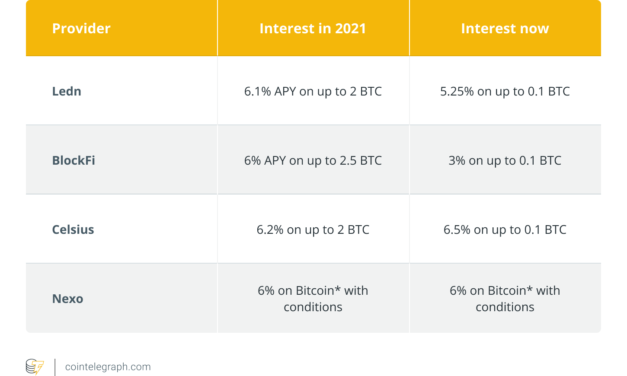
Generating a yield on crypto is increasingly tricky. The Terra ecosystem implosion — where up to $50 billion was wiped out — led to a decline in decentralized finance (DeFi) protocols offering interest.At the other end of the table, centralized finance, or CeFi, where all processes are rooted through a central body, has endured a comparatively peaceful bear market, yet interest rates are trending down. On the first of the month, investors who have an account with a CeFi provider such as Ledn, Celsius, BlockFi or Nexo generally receive emails detailing the interest rate for the following month.A blow for those looking for passive income, the interest paid from CeFi providers has ground down since the 2021 bull market. Giving up custody of a crypto asset for a miserly interest payment has encouraged some crypto enthusiasts to take control of their private keys, even drawing comparisons to legacy banking. In the table below, three of the largest custodians of Bitcoin (BTC) and crypto assets have fallen, taking into account both the interest rate and the amount of interest paid on each asset.CeFi interest rates have all but trended down over the past year. Source: Data was taken from each individual provider’s site.Cointelegraph spoke to three of the largest lenders of Bitcoin and other crypto assets to understand whether interest rates from CeFi providers may eventually hit rock bottom, aka 0.01% interest — like at banks — and why these lenders and interest providers exist. Interest rates will continue to be attractiveRepresentatives from Ledn, Nexo and BlockFi agreed that while interest in crypto is lower, it outcompetes legacy lending. Mauricio Di Bartolomeo, co-founder of Canada-based Ledn, told Cointelegraph, ”We are still five to 10 years away from Bitcoin rates coming anywhere close to those of fiat bank accounts.”“Most legacy bank savings accounts are paying out mere basis points (between 0.01% and 0.05%). Interest rates for our Bitcoin Savings Account product are still 5.25% APY for the first 0.1 BTC and 2% APY for balances above 0.1 BTC as of today.”In a tweet thread, Di Bartolomeo shared that “changing market conditions” have obliged lenders to drop their rates, as the difficulty level of turning a profit on arbitrage opportunities and the futures basis trade has risen. In simple terms – this means that market makers are also seeing their average returns get compressed. Which forces them to have to lower their borrowing costs.— Mauricio (@cryptonomista) May 4, 2022Jonathan Haspel, senior institutional trading associate at BlockFi, agreed, stating that “yield related to crypto interest-bearing accounts is impacted by a number of factors, including market sentiment, funding rates, supply and demand, and balance sheet optimization.”It’s true that crypto market sentiment has plummeted since the March 2020 crash, while funding rates, particularly for altcoins, have dropped to “worrying levels.” Haspel explained:“Ultimately, compressed rates and volatility are a sign of the asset class’s maturation. Where yield was once rampant and liquidity once sparse, there are more players in the crypto game feeding its competitive financing and widespread access.”Bullish on CeFi: The future remains brightZac Prince, CEO of BlockFi, told Cointelegraph that he’s still “bulllish on […] clients’ desire to earn crypto interest back for the long term.”In a similar note of optimism, Nexo co-founder and executive chairman Kosta Kantchev told Cointelegraph, “‘The times, they are a-changing,’ but crypto yields are still multiple times higher than those of traditional banks.” In a nod to the price of Bitcoin flatlining at around the $30,000 mark, Kantchev said:“While interest on some assets has become more stable, this mirrors the assets themselves. I think people largely overlook the sky-high rates on some of the newer assets on the block.”Ultimately, and in agreement with Di Bartolomeo, “regardless of how historically volatile crypto has been, the opportunity is always there.” CeFi providers will continue to offer more attractive interest rates than legacy financial institutions. It’s important to note that Nexo operates a different model, which would explain why rates are not technically dropping (as shown in the above table). Users experience higher rates of interest if they lock up the asset or hold a proportion of the Nexo token. Contrary to the other CeFi lenders, Kantchev explained: “Rates are not dropping. It’s more that yields on older cryptos on Nexo are ensured to be sustainable in the long run, but the eyebrow-raising rates are often available either with Nexo Tokens through our loyalty program or for some of the newer coins for which we can generate such impressive yield.”Growing adoption and innovation, anticipating regulationThat dropping rates should not be cause for concern: Per Di Bartolomeo, not only are centralized entities “instrumental to the adoption and evolution of Bitcoin as pristine collateral,” but legacy banks may even look to “partner” with CeFi players in the future. He said:“This means that centralized lenders, like Ledn, will act as a conduit to bring legacy capital to Bitcoin — benefiting both Bitcoiners (by letting them borrow at increasingly better rates) and capital providers (by offering them a great risk-adjusted return).”Related: Can DeFi and CeFi coexist? Three takeaways from experts panelBlockFi’s Haspel agreed, “CeFi offers a compelling use case supporting crypto’s narrative for global monetary access.” Despite the turbulent waters the crypto industry treads in spring 2022, BlockFi sees “an increase in global demand for risk-managed crypto products — such as interest accounts — in other emerging digital assets.”“While credit checks and a lack of financial history harm individuals seeking access to capital on a global scale, CeFi lending offers a solution. By utilizing crypto assets confirmed on a transparent and immutable ledger, CeFi protocols are able to quickly verify their possession.”For Kantchev, innovation, customers and new products are right around the corner: “Compliant, sustainable interest products that address regulatory guidance while profitably paying customers will be one of the next such products.”“The industry has matured tremendously, […] so I’m convinced we will continue to find risk-free strategies that yield attractive returns and be able to share these with the community.”In Nexo’s case, that means diversifying its product offering; for BlockFi, it continues to onboard institutions, while Ledn has branched out into Bitcoin-backed mortgages.Cointelegraph reached out to CeFi provider Celsius for comment but did not receive a response as of publishing time. 

Čítaj viac

Získaj BONUS 8 € v Bitcoinoch

nakup bitcoin z karty

Registrácia Binance

Burza Binance

Aktuálne kurzy