
Autor Cointelegraph By Joseph Hall

Nexo offers to buy out Celsius’ loans amid withdrawal suspension

There’s a glimmer of hope for the bear market’s most recent victim. Following reports that Celsius is insolvent, Nexo is offering a buy-out. A Nexo representative told Cointelegraph that Nexo is trying to do the “right thing” as they are “mindful of the repercussions for retail investors & the crypto community.”Celsius suspended all network withdrawals on Monday; users are not able to access their funds. In an open letter, Nexo has extended a formal offer to acquire qualifying assets of Celsius Network after their withdrawal freeze. The letter states:“Nexo, its partners, and affiliates could readily acquire from Celsius part or all qualifying, outstanding collateralized loan receivables secured by their corresponding pledged cryptocurrency collateral, subject to Nexo’s risk management and collateral requirements.”In a nutshell, the Nexo team would absorb all of Celsius’ loans and gain its customer database. The Nexo team has allowed seven days for the Celsius team to respond, as the proposal will terminate on June 20. In a tumultuous weekend of market action, Nexo’s first call to help was rejected by the Celsius team on June 12:“Yesterday [June 12] we reached out to the Celsius team to offer our support, but our help was refused.”Separately, Nexo has reassured investors that funds are safe. The Nexo representative told Cointelegraph it was “the first crypto lender to publicly open its books to the public in real time back in September and invited all our competitors and responsible crypto platforms to follow our lead.”Competitors including Ledn, a Bitcoin-only (BTC) credit and savings product platform have released similar statements to spread calm among investors.  In a tweet, Ledn shared that customers’ investments are secure. BlockFi CEO Zac Prince tweeted that his business is operating normally.  Ledn, Nexo and Blockfi have been open to talking about their business models with Cointelegraph previously.Related: Mashinsky says ‘Sharks of Wall Street’ circling around Celsius and other projectsNexo is not the only company to come to the aid of Celsius. Bitcoin maximalist Cory Klippsten, founder of Bitcoin-only exchange Swan Bitcoin (who had previously called out Celsius as risky) has offered a “life raft” to Celsius investors. Hey @celsiusnetwork users, I really hope you get your coins back from @mashinsky. And I also hope you never, EVER trust him again.NO MORE 1 BTC MINIMUM for the @swanbitcoin life raft. Free membership in Swan Private ($3000 value) for the first 1000 Celsius members who DM me.— Cory Klippsten (@coryklippsten) June 13, 2022For some commentators, such as analyst Will Clemente, comparisons between Luna’s implosion and Celsius’ apparent insolvency are too hard to ignore:I guess Luna and Celsius will be our two sacrifices to the crypto gods for this bear market?— Will Clemente (@WClementeIII) June 13, 2022

As Klippsten and Nexo have made clear, the crypto community is attempting to limit the immediate fallout of Celsius’ reported insolvency. The Nexo spokesperson said “[Nexo] hopes Celsius will accept this help and as few investors will be affected adversely as possible.”

Čítaj viac

Swedish Central bankers snipe Bitcoin mining, cite rampant energy use

Another day, another environmental attack on proof-of-work (PoW) mining. A report shared by the Swedish central bank argued that energy-intensive Bitcoin (BTC) and cryptocurrency mining should be banned. The Swedish central bank, known as the Riksbank, is the oldest central bank in the world. In a damning report entitled, “Cryptocurrencies and their impact on financial stability,” the bank had a crack at PoW cryptocurrency mining. PoW mining employs energy-guzzling data centers that solve puzzles to secure blockchains. The report stated:“Recently, some extraction of crypto assets has been established in northern Sweden, where it consumes as much electricity as 200,000 households do on an annual basis.”For Knut Svanholm, a Bitcoin author who recently penned  “∞/21M,” told Cointelegraph, “A central bank has no business telling people what they can and cannot do with their electricity.” “If they really cared about the environment, they’d shut their own operation down for good tomorrow morning.”The paper cites peers at the environmental agency and the Swedish Financial Supervisory Authority, equivalent to the United States Securities and Exchange Commission, in its examination of Bitcoin’s energy use: “The proof-of-work method, which is used to confirm transactions and extract new cryptocurrencies, should be banned in favor of other, less energy-intensive methods.”Svanholm has a different take: “Bitcoin mining is guessing a number over and over again. […] As so many other Swedish institutions have done before them, they [the central bank] choose to comment on something that they don’t understand and have no business having even an opinion on.”The report comes as little surprise, given that banks and governments regularly take aim at PoW energy use. The report also flies in the face of Bitcoin adoption in Sweden. Home to a number of Bitcoin startups, Sweden is advanced in terms of European Bitcoin adoption.Prominent Swedish Bitcoiners, including Svanholm as well as Christian Ander, the founder of Swedish Bitcoin exchange BTX, were quick to refute the report on Twitter. Svanholm shared a Youtube video that argued that “none of the energy used for Bitcoin mining goes to waste.”Här är en liten video jag och några kompisar har gjort om ämnet: https://t.co/uz4p5Ap7EC— knutsvanholm.com ∞/21M (@knutsvanholm) June 10, 2022Ander called the report “highly inappropriate.” He tweeted: “Energy consumption must be neutral, production must be regulated. Do not regulate what individuals do with it.”As the bank’s friends at the International Monetary Fund march onward with a central bank digital currency — as it would use less energy — the figures for Bitcoin mining are stark. In late 2021, Bitcoin took first place as the cleanest industry in the world with its high renewable energy mix. In neighboring Norway, Bitcoin miners use 100% renewable energy, while Bitcoin miners worldwide strive to make the world a better place. Related: Bitcoin’s real energy use questioned as Ethereum founder criticizes BTCThe proposed ban from the Swedish central bankers also lands concurrently with the publication of a report examining the energy efficiency of crypto transactions . The report stated: “When Bitcoin Lightning layer is compared to Instant Payment scheme, Bitcoin gains exponentially in scalability and efficiency, proving to be up to a million times more energy efficient per transaction than Instant Payments.”Bitcoin’s Lightning Network recently hit the 4,000 BTC milestone showing its promise as a payment solution. Lightning payments take place off-chain and use considerably less electricity than the Bitcoin miners that secure the network’s layer one. Nonetheless, research from Cambridge Centre for Alternative Finance states that Bitcoin consumes an estimated 15GW of electricity each day. In meme-worthy material, back-of-the-napkin math from one Twitter user claims that clothes driers in the U.S. consume more energy: (reposting the math here, for ref)- There are 130M US households- An avg household uses 12000 KWh / yr (EPA)- Dryers are 6% of household energy consumption (EPA), which = 720 KWh / yr- 720 KWh * 130M = 93.6 TWh- Bitcoin uses 70-120 TWh (estimates vary)^ that’s just the US— Daniel Ƀrrr (@csuwildcat) February 15, 2021

An Our World in Data report demonstrated that the global sports industry emits three times the emissions of the Bitcoin network. It begs the question, why do central banks continue to attack PoW’s energy usage? And which financial institution will fire the next shot? 

Čítaj viac

Bitcoin Lightning Network Capacity charges through 4,000 BTC

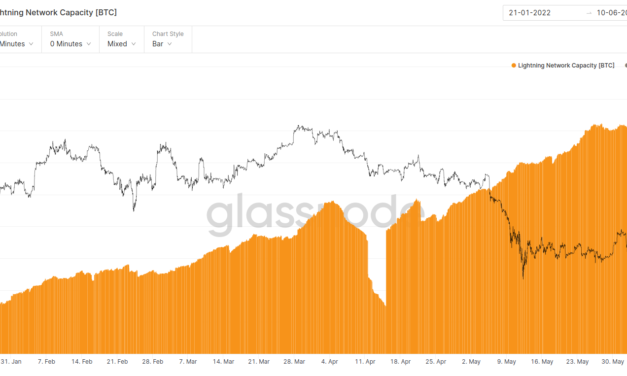
There’s cause for celebration from the world’s largest cryptocurrency. The Lightning Network hit the 4,000 Bitcoin (BTC) public capacity milestone, meaning $120 million in value is ready for peer-to-peer payments.The Lightning Network first broke the 1,000 BTC barrier in August 2020 and the 2,000 BTC barrier in July 2021. The capacity has doubled in the space of 18 months. Lightning Network capacity growth since January 2022. Source: Glassnode.CoinCorner CEO Daniel Scott told Cointelegraph that “we had slow and steady growth with Lightning capacity to begin, but since Jan 2021 the uptick has been strong.”Danny Brewster, CEO of United Kingdom-based Bitcoin exchange Fast Bitcoins told Cointelegraph that Lightning Network capacity “likely passed 4k a long time ago with private channel metrics not being publicly available.”“With that being said, the constant growth has been a great start for the Lightning Network and I foresee it continuing into the future, as long as all stakeholders, from developers to entrepreneurs building businesses continue to push forward.”A layer-2 payment protocol built on Bitcoin’s base layer, the Lightning Network allows for near-instant transaction finality. In the following video, Paco de la India — a Bitcoin-powered world traveler — buys a pair of shorts from Mozambique-based Bitcoiner Jorge, using the Lightning Network:Day 261I got to buy a pair of shorts for #Bitcoin from Jorge in Tofo. Paid him sats via #paxful Lighting to his @MuunWallet Thanks to @BitcoinEkasi for orange pilling him. Jorge misses you. This is #btc adoption in MozambiqueObrigado,Paco#runwithbitcoin https://t.co/UqFtKZzfFL pic.twitter.com/JRMUel6twK— Paco de la India⚡ (@RunwithBitcoin) June 3, 2022Lead on-chain analyst for Glassnode, James Check, told Cointelegraph, “The expansion of Bitcoin’s Lightning Network appears to be transitioning out of the ‘reckless’ phase, and into proper experimentation by early adopters.”Related: The Lightning Network Lunch: A Bitcoin contactless payment story“As wallet designs and user experience improve, more kinks can be worked out, and the network will mature. The persistent growth of public Lightning capacity and channel count is a reflection of this vote of growing confidence and growing utilization,” he said.Scott agreed, sharing that the positive trend is likely to continue “as more companies adopt Lightning and we see more use cases come to fruition.”“The influence of El Salvador adopting Bitcoin seems to have been an inflection point for Lightning, giving it confidence and proving a real-world use case.”According to data from 1ML, the average and median transaction cost for sending Satoshis (the smallest denomination of a Bitcoin) over the Lightning is well under $0.01, proving it packs a punch as payment technology. Brewster concludes, it’s an “awesome start but a long way to go. It really is still early!”

Čítaj viac

Tether is ‘instrument of freedom’ and 'Bitcoin onramp,’ says Bitfinex CTO

On a sun-splashed day in the Swiss Alps, the chief technology officer of Bitfinex and Tether, Paolo Ardoino, shed light on the Plan B Lugano strategy, Tether as an onramp into Bitcoin (BTC) and —crucially — his favorite pizza toppings. Fresh off the plane from Norway, where Ardoino attended an increasingly Bitcoiner-friendly event, the Oslo Freedom Forum, the Italian explained that, in contrast to the WEF,there was no “shilling” in Norway. Tether was invited to speak at the Oslo Freedom Forum as the stablecoin is increasingly considered an “instrument of freedom.” Tether has been adopted by the Myanmar government while the Ukrainian government has accepted crypto donations, including Tether, since the onset of the Russia-Ukraine war. “Tether is one of the tools to be used by distressed countries where the national currency is devaluating—where people want an edge against insane inflation.”Ardoino cites Turkey and Argentina as examples. The Turkish lira has lost 50% of its purchasing power and crypto, often seen as a hedge against uncertain currencies, is experiencing a second wave of interest. Ardoino also conceded that:“Bitcoin is great but they want the price stability, the long-term price stability. […] “Bitcoin is great for many things but it’s not yet understood by many.”Regarding the Plan B strategy in Lugano, where Bitcoin and Tether are de facto legal tender in the Swiss city, Ardoino shared that educational models in Switzerland are being shared across to El Salvador.“Bitcoin is for everyone. You have people in a poor country that need Bitcoin as the basic financial infrastructure. On the other side, you have a country with the most banks in the world, and they still need Bitcoin.”Related: Tether launches crypto and blockchain education program in SwitzerlandArdoino also critiqued Satoshi Nakamoto’s choice of pizza toppings. Bitcoin Pizza Day occurred the day before the WEF, a day where Bitcoiners around the world eat and attempt to pay for pizza with Bitcoin. The creator of Bitcoin, Satoshi Nakamoto, famously enjoyed pineapple and jalapeños on pizza, to which Ardoino commented, “nobody is perfect.”

Čítaj viac

Digital assets still make a lot of sense, says Codex co-founder

Co-founder and chief evangelist officer for Codex, Alex Gordon-Brander, spoke to Cointelegraph about his Bitcoin story, the real-world use cases for crypto, and the economic downturn during a World Economic Forum interview in Davos, Switzerland. Standing curbside in front of Davos’ “Crypto House” at dusk, where Gordon-Brander had just finished demonstrating Codex’s capabilities during a crypto panel, the co-founder shared an upbeat outlook on crypto. A long-serving crypto enthusiast and trad-fi veteran, Gordon-Brander told Cointelegraph he was exploring digital and energy-backed currencies prior to discovering Bitcoin (BTC). He researched a “distributed currency based on renewable energy credits and governments,” but he concedes it was “super complicated.” Around the time, a friend shared a Bitcoin idea with Gordon-Brander, but like most people that first hear about Bitcoin — especially so early on — Gordon-Brander thought it’s “probably not going to work.” He tried to get hold of some satoshis but his employer at the time, Bridgewater Associates– — founded by former Bitcoin basher turned Bitcoin bull, Ray Dalio — “couldn’t handle the compliance.” Fast forward to 2015, the year the Ethereum network launched, and Gordon-Brander realized the cryptocurrency space had legs. “I’d been really intrigued by Bitcoin but the idea of a programmable currency — the idea of a world computer and an interoperable financial system, that blew me away,” he said.From 2015 onwards, Gordon-Brander assisted the launch of a crypto exchange and participated in the initial coin offering boom before joining Codex Labs. Related: ‘CBDCs are the natural evolution,’ says HyperLedger director BarbosaAlthough interest among investors in decentralized applications is swelling such as those keen to acquire their first Ether (ETH), there is still “a lot of Bitcoin first” interest from institutions. Finally, while the bear market price action drags on, there is hope for Bitcoin and cryptocurrencies: “As a secular trend bet, digital assets still make a lot of sense.”Ultimately, Gordon-Brander explains, there has been an awakening regarding crypto finance and the role it can play in solving real-world problems, from “ordinary people realizing that their money in the bank was no longer safe if their government doesn’t like their politics,” to tackling climate change: “The world is in a much better place with this technology than it would be without it.”His former boss at Bridgewater, Ray Dalio, now recommends a small allocation to Bitcoin and the optimism that crypto brought to the WEF was hard to ignore.

Čítaj viac

Získaj BONUS 8 € v Bitcoinoch

nakup bitcoin z karty

Registrácia Binance

Burza Binance

Aktuálne kurzy