
Autor Cointelegraph By Jordan Finneseth

Bitcoin price holds $20K, but analysts say ‘expect 6 months of sideways’ price action

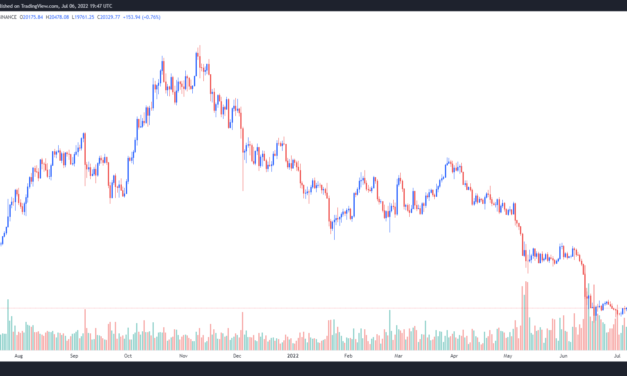
Trading across the cryptocurrency market was relatively subdued on July 5 as the ecosystem continues to digest the fallout from the Three Arrows Capital scandal and Voyager Digital announcing that it has filed for Chapter 11 bankruptcy protection. Data from Cointelegraph Markets Pro and TradingView shows that the price of Bitcoin (BTC) has spent the day oscillating around the $20,000 support level, ranging from a low of $19,775 to an intraday high of $20,480 on $25.48 billion in trading volume. BTC/USDT 1-day chart. Source: TradingViewHere’s a look at what several analysts are saying about what could come next for Bitcoin and what support and resistance levels to keep an eye on in the event of a sharp move in price. Watch the repeating pennant patternA noticeable pattern on the Bitcoin chart prior to the pullbacks that have occurred since November 2021 was pointed out by crypto analyst and pseudonymous Twitter user Moustache, who posted the following chart displaying the similarities between each drawdown. BTC/USD 1-day chart. Source: TwitterMoustache said, “$BTC has done the same pattern every time, but each descending triangle has gotten smaller and smaller? Another bearish breakout and the target would be between $14,000 and $16,000.”Noted market analyst Peter Brandt also recently highlighted the repeating pennant pattern on the Bitcoin chart, but stopped short of saying which way the price could move once the formation completes. When it looks like a pennant and acts like a pennant it is often a pennant $BTC pic.twitter.com/O7RtnvFSp0— Peter Brandt (@PeterLBrandt) July 5, 2022Address count grows as the market looks for a bottomLately, one of the most popular topics of conversation on crypto Twitter has been centered around trying to predict the bottom in Bitcoin price.According to cryptocurrency research firm Delphi Digital, Bitcoin has now closed below its 200 weekly average for four consecutive weeks, a development that has historically “marked previous market bottoms.” Bitcoin price performance since January 2020. Source: Delphi DigitalAs for whether or not Bitcoin traders should expect a rapid recovery, Delphi Digital noted that “this is the longest BTC has remained below its 200 weekly average” and highlighted the fact that “Bitcoin’s weekly correlation coefficient continues to remain inversely related to the US Dollar as it hit a 17-month low of -0.77.”While a strong dollar suggests that Bitcoin price will continue to struggle alongside other assets, Delphi Digital highlighted one encouraging development that suggests BTC adoption continues to grow. Delphi Digital said, “With prices continuing to fall, the number of BTC addresses accumulating BTC continues to rise. Addresses holding at least one BTC have reached a new all-time high of 877,501.”Related: World’s first short Bitcoin ETF sees exposure explode 300% in daysSome traders predict chop for the remainder of 2022A macro look at what the past performance of Bitcoin suggests about its future was provided by market analyst and pseudonymous Twitter user KALEO, who posted the following chart outlining previous market cycles. BTC/USD 3-day chart. Source: TwitterBased on the chart and the predicted path provided, Kaleo suggested that the market will continue to trade sideways for the foreseeable future and will be “defined by a crab market saying above HTF logarithmic support. Kaleo said, “Most likely path from here is seeing a base range between $16K – $30K established, that eventually resolves around December when price finally breaks above HTF diagonal resistance.”The overall cryptocurrency market cap now stands at $916 billion and Bitcoin’s dominance rate is 42.5%.The views and opinions expressed here are solely those of the author and do not necessarily reflect the views of Cointelegraph.com. Every investment and trading move involves risk, you should conduct your own research when making a decision.

Čítaj viac
Bitcoin price swings 7.5% during intraday trading as US recession concerns mount

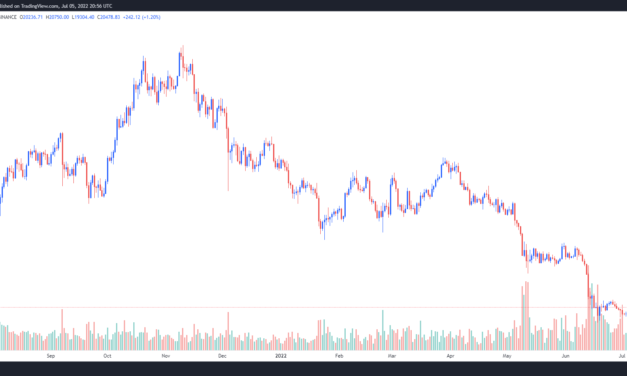
The cryptocurrency market along with the tech-heavy Nasdaq saw a bit of positive price action on July 5 amid a backdrop of rising recession concerns in the United States. Data from Cointelegraph Markets Pro and TradingView shows that an early morning onslaught by bears managed to drop Bitcoin (BTC) to a daily low of $19,309 before reinforcements arrived to bid the price back above support at $20,400 during the afternoon. BTC/USDT 1-day chart. Source: TradingViewHere’s what several analysts are saying comes next for the top cryptocurrency and what support and resistance levels to keep an eye on moving forward. Looking for a continuation to $23KA bullish take on the recent Bitcoin price action was offered by independent analyst Michael van de Poppe, who posted the following chart as a follow-up to a previous Tweet that suggested Bitcoin needed to crack the resistance zone at $19,700 to continue higher:BTC/USD 15-minute chart. Source: TwitterThe analyst said:“This one did crack the resistance and ran towards the next area of resistance at $20.3K. I’m expecting #Bitcoin to consolidate for a bit here, but breaking the next resistance zone is a trigger for continuation towards $23K and a summer relief rally.”Possible pullback to $15,800A decidedly less optimistic take on the recent price action was provided by crypto analyst and pseudonymous Twitter user il Capo of Crypto, who posted the following chart highlighting several “fake pumps” that resulted in lower highs:BTC/USD 4-hour chart. Source: TwitterIl Capo of Crypto said:“Lower highs all the time. Pumps have low volume and they look corrective. Main target remains $15,800-16,200.”Related: Bitcoin faces fresh pressure as US dollar crushes gold, risk assetsDouble bottom on the BTC chartA final bit of hopium was offered by crypto trader and pseudonymous Twitter user Captain Faibik, who posted the following chart and highlighted the importance of a daily close above $20,000:BTC/USD 1-day chart. Source: TwitterCaptain Faibik said:“Double Bottom & Bullish Divergence Both in Play… If Bulls Reclaimed the $21.6K Resistance, Expecting +30-40% Relief RALLY.”For those looking for more reassurance that the market may be nearing its bottom for the current bear cycle, pseudonymous Twitter user Bitcoin Archive posted the following chart of Bitcoin’s MRVR Z-score, which has been a reliable indicator of past market bottoms:Bitcoin MVRV Z-score. Source: TwitterBitcoin Archive explained:“#Bitcoin is now deep into the “green zone” – which has signaled market bottoms on 4 occasions.”The overall cryptocurrency market cap now stands at $911 billion and Bitcoin’s dominance rate is 42.7%.The views and opinions expressed here are solely those of the author and do not necessarily reflect the views of Cointelegraph.com. Every investment and trading move involves risk, you should conduct your own research when making a decision.

Čítaj viac

Bitcoin exchange outflows surge as 'not your keys, not your crypto' comes back into fashion

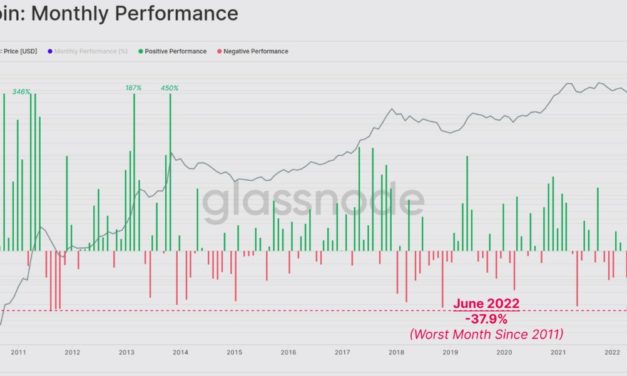
Bear markets in cryptocurrency are known to be painful, but the month of June was especially trying for the crypto faithful as a confluence of factors resulted in the price of Bitcoin (BTC) falling 37.9%, its worst monthly performance since 2011.Bitcoin monthly performance. Source: Glassnode.As a result of the continued widespread weakness, a majority of the so-called Bitcoin “tourists” have now exited the space, leaving only the most dedicated holders remaining, according to blockchain analytics firm Glassnode. Despite Bitcoin’s ongoing struggles and the fact that crypto traders are currently experiencing the worst bear market in the sector’s history, several metrics suggest that the outlook isn’t as dire as some are predicting and that the hodler base of the crypto market remains strong. Dedicated hodlers increase in numberA significant purge of active Bitcoin wallets is a common occurrence during major sell-off events as well as in early bear markets, according to Glassnode. However, the severity of the exodus has been diminishing since the bear market of 2018, indicating that “there is an increasing level of resolve amongst the average Bitcoin participant,” Glassnode said.During the most recent reduction in the number of addresses with a non-zero balance, only 1% of the Bitcoin addresses purged their holdings entirely as compared to 2.8% between April and May 2021, and the whopping 24% that did the same between January to March of 2018. Number of Bitcoin addresses with a non-zero balance. Source: GlassnodeWhile on-chain activity for Bitcoin remains muted and solidly in bear-market territory, the most dedicated Bitcoin holders continue to hold the line, and will likely continue to do so until the market turmoil subsides and a floor in the BTC price is established. A return to best Bitcoin practicesThe ethos of “not your keys, not your crypto” is once again gaining traction in the crypto community as traders have been withdrawing their tokens from exchanges at a frantic pace. The collapse of the Terra ecosystem, potential insolvency of Celsius and the implosion of Three Arrows Capital have all served as a stark reminder that crypto is intended to be stored in cold storage. Bitcoin exchange net position change. Source: GlassnodeSince March 2020, the number of Bitcoin held on exchanges has declined from 3.15 million to 2.4 million. That’s a total outflow of 750,00 BTC with 142,500 of that total occurring in the past three months. With platforms like Celsius halting withdrawals and smaller exchanges beginning to put limits on the amount that users can remove, the desire to regain personal control of crypto assets has become a top concern for holders. This can actually be seen as a positive for prices in the long-term as the likelihood of further capitulation decreases when tokens are locked in cold storage and not readily available to sell on exchanges. Related: With the bear market in full throttle, crypto derivatives retain their popularityRetail starts to gain interestAnother encouraging development amid the worst month in Bitcoin history is an increasing interest from wallets holding less than 1 BTC, which are more likely to represent the retail cohort of the crypto market. These so-called “shrimp” wallets have been eagerly scooping up low-priced Bitcoin to the tune of 60,460 BTC per month according to Glassnode, which is “the most aggressive rate in history.” Bitcoin shrimp wallet net position change. Source: GlassnodeEven with crypto in a bear market, several underlying metrics, including a dedicated cohort of crypto hodlers and rising interest from smaller retail buyers. suggest that calls for the death of Bitcoin are once again premature. Oh, look, #bitcoin balance on exchanges still dropping… Some people understand that there will only ever be 21 million $BTC. They are getting their piece of the pie. pic.twitter.com/NSVBJicjZo— Lark Davis (@TheCryptoLark) July 5, 2022The views and opinions expressed here are solely those of the author and do not necessarily reflect the views of Cointelegraph.com. Every investment and trading move involves risk, you should conduct your own research when making a decision.

Čítaj viac
Bitcoin trader says expect more chop, downside, then sideways price action for BTC this summer

Discussion of the state of the crypto market has been a dominant headline over the past few weeks as non-crypto native media excoriate Bitcoin (BTC) and DeFi investors for investing in assets with no fundamental value. At the same time, crypto-savvy analysts and traders have been pouring over charts, looking for clues that signal when the market will bottom and reverse course.Novice investors are clearly nervous and a few have predicted the demise of the burgeoning asset class, but for those that have been around for multiple cycles, this new bear market is just another forest clearing fire that will eventually lead to a healthier ecosystem. The next steps for the crypto market was a topic discussed in depth with Cointelegraph contributor Crypto Jebb and independent market analyst Scott Melker. The pair chatted about their views on why the value proposition for Bitcoin remains strong and what the price action for the top cryptocurrency could look like moving forward. [embedded content]Here’s a look at some of the key points discussed by Crypto Jebb and Melker. Bitcoin is being used as it was originally intendedTraders are primarily focused on Bitcoin’s spot price and lamenting the fact that it is not performing as the inflation hedge that many promised it would be, but Melker pointed out that its performance largely depends on the country and economic state of where an individual lives. Bitcoin may be down significantly in terms of U.S. dollars, but when compared to countries like Venezuela that are experiencing hyperinflation, or Nigeria, which has a large unbanked population, BTC has offered people a way to preserve the value of their money and transact in an open financial system. One of the biggest functions highlighted by Melker is that Bitcoin is the first real asset that has given people around the world the ability to opt out of the current financial system if it’s not working for them. According to Crypto Jebb, Bitcoin is thermodynamically sound, meaning he defined as the asset holding on to the energy that is put into the system and that it doesn’t “leak” it out through things like inflation. What direction will the market take?Regarding the market’s future, Melker made sure to emphasize that while it may not seem like crypto adoption is moving fast to those who have been in the market for years, “the adoption of Bitcoin is faster than the internet. It’s a hockey stick curve that is absolutely going parabolic.” Both Crypto Jebb and Melker suggested that the paradigm shift toward investing in cryptocurrencies just needs more time because people who have been conditioned to invest in things like a 401k or Roth IRA and most investors are trained to fear risk.In response to possible critics who would cite Bitcoin’s volatility as a core reason to avoid cryptocurrencies, Melker highlighted the struggles that equities markets have had lately, citing the poor performance of stocks like Netflix, Facebook, PayPal and Cathie Woods’s ARK funds. Melker said, “Last month was the first time I believe I saw research from Messari that said there wasn’t a single place that you could have basically put money in an asset class and stored any sort of value. And if you stayed in cash, you lost 8% of your buying power doing that.”Related: Deutsche Bank analysts see Bitcoin recovering to $28K by DecemberExpect more downside over the short-termAccording to Melker, the current condition of the market is poor and in the short-term, it’s important to remember that “the trend is your friend” and that further downside is likely. That being said, Melker indicated that there are some developments coming up that could help the market out of its lull, including the Fed tightening cycle which has historically put pressure on asset prices for the first three quarters of the tightening cycle until the market adjusts to the new reality. Melker said, “My best guess is that we have a very choppy, boring low-volume, low liquidity summer. Maybe we put in new lows, or maybe we just chop around from $17.5K to $22K or $23K, something like that. And then we really start to see what the market is made of coming into the end of the year.” Don’t miss the full interview on our YouTube channel and don’t forget to subscribe!The views and opinions expressed here are solely those of the author and do not necessarily reflect the views of Cointelegraph.com. Every investment and trading move involves risk, you should conduct your own research when making a decision.

Čítaj viac

Analysts identify 3 critical flaws that brought DeFi down

The cryptocurrency market has had a rough go this year and the collapse of multiple projects and funds sparked a contagion effect that has affected just about everyone in the space. The dust has yet to settle, but a steady flow of details is allowing investors to piece together a picture that highlights the systemic risks of decentralized finance and poor risk management.Here’s a look at what several experts are saying about the reasons behind the DeFi crash and their perspectives on what needs to be done for the sector to make a comeback. Failure to generate sustainable revenueOne of the most frequently cited reasons for DeFi protocols struggling is their inability to generate sustainable income that adds meaningful value to the platform’s ecosystem. Fundamental Design Principles for DeFi:- If the protocol doesn’t work without a reward token, it’s a Ponzi schemeA reward token should not be necessary for a protocol to function. That means the protocol is not a revenue generating business.— Joseph Delong* (@josephdelong) May 23, 2022In their attempt to attract users, high yields were offered at an unsustainable rate, while there was insufficient inflow to offset payouts and provide underlying value for the platform’s native token. This essentially means that there was no real value backing the token, which was used to payout the high yields offered to users. As users began to realize that their assets weren’t really earning the yields they were promised, they would remove their liquidity and sell the reward tokens. This, in turn, caused a decline in the token price, along with a drop in the total value locked (TVL), which further incited panic for users of the protocol who would likewise pull their liquidity and lock in the value of any rewards received. Tokenomics or Ponzinomics?A second flaw highlighted by multiple experts is the poorly designed tokenomic structure of many DeFi protocols that often have an extremely high inflation rate which was used to lure liquidity.High rewards are nice, but if the value of the token being paid out as a reward isn’t really there, then users are basically taking a lot of risk by relinquishing control of their funds for little to no reward. This largely ties in with DeFi’s revenue generation issue, and the inability to build sustainable treasuries. High inflation increases token supply, and if token value is not maintained, liquidity leaves the ecosystem.Related: Bear market will last until crypto apps are actually useful: Mark CubanOverleveraged usersThe overuse of leverage is another endemic DeFi problem and this flaw became crystal clear as Celsius, 3AC and other platforms invested in DeFi began to unravel last month.Users who staked these inflationary tokens to over-leverage their positions got liquidated as prices dipped due to market sell-offs.This led to a death spiral for the protocol. @Wonderland_fi is one such protocol where users leveraged $TIME to borrow $MIM and got liquidated— Magik Invest ✨ (@magikinvestxyz) June 28, 2022

These liquidations only exasperated the downtrend that many tokens were already experiencing, triggering a death spiral that spread to CeFi and DeFi platforms and a few centralized crypto exchanges.In this sense, the onus really falls on the users for being over-leveraged without a solid game plan on what to do in the eventuality of a market downturn. While it can be a challenge to think about these things during the height of a bull market, it should always be something in the back of a trader’s mind because the cryptocurrency ecosystem is well known for its whipsaw volatility. The views and opinions expressed here are solely those of the author and do not necessarily reflect the views of Cointelegraph.com. Every investment and trading move involves risk, you should conduct your own research when making a decision.

Čítaj viac

Získaj BONUS 8 € v Bitcoinoch

nakup bitcoin z karty

Registrácia Binance

Burza Binance

Aktuálne kurzy