
Autor Cointelegraph By Jordan Finneseth

Analysts expect Bitcoin trend change after Fed lays out its 2022 roadmap

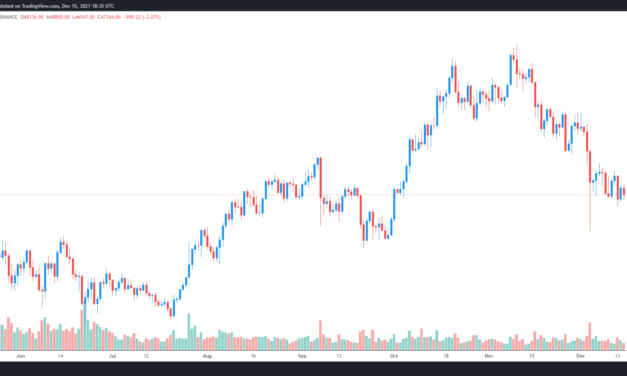
The year-long calls for a $100,000 Bitcoin (BTC) price have fallen to the wayside since the asset struck a new all-time high at $69,000, but traders are not completely dismayed. At the moment, most analysts view the current price range as an optimal accumulation zone.For the past week, markets had been a bit rocky as investors across the globe grew increasingly nervous about Dec. 15’s Federal Open Market Committee meeting, but confirmation that the Federal Reserve would enact three rate hikes and gradual tapering in 2022 appears to have been priced into last week’s market volatility. Data from Cointelegraph Markets Pro and TradingView shows that the price of BTC continues to trade above the $47,000 support and after Chairman Powell’s statement, the price rose about 0.55% to trade at $49,000.  BTC/USDT 4-hour chart. Source: TradingViewHere’s a look at what market analysts expect from BTC price now that the Fed’s policy intentions for 2022 were clarified. There is a solid base of support near $46,500A more detailed analysis of the recent price action was offered by options trader and pseudonymous Twitter user John Wick, who posted the following chart highlighting the bullish and bearish reversals that have occurred over the past two weeks. BTC/USD 4-hour. Source: TwitterAccording to Wick, the recent price action from BTC has established “a solid base support,” which is represented by the yellow horizontal line at $46,588, which is structurally “called a stage 1 base.”Wick said, “We can expect volatility to build up as well. The next setup I am targeting is an upcoming squeeze. This may turn out just like July did after we based in a stage 1 support. Next stage is fire.”Volatility is par for the courseCompared to historical price action after all-time highs, the current volatility seen in the market is nothing to fret about, according to independent market analyst Rekt Capital who tweeted that the market showed similar drawdowns in previous bull markets only to storm higher after the fear dissipated.The panic & bearish sentiment towards #BTC is extreme right nowBut there’s nothing extreme about this -38% retraceOver the years, BTC has retraced 30-40% many times in Bull MarketsIn fact, $BTC retraced -53% this past May-38% isn’t extreme#Crypto #Bitcoin— Rekt Capital (@rektcapital) December 15, 2021Trader and pseudonymous Twitter user Crypto Ed_NL likewise sees a bounce coming in the future and he posted the following chart outlining how the price action could play out in the next few weeks.BTC/USD 1-hour chart. Source: TwitterCrypto Ed_NL said, “Expectations for the coming hours: 1 more leg down pre FOMC into the green boxes, a bounce after FOMC, continuation of the bull run.” Related: Bitcoin struggles to hold $47K as Fed meeting adds to ‘extreme’ BTC market panicEchoes of September’s BTC price actionA final bit of perspective was offered by crypto investor and pseudonymous Twitter user Crypto Bull God, who posted the following chart comparing the current price action for BTC with how it performed in September before going on a bullish breakout. BTC/USD 12-hour chart. Source: TwitterThe analyst said, “Been staring at this the past few days. Not saying this will happen, but I certainly see a similarity now as compared to back in Sept. of this year.”While no one can know for certain how things will play out as 2021 comes to a close, a possible sign that BTC could close out the year strong was pointed out in the following tweet by Cointelegraph contributor Michaël van de Poppe.Whales are buying and heavily getting into the markets in these ranges. Retail is scared.Good.— Michaël van de Poppe (@CryptoMichNL) December 15, 2021

The overall cryptocurrency market cap now stands at $2.152 trillion and Bitcoin’s dominance rate is 41.6%.The views and opinions expressed here are solely those of the author and do not necessarily reflect the views of Cointelegraph.com. Every investment and trading move involves risk, you should conduct your own research when making a decision.

Čítaj viac
3 reasons why Nexus Mutual (WNXM) price is holding steady in a volatile market

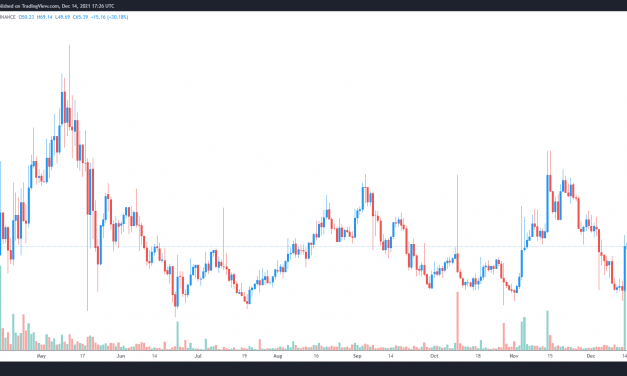
There is always going to be risks involved with interacting with cryptocurrencies and recent proof of this can be seen over the past few weeks after savvy hackers managed to abscond with millions of dollars worth of tokens from Bitmart, AscendEX and BadgerDAO exchange. Nexus Mutual is a decentralized platform that allows investors to secure insurance coverage against smart contract exploits and today the altcoin rallied by 38% even as Bitcoin and the wider crypto market continue to correct.Data from Cointelegraph Markets Pro and TradingView shows that after hitting a low of $46.59 on Dec. 13, the price of the protocols native WNXM token spiked 38% to a daily high at $69.22 on Dec. 14. WNXM/USDT 4-hour chart. Source: TradingViewThree reasons for the sudden price reversal of WNXM include a series of new partnerships and integrations with the Nexus Mutual protocol, an increasing total value locked within the Nexus Mutual ecosystem and the project’s ability to successfully provide cover to victims of protocol exploits which involved the loss of funds.Partnerships expand the Nexus Mutual ecosystem New partnerships and protocol integration with various DeFi platforms appear to be one of the driving factors behind WNXM’s current recovery.Recently, the developers behind Nexus Mutual held community calls with mStable, Balancer Labs, Alpaca Finance, Notional Finance and PoolTogether. The project has also seen a steady rise in the number of cover policies purchased, and within the last week a few multi-million policies were opened at Curve, Anchor, Stake DAO and OlympusDAO. Week over week increases in Nexus Mutual policies. Source: TwitterAs shown in the chart above, Nexus Mutual saw a 53% increase in the number of policies sold between Nov. 22 and Nov. 29, and the total value of the coverage offered increased by 121%. The increase in usage resulted in a 125.8% increase in the premiums earned by the protocol. Total value locked is on the riseThe total value locked on Nexus Mutual has also risen within the last 6 months and data from Defi Llama shows the metric hitting a high of $780.58 million on Nov. 9. Currently, the TVL on Nexus Mutual sits at $585.33 million, which is reflective of the sharp market-wide downturn which started last week.Total value locked on Nexus Mutual. Source: Defi LlamaProtocol users have the option of staking NXM tokens with projects they think are secure as the financial backing for the coverage provided. In exchange for funding the coverage, users receive a yield on their staked tokens, and a current average APY of 4.96%. According to the data provided by Nexus Mutual app, there is currently $1.1 billion staked through the protocol,   $25.5 million in coverage purchased and $12.7 million in rewards paid out. Related: ‘DeFi is the most dangerous part of the crypto world,’ says Senator Elizabeth WarrenSatisfied customers are good for businessA third reason for the growing strength of Nexus Mutual and the price appreciation of WNXM has been the proven track record of making victims whole after they lose money to a smart contract exploit or protocol hack.One of the DeFi platforms that had Nexus Mutual coverage prior to an exploit of $100 million was Cream Finance, a protocol that has suffered back-to-back losses in 2021 due to hacks and flash loan exploits.Luckily for those who had purchased coverage prior to the exploit, the Nexus Mutual community has paid out multiple claims for lost funds. Late Post: I want to thank the team at @NexusMutual for accepting my claim, I’m actually in tears right now I’m so thankful, I didn’t even realize that I was impacted by the CREAM finance exploit until I tried to withdraw my $BNT funds on CREAM. I recently quit my job to go..— Kar Ξ im $BNT (@Kareim30184380) December 8, 2021VORTECS™ data from Cointelegraph Markets Pro also began to detect a bullish outlook for WNXM on Dec. 11, prior to the recent price rise. The VORTECS™ Score, exclusive to Cointelegraph, is an algorithmic comparison of historical and current market conditions derived from a combination of data points including market sentiment, trading volume, recent price movements and Twitter activity.VORTECS™ Score (green) vs. WNXM price. Source: Cointelegraph Markets ProAs seen in the chart above, the VORTECS™ Score for WNXM climbed into the green zone on Dec. 11 and reached a high of 77 around 57 hours before the price increased 49% over the next day.The views and opinions expressed here are solely those of the author and do not necessarily reflect the views of Cointelegraph.com. Every investment and trading move involves risk, you should conduct your own research when making a decision.

Čítaj viac
Bitcoin price slips below $47K as stocks, crypto prepare for this week’s FOMC meeting

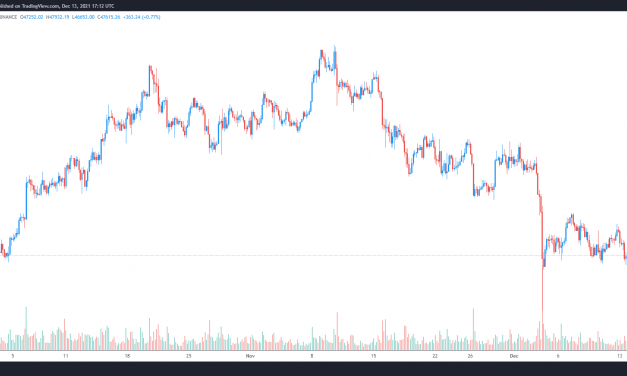
Bitcoin (BTC) bulls are once again on the defensive foot after the breakout momentum that put the price above $50,000 on the weekend evaporated and pulled the price under $47,000. Analysts say the slight pullback in equities markets and the upcoming Federal Open Market Committee (FOMC) meeting are the primary reasons for Dec. 13’s pullback and a few suggest that a revisit to the swing low at $42,000 could be on the cards. BTC/USDT 4-hour chart. Source: TradingViewHere’s a look at what analysts are saying about the current Bitcoin price action and what they expect in the short term.Fed taper talks put pressure on the marketThe current headwinds facing BTC are in large part being influenced by regulatory matters in the United States, as highlighted in a recent report from Delphi Digital, which noted that “the latest tightening by global policymakers and Fed tapering has already caused markets to reprice.”Delphi Digital said, “BTC is among one of the worst-performing assets compared to traditional asset classes since the November FOMC meeting, losing nearly 20% of its value over the last month.”While this latest downturn is testing the will of many traders who hold out hope that this is just another shakeout before the price heads higher, cryptocurrency analyst and pseudonymous Twitter user CryptoCapo offered some hope after posting the following chart comparing the current price action to the price dump that was seen back in September. BTC/USD 4-hour chart. Source: TwitterCryptoCapo said, “These two corrections are very similar. Same 3 wave move pattern. Same bottom formation (3 touches). Same funding+premium negative rates. Same hidden bearish divergence before the last leg down.”Looking for a bullish divergence below $46,500Further insight into the price action for BTC was offered by analyst and Cointelegraph contributor Michaël van de Poppe, who posted the following chart noting that the “market is dropping down as resistances rejected on Bitcoin.” BTC/USD 3-hour chart. Source: TwitterPoppe said, “Looks to me as if we’re looking for a bullish divergence to be created beneath the $46.5K area in order to have a reversal possible.”Related: ‘Monster bull move’ means whales could secure the next Bitcoin price surgeThis price action is “nothing out of the ordinary”A final word of reassurance was provided by market analyst and pseudonymous Twitter user Rekt Capital, who posted the following chart and noted that “BTC downside wicking below the red weekly support area has happened many times in the past (orange circles).”BTC/USD 1-week chart. Source: TwitterRekt Capital indicated this recent dip is par for the course and is nothing to be too concerned about in the long term. He said, “This sort of downside volatility at these price levels is nothing out of the ordinary.”The overall cryptocurrency market cap now stands at $2.152 trillion and Bitcoin’s dominance rate is 41.5%.The views and opinions expressed here are solely those of the author and do not necessarily reflect the views of Cointelegraph.com. Every investment and trading move involves risk, you should conduct your own research when making a decision.

Čítaj viac
ZK-rollups step into the limelight after the quest to scale Ethereum evolves

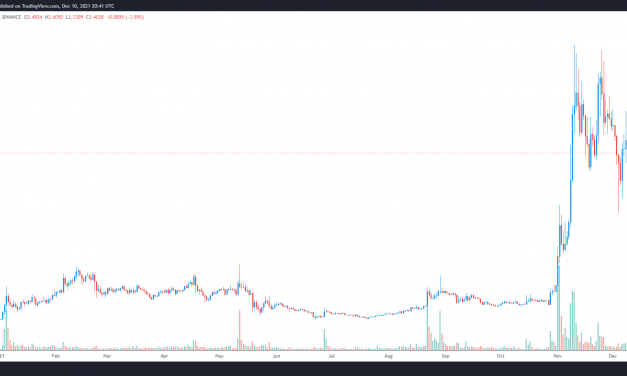
Scalability on the Ethereum (ETH) network has been a point of contention within the cryptocurrency ecosystem for years, primarily due to high fees and network congestion during periods of peak demand.The latest solution to emerge as the final fix to Ethereum’s scalability woes are Zero-knowledge rollups (ZK rollups), a form of scaling that runs computations off-chain and submits them on-chain via a validity proof. Zk rollup season — cryptowarlord.eth ( ͡° ͜ʖ ͡°) (@CryptoWarlordd) December 7, 2021Earlier in the year, protocols that opted to use optimistic rollups such as Optimism and Arbitrum dominated the headlines and were touted as the best solution to scaling on Ethereum, but aside from Arbitrum, the hype for those protocols has quieted down and traders have pointed out that even optimistic rollups have higher than desirable fees when the network is under peak demand.Early successes in 2021At the same time that optimistic rollup solutions were in the spotlight, protocols that adopted the ZK rollups model quietly demonstrated their capabilities.dYdX, a decentralized perpetual and futures exchange, was one of the earliest adopters of ZK-rollup technology through its partnership with StarkWare, whose StarkNet network is a permissionless decentralized ZK-Rollup.To date, the platform has seen a decent amount of success and at times managed to process a higher 24-hour trading volume than Coinbase. Loopring (LRC) is another protocol that has utilized ZK-rollups to decrease transaction costs and speed up its throughput capabilities, which has helped drive the price of LRC to a new all-time high of $3.83 in early November. LRC/USDT 1-day chart. Source: TradingViewRelated: Ethereum layer-two TVL reaches all-time highZK-rollups could be the next “rotation” for tradersFollowing last week’s sharp market-wide sell-off, ZK-rollups have reemerged as a buzzword in crypto sector. Polygon, a layer-two platform for the Ethereum network, made headlines with the announced acquisition of Mir, a project developing two subcategories of zero-knowledge proofs known as PLONK and Halo. The 250 million MATIC token investment by Polygon, which already offers some of the lowest fees of any protocol on the Ethereum network, was done in an effort “to explore and encourage all meaningful scaling approaches and technologies at this stage,” according to Polygon co-founder Sandeep Nailwal.Another much-anticipated protocol that has been gaining traction recently is zkSync, a scaling solution created by Matter Labs that secured $50 million in a Series B round led by Andreessen Horowitz in early November.zkSync total deposits vs. total unique usersAccording to Digital Delphi, the two main projects that are live on zkSync is ZigZag, a decentralized exchange, and a funding platform called Gitcoin.Analysts at Delphi Digital said, “According to L2 fees, token swaps through ZigZag on zkSync have the lowest fees.”The views and opinions expressed here are solely those of the author and do not necessarily reflect the views of Cointelegraph.com. Every investment and trading move involves risk, you should conduct your own research when making a decision.

Čítaj viac

Altcoin Roundup: 3 metrics that traders can use to effectively analyze DeFi tokens

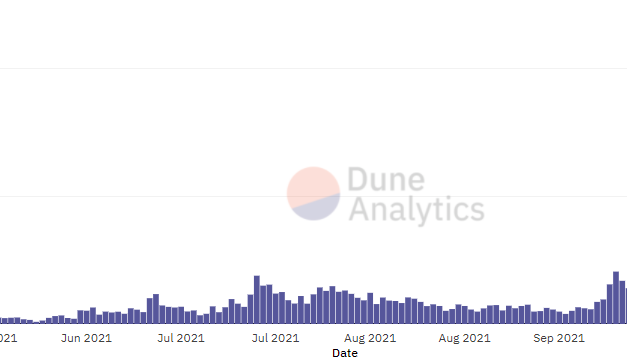
Much to the chagrin of cryptocurrency proponents who call for the immediate mass adoption of blockchain technology, there are many “digital landmines” that exist in the crypto ecosystem such as rug pulls and protocol hacks that can give new users the experience of being lost at sea. There’s more to investing than just technical analysis and gut feelings. Over the past year, a handful of blockchain analysis platforms launched dashboards with metrics that help provide greater insight into the fundamentals supporting — or the lack thereof — a cryptocurrency project. Here are three key factors to take into consideration when evaluating whether an altcoin or decentralized finance (DeFi) project is a sound investment.Check the project’s community and developer activityOne of the basic ways to get a read on a project is to look at the statistics that show the level of activity from the platform’s user base and developer community.Many of the top protocols in the space offer analytics that track the growth in active users over time. On-chain dashboards like Dune Analytics offer more granular insights into this metric such as the following chart showing the daily new users on the Olympus protocol. Olympus daily new users. Source: Dune AnalyticsOther pertinent data points to consider when it comes to evaluating community activity include the average number of active wallets on a daily, weekly and monthly basis. Investors should also look at the number of transactions and volumes transacted on the protocol, as well as social media metrics such as Twitter mentions that can help with gauging investors’ sentiment about a particular project.Alert systems like Cointelegraph Markets Pro provide up-to-date notifications on a project’s Twitter mention volumes and unusual changes in trading volume that can be an early sign that a cryptocurrency is turning bullish or bearish. CT Markets Pro twitter and trading volume dashboard. Source: Cointelegraph Markets ProRegarding project development and developer activity, GitHub has been the go-to place for learning about upcoming upgrades, integrations and where the project is in its roadmap.If a protocol is boasting about “soon to be released” features but showing little ongoing development or commits being submitted, it might be a sign to steer clear until the activity is better aligned with the claims.On the other hand, spotting an under-the-radar project with steady development activity and a committed user base could be a positive sign. Look for steady increases in total value lockedA second metric to look at when assessing the overall strength of a project is the sum of all assets deposited on the protocol, otherwise known as the total value locked (TVL). For example, data from Defi Llama shows that the total value locked on the DeFi protocol DeFiChain (DFI) has been rising lately following a major protocol upgrade, with the TVL hitting new all-time highs on several days so far in December. This signals that momentum and interest in the project are increasing.Total value locked on DeFiChain. Source: Defi LlamaDeFi aggregators like Defi Llama and DappRadar allow users to dive deeper into the data and look at the statistics for different blockchain networks such as the TVL on the Ethereum Network or Binance Smart Chain, as well as by individual projects like Curve and Trader Joe. Protocols with a higher TVL tend to be more secure and trusted by the community, while projects that rank lower on the list generally carry more risk and tend to have less active communities.Related: Point of no return? Crypto investment products could be key to mass adoptionIdentify who the majority token holders areOther factors to take into consideration are the benefits that token hodlers receive for holding and being active in the community. Investors should also look into the manner in which the token was launched and who the dominant token holders currently are. For example, SushiSwap allows users to stake the native token SUSHI on the platform to receive a portion of the exchange fees generated, whereas Uniswap, the top decentralized exchange (DEX) in DeFi, currently offers no such feature. While other factors like trading volume and daily users have made Uniswap a legitimate investment for many holders, some traders prefer to hold SUSHI because of its revenue-sharing model and multichain trading capabilities. On the flip side, caution is warranted when excessive yields are offered for low liquidity, anonymously-run protocols with little community activity because this can be the perfect setup for catastrophic losses. In DeFi, these are called rug pulls, and typically they occur after a large amount of money has been deposited onto smart contracts controlled by a single anonymous party. Examining the token distribution for the protocol, as well as keeping an eye on the percentage of tokens allocated to the developers and founders vs. the tokens held by the community can give some useful signal on whether a platform could fall victim to a rug pull or the whimsy of mercenary capital.If most of the available supply is held by the creators and backers, there is always going to be a chance that these tokens will later be sold at market rate if or when early investors choose to exit their position.Want more information about trading and investing in crypto markets?The views and opinions expressed here are solely those of the author and do not necessarily reflect the views of Cointelegraph.com. Every investment and trading move involves risk, you should conduct your own research when making a decision.

Čítaj viac

Získaj BONUS 8 € v Bitcoinoch

nakup bitcoin z karty

Registrácia Binance

Burza Binance

Aktuálne kurzy