
Autor Cointelegraph By Jordan Finneseth

3 reasons why QuickSwap (QUICK) price spiked by 50%

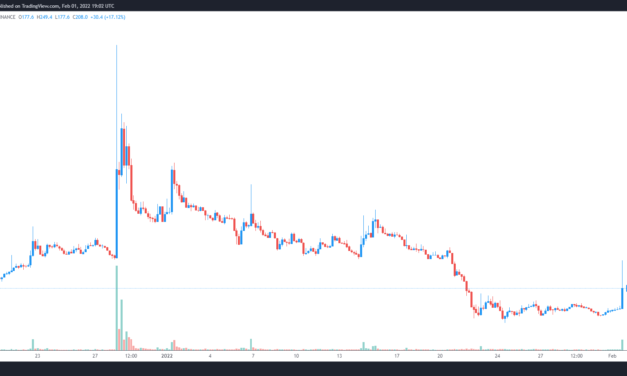
Decentralized finance (DeFi) and the control it gives users over their assets is one of the most applicable sectors of the cryptocurrency ecosystem, but the general public is still hesitant to interact with most DeFi products due to the steep learning curve and the possibility of losing funds.One decentralized exchange (DEX) that is taking strides toward bridging the gap between DeFi and centralized finance (CeFi) is QuickSwap (QUICK), the top ranked DEX on the Polygon network. Data from Cointelegraph Markets Pro and TradingView shows that the price of QUICK saw a rapid 50% spike in value from $166.40 on Jan. 31 to a daily high of $250 on Feb. 1 after its 24-hour trading volume surged by 168%.QUICK/USDT 4-hour chart. Source: TradingViewThree reasons for the rapid bounce back in QUICK price include the announcement of a partnership with Celsius, the addition of new high yield liquidity pools and the launch of stable-stable pools that offer a higher yield and decrease the risk of impermanent losses. QuickSwap partners with CelsiusXThe most significant recent development for QuickSwap was the announcement that the DEX partnered with CelsiusX, the DeFi arm of the Celsius banking and financial services platform that is focused on integrating CeFi and DeFi. #DeFi is about to get a lot more interesting @CelsiusXDeFi x QuickSwap x @0xPolygon ❤️‍Now THAT is progress@CelsiusNetwork $MATIC $QUICK pic.twitter.com/jgn4GZQFLX— QuickSwap (@QuickswapDEX) January 12, 2022Partnering with QuickSwap also allows for the creation of wrapped versions of popular tokens like Cardano’s ADA and Dogecoin (DOGE), which do not currently have a major presence on Polygon, along with well-funded liquidity pools for these assets so that users, bots, arbitrageurs and institutions have easy access to that token.This also provides DOGE and ADA holders with added ways to use their assets in DeFi to earn a yield instead of simply holding their DOGE or staking their ADA. New liquidity pools could attract a new breed of investorA second factor helping to bolster the price and momentum of QUICK has been the launch of multiple new liquidity and ‘syrup’ pools. This could be a bullish sign, especially when considering that a handful of projects launched and integrated bridges to the Polygon network in January. Aside from the addition of support for DeFi protocols like Atlantis Loans or the layer-one blockchain solution Orbs (ORBS), QuickSwap has seen a flurry of added support for nonfungible tokens (NFT) projects, which have once again been gaining momentum despite the wider weakness in the cryptocurrency market. Some of the newly supported NFT projects on QuickSwap include the UniArts network, Dogira, OneRare and Blockchain Monsters Hunt. Related: $1B worth of ETH burned in the past 30 days due to record high OpenSea NFT transactionsNew staking options for stablecoin holders A third factor helping to attract users and liquidity to the QuickSwap DEX is attractive yields for liquidity providers of stablecoin-stablecoin pairs. Yielding on stables sound good? ⚖️QuickSwap offers several stable-stable pools where LPs can earn over 14% #APY & balance risk of Impermanent LossIf yielding on $USDC, $USDT, $MAI & $DAI while earning $dQUICK rewards sounds like your jam: https://t.co/Ac4PagsDsY pic.twitter.com/uRMQ8C790G— QuickSwap (@QuickswapDEX) January 24, 2022

These pools provide users with an opportunity to earn a decent yield while also decreasing the risk of impermanent loss associated with other types of liquidity pools. This could also present more attractive stablecoin yields for depositors on the Celsius network and increase the overall liquidity locked on the QuickSwap protocol.The views and opinions expressed here are solely those of the author and do not necessarily reflect the views of Cointelegraph.com. Every investment and trading move involves risk, you should conduct your own research when making a decision.

Čítaj viac
Altcoins rack up 30% gains as Bitcoin price chases after $39,000

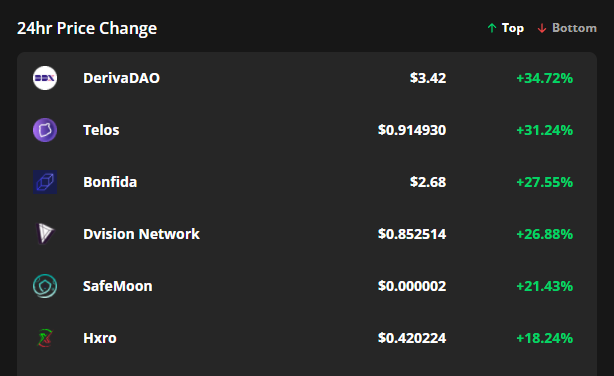
The cryptocurrency market is in a state of confusion on Jan. 31 as many traders view Bitcoin’s (BTC) weakness as a sign that a crypto winter is beginning, yet increasing news of adoption and multi-million-dollar financing rounds continue to make headlines on a regular basis. As Bitcoin trades at $38,500, analysts are highlighting the current price action as a possible buy zone and this bullish sentiment is spilling into altcoins also.Top 7 coins with the highest 24-hour price change. Source: Cointelegraph Markets ProData from Cointelegraph Markets Pro and TradingView shows that the biggest gainers over the past 24-hours were DerivaDAO (DDX), Telos (TLOS) and Bonfida (FIDA).DerivaDAO sees a 3,692% increase in trading volumeDerivaDAO is a decentralized exchange for derivatives that operates on the Ethereum (ETH) network. VORTECS™ data from Cointelegraph Markets Pro began to detect a bullish outlook for DDX Jan. 25, prior to the recent price rise. The VORTECS™ Score, exclusive to Cointelegraph, is an algorithmic comparison of historical and current market conditions derived from a combination of data points including market sentiment, trading volume, recent price movements and Twitter activity.VORTECS™ Score (grey) vs. DDX price. Source: Cointelegraph Markets ProAs seen in the chart above, the VORTECS™ Score for DDX hit a high score of 70 on Jan. 25, around 62 hours before the price increased 102% over the next three days.The surge in DDX price comes amid a 3,692% increase in trading volume for the token, with more than $13 million in volume coming from the top U.S.-based cryptocurrency exchange Coinbase. TLOS partners with BikeChainTLOS is a blockchain network created with EOSIO software, and it is designed to bring speed and scalability to smart contracts for decentralized finance (DeFi), nonfungible tokens (NFTs), gaming and social media. VORTECS™ data from Cointelegraph Markets Pro began to detect a bullish outlook for DDX on Jan. 28, prior to the recent price rise. VORTECS™ Score (grey) vs. TLOS price. Source: Cointelegraph Markets ProAs seen in the chart above, the VORTECS™ Score for DDX climbed to a high of 71 on Jan. 25, around 2 hours before the price began to increase 61.54% over the next two days. The bullish move for TLOS comes as the project has announced a new partnership with the self-governing ride-share application BikeChain and celebrated the growth of its first native decentralized exchange OmniDEX. Related: Bottom ahead? Solana paints its first ‘death cross’ as SOL losses 50% in JanuarySolana name service launches on BonfidaBonfida is a protocol built on the Solana network that will create a bridge between the Serum DEX and the wider Solana ecosystem. Data from Cointelegraph Markets Pro and TradingView shows that since hitting a low of $1.59 on Jan. 28, the price of FIDA has rallied 84.72% to a daily high at $2.95 on Jan. 31 as its 24-hour trading volume spiked 81% to $28.5 million. FIDA/USD 4-hour chart. Source: TradingViewThe sudden jump in price and trading volume follows the launch of perpetual futures trading for FIDA on the AscendEX cryptocurrency exchange and the rollout of user registration of Twitter handles with the Solana name service. The overall cryptocurrency market cap now stands at $1.745 trillion and Bitcoin’s dominance rate is 41.6%.The views and opinions expressed here are solely those of the author and do not necessarily reflect the views of Cointelegraph.com. Every investment and trading move involves risk, you should conduct your own research when making a decision.

Čítaj viac
Altcoin Roundup: Cross-chain bridge tokens moon as crypto shifts toward interoperability

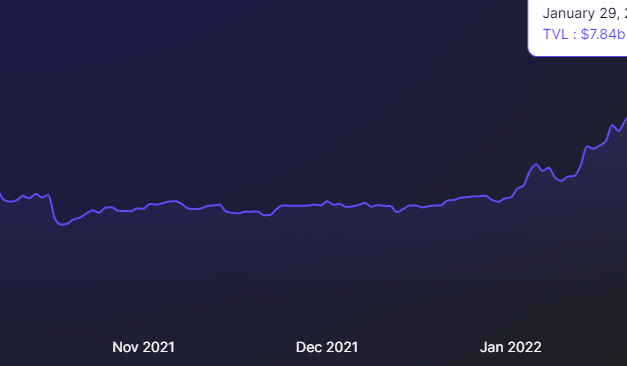
Interoperability is shaping up to be one of the main themes for the cryptocurrency market in 2022 as projects across the ecosystem unveil integrations that make their networks Ethereum (ETH) Virtual Machine (EVM) compatible.While this has been one of the long-term goals of the ecosystem as a step on the path to an interconnected network of protocols, it has also created a new decentralized finance (DeFi) market for multi-chain bridges and decentralized finance.Here are three of the top volume cross-chain bridges that the cryptocurrency community uses to transfer assets between blockchain networks. MultichainMultichain (MULTI), formerly known as Anyswap, is a cross-chain router protocol that aims to become the go-to router for the emerging Web3 ecosystem. According to data from Defi Llama, Multichain is the top-ranked cross-chain swap protocol by total value locked, with $8.95 billion currently locked on the platform. Multichain total value locked. Source: Defi LlamaOne of the main reasons for the high TVL on Multichain is the large number of blockchain networks supported by the protocol. Currently, 30 different chainscan be accessed on the network. Blockchain protocols supported by Multichain. Source: MultichainAccording to data provided by Multichain, the protocol has processed a total of $53.15 billion worth of volume since launching, with $19.08 billion of that being transacted in the past 30 days alone. There are currently 485,399 users that have interacted with the Multichain protocol, amounting to nearly 2.256 million transactions. Multichain network statistics. Source: MultichainUsers who deposit tokens into one of the pools supported by Multichain receive a sare of the transaction fees generated by the pool in question. The protocol’s native MULTI token is used to vote and participate in the governance of the Multichain ecosystem and has a circulating supply of 18.64 million tokens out of a total 100 million. Synapse Synapse (SYN) refers to itself as a “cross-chain layer ∞ protocol” that is designed to offer users interoperability between separate blockchain networks. According to data from Defi Llama, Synapse recently hit an all-time high in total value locked of $1.16 billion prior to experiencing a wave of outflows that lowered the TVL to 740.43 million. Total value locked on Synapse. Source: Defi LlamaThe Synapse protocol currently supports 12 different chains which have a combined total bridged volume of $5.33 billion according to data from the platform’s dashboard.Total bridged volume on each network supported by Synapse. Source: SynapseA large percentage of the total volume recorded on Synapse has come since the start of 2022 with the protocol seeing an all-time high bridge volume of $157.8 million on Jan. 23. Synapse bridge volume. Source: Synapse AnalyticsThe protocol’s native SYN token has several uses within the ecosystem. Token holders can use it to conduct community governance votes via the SynapseDAO, liquidity providers (LPs) receive a percentage yield paid out in SYN for their deposits and it is also used as a subsidy to pay for the gas expended by network validators to secure transactions across the network.LPs also receive a share of the protocol fees earned by the Synapse platform on each transaction. Related: Web3 innovations are replacing middlemen with middleware protocolsCeler cBridgeAnother popular cross-chain bridge is the Celer cBridge, a multi-chain network that enables instant, low-cost value transfers between 19 different networks. The cBridge is a subsector of the larger Celer (CELR) ecosystem and utilizes the CELR token for operations on the protocol and as the reward token for liquidity providers. Along with the CELR rewards paid to LPs, a percentage of the transaction fees generated by people who use the liquidity pools to bridge funds across chains are paid out to LPs and added directly to the pools, allowing the rewards to compound. According to data from cBridge analytics, the total value of funds locked in the bridge contract (pool-based bridge) and the funds locked in the token vault contract (canonical token bridge) currently stands at $240.92 million. cBridge usage statistics. Source: cBridgeA total of 89,897 unique addresses have interacted with the protocol since inception and have conducted a total of $2.842 billion in transaction volume. Similar to the transfer trend seen with Synapse, the transaction volume on cBridge has gotten noticeably higher in 2022 with a record $71.12 million being transacted on Jan. 22. Daily transaction volume on cBridge. Source: cBridge analyticsSome of the protocols currently supported by cBridge include Ethereum, Binance Smart Chain, Avalanche, Polygon, Fantom, Metis, Harmony, Gnosis, Arbitrum and Optimism. Want more information about trading and investing in crypto markets?The views and opinions expressed here are solely those of the author and do not necessarily reflect the views of Cointelegraph.com. Every investment and trading move involves risk, you should conduct your own research when making a decision.

Čítaj viac
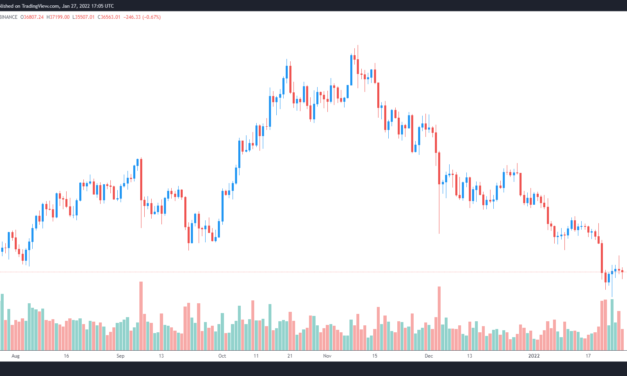
Kyber Network (KNC) bucks the market-wide downtrend with a 57% gain in January

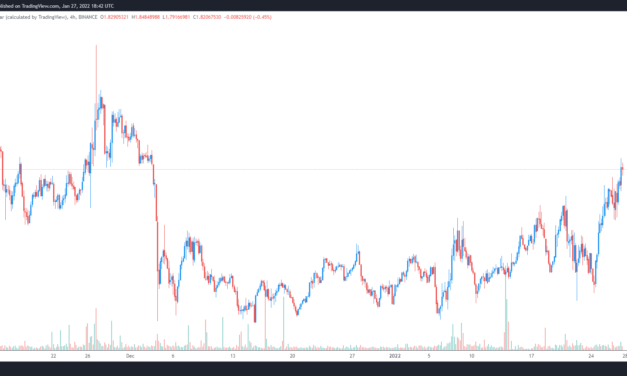
In the crypto market volatility continues to reign supreme, and fear, uncertainty and doubt (FUD) run rampant. This makes it challenging for any project to rise above the noise and post positive price gains but there are a few projects that are showing strength during the current downturn. Kyber Network (KNC) is a multi-chain decentralized exchange (DEX) and aggregation platform designed to provide decentralized finance (DeFi) applications and their users with access to liquidity pools that provide the best rates. Data from Cointelegraph Markets Pro and TradingView shows that since hitting a bottom of $1.18 on Jan. 6, the price of KNC has rallied 57% to a daily high at $1.87 on Jan. 27 despite the wider weakness in the crypto market. KNC/USD 4-hour chart. Source: TradingViewThree reasons for the strong showing from KNC include the release of Kyber 3.0, which included a rebrand to KyberSwap, the expanding list of DEXs integrated with the Kyber ecosystem and the widespread availability of KNC on centralized and decentralized exchanges. The release of Kyber 3.0The most significant development driving momentum for the Kyber Network was the release of Kyber 3.0. The launch included a rebrand of the platform’s exchange interface to KyberSwap and an integration with six blockchain networks, including Ethereum, Polygon, Binance Smart Chain, Avalanche, Fantom and Cronos. We’re excited to announce Kyber 3.0 transitioning Kyber from a single protocol to a hub of purpose-driven liquidity protocols catered to various DeFi use cases. This is the biggest change to Kyber’s architecture incl. the new DMM & a KNC Migration proposal https://t.co/pgffnUKjsx— Kyber Network (@KyberNetwork) January 21, 2021On top of the integration of multiple popular blockchain networks, the Kyber 3.0 upgrade was also designed to address some of the biggest limitations in DeFi, like high gas fees and the limited access some projects get by only being available on one exchange. Kyber has achieved its new functionality through the implementation of dynamic market makers (DMM), which allows adjustments to be made to the key parameters of a liquidity pool based on recent fee data and trade volume. This approach helps improve concerns that have been raised about automated market makers (AMM), including reducing capital requirement, preventing front-running and mitigating impermanent loss. Integration of new DEXsAnother for the bullish momentum driving KNC higher has been the continued integration of new decentralized exchange protocols into the Kyber Network ecosystem. Most recently, KyberSwap integrated pools from multiple DEX protocols including ShibaSwap, DefiSwap, MMF, EmpirDEX, PhotonSwap, Morpheus, BeethovenX, Gavity, Cometh, DinoSwap and PantherSwap. The new additions mean that the KyberSwap protocol now supports more than 40 DEXs and 31,000 liquidity pools across six major blockchain networks. The developers at KyberSwap have also indicated that the support and integration of additional blockchain networks and decentralized exchanges is currently underway. Related: Kyber plans to become a hub for DeFi with massive DEX upgradeWidespread availability of KNC on exchangesKNC also has widespread availability on exchanges across the cryptocurrency ecosystem. Top-11 DEX tokens by presence on Exchanges. Source: TwitterAs shown in the graphic above which was posted on Twitter by pseudonymous user ‘Cryptolaxy’, KNC is the second-ranked DEX token by the presence on exchanges and it is currently available on 80 separate exchanges. The only other projects with similar availability are ZRX with 105 exchange listings and Uniswap at 76. VORTECS™ data from Cointelegraph Markets Pro began to detect a bullish outlook for KNC on Jan. 22, prior to the recent price rise. The VORTECS™ Score, exclusive to Cointelegraph, is an algorithmic comparison of historical and current market conditions derived from a combination of data points including market sentiment, trading volume, recent price movements and Twitter activity.VORTECS™ Score (green) vs. KNC price. Source: Cointelegraph Markets ProAs seen in the chart above, the VORTECS™ Score for KNC climbed into the green and hit a high of 79 on Jan. 22, around 35 hours before the price increased 44% over the next three days.The views and opinions expressed here are solely those of the author and do not necessarily reflect the views of Cointelegraph.com. Every investment and trading move involves risk, you should conduct your own research when making a decision.

Čítaj viac

Bitcoin ‘gives back gains’ after Fed comments ‘add downside risks’ to crypto markets

Bitcoin (BTC) price continues to flash mixed signals, raising uncertainty among investors and negatively impacting asset prices across the market.Data from Cointelegraph Markets Pro and TradingView shows BTC price pinned below $36,000 and even though crypto and equities markets underwent a brief relief rally on Jan. 26, comments from the recent FOMC meeting appear to be settling in as investors internalize the fact that interest rate hikes are on the way.BTC/USDT 1-day chart. Source: TradingViewHere’s a look at what analysts and traders are saying about Bitcoin’s most recent price action and the macroeconomic factors impacting the wider crypto market.A year of “range bound” tradingThe long-term range-bound trading that BTC has been in since early 2021 was addressed by Mike McGlone, senior commodity strategist for Bloomberg Intelligence, who posted the following chart and asked, “What ends Bitcoin, Ethereum range trade?BTC/USD 1-week chart. Source: TwitterAccording to McGlone, the key to escaping the current range are the “bullish fundamentals” that back the underlying strength of Bitcoin. McGlone said, “By the rules of economics, a market with rising demand and declining supply will go up over time, suggesting that Bitcoin may be forming a bottom again around $30,000 as $60,000 resistance ages.”The Fed continues to add downside risksA deeper analysis on the impact of Jan. 26’s Federal Reserve meeting was provided by Bilal Hafeez, CEO and head of research at Macro Hive, who noted that the tone of the meeting “turned out to be more hawkish than expected.”Hafeez pointed to the decision by the Fed to raise the inflation forecast as a sign that the central bank has realized that “they need to be more hawkish than before,” and he highlighted Powell’s comments that “this cycle would be different to the last cycle, which suggests faster hikes than before.”With that being said, Hafeez indicated that the Fed “has not decided on a path yet,” and noted that Powell “didn’t give much additional information on quantitative tightening except that it would operate in the background.”Hafeez said, “Overall, the Fed is comfortable with equity and risk markets selling off as it tightens financial conditions and so could reduce inflation. Bond yields have risen after the meetings, equity and crypto markets have given back gains. The Fed continues to add downside risks to risky markets.”Related: Derivatives data suggests that Bitcoin’s $39K bounce was a mere blipShort-term weakness, long-term strengthThe near-term outlook for BTC was briefly touched upon by derivatives traders and pseudonymous Twitter user Crypto McKenna, who posted the following chart and stated that “BTC price action is about to get very boring.”BTC/USD 6-hour chart. Source: TwitterMcKenna said, “No trade season for the next 10–20 days in my opinion.”Despite this projection for near-term weakness and sideways price action, the long-term outlook continues to brighten for multiple reasons, as noted in the following Tweet from crypto analyst Will Clemente. Bitcoin price weakness because of risk-off behavior while fundamentals strengthening: Intel creating mining chips, Russia looking to get involved in mining, Goldman Sachs bullish, Google partnership w/ Coinbase, El Salvador Bond.Hard to think asymmetry is to the downside.— Will Clemente (@WClementeIII) January 27, 2022The overall cryptocurrency market cap now stands at $1.663 trillion and Bitcoin’s dominance rate is 41.5%.The views and opinions expressed here are solely those of the author and do not necessarily reflect the views of Cointelegraph.com. Every investment and trading move involves risk, you should conduct your own research when making a decision.

Čítaj viac

Získaj BONUS 8 € v Bitcoinoch

nakup bitcoin z karty

Registrácia Binance

Burza Binance

Aktuálne kurzy