
Autor Cointelegraph By Jordan Finneseth

Bitcoin halving analysis hints at $24K bottom before the end of 2022

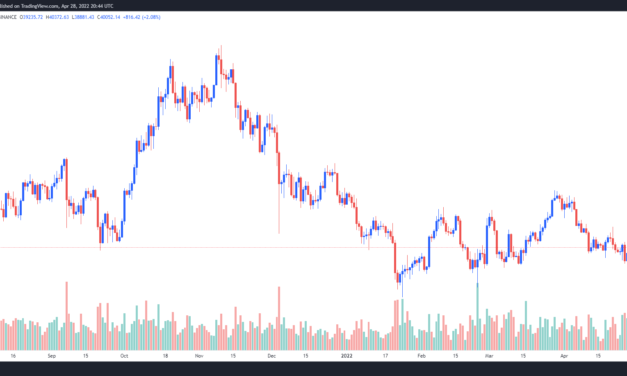
One of the most popular topics of debate within the crypto community revolves around the Bitcoin (BTC) four-year halving cycle and the effect it has on the long-term price of the top cryptocurrency. Bitcoin price failed to hit the long-predicted $100,000 level in 2021 and many crypto analysts now find themselves wondering about the outlook for the next six to 12 months. Currently, BTC price trades below $40,000 and various technical analysis metrics suggest that further downside is more likely that a recovery to the $40,000 to $45,000 range. Let’s take a look at what analysts’ views are on Bitcoin’s longer-term prospects.BTC/USDT 1-day chart. Source: TradingViewBitcoin could bottom in November or DecemberA general overview of the four-year cycle theory was discussed in a Twitter thread by crypto analyst and pseudonymous Twitter user “Wolves of Crypto,” whose analysis indicates that “the most probable bear market bottom for Bitcoin will take place in November/December 2022.”BTC/USD 1-week chart. Source: TwitterThis projection assumes that the peak BTC price of $68,789 back on November 10, 2021 marked the high of the last cycle and that the market is currently in the corrective phase typically seen after a cycle top. The analyst said, “The 200–week SMA has been the long-tested bear market bottom indicator for Bitcoin, and hence, the bottom will likely be placed at ~$24,000.”Should this model play out, the price of BTC will breakout above its previous all-time high sometime around August or September of 2023. Bitcoin “seems a bit undervalued here”The possibility that the bottom in BTC could come before the end of 2022 was hinted at by Willy Woo, an independent market analyst who posted the following chart suggesting that the “Orange coin seems a bit undervalued here.”Highly liquid supply shock oscillator. Source: TwitterThe “Highly Liquid Supply Shock” metric quantifies on-chain demand and supply, and shows its relative movement in standard deviations from the long-term average. As shown on the chart above, each time the oscillator dipped as low as the current reading, the price of BTC entered a sharp rally shortly thereafter.Woo said, “Not a bad time for investors to wait for the law of mean reversion to play out.”Related: Bitcoin is 40%+ down from its ATH, but on-chain analysts say it’s ‘starting to bottom out’Bitcoin price is at a mid-term low Many analysts believe that BTC could be in an optimal accumulation range, a point touched on by crypto market analyst Philip Swift. According to Swift, the active address sentiment indicator (AASI) suggests that BTC is in a buy zone. Active address sentiment indicator. Source: TwitterAccording to Swift, the AASI is currently “back in the green zone,” which suggests that the “Bitcoin price change is at a sensible level relative to active address change.”Swift said, “This tool has a good hit rate across bull and bear markets for signaling a mid-term low.”Indeed, a survey of the previous instances where the AASI hit levels similar to its current reading shows that the price of BTC hit its low point around the same time and proceeded to climb higher in the following weeks and months. Generally, it appears as though Bitcoin’s price action is keeping in-line with the previously established four-year cycle, albeit to a lesser percentage increase than expected. The views and opinions expressed here are solely those of the author and do not necessarily reflect the views of Cointelegraph.com. Every investment and trading move involves risk, you should conduct your own research when making a decision.

Čítaj viac
Bitcoin is 40%+ down from its ATH, but on-chain analysts say it's ‘starting to bottom out’

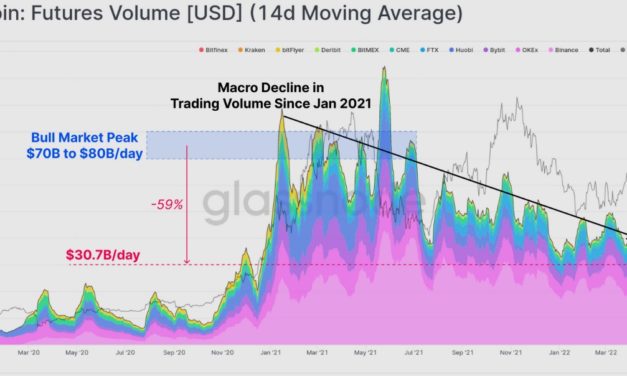
The cryptocurrency market has experienced another rollercoaster week that saw Ether (ETH) price drop below $3,000 and Bitcoin (BTC) price hit a new multi-month low at $37,700. Equities markets also endured a sharp sell-off primarily due to investor fear over potential changes to the size of the Federal Reserve’s next rate hike.To date, Bitcoin price fell 41.72% down from its $69,000 all-time high and while the price might be in what some describe to be a bear market, a deeper dive into various on-chain and derivatives data shows that a drop in inflows and thepivot from institutional investors are the main factors impacting BTC price action.Perpetual futures dominate trade volumesA lot has changed in the crypto market since 2017 when the Bitcoin market was dominated by spot trading and derivatives markets made up just a small fraction of trading volume. According to a recent report from on-chain market intelligence firm Glassnode, Bitcoin derivatives “now represent the dominant venue for price discovery” with the “future trade volume now representing multiples of spot market volume.” This has important implications for the current price action for BTC because thefutures trade volume has been declining since January 2021. The metric is down more than 59% from a high of $80 billion per day during the first half of 2021 to its current volume of $30.7 billion per day. Bitcoin futures volume. Source: GlassnodeDuring that same time period, perpetual futures have overtaken traditional calendar futures as the preferred instrument for trading because they more closely match the spot index price and the costs associated with taking delivery of BTC are considerably lower than with traditional commodities. According to Glassnode, “the current open interest in perpetual swaps is equivalent to 1.3% of the Bitcoin market cap, which is approaching historically high levels.”Despite this, the total transfer of capital and leverage out of calendar expiring futures has led to a declining leverage ratio, which “suggests that a reasonable volume of capital is actually leaving the Bitcoin market.” The cause for this capital rotation is likely related to the fact that the yields available in futures markets are currently just above 3.0%, which is only 0.1% higher than the 2.9% yield available on the 10-year U.S. Treasury Bond and well below the 8.5% U.S. Consumer Price Index (CPI) inflation print. Bitcoin annualized perpetual funding vs. 3-month basis. Source: GlassnodeGlassnode said, “It is likely that declining trade volumes and lower aggregate open interest is a symptom of capital flowing out of Bitcoin derivatives, and towards higher yield, and potentially lower perceived risk opportunities.”Related: Trader flags BTC price levels to watch as Bitcoin still risks $30K ‘ultimate bottom’On-chain data points to large entity adoptionMoving away from derivatives markets, positive signs for the future of Bitcoin can be found by digging deeper into on-chain volume data. Beginning in October 2020, the percentage of transactions greater than $10 million has increased from 10% of transfer volume on a good day to the current average daily dominance of 40%. According to Glassnode, this points to significant growth “in value settlement by institutional sized investment/trading entities, custodians and high net worth individuals.”Bitcoin relative transfer volume breakdown by size. Source: GlassnodeUsing aggregate transaction volumes in conjunction with the Network Value to Transactions (NVT) Ratio, the current value of Bitcoin is between $32,500 and $36,100.Bitcoin NVT price model. Source: GlassnodeAccording to Glassnode, both the 28-day and 90-day NVT models are “starting to bottom out and potentially reverse” with the 28-day breaking above the 90-day, which has historically “been a constructive medium to long-term signal.”The overall cryptocurrency market cap now stands at $1.791 trillion and Bitcoin’s dominance rate is 41.5%.The views and opinions expressed here are solely those of the author and do not necessarily reflect the views of Cointelegraph.com. Every investment and trading move involves risk, you should conduct your own research when making a decision.

Čítaj viac
ApeCoin (APE) hits a new all-time high ahead of this week’s Otherside land auction

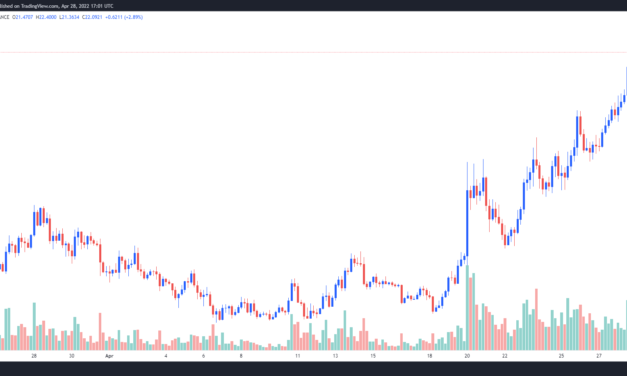
The nonfungible token (NFT) and Metaverse sectors have been the bright spots in an otherwise sideways crypto market in 2022 and proof of this comes as the APE token hit a new all-time high at $22.60 on April 28.The steady bullish momentum for APE is, in large part, due to the upcoming The Otherside land auction being held by Yuga Labs and Animoca Brands in conjunction Bored Ape Yacht Club NFT project on April 30. APE/USDT 4-hour chart. Source: TradingViewThe Otherside launch will consist of a Dutch auction-style sale and only Know Your Customer (KYC)-approved wallets will be allowed to participate in the sale of the first 100,000 land parcels. All sales will be paid for using APE, which is clearly helping to drive demand for the token higher as interested parties accumulated the token in anticipation of the sale.The Otherside adventure will begin on 4/30 at 12pm ET, only on https://t.co/UWRD4dOC9H. The KYC on https://t.co/mbSVzDX9tp was to participate in Saturday’s mint — only those who KYCed can participate. More details in the .— OthersideMeta (@OthersideMeta) April 25, 2022Related: ApeCoin price breakout stalls after $2.4M BAYC NFT robbery — What’s ahead?Wallets that already hold a BAYC or Mutant Ape Yacht Club (MAYC) NFT will be able to claim a land parcel for free for 21 days after the auction without needing to be KYC-approved to claim. Ongoing governance votes within the ApeCoin community have also helped increase demand for APE, a clear demonstration that BAYC and MAYC holders are looking to get more engaged with the direction the ecosystem will take in the years ahead.The views and opinions expressed here are solely those of the author and do not necessarily reflect the views of Cointelegraph.com. Every investment and trading move involves risk, you should conduct your own research when making a decision.

Čítaj viac
Synthetix (SNX) rallies in anticipation of L2 Curve Wars and Optimism airdrop announcement

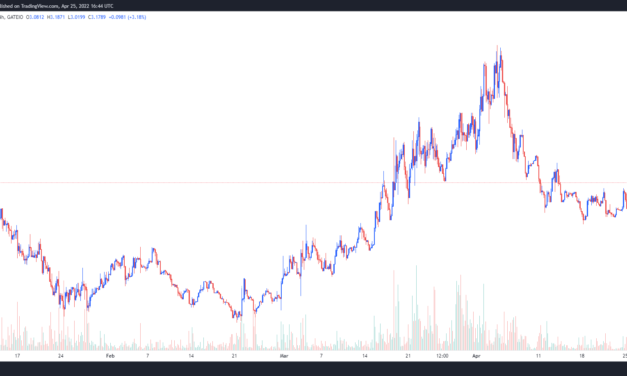
Layer-two (L2) solutions for the Ethereum (ETH) network have grown in prominence over the last year because of the need for scalable networks that offer low-fee transactions and led to numerous projects that built cross-chain bridges with competing blockchain networks. One project that has benefitted from the growth of the L2 scaling solutions is Synthetix (SNX), a decentralized finance (DeFi) protocol that enables the creation of synthetic assets and offers exposure to derivatives and futures trading on blockchain. Data from Cointelegraph Markets Pro and TradingView shows that since hitting a low of $4.44 on April 11, the price of SNX rallied 52.6% to hit a daily high at $6.78 on April 26 before a widespread market downturn dropped it back down to $5.90.SNX/USDT 1-day chart. Source: TradingViewWhile the majority of the market is down, there are potential catalysts for SNX price to see further appreciation.Launch on OptimismOne of the biggest developments for the Synthetix protocol was its launch on Optimism, a L2 network which is making waves this week thanks to an airdrop announcement. SNX staking began on Jan. 16 and as the network grows, speculators are giddy at the prospect of future airdrops and staking incentives.Most recently, Synthetix used its launch on Optimism to get more involved in the “Curve Wars” and currently, it is offering the highest bribe to get veCRV voters to incentivize voting for the sUSD Curve pool. Synthetix has also partnered with Lyra Finance (LYRA) to offer 12,000 SNX and 50,000 LYRA per week as an added incentive for veCRV voters. L2 airdrop season could be a catalyst for SNXA second reason the price of SNX has the potential to see further appreciation is traders’ expectation that an airdrop season for L2 protocols could occur.There has been a significant amount of speculation that Optimism and Arbitrum, two of the most popular L2 networks in the crypto ecosystem, would eventually airdrop their protocol tokens to early adopters of the networks.This speculation became reality after Optimism released the initial details of the Optimism Collective, a “large-scale experiment in digital democratic governance” that is “built to drive rapid and sustainable growth of a decentralized ecosystem.”Along with the launch of the Optimism Collective comes the launch of the OP governance token, of which 5% of the initial supply will be airdropped to early adopters. For those who did not qualify for the first airdrop round, there is still a chance to qualify for future airdrops by being active on the network using protocols like Synthetix. With Synthetix offering futures trading on Optimism, the protocol could benefit from users seeking ways to be active on the network and this could increase demand for SNX. On top of the potential to receive an OP airdrop, SNX holers have also been lured to Optimism by the 81% staking rewards currently being offered by the protocol. Related: Optimism-based projects spike on rumors of token airdropClimbing user base and volume transactedFurther evidence of the rising popularity of Synthetix can be found looking at the platform’s metrics on Optimism, which have been steadily increasing for the past month according to data from Dune Analytics. Synthetix protocol metrics. Source: Dune AnalyticsAs shown in the graphic above, the number of unique traders on the protocol has been climbing since launching futures trading in mid-March and the protocol has handled nearly $1.59 billion in total volume. VORTECS™ data from Cointelegraph Markets Pro began to detect a bullish outlook for SNX on April 23, prior to the recent price rise. The VORTECS™ Score, exclusive to Cointelegraph, is an algorithmic comparison of historical and current market conditions derived from a combination of data points including market sentiment, trading volume, recent price movements and Twitter activity.VORTECS™ Score (green) vs. SNX price. Source: Cointelegraph Markets ProAs seen in the chart above, the VORTECS™ Score for SNX climbed into the green zone and hit a high of 77 on April 23, around 39 hours before the price spiked 28% over the next day.The views and opinions expressed here are solely those of the author and do not necessarily reflect the views of Cointelegraph.com. Every investment and trading move involves risk, you should conduct your own research when making a decision.

Čítaj viac

Here’s why the growth of token staking could be bullish for Lido (LDO)

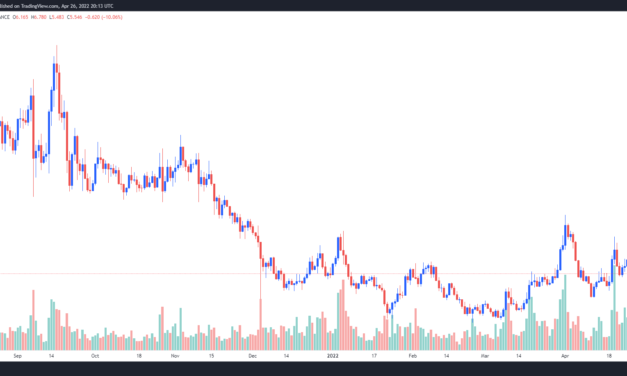
Liquid staking has grown in popularity over the past year thanks in part to the launch of the Ethereum beacon chain and the inability of ETH stakers to withdraw their tokens until the full launch of the consensus layer. As a result, Lido (LDO) has established itself as a leader in the liquid staking sector. Lido is one of the main staking protocols for several popular tokens and it allows token holders to earn an extra yield by putting their staked assets to work in decentralized finance (DeFi). LDO/USDT 4-hour chart. Source: TradingViewData from Cointelegraph Markets Pro and TradingView shows that the price of LDO trended higher throughout the month of March and then entered a consolidation period in early April. Currently, the wider market is in a sharp downtrend, but the growth of the staking sector and upcoming Ethereum “merge” could still lead to bullish outcomes for LDO.Expanding liquid staking optionsLDO price reversed trend toward the end of February and this was in part due to the addition of Polygon (MATIC) liquid staking to the Lido protocol, which was developed in conjunction with Shard Labs. Lido for Polygon is here ️https://t.co/FCv36KDQj4Stake your MATIC with Lido for an effortless staking experience. Get started on https://t.co/usVwJcgv4Q. pic.twitter.com/ueBk2iSYeE— Lido (@LidoFinance) March 2, 2022At the time of writing, there is more than $14.5 million worth of MATIC staked on Lido and it is earning a 8.7% yield. The protocol currently allows staking of ERC-20 MATIC tokens and stakers receive stMATIC in return, which can be utilized in DeFi protocols on the Ethereum and Polygon network. The addition new assets, as well as an increase in the amount of Ether staked on Lido sent the total value locked on the protocol to a record-high $20.83 billion on April 5 and currently this figure stands at $18.3 billion according to data from Defi Llama. Total value locked on Lido Finance. Source: Defi LlamaNew partnerships and integrations increase Lido’s marketshareInvestments from institutions and integrations with other protocols also paint a bullish picture for LDO. The project recently received a $70 million investment from Andreessen Horowitz’s firm a16z firm.We are pleased to welcome a16z to the Lido family. ️ pic.twitter.com/XSDc3ANfjS— Lido (@LidoFinance) March 3, 2022

Along with the $70 million investment, a16z also revealed that it would be staking a portion of its Ether holdings on the platform as a way to help reduce some of the operational complexities for institutional investors.Lido also benefited from multiple integrations throughout March and April, including staked Ether (stETH) being added to the lending pools on AAVE. Staked Solana (stSOL) was also integrated on multiple platforms in the Solana ecosystem, including Raydium, Friktion Finance and multiple protocols adding support for staked Terra (stLUNA).Related: The many layers of crypto staking in the DeFi ecosystemEnhancing decentralization could attract investorsAnother factor that could help boost the forward outlook for LDO is the developers’ focus on enhancing the decentralization of the protocol. One step in this process is the adoption of Distributed Validator Technology (DVT), which groups validators into independent committees that propose and attest to blocks together as a way to help reduce the risk of an individual validator underperforming or misbehaving. This helps to simplify and speed up the process of adding new node operators (NOs) because new operators can be paired with a group of majority trusted NOs to help decrease potential risks. A second improvement includes the ability to stake based on a Node Operator Score which is derived from several metrics and this helps provide an incentive to operators to maintain optimal performance. One final improvement is the creation of new mechanics such as longer time-locks and giving veto rights to a quorum of stETH holders as a way to mitigate the risk of governance capture to prevent unplanned changes to Lido. The views and opinions expressed here are solely those of the author and do not necessarily reflect the views of Cointelegraph.com. Every investment and trading move involves risk, you should conduct your own research when making a decision.

Čítaj viac

Získaj BONUS 8 € v Bitcoinoch

nakup bitcoin z karty

Registrácia Binance

Burza Binance

Aktuálne kurzy