

Autor Cointelegraph By Jordan Finneseth

Polkadot parachains spike after the launch of a $250M aUSD stablecoin fund

Crypto prices have been exploring new lows for weeks and currently it’s unclear what it will take to reverse the trend. Despite the downtrend, cryptocurrencies within the Polkadot ecosystem began to rally on May 24 and have managed to maintain gains ranging from 10% to 25%, a possible sign that certain sub-sectors of the market are on the verge of a breakout.Here’s a look at three Polkadot ecosystem protocols that have seen their token prices trend higher in recent days. Acala launches a $250 million aUSD ecosystem fundAcala (ACA) is the leading decentralized finance (DeF) platform on the Polkadot network, primarily due to the launch of aUSD, the first native stablecoin in the Polkadot ecosystem. Following the collapse of Terra’s LUNA and TerraUSD (UST), traders were searching for “safer” stablecoin options. On March 23, ACA rallied after the project announced the launch of a $250 million ‘aUSD Ecosystem Fund’ that aims to support early-stage startups planning to build strong stablecoin use cases on any Polkadot or Kusama parachain. Acala, nine parachain teams, and a group of venture funds have launched the $250 million ‘aUSD Ecosystem Fund’ ️The fund is seeking early-stage projects from any @Polkadot or @KusamaNetwork parachain with strong $aUSD stablecoin use cases https://t.co/OJ2V47ZUry pic.twitter.com/NDgLg2bG8N— Acala (@AcalaNetwork) March 23, 2022Acala also announced the launch of a kickoff rewards program that has set aside 1 million ACA tokens as rewards for LCDOT/DOT, LCDOT/aUSD, ACA/aUSD and aUSD/LDOT liquidity providers. Following the aUSD ecosystem fund announcement, the price of ACA spiked 31% from a low of $0.364 on May 23 to a daily high of $0.478 on May 24. Astar rallies after revealing a partnership with MicrosoftThe Astar (ASTR) network is a smart contract hub for the Polkadot community that supports Ethereum (ETH), WebAssembly and other layer-two solutions like ZK-rollups. Since the Polkadot relay chain doesn’t offer Ethereum Virtual Machine (EVM) support, Astar was created to become a multi-chain smart contract platform capable of supporting multiple blockchains and virtual machines so that they can integrate with the Polkadot ecosystem.On May 24 it was revealed that AstridDAO, an Astar-based protocol responsible for minting the collateralized BAI stablecoin, had signed a partnership with Microsoft to become part of Microsoft for Startups, an initiative “which removes traditional barriers to building a company with exclusive access to technology, coaching, marketing, and support.”Hello Astridians!PARTNERSHIP ANNOUNCEMENT @Microsoft welcomes AstridDAO to @msft4startups program to Accelerate Growth of Decentralized Money Market and Stablecoin $BAI Details below https://t.co/r9YO7E4NaS pic.twitter.com/J26pbrwCTU— AstridDAO – No.1 native stablecoin on Astar (@AstridDAO) May 24, 2022

If successful, the partnership should accelerate AstridDAO’s go-to-market speed and maximize its market influence. It also includes up to $350,000 worth of benefits through Github Enterprise, Microsoft Teams, and Azure credits.Following the partnership announcement, the price of ASTR spiked 61% from $0.055 to a daily high of $0.0888. Related: Polkadot vs. Ethereum: Two equal chances to dominate the Web3 worldUniswap v3 to deploy on MoonbeamMoonbeam (GLMR) is an Ethereum-compatible smart contract parachain on Polkadot that streamlines the use of Ethereum developer tools to build or redeploy Solidity projects in a Substrate-based environment.Interoperability with the Ethereum network is a highly sought-after capability since a majority of decentralized applications currently operate on Ethereum along with a majority of the value in decentralized finance. The benefit of EVM interoperability was demonstrated with the May 24 announcement that a proposal to deploy Uniswap v3 on the Moonbeam network passed, meaning that the top decentralized exchange in the crypto ecosystem will soon be accessible to Moonbeam users. Congratulations to everyone at @GnosisChain and @MoonbeamNetwork!The proposals have passed and v3 will be deployed on both chains— Uniswap Labs (@Uniswap) May 23, 2022

Following the announcement, the price of GLMR climbed 29% from a low of $1.15 on May 23 to a daily high at $1.48 on May 24 as its 24-hour trading volume increased 106% to $75.3 million. The views and opinions expressed here are solely those of the author and do not necessarily reflect the views of Cointelegraph.com. Every investment and trading move involves risk, you should conduct your own research when making a decision.

Čítaj viac
Low inflation or bust: Analysts say the Fed has no choice but to continue raising rates

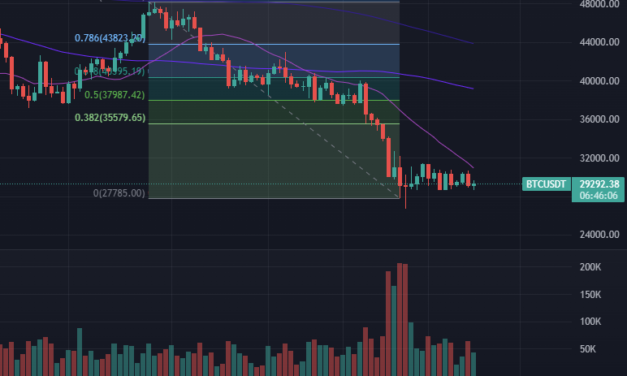
As economic conditions continue to worsen, financial experts worldwide are increasingly placing the blame at the feet of the Federal Reserve after the central bank was slow to respond to rising inflation early on. Financial markets are currently experiencing their worst stretch of losses in recent history and it doesn’t appear that there is any relief in sight as May 24 saw the tech-heavy Nasdaq fall another 2%, while Snap, a popular social media company, shed 43.1% of its market cap in trading on May 23. This past couple of months have been absolutely brutal for the markets… 8 consecutive weeks of red candles in the #SPX, #NASDAQ and #BTC… no significant bounces pic.twitter.com/hgU2VwIoxh— Crypto Phoenix (@CryptoPheonix1) May 24, 2022Much of the recent turmoil again comes back to the Fed, which has embarked on a mission to raise interest rates in an attempt to get inflation under control, financial markets be damned. Here’s what several analysts are saying about how this process could play out and what it means for the price of Bitcoin (BTC) moving forward. Will the Fed tighten until the markets break?Unfortunately, for investors looking for short-term relief, economist Alex Krüger thinks that “The Fed will not stop tightening unless markets break (far from that) or inflation drops considerably and for many months.”One of the main issues affecting the psyche of traders is the fact that the Fed has yet to outline what inflation would need to look like for them to take their foot off the rate hike gas pedal. Instead, it simply reiterates its goal “to see clear and convincing evidence inflation is coming down towards its 2% target.”According to Krüger, the Fed will “need to see the year-over-year inflation drop 0.25% – 0.33% on average every month until September” if it is to meet its goal of bringing down inflation to the 4.3% – 3.7% range by the end of the year. Should the Fed fail to meet its PCE inflation target by September, Krüger warned about the possibility that the Fed could initiate “more hikes than what’s priced in” and could also begin exploring the sale of mortgage-backed securities as part of a quantitative tightening campaign. Krüger said, “Then markets would start shifting to a new equilibrium and dump hard.”A setup for double-digit sustained inflationThe Fed’s responsibility for the current market conditions was also touched on by billionaire investor and hedge fund manager Bill Ackman, who suggested that “the only way to stop today’s raging inflation is with aggressive monetary tightening or with a collapse in the economy.In Ackman’s opinion, the Fed’s slow response to inflation has significantly damaged its reputation while its current policy and guidance “are setting us up for double-digit sustained inflation that can only be forestalled by a market collapse or a massive increase in rates. Due to these factors, demand for exposure to stocks has been muted in 2022 a fact evidenced by the recent decline in stock prices and especially in the tech sector. For example, the tech-heavy Nasdaq index is now down 26% on the year. With the cryptocurrency sector being highly tech-focused, it’s not surprising that weaknesses in the tech sector has translated to weakness in the crypto market, a trend that could persist until some form of resolution to high inflation. Related: Bitcoin price returns to weekly lows under $29K as Nasdaq leads fresh US stocks diveHow could Bitcoin fare going in 2023?According to Krüger, the “base case scenario for upcoming price trajectory is a summer range that starts with a rally followed by a drop back to the lows.”BTC/USDT 1-day chart. Source: TwitterKruger said, “For BTC, that rally would take price to the start of the Luna dump ($34,000 to $35,500).”Further insight into what price level to keep an eye on for a good entry point moving forward was offered by crypto trader and pseudonymous Twitter user ‘Rekt Capital’, who posted the following chart of Bitcoin relative to its 200-day moving average. BTC/USD 1-week chart. Source: TwitterRekt Capital said, “Historically, the 200-MA tends to offer fantastic opportunities with outsized ROI for long-term BTC investors (green circles). Should BTC indeed reach the 200-MA support… It would be wise to pay attention.”The overall cryptocurrency market cap now stands at $1.258 trillion and Bitcoin’s dominance rate is 44.5%.The views and opinions expressed here are solely those of the author and do not necessarily reflect the views of Cointelegraph.com. Every investment and trading move involves risk, you should conduct your own research when making a decision.

Čítaj viac
Crypto funds under management drop to a low not seen since July 2021

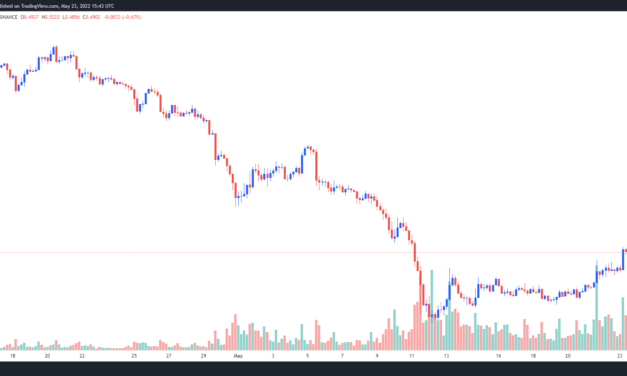
Digital asset investment products saw $141 million in outflows during the week ending on May 20, a move which reduced the total assets under management (AUM) by institutional funds down to $38 billion, the lowest level since July 2021. According to the latest edition of CoinShare’s weekly Digital Asset Fund Flows report, Bitcoin (BTC) was the primary focus of outflows after experiencing a decline of $154 million for the week. The removal of funds coincided with a choppy week of trading that saw the price of BTC oscillate between $28,600 and $31,430. BTC/USDT 1-day chart. Source: TradingViewDespite the sizable outflow, the month-to-date BTC flow for May remain positive at $187.1 million, while the year-to-date figure stands at $307 million.On a more positive note, the multi-asset category of investment products managed to record a total of $9.7 million worth of inflows last week. This brings the yearly total inflow into these products to $185 million, representing 5.3% of the total AUM. CoinShares pointed to the uptick in volatility as a possible source for the increased inflows into multi-asset investment products, which can be seen as “safer relative to single line investment products during volatile periods.” So far in 2020, these investment products have only experienced two weeks of outflows. Cardano and Polkadot led the altcoin inflows with increases of $1 million each, followed by $700,000 worth of inflows into XRP and $500,000 into Solana (SOL). Flows by asset during the week ending May 20, 2022. Source: CoinSharesOut of all the assets covered, Ethereum (ETH) has seen the worst performance so far this year with $44 million worth of outflows in the month of May bringing its year-to-date figure to $239 million. Related: Bitcoin’s current setup creates an interesting risk-reward situation for bullsStrengthening dollar continues to impact crypto market sentimentThe declining interest in digital asset investment products comes amidst the backdrop of a strengthening dollar, which has been “one of the most important macro factors driving asset prices over the last 6 months” according to cryptocurrency market intelligence firm Delphi Digital. U.S. dollar currency index. 1-week chart. Source: Delphi DigitalAs shown on the chart above, the Dollar Index (DXY) has risen from 95 at the start of 2022 to 102 on May 23, a year-to-date gain of 6.8%. This marks the fastest year-over-year change for the DXY in recent history and led to a breakout from the range it had been stuck in for the past 7-years. Delphi Digital said, “This DXY strength has been a consistent drag to risk asset performances over this same time period.”The views and opinions expressed here are solely those of the author and do not necessarily reflect the views of Cointelegraph.com. Every investment and trading move involves risk, you should conduct your own research when making a decision.

Čítaj viac
fUSD stablecoin launch and rumors of Cronje’s return send Fantom (FTM) price higher

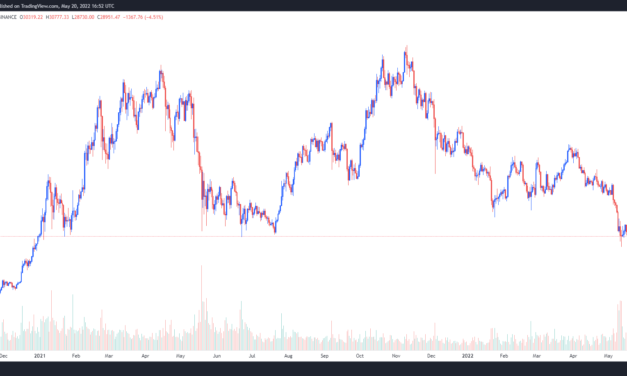
After a strong 2,000% rally in early 2021, Fantom (FTM) price collapsed alongside multiple altcoins and even though the blockchain has an impressive capability, it has yet to find mass adoption due to the lack of a compelling use case. FTM price hit an all-time high at $3.46, only to collapse to its pre-bull market lows under $0.25 after the failure of the Solidly DeFi project and the departure of developer Andre Cronje.  Data from Cointelegraph Markets Pro and TradingView shows that since dropping to $0.238, FTM has rallied 119.23% to $0.5216 on May 23.FTM/USDT 4-hour chart. Source: TradingViewThree reasons for the uptrend in FTM price are the launch of the first native stablecoin on the Fantom network, new protocol upgrades and partnership announcements, which bring new functionality to the network, and speculation that Andre Cronje is working with decentralized finance (DeFi) protocols on Fantom. Fantom launches its first native stablecoinThe most notable development to occur in the Fantom ecosystem in the past few weeks was the release of fUSD, the first native stablecoin on the network. The launch of fUSD comes on the heels of the collapse of TerraUSD and looks to capture some of the capital flight from algorithmic stablecoin by offering an over-collateralized alternative. On May 20, the Fantom Foundation released an update outlining the maximum collateral factor and minting cap for each supported form of collateral. The foundation also set the fUSD staking reward at 11.3% The update also included details on Fantom liquid staking, setting a global cap of 150 million staked Fantom (sFTM), removing validators for the list of those eligible to mint sFTM and setting a loan-to-value (LTV) ratio of FTM at 90% for the purposes of minting sFTM. New partnerships improve sentiment for FTMA handful of recent protocol updates and new partnerships have also helped to bring a boost in momentum to Fantom, including the launch of Snapsync, which allows new nodes to quickly join the network. With the integration of Snapsync, the time it takes for new nodes to synch could be reduced from 24 to seven hours, helping to enhance network reliability, improve scalability and create a greater degree of decentralization. Fantom has also announced that it is currently in the process of launching Gitcoin on the Fantom network to simplify the process of obtaining grants to develop in the Fantom ecosystem. Fantom also partnered with Unmarshal and XP.Network. Unmarshal is a Web3 infrastructure provider that will integrate its indexing services with the Fantom protocol to give developers easy access to organized and granular on-chain data.Through the partnership with XP.Network, Fantom users will be able to bridge nonfungible tokens (NFTs) between Ethereum (ETH), BNB Smart Chain (BNB), Elrond (EGLD), Aurora (AURORA), Tron (TRX), Avalanche (AVAX) and Velas (VLX). Related: Crypto remittances must have allure of cash without regulatory constraints — Jeremy AllaireDid Andre Cronje return?Another factor, albeit speculative, bringing a boost FTM price is speculation that well-known DeFi developer Andre Cronje could be contributing toward DeFi development on the Fantom network. Amid rumors about the return of lead DeFi developer Andre Cronje, the price of the native FTM token has risen by almost 40%. Cronje proposed a number of measures aimed at stabilizing the situation and increasing the sustainability of the Fantom ecosystem as a whole.— Ashley Torres (@torresamba) May 23, 2022The speculation started when Cronje submitted an fUSD optimization proposal that designed to solve a major depegging issue with the stablecoin on May 20 . A Fantom wallet that is believed to belong to Cronje has also added more than 100 million FTM over the past two weeks. VORTECS™ data from Cointelegraph Markets Pro began to detect a bullish outlook for FTM on May 20, prior to the recent price rise. The VORTECS™ Score, exclusive to Cointelegraph, is an algorithmic comparison of historical and current market conditions derived from a combination of data points including market sentiment, trading volume, recent price movements and Twitter activity.VORTECS™ Score (green) vs. FTM price. Source: Cointelegraph Markets ProAs seen in the chart above, the VORTECS™ Score for FTM spiked to a high of 89 on May 20 at the same time as its price began to increase 62.3% over the next three days.The views and opinions expressed here are solely those of the author and do not necessarily reflect the views of Cointelegraph.com. Every investment and trading move involves risk, you should conduct your own research when making a decision.

Čítaj viac

20% drop in the S&P 500 puts stocks in a bear market, Bitcoin and altcoins follow

Whoever coined the phrase “sell in May and go away” had brilliant insight and the performance of crypto and stock markets over the past three weeks has shown that the expression still rings true.May 20 has seen a pan selloff across all asset classes, leaving traders with few options to escape the carnage as inflation concerns and rising interest rates continue to dominate the headlines. Data from Cointelegraph Markets Pro and TradingView shows that the price of Bitcoin (BTC) taking on water below $29,000 and traders worry that losing this level will ensure a visit to the low $20,000s over the coming week. BTC/USDT 1-day chart. Source: TradingViewAs reported by Cointelegraph, some analysts warn that BTC could possibility decline to $22,700 based on its historical price performance following a death cross. Further evidence of muted expectations from traders can be found in the put/call ratio for BTC open interest, which hit a 12-month high of 0.72 on May 18 according to the cryptocurrency research firm Delphi Digital. Bitcoin put/call ratio on open interest and volume. Source: Delphi DigitalDelphi Digital said, “A high put/call ratio indicates that investors are speculating whether Bitcoin will continue to sell off, or it could mean investors are hedging their portfolios against a downward move.”Stocks enter bear market territoryMay 20 brought more pain to the traditional markets as the S&P 500 fell another 1.62%, marking a more than 20% decline from its January 2022 all-time high and further stoking recession fears. If the index manages to close the day down 20% from the all-time-high, that would officially put the benchmark index in bear market territory. Performance of the major indices on May 20. Source: Yahoo FinanceThe Nasdaq Composite and Dow have also seen significant losses amid the widespread weakness, with the Nasdaq losing 275 points for a 2.42% loss, while the Dow has fallen 362 points, marking a decline of 1.28%. Related: Crypto veterans extend a helping hand to bear market newbiesWhat’s bad for BTC is even worse for altcoinsDaily cryptocurrency market performance. Source: Coin360Altcoins also sold off sharply as BTC, Ether and stocks pulled back, reversing the gains seen earlier on the day. The few bright spots were Ellipsis (EPS), Persistence (XPRT) and 0x (ZRX), which gained 30%, 13.92% and 12.34% respectively. The overall cryptocurrency market cap now stands at $1.234 trillion and Bitcoin’s dominance rate is 44.6%.The views and opinions expressed here are solely those of the author and do not necessarily reflect the views of Cointelegraph.com. Every investment and trading move involves risk, you should conduct your own research when making a decision.

Čítaj viac

Získaj BONUS 8 € v Bitcoinoch

nakup bitcoin z karty

Registrácia Binance

Burza Binance

Aktuálne kurzy