
Autor Cointelegraph By Jordan Finneseth

Traders think Bitcoin bottomed, but on-chain metrics point to one more capitulation event

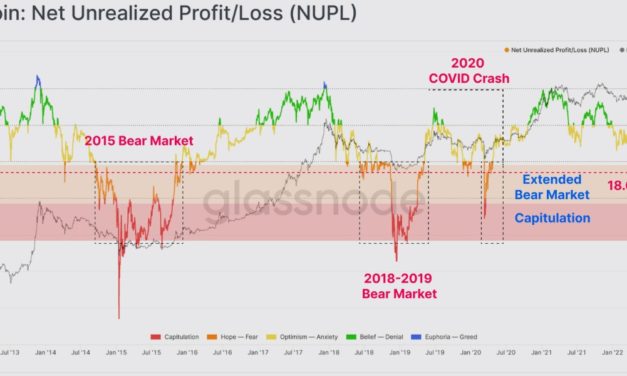
The bull market euphoria that carried prices to new highs throughout 2021 has given way to bear market doldrums for any Bitcoin (BTC) buyer who made a purchase since Jan. 1, 2021. Data from Glassnode shows these buyers “are now underwater” and the market is gearing up for a final capitulation event. Bitcoin net unrealized profit/loss. Source: GlassnodeAs seen in the graphic above, the NUPL, a metric tha is a measure of the overall unrealized profit and loss of the network as a proportion of the market cap, indicates that “less than 25% of the market cap is held in profit,” which “resembles a market structure equivalent to pre-capitulation phases in previous bear markets.”Based on previous capitulation events, if a similar move were to occur at the current levels, the price of Bitcoin could drop into a price range of $20,560 to $25,700 in a “full-scale capitulation scenario.” The market is in search of the bottomWith the crypto market clearly trading in bear market territory, the question on everyone’s mind is “where is the bottom?”One metric that can help provide some possible guidance is the Mayer Multiple, an oscillator that tracks the ratio between price and the 200-day moving average. Mayer Multiple model for Bitcoin. Source: GlassnodeIn previous bear markets, “oversold or undervalued conditions have coincided with the Mayer Multiple falling in the range of 0.6–0.8,” according to Glassnode and that is precisely the range where Bitcoin now finds itself. Based on the price action from previous bear markets, the recent trading range of Bitcoin between $25,200 and $33,700 lines up with the B phase of the previous bear market cycles and could mark the low of BTC in the current cycle. The Bitcoin realized price model also offers insight into what a potential price bottom for Bitcoin could be, with the current reading provided by the Bitcoin data provider LookIntoBitcoin suggesting the realized price for BTC is $23,601 as of June 5.Bitcoin realized price. Source: LookIntoBitcoinCombining these two metrics suggests that the low for BTC could occur in the $23,600 to $25,200 range. Related: Amid crypto bear market, institutional investors scoop up Bitcoin: CoinSharesShort term holder and miner capitulationSelling in the current market conditions has largely been dominated by short-term hodlers, similar to the behavior that was seen during the two previous extended bear markets where long-term holders held more than 90% of the profit in the market. Long-term Bitcoin holders share from supply in profit. Source: GlassnodeThe recent drop below $30,000 for Bitcoin saw the percentage of supply in profit spike above 90% for the long-term holder cohort, suggesting short-term holders have “essentially reached a near-peak pain threshold.”According to Glassnode, miners have also been net sellers in recent months as the decline in BTC has hampered the profitability for miners resulting in “an aggregate miner balance reduction of between 5K and 8K BTC per month.” Bitcoin miner net position change. Source: GlassnodeShould the price of BTC continue to decline from here, the potential for an increase in miner capitulation is not out of the question, as demonstrated in the past by the Puell Multiple, which is the ratio of the daily issuance value of bitcoin to the 365-day moving average of this value.Puell multiple vs. BTC price. Source: LookIntoBitcoinHistorical data shows that the metric has declined into the sub-0.5 zone during the late stages of previous bear markets, which has yet to occur during the current cycle. Based on the current market conditions, a BTC price decline of an additional 10% could lead to a final miner capitulation event that would resemble the price decline and selling seen at the hight of previous bear markets.The views and opinions expressed here are solely those of the author and do not necessarily reflect the views of Cointelegraph.com. Every investment and trading move involves risk, you should conduct your own research when making a decision.

Čítaj viac
5 reasons why Bitcoin could be a better long-term investment than gold

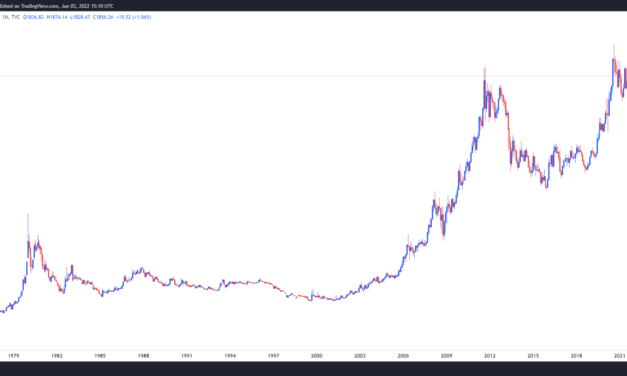
The emergence of forty-year high inflation readings and the increasingly dire-looking global economy has prompted many financial analysts to recommend investing in gold to protect against volatility and a possible decline in the value of the United States dollar. For years, crypto traders have referred to Bitcoin (BTC) as “digital gold,” but is it actually a better investment than gold? Let’s take a look at some of the conventional arguments investors cite when praising gold as an investment and why Bitcoin might be an even better long-term option. Value retentionOne of the most common reasons to buy both gold and Bitcoin is that they have a history of holding their value through times of economic uncertainty. This fact has been well documented, and there’s no denying that gold has offered some of the best wealth protection historically, but it doesn’t always maintain value. The chart below shows that gold traders have also been subject to long bouts of price declines. Gold price. Source: TradingViewFor example, a person who bought gold in September of 2011 would have had to wait until July 2020 to get back in the green, and if they continued to hold, they would once again be near even or underwater. In the history of Bitcoin, it has never taken more than three to four years for its price to regain and surpass its all-time high, suggesting that on a long-term timeline, BTC could be a better store of value. Could Bitcoin be a better inflation hedge?Gold has historically been seen as a good hedge against inflation because its price tended to rise alongside increases in the cost of living. But, a closer look at the chart for gold compared with Bitcoin shows that while gold has seen a modest gain of 21.84% over the past two years, the price of Bitcoin has increased 311%. Gold vs. BTC/USDT 1-day chart. Source: TradingViewIn a world where the overall cost of living is rising faster than most people can handle, holding an asset that can outpace the rising inflation actually helps increase wealth rather than maintain it. While the volatility and price declines in 2022 have been painful, Bitcoin has still provided significantly more upside to investors with a multi-year time horizon.Bitcoin could mirror gold during geopolitical uncertaintyOften called the “crisis commodity,” gold is well-known to hold its value during times of geopolitical uncertainty as people have been known to invest in gold when world tensions rise.Gold is called the crisis metal so I’d assume if we enter into a recession again, gold will go up as a commodity— Scott Hempstead (@scottytrip1) April 22, 2022Unfortunately for people located in conflict zones or other areas subject to instability, carrying valuable objects is a risky proposition, with people being subject to asset seizures and theft. Bitcoin offers a more secure option for people in this situation because they can memorize a seed phrase and travel without fear of losing their funds. Once they reach their destination, they can reconstitute their wallet and have access to their wealth. The digital nature of Bitcoin and the availability of multiple decentralized marketplaces and peer-to-peer exchanges like LocalBitcoins provides a greater opportunity to acquire Bitcoin.The dollar keeps losing valueThe U.S. dollar has been strong in recent months, but that is not always the case. During periods where the dollar’s value falls against other currencies, investors have been known to flock to gold and Bitcoin. If various countries continue to move away from being U.S. dollar centric in favor of a more multipolar approach, there could be a significant amount of flight out of the dollar but those funds won’t go into weaker currencies. While gold has been the go-to asset for millennia, it’s not widely used or accepted in our modern digital society and most people in younger generations have never even seen a gold coin in person. For these cohorts, Bitcoin represents a more familiar option that can integrate into people’s digitally-infused lifestyles, and it doesn’t require extra security or physical storage. Related: Argentines turn to Bitcoin amid inflation worries: ReportBitcoin is scare and deflationaryMany investors and financial experts point to scarcity and supply constraints for gold following years of declining production as a reason gold is a good investment. It can take five to ten years for a new mine to reach production, meaning rapid increases in supply are unlikely and central banks significantly slowed their rate of selling gold in 2008. That being said, it is estimated that there is still more than 50,000 metric tons of gold in the ground, which miners would happily focus on extracting in the event of a significant price increase. Gold will never reach the promised land of ‘true scarcity’. The more the price inches up, the more it is mined, thus increasing supply, which then lowers the price. #bitcoin #gold #goldprice— DeepSee-er (@ErDeepsee) March 7, 2022

On the other hand, Bitcoin has a fixed supply of 21 million BTC that will ever be produced, and its issuance is happening at a known rate. The public nature of the Bitcoin blockchain allows for the location of every Bitcoin to be known and verified. There’s no way to ever really locate and validate all of the gold stores on this planet, meaning its true supply will never really be known. Because of this, Bitcoin wins the scarcity debate, hands down, and it is the hardest form of money created by humankind to date.Want more information about trading and investing in crypto markets?The views and opinions expressed here are solely those of the author and do not necessarily reflect the views of Cointelegraph.com. Every investment and trading move involves risk, you should conduct your own research when making a decision.

Čítaj viac
Bitcoin’s move to $32.4K was a fakeout — Here’s the price level most BTC traders are waiting for

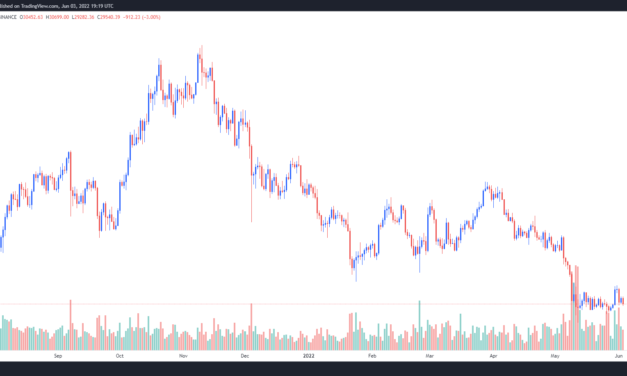
The end of the first week in June brought more pain to global financial markets as the tech-heavy Nasdaq composite closed the day on June 3 down 2.3%, while the S&P 500 shed 1.4% of its value. The cryptocurrency market hasn’t faired any better and data from Cointelegraph Markets Pro and TradingView shows that an early morning attempt to push Bitcoin (BTC) above $30,000 was hit with a wave of selling that dropped it to a daily low of $29,286. BTC/USDT 1-day chart. Source: TradingViewHere’s a look at what several market analysts are saying about the outlook for BTC as it remains pinned inside a narrow trading range. Price is stuck in the lower rangeBitcoins’ slide back into its current range was “expected” according to crypto trader and pseudonymous Twitter user Altcoin Sherpa, who posted the following chart highlighting the price pullback into the middle of its recent trading range. BTC/USD 4-hour chart. Source: TwitterAltcoin Sherpa said, “A bit lower is likely a better place to long but this entire area is choppy and not very clear to me for levels. Would rather wait for 28.4k first. #Bitcoin”Fellow trader and pseudonymous Twitter user ShardiB2 like-wise lamented the price pullback into the trading range, noting that “Elon, Dimon, Goldman, etc. saying economy is going to be shit for a while is going to weigh on markets.”ShardiB2 said, “Not awesome, back in our lower channel…needs to hold here or a visit back to 28.6[K] may be in order, crack that and we’ll get that 25-26K me thinks…”Bitcoin’s rally to $32,400 was just a fakeoutFurther insight into what levels to keep an eye on for a good entry was offered by EmperorBTC, who posted the following chart highlighting the “previous range high acting as the resistance.”BTC/USDT 4-hour chart. Source: TwitterEmperorBTC said, “Looks like the run to 32K was only a deviation. Was not expecting the previous range high to act as such strong a resistance. Expecting support at PoC [point of control] now and will Spots there.”Related: The crypto market dropped in May, but June has a silver liningBulls will win in the long-runAn estimate on how long crypto traders can expect the current market struggle to persist was provided by Twitter user Crypto Rover, who posted the following chart outlining the formation of a bullish reversal pattern. BTC/USD 1-day chart. Source: TwitterCrypto Rover said, “It may still take another 3 months before #Bitcoin finally starts moving up at a significant pace. But one thing is sure, we are creating a typical bullish buyers reversal pattern. Time is on our side now.”The overall cryptocurrency market cap now stands at $1.217 trillion and Bitcoin’s dominance rate is 46.3%.The views and opinions expressed here are solely those of the author and do not necessarily reflect the views of Cointelegraph.com. Every investment and trading move involves risk, you should conduct your own research when making a decision.

Čítaj viac
5 metrics to monitor before investing in crypto during a bear market

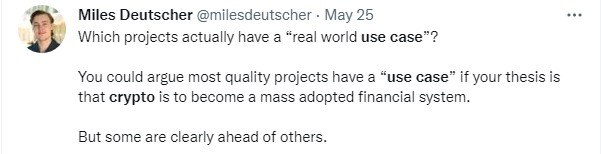
Cryptocurrency bear markets destroy portfolio value and they have a dangerous tendency to drag on for longer than anyone expects. Fortunately, one of the silver linings of a market-wide pullbacks is that it gives investors time to re-focus and spend time researching projects that could thrive when the trend turns bullish again.Here’s a five areas to focus on when deciding whether to invest in a crypto project during a bear market.Is there a use case?The cryptocurrency sector has no shortage of flashy promises and gimmicky protocols, but when it comes down to it there are only a handful of projects that have delivered a product which has demand and utility.When it comes down to determining if a token should continue to be held, one of the main questions to ask is “Why does this project exist?” If there is not a simple answer to that question or the solutions offered by the protocol don’t really solve a pressing problem, there is a good chance it won’t gain the adoption it needs long term to survive. Identify a competitive advantageIn the cases where a viable use case is present, it’s important to consider how the protocol compares against other projects that offer solutions to the same problem. Does it offer a better or simple solution than its competitors, or is it more of a redundant protocol that doesn’t really bring anything new to the table? A good example of unnecessary redundancy is the oracle sector of the market, which has seen a handful of protocols launched over the past three years. Despite the growing number of options, the oldest and most widely integrated oracle solution Chainlink (LINK) and it remains the strongest competitor in the field. Does the protocol generate revenue, and how?“If you build it, they will come,” is a cliche expression tossed around in tech circles, but it doesn’t always translate into real-world adoption in the cryptocurrency sector. Operating a blockchain protocol takes time and money, meaning that only protocols with revenue or sufficient funding will be able to survive a bear market. Identifying whether a project is profitable and where the revenue comes from can help guide investors who are interested in buying DeFi tokens.Projects with the highest protocol revenue. Source: Token TerminalIf a project shows limited activity and revenue, it may be a good time to start evaluating whether it’s undervalued or a investment that should be avoided.Are there cash reserves?Every startup is meant to have a war chest, treasury or runway and prior to investing it’s important to identify whether or not the project has sufficient funds to survive downtrends, especially if providing yield on locked assets is the primary incentive for attracting liquidity.As mentioned earlier, running a blockchain protocol isn’t cheap, and a majority of the protocols out there might not be liquid enough to survive a lengthy bear market.Every successful NFT project should bring in a crypto financial manager/treasurer to properly diversify/hedge their war chest, not just keep everything in ETH. A project needs to know how to take profit too.— $trawberry Sith (@StrawberrySith) May 10, 2022Ideally, a DeFi-style project should have a large treasury containing a variety of assets like Bitcoin (BTC), Ether (ETH) and more reliable stablecoins like USD Coin (USDC) and Tether (USDT). Having a well-funded and diversified treasury that can be pulled from during touch times is crucial and as $trawberry Sith suggests, projects need to learn when to take profit, and not leave a majority of the protocol treasury in Ether or the platform’s native token.Related: Major crypto firms reportedly cut up to 10% of staff amid bear marketAre roadmap deadlines kept and met?While past performance is not necessarily an indicator of future results, a project’s history of following its roadmap and meeting important deadlines can offer valuable insight into whether it is prepared to endure tough times.In addition to keeping track of roadmap milestones, sites like CryptoMiso and GitHub can help investors peer behind the curtain to see the frequency of development and developer activity for a protocol. If a team is displaying little to no signs of activity as roadmap deadlines come and go, it might be time to consider the possibility that a slow rug pull is occurring and that it may be time to get out before further losses are realized. This article does not contain investment advice or recommendations. Every investment and trading move involves risk, and readers should conduct their own research when making a decision.The views, thoughts and opinions expressed here are the author’s alone and do not necessarily reflect or represent the views and opinions of Cointelegraph.

Čítaj viac

3 key indicators traders use to determine when altcoin season begins

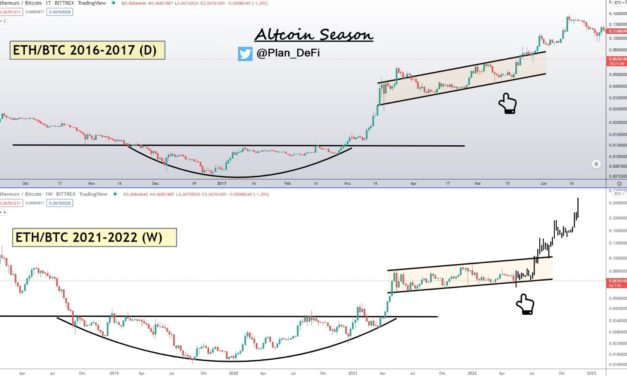
It’s widely accepted that the fate of the cryptocurrency market depends largely on the performance of Bitcoin (BTC), which makes times like these for crypto traders who prefer to invest in altcoins. When BTC price is down, altcoins tend to follow, but as a bottoming process begins, altcoins tend to perk up during Bitcoin’s consolidation phases and this typically leads to a call for an altcoin season. While Bitcoin’s current dip below $30,000 shows that it’s a bit premature to call for an altseason, analysts are still charting a variety of different outcomes that point to an altcoin season. Let’s have a look.ETH/BTC price action could be an early indicatorInsight into the possibility of an altcoin season using the ETH/BTC chart as an indicator was discussed by analyst and pseudonymous Twitter user PlanDeFi, who posted the following chart comparing the 2016 to 2017 performance of ETH/BTC against the pair’s performance in 2021–2022. ETH/BTC in 2016/2017 vs. ETH/BTC in 2021/2022. Source: TwitterPlanDeFi said, “Looks damn similar, right? Accumulation >Breakout >Ascending Channel >Breakout. The market is bigger now — it just takes longer.”Based on the projection provided, the next altseason could kick off sometime after the start of July and it has the potential to extend through the end of 2022. A 2017 fractal suggests an altseason is imminentFurther evidence that the market may be approaching an inflection point was provided by El_Crypto_Prof, who posted the following chart looking at the history of the altcoin market capitalization.Altcoin market cap. Source: TwitterEl_Crypto_Prof said, “When it comes to altcoins, I can see the following scenario playing out. There are just too many similarities with the previous cycle. RSI also looks incredible. The next wave up will leave many behind.”Related: Fed money printer goes into reverse: What does it mean for crypto?The market is firmly in “Bitcoin Season”While fractals are pleasing to the eye and give hope to disillusioned traders, most fail to materialize and they are not accurate analysis methods to rely on when trading.The Altseason Indicator provides a more metrics-based method for predicting when the market is in “Bitcoin season” and “altcoin season.”Altseason indicator. Source: Blockchain CenterAccording to the chart above, it does not appear as though an altseason is likely to happen anytime soon because the metric is currently providing a readout of 24, while the level needed to signify an altseason is 75.Based on the past performance of the index, it has taken a minimum of two to three months for it to climb from the area indicating that it is Bitcoin season to the altcoin season level. Current projections, according the the indicator, suggest that an altcoin season might not start until August or September 2022.The views and opinions expressed here are solely those of the author and do not necessarily reflect the views of Cointelegraph.com. Every investment and trading move involves risk, you should conduct your own research when making a decision.

Čítaj viac

Získaj BONUS 8 € v Bitcoinoch

nakup bitcoin z karty

Registrácia Binance

Burza Binance

Aktuálne kurzy
