
Autor Cointelegraph By Johnny Lyu

In the Economy 3.0, metaverses will create jobs for millions

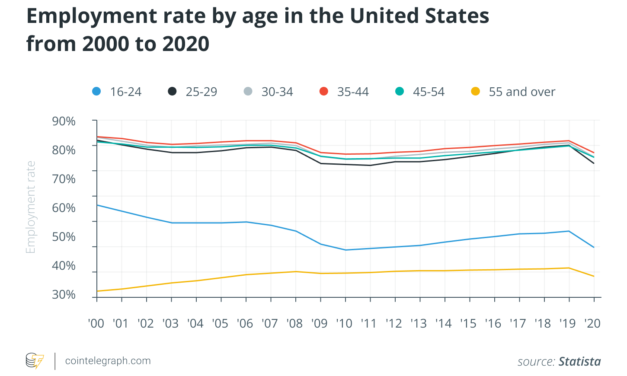
Job creation is traditionally engineered by politicians desperate to get the country back to work and to be seen as stimulating the economy. From the job creation programs of the Great Depression to United States President Barack Obama’s American Jobs Act, employment schemes have a long, checkered history. Today, fostering meaningful employment for the masses remains as popular as ever with policymakers, and yet, the next great job creation scheme is unlikely to be issued as a top-down order.Rather, it will emanate from a realm that most politicians have little dominion over and few powers to control: the Metaverse. That virtual world running parallel to our physical one is not constrained by national borders, nor is it the fiefdom of social media companies cynically commandeering its name.The Metaverse comprises an interconnected series of virtual worlds in which humankind can recreate, interact and transact. As avatars, its users are free to flit between games, meeting spaces and markets, reenacting many of the tasks once constrained to meatspace.The greatest promise the Metaverse holds, however, is not the ability for humans to don lurid skins and twerk as one in virtual concert halls. Rather, it is for these same people to obtain meaningful employment in worlds, realms and spaces across the Metaverse that will form the beating heart of Web3.Related: Demystifying the business imperatives of the MetaverseMaking bank in the MetaverseGiven the amorphous nature of the Metaverse, it can be hard to envisage what a virtual world in which millions clock in and out to earn their crust might resemble. As it happens, though, there is already work being performed in fledgling metaverses the (virtual) world over.In the play-to-earn — or “GameFi” — sector, virtual pets roam freely, with their human owners petting, dressing and training them. But it’s not just about recreation: With their respective metaverses, players can collect tokens and other in-game assets that spawn and trade them for real money.Related: Crypto gaming and the monkey run: How we should build the future of GameFiWorkers from developing countries such as the Philippines earn around $30 per day for performing these tasks on behalf of owners, using the creatures to collect tokens. Owners, in turn, earn money from lending out their stable of virtual pets — without needing to concern themselves with the drudgery of collecting tokens all day.It’s a simple economy in which all participants benefit commensurate with their interests and financial expectations. How might this earning model work for Metaverse participants higher up the chain?Well, for celebrities and creators, specialist platforms enable virtual experiences to be entertained in the Metaverse. Fans can pay to interact with their favorite creators within a virtual world, whether they’re playing golf with a YouTube influencer or learning new skills through a one-on-one with a thought leader. It’s yet another example of the vast potential the Metaverse holds.Meta-work for the massesNot all of the work centered around the Metaverse will occur within it. Much of it will involve connecting the nuts and bolts that keep it turning — coders, designers, testers and developers. For the millions currently employed in offices and on shop floors around the globe, however, the ascendancy of the Metaverse will see their work transition to a virtual world not so dissimilar to that to which they are accustomed.Real estate: Virtual land is already selling for millions of dollars in metaverse worlds such as The Sandbox and Decentraland. The battle for desirable virtual real estate is fierce — flipping pixels for profit is a specialist role that will create a slew of jobs for those with an eye for a prime plot. At the same time, real-world property will also transition to the metaverse, enabling prospective buyers to “walk around” a beachfront condo on the other side of the world or ogle one that is still in spec. In a virtual world where anything is possible, “try before you buy” is the norm.Related: The Metaverse is booming, bringing revolution to real estateFashion: From Louis Vuitton to Nike and Gucci, fashion brands are clamoring to catch a slice of the Metaverse action, and it’s easy to see why. A world in which millions mingle while represented as avatars provides endless opportunities for sartorial splendor. No longer are people constrained by gender, body type and, indeed, imagination when dressing. In the Metaverse, you can assume any identity you want, with the accessories to match. Models will strut their stuff on virtual catwalks, and fashionistas will pay top dollar to dress their avatars in limited-edition threads from the hippest brands.Music: As much a boon to independent artists as it is to major labels, the Metaverse showed its worth during global lockdowns, with over 27 million fans tuning in to Travis Scott’s Fortnite concert in 2020. Enterprising artists have already experimented with Web3 technology such as nonfungible tokens (NFTs), using them to release limited-edition and exclusive albums and foster intimate experiences. The emergence of a fully immersive Metaverse will elevate this capability to a new level, providing endless ways to monetize and engage with fans.Related: The Metaverse will change the live music experience, but will it be decentralized?Movies: Technology is a double-edged sword, creating new opportunities while destroying others. Actors who’ve found their likeness being assumed by artificial intelligence and their intellectual property infringed know this only too well. But the very same tech that threatens their livelihoods can be utilized to enrich them within the Metaverse. Just imagine the capabilities presented by a world in which voice, television and movie actors can use their digitized doppelgangers to interact with fans and sell experiences that incorporate one-on-one time — without the celeb needing to leave the comfort of their Malibu mansion.As the Metaverse materializes and its promise becomes a reality, the employment opportunities it offers will lift everyone from the mechanical turk, toiling for $2 per hour, to the rich and famous. Already, there are Metaverse stores you can visit with your avatar to order everything from fast food to medical marijuana — and then have it delivered to your real-world front door. In the near future, many of those earning from the Metaverse — such as delivery drivers and food producers — may have no inkling that they owe their livelihood to a world they have yet to discover.Not all of us will play and interact in the Metaverse, but just like the internet itself, we will be more prosperous because of its existence. The sooner the Metaverse becomes a mass reality, the better we will all be.This article does not contain investment advice or recommendations. Every investment and trading move involves risk, and readers should conduct their own research when making a decision.The views, thoughts and opinions expressed here are the author’s alone and do not necessarily reflect or represent the views and opinions of Cointelegraph.Johnny Lyu is the CEO of KuCoin, one of the largest cryptocurrency exchanges, which was launched in 2017. Before joining KuCoin, he had accumulated abundant experience in the e-commerce, auto and luxury industries.

Čítaj viac
The metaverse will change the paradigm of content creation

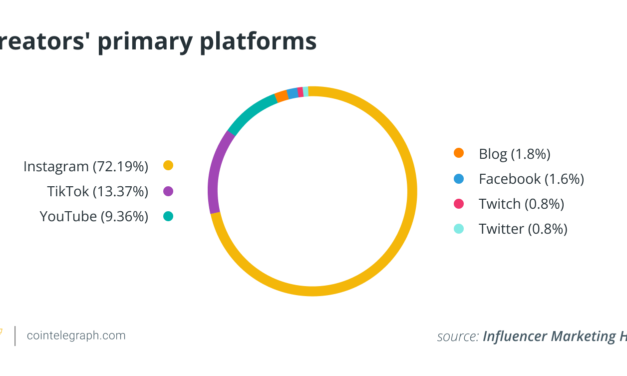
Content constitutes the essence of the internet and comes in many different forms that the current Web2 internet iteration supports — text, audio, video or a mix of all three. However, content is scarcely a free resource. It is content creators who are now becoming opinion leaders, influencers and the cornerstones of so many of the critical services businesses rely on, such as advertising, marketing and public relations management.The need for content and its strive for independence — embodied by thousands of bloggers and indie performers — has spawned an immense online economy that trades talent and often rakes in sales volumes many a top-level artist would salivate to earn. This economy has been dubbed the creator economy: a financial framework that allows independent individuals to earn on their self-expression by feeding audiences the type of content they are willing to pay to consume.A rising forceThe creator economy is a tremendous force: a unique, online phenomenon that overstepped the $104-billion market size threshold at the end of 2021. Given the snowballing demand for new content on popular platforms, such as TikTok, that empower independent artists and performers, experts are hesitant to make forecasts about the potential market size of the creator economy in the near future.The reason for the lack of tangible predictions is that the creator economy is an extremely young phenomenon that started with the COVID-19 pandemic. The lockdowns evoked a wave of talent among people confined indoors, resulting in a release of creativity that others sharing confinement were eager to consume as much-needed entertainment.Related: The best is yet to come: What’s next for blockchain and the creator economyConsidering that micro-entrepreneur creators are closely related to influencer marketing, which spots around $13.8 billion in market size, it is possible to understand the prospects that further expansion of the phenomenon can yield. More importantly, experts believe the transition to a new technological medium will allow content creators to overwhelm markets and industries with new opportunities for product and service promotion.Decentralizing talentMore than 50 million creators are driving their own economy of talent, attracting in excess of $800 million in venture capital. Such figures are but a shadow of what they can become later, as new venues are rapidly becoming available.The development of blockchain technologies has resulted in a sweeping revolution across financial markets, empowering individuals instead of institutions and channeling ownership of data and funds to their holders. The qualities of the blockchain — immutability, full transparency and the trustless nature of operations — have permeated many industries, swooning the balance of business orientation from centralized corporate reliance to decentralization. This shift in the basic concepts that govern relations between participants to transactions, facilitated by smart contracts, has not gone unnoticed in the creator economy.With the decentralized finance and GameFi sectors marshaling across their respective industries and detracting droves of users from conventional approaches to banking and gaming, it was only a matter of time before influencers and content creators decided to shift the paradigm in their operating environments. The content creation model has been altered forever with the incorporation of blockchain technologies that allow users to incentivize content creators, while creators can actually monetize their talent without having to share the proceeds with centralized, often-unfair hosting platforms.Related: DAOs are the foundation of Web3, the creator economy and the future of workGoing metaverseThe development of metaverses — fully digital environments powered by the blockchain on Web3 and virtual reality — will herald a new era in content creation. Never before has talent had access to such an advanced set of tools to embellish even the bravest of ideas on the threshold of the real and digital worlds. Metaverses allow creators to visualize in stunning graphical detail anything from an opera concert in the void of space against a backdrop of nebulae to a blog stream on a deserted island. Anything creativity can fathom can be implemented in the metaverse for the benefit of all parties involved. By relying on the unlimited opportunities of the metaverse in its incorporation of virtual reality, content creators will be able to unleash their creativity and allow it to roam wild. Such promises of unseen quality of content can only be described as honeysuckle for an eager audience of viewers longing for more variety in types of content consumed — and, more importantly, new experiences.The blockchain basis of the metaverse offers even more benefits for content creators, as it allows them to employ various mechanisms for monetizing their content through the versatile nature of internal cryptocurrencies. Users can stake their digital assets on specific creators, encouraging them to release more content of a certain type. Others can pay to access special content, while others can simply reward their favorite creators with donations. The monetization avenues are numerous, and content creators can always be sure that their talent will be paid for and no hosting platform can strip them of their earnings.Even more lucrative are the prospects for businesses in terms of content-creator economy permeation in the metaverse. Marketing, advertising and promotion in general gain a new lease on evolution with content that can be tailored in an endless variety of ways and seamlessly integrated into the channels of select creators. The metaverse provides businesses with an entirely new frontier for deployment and audience reach, and the creators are the takeoff ramps that can showcase products and services before their followers — for a price.In digital hindsightThe metaverse is the next iteration of the internet we know today: a fully user-centric environment serving the purpose of elevating creativity to a new level. However, audiences will not be the only sources of revenue for content creators, as businesses are eager to tap into this lucrative niche and leverage the possibilities offered by native, organic and highly versatile ad integrations in virtual reality content.This article does not contain investment advice or recommendations. Every investment and trading move involves risk, and readers should conduct their own research when making a decision.The views, thoughts and opinions expressed here are the author’s alone and do not necessarily reflect or represent the views and opinions of Cointelegraph.Johnny Lyu is the CEO of KuCoin, one of the largest cryptocurrency exchanges, which was launched in 2017. Before joining KuCoin, he had accumulated abundant experience in the e-commerce, auto and luxury industries.

Čítaj viac

When and why did the word ‘altcoin’ lose its relevance?

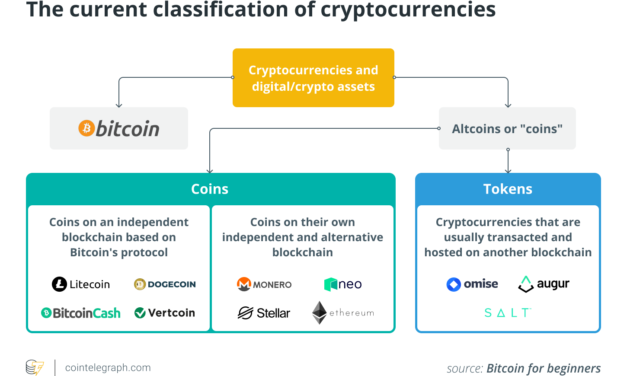
All cryptocurrencies other than Bitcoin (BTC) were first described as altcoins for a single reason: There was a rise of projects that copied and pasted Bitcoin’s source code. The cryptocurrencies in the early stages weren’t unique enough to have a distinctive term, so “altcoin” (alternative coins) best fit their description. The community, at that point, didn’t put too much thought into other cryptocurrencies due to Bitcoin’s potential advancement — its future price growth, use cases, mainstream adoption, etc. It was the leading head in crypto.But things changed when people caught onto Ethereum’s smart contract platform, as it can produce “smart contract tokens” — cryptocurrencies with the ability to perform intelligent tasks autonomously.This led the community to distinguish altcoins from tokens. Altcoins were now coins that had their own blockchain, and tokens were defined as cryptocurrencies created on smart contract platforms. The other factor now at work is that there are many blockchain projects that are scaling rapidly and decreasing Bitcoin’s dominance.The community started noticing weaknesses in Bitcoin’s correlation to other coins as other interesting new projects popped up, which provoked the crypto world to rethink how it sees cryptocurrencies. Now, every altcoin distinguishes itself on the market by offering a unique set of features related to things such as transaction management, scripting language, mining mechanisms and consensus algorithms. Although altcoins’ superior features may outperform Bitcoin in one way or another, their value is still completely dependent on Bitcoin’s market capitalization.Related: Where does the future of DeFi belong: Ethereum or Bitcoin? Experts answerThe community started to envision a world where various cryptocurrencies, not just Bitcoin, can disrupt the world. Now, with Ether’s (ETH) growing dominance in the market, it’s clear that Ethereum is the leader of crypto innovation. A large percentage of tokens today are Ethereum ERC-20 smart contracts, so the ways token minters classify their projects are easily normalized in the community.Ethereum’s role in crypto classifications Ethereum’s ecosystem is responsible for every crypto advancement and for mainstream interest, starting with initial coin offerings (ICOs) — which disrupted the initial public offering model by allowing anyone to buy a project’s coin at launch. The attention from ICOs led to many use cases for ERC-20 tokens, with developers making their next cryptocurrency an Ethereum-based token and crypto users having an incentive to learn more about the tech. With a wide variety of ERC-20 tokens, our human nature must intervene to categorize and associate things.The term “altcoin” is no longer an acceptable way to define a project, as it’s ambiguous — especially now with decentralized finance (DeFi). People want to know what type of coin it is, whether it be a staking coin, liquidity mining coin, crypto derivative, stablecoin, utility token, etc. They’re aware that cryptocurrencies do much more than send and receive payments.“Meme tokens” have entered into the crypto vocabulary, too “Meme token” is a term most crypto users are familiar with due to Elon Musk tweeting to the world about Dogecoin (DOGE). But the crypto community had to make the distinction between tokens and meme tokens, as cryptocurrencies are capable of highly intellectual activity. Tokens based on social media content could potentially affect how the crypto sector is perceived, so a further classification had to be established.The rise of nonfungible tokens (NFTs) proved that the crypto community is ready to onboard and learn about new definitions. Imagine if NFTs were described as altcoins? By definition, they technically are, but there’s so much that NFTs can do that demonstrates their difference. The community acknowledges that NFTs are ERC-721 tokens and recognizes the capabilities they possess. For starters, they’re structured to make cryptocurrencies unique, with no two tokens sharing the same value.Related: DeFi and Web 3.0: Unleashing creative juices with decentralized finance“GameFi” (gaming DeFi) is another term that was added to the crypto dictionary. It deals with merging blockchain technology with NFTs, liquidity mining and other DeFi protocols. The result is games where people can earn real crypto and trade assets. GameFi is still new, so there’s a chance that something trendy will come into existence and result in further classifications within the space.The crypto community is getting smarterThe crypto community’s collective understanding of the space is improving rapidly. Content creators, influencers and YouTubers are also good at converting complex jargon into easy-to-digest information. The community recognizes that correctly classifying cryptocurrencies increases the chances of finding good new projects early. For example, telling someone that a revolutionary NFT is just an altcoin will influence their first impression and possibly give the NFT less worth.Classifying cryptocurrencies helps with comparing them. To effectively compare cryptocurrencies, you must know what they are and whether others are doing the same thing. That’s why you can’t compare Dash to something like ADA — one is a payment cryptocurrency, while the other is the utility token of a proof-of-stake smart contract platform. Another argument for the collapse of the classification of Bitcoin vs. altcoins is the varying correlations between BTC and other coins. While the correlation is high within some pairs, others demonstrate weaker dependence on each other. For instance, ADA and XRP show a lower correlation with other digital assets, not to mention that stablecoins such as Tether (USDT) show negative correlations.Related: Bull or bear market, creators are diving headfirst into cryptoClassifications also help with diversification. You can have your crypto distributed between several coins, but the phrase “don’t put all your eggs all in one basket” can apply to you if all your coins are under the same classification.Although a growing number of new crypto concepts are emerging, we can still put them all — DeFi, GameFi, NFTs and meme tokens — under the umbrella of altcoins. From the traders’ perspective, many believe that altcoins will have a larger return in the future, though maybe there is a weaker consensus than there is with Bitcoin, for now.As a Bitcoin maximalist and the CEO of a crypto exchange, I’m happy to see more classifications arising, as the industry can hardly achieve mass adoption with just Bitcoin.This article does not contain investment advice or recommendations. Every investment and trading move involves risk, and readers should conduct their own research when making a decision.The views, thoughts and opinions expressed here are the author’s alone and do not necessarily reflect or represent the views and opinions of Cointelegraph.Johnny Lyu is the CEO of KuCoin, one of the largest cryptocurrency exchanges, which was launched in 2017. Before joining KuCoin, he had accumulated abundant experience in the e-commerce, auto and luxury industries.

Čítaj viac

Získaj BONUS 8 € v Bitcoinoch

nakup bitcoin z karty

Registrácia Binance

Burza Binance

Aktuálne kurzy