
Autor Cointelegraph By Jesse Coghlan

About 67% of banned Anthropic accounts used AI to prep for cyberattacks

More than two-thirds of accounts banned by Anthropic for policy violations over the last year used AI to help them prepare for cyberattacks, such as writing malware, according to the AI firm. Anthropic said on Wednesday that between March 2025 and March 2026, out of 832 accounts that it examined for violating its policies, 560 accounts were used in this way. The data reflects an alarming global trend — that AI is increasingly being used to carry out mass cyberattacks. In April, the value of crypto stolen in hacks surged to $629.7 million, the highest since February 2025, which some analysts linked to the widespread use of AI. Source: AnthropicManuel Aráoz, the founder of the crypto security platform OpenZeppelin, said on May 27 that he considered “all of DeFi unsafe” due to AI models’ ability to identify smart contract vulnerabilities.While the data shows that most of the AI use is in the preparation phase of an attack, Anthropic said it has also started to be deployed “deeper in the attack life cycle,” with 6.5% of the banned accounts using AI to assist with “lateral movement” — referring to techniques a cyberattacker uses after gaining initial access. “These sorts of ‘post-compromise’ techniques used to be restricted to actors with the technical knowledge to carry them out,” Anthropic said. “Our investigation shows that AI can now be made to perform these activities on behalf of less sophisticated actors.”AI also increased the threat level of attackers. Anthropic classified a third of accounts, or 33%, as “medium risk or higher” in the first six months of its analysis, but that figure nearly doubled to 56% in the second six-month period of its study.The type of threat posed by AI-powered hackers was detailed by Google researchers last month. The researchers found what they believed was the first-ever case of AI being used to develop a zero-day exploit, which allowed hackers to bypass the two-factor authentication of an unnamed “popular open-source, web-based system administration tool.”Related: AI guardrail removals raise questions over limits of open-source model regulationIt added that AI can now undertake highly technical tasks for attackers, and there is “little correlation between the skill of a threat actor and how many techniques they use,” a metric that traditionally measured an attacker’s risk level.Anthropic said in some cases, such as one in November, a Chinese state-sponsored group carried out an attack where an AI model worked autonomously, where it conducted an exploit, stole credentials and made decisions with a human making an input at “key moments.”“These are precisely the behaviors we expect to see much more of as AI agents become more capable,” it said.Anthropic is set to roll out its AI model Mythos in the coming weeks, the company’s large language model that has concerned analysts due to its powerful cybersecurity capabilities that found over 10,000 major vulnerabilities in widely-used software.Magazine: AI-driven hacks could kill DeFi — unless projects act now

Čítaj viac
CFTC follows SEC in scrapping ‘no-deny’ policy for settlements

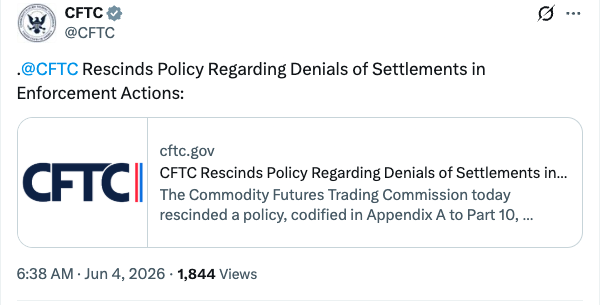
The US Commodity Futures Trading Commission has rescinded a long-standing policy that prevented it from accepting a lawsuit settlement if the defendant denied the agency’s allegations.The CFTC said on Wednesday that it scrapped the policy, first adopted in 1998, because it “may have created an incorrect impression that the Commission is trying to shield itself from criticism.”The language was similar to that provided by the US Securities and Exchange Commission when it rescinded a similar policy in May. “For nearly three decades, the Commission has refused to settle cases unless the defendant promised not to publicly deny the Commission’s allegations,” CFTC Chairman Mike Selig said. “I am pleased that we are rescinding the no-deny policy consistent with regulators throughout the government.”Crypto companies that have faced enforcement action by the CFTC or SEC have criticized the rule, claiming it restricted their right to free speech.Source: CFTCThe CFTC said the policy change now gives it more flexibility when settling enforcement actions.However, it will not enforce existing no-deny provisions and could still require some defendants to admit certain facts or liabilities when settling enforcement actions.Under the Trump administration, the CFTC and SEC have rolled back enforcement actions taken against crypto companies that were launched under the Biden administration.On Thursday, the CFTC sought to vacate its $5 million settlement with crypto exchange Gemini, a case that Selig claimed was “politically targeted.”Tim Massad, who headed the CFTC under the Obama administration, told Cointelegraph on Friday that the agency’s choice to reverse the settlement was “extraordinarily unusual.”Magazine: The legal battle over who can claim DeFi’s stolen millionsCointelegraph is committed to independent, transparent journalism. This news article is produced in accordance with Cointelegraph’s Editorial Policy and aims to provide accurate and timely information. Readers are encouraged to verify information independently.

Čítaj viac

Galaxy’s Novogratz speaks in court over failed $1.2B BitGo deal: Report

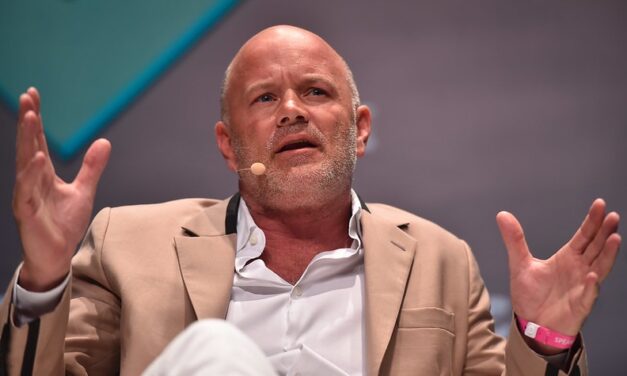
Galaxy Digital founder Mike Novogratz appeared in court on Tuesday to face off against BitGo CEO Mike Belshe in a long-running legal fight over a failed proposed $1.2 billion merger in 2021.The planned deal was the largest-ever crypto merger at the time, set to create a massive conglomerate offering a suite of services at a time when investor interest in crypto was high. Galaxy called off the deal in August 2022 as the crypto market was reeling from the collapse of the Terra ecosystem. BitGo has asked Galaxy to pay a $100 million fee for pulling out of the deal and also hid it was being probed by US authorities, while Galaxy has claimed BitGo failed to provide financial information on time.According to Bloomberg, Novogratz testified in Delaware Chancery Court on Tuesday that he was “pushing to get this deal done,” but Galaxy and BitGo realized regulatory approval for the merger was unlikely because the Securities and Exchange Commission, then headed by Gary Gensler, made it “very difficult.”Mike Novogratz, pictured in 2018 at a conference in Hong Kong, has appeared in court over a failed merger with BitGo. Source: RISEHe also said Galaxy was not the subject of the probe and it would not have affected the merger, while BitGo did not provide the needed financial information in time, forfeiting its right to a $100 million termination fee.Related: On-Chain, In Court: What happened in crypto legal news this weekBitGo bargained for the termination fee, including a deadline to hand over financial statements, but that was complicated by the SEC’s accounting rules requiring companies to record customer crypto holdings as liabilities.“This was incredibly damaging,” Belshe testified on Monday, claiming that BitGo had provided all the needed information. “Galaxy is telling the world we can’t pass an audit.”The trial is set to end this week, and a judge will decide whether BitGo should receive the $100 million fee.Magazine: Guide to the top and emerging global crypto hubs: Mid-2026Cointelegraph is committed to independent, transparent journalism. This news article is produced in accordance with Cointelegraph’s Editorial Policy and aims to provide accurate and timely information. Readers are encouraged to verify information independently.

Čítaj viac

Hyperliquid ETFs surprise with 50% volume jump after slow launch

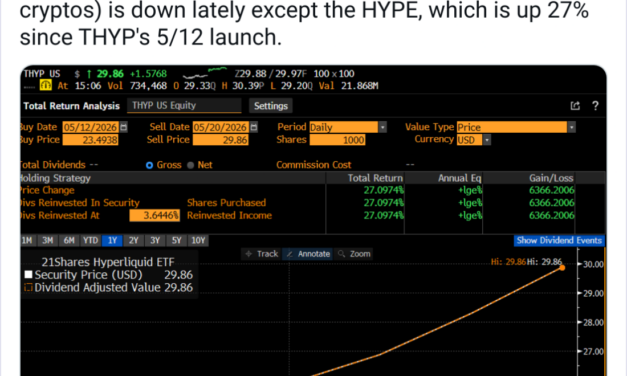
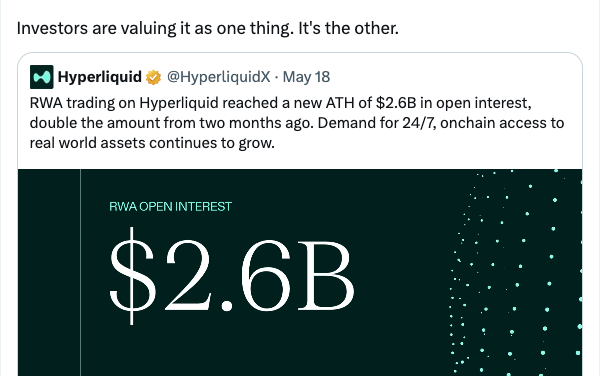
US-based exchange-traded funds tied to HYPE recorded a 50% trading volume jump on Wednesday, in a rare move for newly debuted ETFs, according to analysts. Two Hyperliquid (HYPE) ETFs from issuers Bitwise and 21Shares have recorded nearly $41 million in total value traded since their launches earlier this month, with trading volumes increasing since their debuts, according to SoSoValue.Bloomberg ETF analyst Eric Balchunas said in an X post Wednesday that such trading increases for ETFs are “very rare,” and many normally record a “big splash [on] day one then drop off OR oblivion for months until [people] notice it. Rare to build in first week like this.”Balchunas pinned the ETFs’ growth on a “perfectly timed launch as EVERYTHING (stocks, bonds, gold, btc [Bitcoin], cryptos) is down lately except the HYPE.”Source: Eric BalchunasThe Hyperliquid token has gained 120% so far this year and is up 18.5% in the past day to $56, according to CoinGecko. Traders have flocked to the token and the platform, with some analysts viewing it as the next trendy crypto play because it has captured a large portion of the crypto perpetual futures market.Over the past year, the S&P 500 has gained 8.6%, while the tech-heavy Nasdaq 100 has gained 16%, while Bitcoin has fallen 11%. It comes a day after Bitwise, one of two issuers of a US-based HYPE ETF, said traders had mispriced HYPE, arguing the platform is more than just a crypto exchange, but a “super-app” encompassing multiple asset classes.Related: Hyperliquid eyes 55% price rise after Silicon Valley investor’s ‘massive HYPE buy’21Shares was the first to launch a HYPE fund in the US, launching its 21Shares Hyperliquid ETF (THYP) on May 12 and drawing $1.2 million in net inflows, far below other altcoin ETF launches such as those for Solana staking. The Bitwise Hyperliquid ETF (BHYP) debuted later that week on May 14 to $750,000 in net inflows, The two ETFs recorded their highest day of net inflows Wednesday, with a combined $25.5 million in net inflows. The 21Shares ETF recorded $16.6 million, while Bitwise’s ETF recorded $8.8 million. Crypto asset manager Grayscale also filed for a Hyperliquid ETF in March, with the planned fund currently being processed by US regulators.The X account Lookonchain said on Wednesday that two wallets linked to Grayscale had purchased $25 million worth of HYPE over the past week and staked it, but its not known if the move is tied to the company’s planned ETF.Magazine: Metric signals $250K Bitcoin is ‘best case,’ SOL, HYPE tipped for gains: Trade Secrets

Čítaj viac

Bitwise calls HYPE ‘most mispriced’ crypto despite 77% rise this year

Crypto asset manager Bitwise has called Hyperliquid “one of the most mispriced assets in crypto today,” despite its outperformance so far this year.“Hyperliquid is one of the most important crypto projects to emerge in years,” Bitwise investment chief Matt Hougan said in a note on Tuesday. “Its native token, HYPE, is the best-performing large-cap crypto asset of 2026, up 77% YTD [year to date]. And yet I still think investors are underestimating its impact and its value.”Bitwise launched a HYPE exchange-traded fund on the New York Stock Exchange on Friday. 21Shares launched a similar HYPE fund earlier that week, which drew only $1.2 million in net inflows, low compared to other altcoin ETF debuts. Hougan said HYPE’s mispricing is partly due to the market valuing Hyperliquid solely as a perpetual crypto futures exchange, when it should be priced as a “global super-app.”Hyperliquid’s main focus is the popular sector of crypto perpetual futures trading, but the platform also has trading linked to stocks, prediction markets and other assets, with Hougan adding that the platform sees nearly half of its volume tied to non-crypto assets.Source: Matt HouganOther crypto platforms have also looked to expand beyond just crypto, with many major US crypto exchanges, such as Coinbase, Kraken and Gemini, working to expand into prediction markets and tokenized equities trading to shore up their balance sheets.Related: ICE, CME press US regulators to ‘rein in’ Hyperliquid energy trading: ReportSEC Chair Paul Atkins has also given his support to “super-apps” that can custody and trade multiple assets on one regulatory license. He has tasked the regulator with exploring how it can allow tokens tied to securities to trade on platforms it doesn’t regulate.Hougan argued that Hyperliquid “has become the ‘super-app’ Atkins envisioned — a ‘non-SEC regulated platform’ offering investors exposure to ‘a variety of asset classes.’”He added, however, that the platform “still needs to mature” as it is not available in the US and would need to integrate itself into the country’s regulatory system.BitMEX co-founder Arthur Hayes was also bullish on HYPE in a March blog post, saying the platform could continue to see its token rally if it continues to pull volume away from centralized exchanges and expand its product offerings.Magazine: Your guide to surviving this mini-crypto winter 

Čítaj viac

Získaj BONUS 8 € v Bitcoinoch

nakup bitcoin z karty

Registrácia Binance

Burza Binance

Aktuálne kurzy