
Autor Cointelegraph By Jesse Coghlan

OpenAI confidentially files to go public in the US

ChatGPT creator OpenAI has confidentially filed for an initial public offering in the US, becoming the third major AI company this year to set up plans for a Wall Street debut.OpenAI posted to X on Monday that it filed confidential paperwork with the US Securities and Exchange Commission, but had not decided when it would launch to the public.“We expect it to leak so we’re just announcing it,” the company wrote. “We have not decided on timing yet; it may be a while because there are things we want to do that are likely easier as a private company.”It comes as rival Anthropic announced on June 1 that it was pursuing an IPO, while SpaceX, Elon Musk’s rocket-building company that owns Grok creator xAI, is expected to debut in the US on Friday.The last 12 months have seen a number of blockbuster IPOs amid a tech investment boom. Multiple crypto companies, such as stablecoin issuer Circle and trading platforms eToro and Bullish, raked in billions of dollars after going public last year. In a blog post accompanying OpenAI’s announcement, company co-founder and CEO Sam Altman and chief scientist Jakub Pachocki said one of OpenAI’s main goals is to build an AI system that can research AI technology to improve itself.Source: Sam AltmanAnthropic said on Thursday that AI development has advanced to the point that AI could soon build, train and improve itself without human input, and said development should slow until the risks are known.Altman and Pachocki said the economy “is beginning to reshape around AI,” and questioned how to make “advanced AI abundant, affordable, safe, useful, and easy enough for every person and organization to benefit from it.”Related: Worldcoin is overlooked bet on AI IPO wave: Maelstrom“A good AI future cannot be one where a small number of institutions control most of the capability and most of the upside,” they wrote. “It should be a future where many people, companies, communities, and countries can build, benefit, and hold power.”Companies have cited that productivity gains from AI have allowed them to cut down on staffing, and nearly 117,000 tech employees have been laid off so far this year, according to layoffs.fyi.Crypto companies have cut more than 5,000 jobs so far this year, with many also citing increased efficiencies from AI as a reason for the layoffs. Block Inc. undertook the biggest round of layoffs by a crypto company so far in 2026, cutting 4,000 staff in February in an AI-driven cutback.AI Eye: How AI just dramatically sped up the quantum risk for Bitcoin

Čítaj viac
Galaxy drops CLARITY Act odds to 60% as time is running out

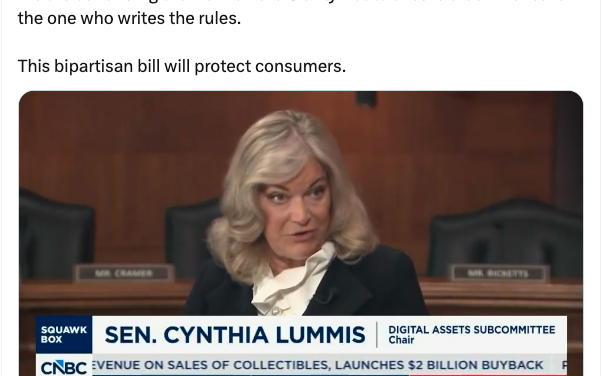
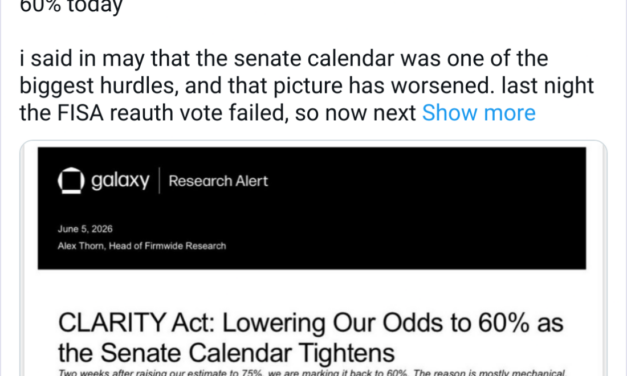
Crypto firm Galaxy Digital has lowered the odds of the Senate passing its crypto market structure bill before the end of the year, noting that the window for lawmakers to act on the bill is closing. “On May 22, we raised our estimate of the probability that the CLARITY Act becomes law in 2026 to 75%, up from the 55% we published the morning of May 14’s Senate Banking markup, Galaxy’s head of research Alex Thorn said in a note on Friday. “We are now lowering that estimate to 60%.”Thorn said the bill must pass the Senate before a month-long August recess starting in late July, as “after that, the window effectively closes.” He added that major legislation has historically not moved in the lead-up to the midterm elections due to lawmakers campaigning.Many Senate lawmakers have been pushing for the chamber to pass the bill after the House passed its version, called the CLARITY Act, last year.The Senate Agriculture and Banking Committees have passed versions of the bill, and it now needs at least 60 votes on the Senate floor to pass without prolonged debate.“For a 60-vote bill that still needs floor debate, an amendment process, reconciliation with the Senate Agriculture text, and then House action on the changes, Majority Leader [John] Thune realistically needs to schedule floor time at some point in July,” Thorn said.“Anything later and the procedural steps do not fit before the recess,” he added.Source: Alex ThornThorn said another reason Galaxy lowered its odds is that no information shows that the bill, or negotiations around it, have advanced, and provisions around ethics and illicit finance are a sticking point that have not yet been resolved.He added that Galaxy would revise its odds if Senate leaders committed to passing the bill next month and that provisions to get lawmakers on side are finalized.Galaxy’s latest odds came after analysts at JPMorgan on Wednesday said they see less than a 50% chance that the CLARITY Act passes this year, similarly citing a tightening congressional calendar ahead of the elections.Meanwhile, Bitwise investment chief Matt Hougan said on Tuesday that his view of the bill passing this year is “less optimistic,” and that “D.C. insiders” he spoke with put the odds of its passage between 5% and 30%.Senator Cynthia Lummis, the chair of the Senate Banking Subcommittee on Digital Assets, has escalated her calls for the Senate to pass the bill, having made at least 15 posts on X about the legislation so far in June.“The Clarity Act passed committee. The floor is next. We did not come this far to quit at the 5 yard line,” she posted on Sunday.Lummis told CNBC on Wednesday that lawmakers working on the bill are addressing issues, including around ethics and illicit finance, that could see it lose support on a floor vote.Magazine: Will the CLARITY Act be good — or bad — for DeFi?

Čítaj viac

Justin Sun’s HTX delists Trump family’s USD1 amid freeze fight

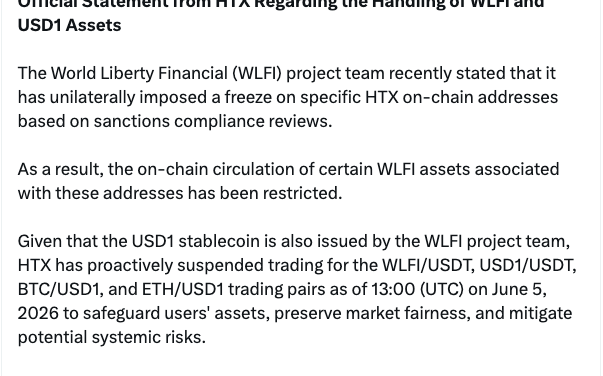
HTX, the crypto exchange linked to crypto entrepreneur Justin Sun, delisted the Trump family’s USD1 stablecoin after claiming World Liberty Financial wrongly froze the exchange’s addresses.“The World Liberty Financial (WLFI) project team recently stated that it has unilaterally imposed a freeze on specific HTX on-chain addresses based on sanctions compliance reviews,” said HTX on Saturday.“As a result, the on-chain circulation of certain WLFI assets associated with these addresses has been restricted,” it said, adding it delisted USD1 to safeguard user assets. Last month, the UK sanctioned HTX, formerly called Huobi Global, on May 26, claiming there were “reasonable grounds to suspect” the exchange had supported Russia’s government through financial services.However, HTX said the sanctioned entity, Huobi Global S.A., is “distinct from the online HTX exchange” and that such a designation should not impact the platform.Source: HTXThe delisting took effect on Sunday. Deposit and conversion services for USD1 are no longer supported, and users’ USD1 holdings would be converted to the stablecoin Tether (USDt) at a 1:1 ratio, with exact completion times and details to be announced separately.It has also suspended WLFI/USDT, USD1/USDT, BTC/USD1 and ETH/USD1 trading pairs. The exchange said its addresses were frozen “without sufficient prior communication, adequate contractual or legal grounds, transparent disclosure or adherence to due process” and that the move infringed the rights of its users and their assets, and has called WLFI to reverse the freeze. HTX said it will also take measures to “safeguard users’ legitimate rights and interests, including but not limited to pursuing legal remedies.”World Liberty, which counts US President Donald Trump and his three sons, Donald Jr., Eric and Barron as advisers, has not publicly addressed whether it froze HTX’s addresses.It posted on X on Wednesday that “in light of recent sanctions updates, World Liberty Financial maintains risk-based sanctions compliance controls.”Cointelegraph contacted World Liberty Financial for comment.Related: Trump claims he can ‘future proof’ crypto regulation with CLARITY ActSun, who reportedly owns HTX and serves on the exchange’s global advisory board, sued World Liberty in April, claiming the platform froze his tokens and threatened to burn them “without any proper justification.”In May, World Liberty sued Sun for defamation, claiming he made false statements about the platform and violated WLFI token sale terms through alleged prohibited transfers, short-selling and straw purchases.Magazine: Quitting Trump’s top crypto job wasn’t easy: Bo Hines

Čítaj viac

Crypto billionaires bankroll Nigel Farage's pro-crypto party

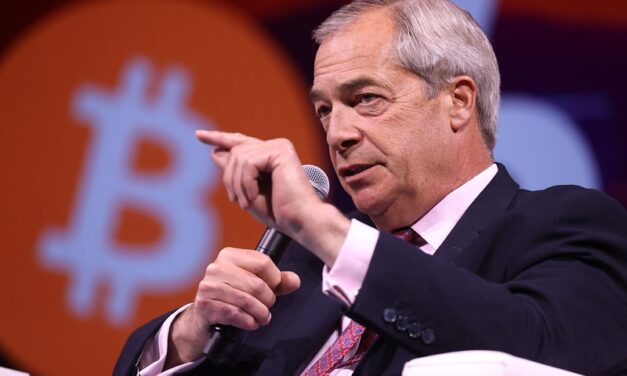
Nigel Farage’s Reform UK received 7 million British pounds ($9.4 million) from two crypto billionaires this year, with total funds raised outstripping all other political parties.The party received a $4 million donation from Christopher Harborne, who has a stake in the stablecoin issuer Tether, and a $5.4 million donation from Ben Delo, the co-founder of the crypto exchange BitMEX, according to Electoral Commission data released on Thursday.The Labour and Conservative parties each received around $5.4 million in the first quarter of the year. Reform UK has pitched itself as a pro-crypto party. It was the first UK political party to accept donations in Bitcoin (BTC), and Farage has proposed cutting capital gains taxes on crypto from 24% to 10%. He has also called for the Bank of England to create a Bitcoin reserve.The crypto industry has been spending heavily on politics as it seeks to influence policy. In the US, crypto-backed political action committees (PACs) have recently spent millions to successfully back candidates who won primary elections ahead of the country’s midterm elections in November.Nigel Farage speaking at the Bitcoin 2025 conference in Las Vegas. Source: Gage SkidmoreDelo is a first-time donor to the right-wing populist party, while the latest donations bring Harborne’s total to $20 million in the past year.Harborne had separately given Farage a $6.7 million personal gift, which is facing a probe by a parliamentary standards inquiry as to whether it should have been registered. Related: UK politician Nigel Farage bought $1.8M house after $6.7M crypto giftFarage has said he didn’t need to declare the money as it was given before he was a member of parliament and was used to pay for personal security. He later claimed the gift was for successfully campaigning for the UK to leave the EU.Reform’s fundraising in the first quarter has increased sixfold compared to the same time last year, when it received $2 million.The total funding across all parties for the quarter had also more than doubled compared with a year ago.Magazine: Guide to the top and emerging global crypto hubs: Mid-2026Cointelegraph is committed to independent, transparent journalism. This news article is produced in accordance with Cointelegraph’s Editorial Policy and aims to provide accurate and timely information. Readers are encouraged to verify information independently.

Čítaj viac

Senate Republicans push finance watchdogs to clarify crypto capital rules

A group of Senate Republicans has urged US financial regulators to clarify the capital standards for companies engaged in crypto activities.Senator Cynthia Lummis said on Thursday that she led the group in sending a letter on May 27 to Federal Reserve Vice Chair for Supervision Miki Bowman, Federal Deposit Insurance Corp. Chairman Travis Hill, and Comptroller of the Currency Jonathan Gould.The letter commended the agencies’ guidance in March that clarified the capital treatment of tokenized securities, but urged them “to build on that progress to move towards a clear and fair capital treatment for on-balance sheet treatment of digital assets.”Current international standards for capitalizing crypto holdings require banks to hold a greater value of reserve assets compared to the value of their digital asset holdings, which the Senators said was essentially a “de facto ban” on banks holding crypto.The letter comes as senators are preparing to act on a bill, dubbed the CLARITY Act, that would outline how federal agencies will regulate crypto. The current version of the bill allows banks to use digital assets and blockchain for activities such as payments, lending, custody and trading.Senate leaders are pushing to pass the bill ahead of the midterms in November, as the legislation risks having to be reintroduced in the next session of Congress if it fails to pass ahead of the elections.Source: Cynthia LummisThe group took issue with the Basel Committee on Bank Supervision’s longstanding standards that assigned a 1,250% risk weight to crypto, which they said was “not derived from a calibrated assessment of the actual risk profile of digital assets.”“Any proposed capital treatment of on-balance sheet digital asset activities should accurately reflect the opportunities and risks of digital assets — and be based on, to the extent possible, a technology-neutral approach that gives banks the authority to participate meaningfully in digital asset markets,” the group said.Related: Debate on CLARITY Act continues this week as US Senate returnsThey added that crypto legislation under consideration in the Senate would “undoubtedly require capital guidance” and urged regulators to begin work on a new capital framework for crypto.Senators Dan Sullivan, Bill Hagerty, Bernie Moreno, Ted Budd and Jon Husted also signed the letter.Debate on the Senate’s crypto bill is slated to resume this week after the Senate returned from recess. The legislation lays out how the Securities and Exchange Commission and the Commodity Futures Trading Commission will regulate crypto markets and companies.The Senate Banking and Agriculture Committees have passed their own versions of the bill addressing securities and commodities, but the full Senate will need to reconcile the different bills.Other issues raised by lawmakers, including stablecoins, ethics and crypto developers, will also need to be addressed in the bill if it is to receive the 60 votes needed to pass the Senate without lengthy debate that could leave the bill stalled indefinitely.Magazine: Will the CLARITY Act be good — or bad — for DeFi?

Čítaj viac

Získaj BONUS 8 € v Bitcoinoch

nakup bitcoin z karty

Registrácia Binance

Burza Binance

Aktuálne kurzy