Autor Cointelegraph By Jesse Coghlan

Institutional investment flows out of ETH and into competing L1 altcoins

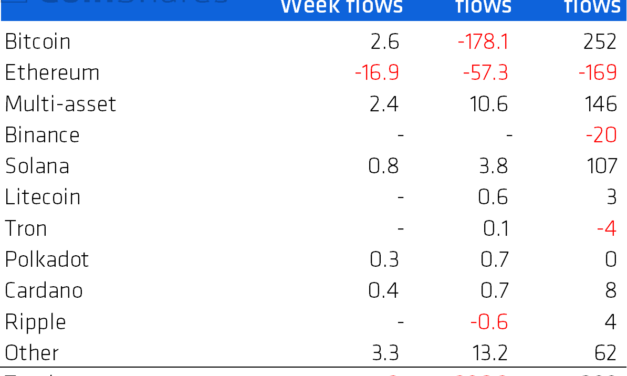
Institutional investors have shifted their attention from Ethereum (ETH) to competing Layer 1 blockchains of late, with capital inflows for altcoin investment products increasing last week whilst Ether products posted outflows for the third week in a row.Data from CoinShares’ latest Digital Asset Fund Flows report shows that investors last week (ending April 22) loaded up on $3.5 million worth of Avalanche (AVAX), Solana (SOL), Terra (LUNA) and Algorand (ALGO) funds whilst capital outflows from Ether products totaled $16.9 million.It marks the third straight week that Ethereum products have seen outflows, bringing the total over that time to $59.3 million, equal to around 35% of the year-to-date outflows of $169 million from the second-largest blockchain.Notably, investors also favored digital gold last week despite some recent hesitancy, with Bitcoin (BTC) products fetching $2.6 million worth of inflows.Over the past 10 weeks, inflows to Ethereum products have reached only $68.5 million in what could signal a bearish trend by institutions towards the major blockchain.Weekly flows showing $16.9m outflows from Ethereum. CoinShares.Alternate layer 1 blockchains have been growing in popularity recently, decentralized application (dApp) usage on Solana in the last 7 days has increased according to metrics from DappRadar. Usage for the decentralized exchange Orca has grown nearly 43% over the week, and automated market maker Raydium has seen a 15.5% increase, with volume in its app reaching over $1.5 billion.Whilst the metrics for Avalanche’s dApp usage haven’t increased over the week, the blockchains’ investments in incentive programs and millions spent luring developers to the platform have traders bullish on the future of AVAX.Related: Does the future of DeFi still belong to the Ethereum blockchain?The Avalanche, Solana, Terra and Algorand inflows were $1.8 million, $800,000, $700,000 and $200,000 respectively, whilst Bitcoin saw inflows equating $2.6 million for the first time in two weeks with the analysts noting that month-to-date outflows for the largest crypto remain at $178 million.Total outflows over the past three weeks have seen $219 million leave the market, with that number cooling last week winding down to just 7.2 million, a stark contrast to the $134 million which left the market in the first week of April.Despite the recent run of outflows, the analysts note that year-to-date flows remain positive with $389 million coming into crypto assets since the start of the year.

Čítaj viac

Sustainable energy usage for BTC mining grows nearly 60% in a year

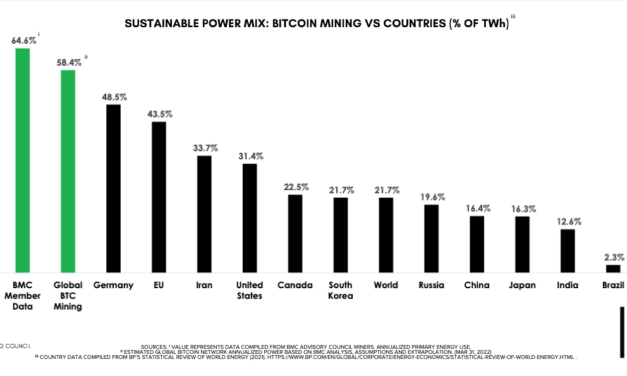
Bitcoin (BTC) mining companies are further adopting green energy as the global Bitcoin mining industry increased its sustainable energy mix by approximately 59% year over year.The Bitcoin Mining Council (BMC) is group of 44 Bitcoin mining companies claiming to represent 50% of the global Bitcoin network, or 100.9 exahash (EH). It released a new report on Monday April 25 with the findings. The group is also fronted by Bitcoin proponent and MicroStrategy CEO Michael Saylor. The latest survey of BMC member companies questioned how much electricity their companies consumed, what percentage of that electricity is generated by hydro, wind, solar, nuclear or geothermal sources, and what the hash rate of their operations were.The BMC estimates the global mining industry’s sustainable electricity mix for the top crypto is now 58.4% which is a fall of 0.1% from last quarter. Perhaps more importantly, it’s significant growth from the 36.8% renewables estimated in Q1 2021. Its worth noting however that the BMC only formed in June 2021, so it is not exactly clear how it formulated the 36.8% worth of renewables estimated in Q1 2021.Data for the new report, which was self-reported from BMC members, showed they were utilizing electricity with a 64.6% sustainable power mix. The figures for global Bitcoin mining was estimated from the data from BMC members.Related: Earth Day analysts say Bitcoin mining is naturally gravitating to green energyBitcoin has come under fire for its heavy energy usage and high carbon footprint, and the mining industry is keen to show its adoption of using greener energy sources or byproduct wasted from other operations to combat the criticism.The figures provided by BMC contradict a February study published in the scientific journal Joules which highlighted that the Chinese ban on crypto mining contributed to a 17% increase in the carbon emissions produced by operations to sustain the Bitcoin network.The report breaks down the total estimated energy usage by industry, alleging that global Bitcoin mining operations use 247 terawatt-hours (TWh), less than half of what gold mining operations consume, and 0.16% when compared to the world’s total energy usage.Global Bitcoin mining vs other industriesBitcoin mining efficiency is improvingThe results on the self-reported electricity consumption and company hash rates seemingly show that mining efficiency has increased.Over the past 12 months electricity consumption by the industry decreased by 25%, whilst the hash rate increased by 23% from 164.9 to 202.1, equaling a 63% increase of mining efficiency in the last year since Q1 2021. The BMC alleges Bitcoin mining is 5,814% more efficient than it was eight years ago.

Čítaj viac

AkuDreams dev team locks up $34M due to smart contract bug

The highly anticipated NFT project Akutars was marred by both an exploit and a bug on the weekend causing over 11,500 Ethereum (ETH) worth nearly $33 million to be locked forever within a smart contract, inaccessible even to the development team.The exploit however, was conducted by someone trying to show a vulnerability in the project and not to steal funds via a hack. The project went live on Friday April 22 with a Dutch Auction, a type of auction where the price lowers until it receives a bid, with the first bid winning the sale as long as the price is above reserve. The auction opened at 3.5 Ethereum with only 5,495 of the available 15,000 NFTs up for sale and the smart contract set to refund any bidders who were underbid. Holders of an “Aku Mint Pass” were also given a 0.5 Ethereum discount on each minted NFT.The $33M BugIn a April 23 Twitter thread explaining the whopping $33 million bug, 0xInuarashi, a developer of multiple NFT projects explained Akutars’ smart contract was coded so that refunds to bidders had to be processed first before the team could withdraw any funds.The contract had a caveat that a minimum number of bids had to be made before it would allow for the team to withdraw, but the minimum number of bids was set to equal the amount of NFTs available for auction.Unfortunately, due to some buyers minting multiple NFTs within the same bid, the terms of the contract mean it will never unlock, sealing away the nearly $33 million in Ethereum forever. Cointelegraph contacted the Akutars team for comment but did not immediately hear back.The exploitIn a now deleted tweet posted by the Akutars that was shared by DeFi developer foobar, it said that developers reached out to them warning that their contract could be exploited but appeared to  shrug them off  completely as they labelled the potential exploit a “feature”.The AkuDreams team pretended that this was a feature, not an exploit, when multiple developers raised concerns prior to mint. Bizarre justifications. pic.twitter.com/cVgEXnnWzF— foobar (@0xfoobar) April 23, 2022During the mint an unknown individual executed what’s known as a “griefing contract” which locked the ability of the Akutars contract to process refunds to those underbid. The individual even embedded a message on the blockchain to the Akutars team saying they would stop the contract:“Well, this was fun, had no intention of actually exploiting this lol. Otherwise I wouldn’t have used Coinbase. Once you guys publicly acknowledge that the exploit exists, I will remove the block immediately.”Akutars then promptly responded by  taking responsibility for the code and suggested that the exploit “was not done out of malice” and the person “intended to bring attention to best practices for highly visible projects.”Quick Update (will go into more detail asap):1. The exploit in the contract was not done out of malice; the person intended to bring attention to best practices for highly visible projects & novel mechanics. They unblocked the exploit quickly after we dug in and took ownership— Aku :: Akutars (@AkuDreams) April 23, 2022

In a tweet on the same day, the project’s founder and former pro-baseballer Micah Johnson offered an apology to the community, noting that after letting them down he will “continue to build brick by brick” and work tirelessly to avoid any similar issues moving forward.  The team also said that it will be issuing 0.5 Ethereum refunds to pass holders as well as airdropping the NFT to successful bidders.The mistakes that were made are no more costly to anyone than myself. I’ve reinvested most everything into building Aku. & most everything will go back to refunds and we will keep building what we set out to do.Brick by brick. https://t.co/vQiPbl0Jpl— Micah Johnson (@Micah_Johnson3) April 23, 2022

In an update posted on Sunday April 24 the team said it had rewritten its minting contract which was then audited by several developers and plans to mint on Monday April 25.Related: Hacker bungles DeFi exploit: Leaves stolen $1M in contract set to self destruct

Čítaj viac

Bank of England’s PRA raises budget $31M for ‘emerging risks’ like crypto

The Bank of England’s regulatory arm has raised its budget by $31.6 million (£24.3 million) for the coming financial year saying that costs have increased due to its growing responsibilities and preparations for “emerging risks in the financial system”.According to the latest business plan released on Wednesday April 20 by the Prudential Regulation Authority (PRA) its budget for the 2022/23 financial year is £320.9 million ($418 million), an 8.2% increase from last year.The PRA Chief Executive Sam Woods outlined its plan for the year ahead saying it was:“Committed to keeping pace with innovation and emerging risks, including the ongoing digitalization of financial services and the growth of crypto assets.”The PRA states that the United Kingdom’s withdrawal from the European Union, along with “proactively preparing” for what it sees as risks to the country’s financial system is driving up operational costs. The regulator will also add 100 supervisory risk specialists to its headcount.Detailing its business plan for the coming year, the PRA says it will be overseeing the risks that arise from firms’ having exposure to or increased levels of business with cryptocurrencies, adding:“The PRA will also ask firms to report their cryptoasset exposures, treatments and future investment plans, and will engage with international partners, including at the Basel Committee on Banking Supervision, to establish a common, international framework for the treatment of cryptoasset exposures.”Related: UK financial watchdog seeks crypto talent amid new crackdownThe regulator said that it will continue its work on developing a regulatory framework for “innovations such as stablecoins.” Earlier this month, the UK Economic and Finance Ministry said it will amend regulations to add stablecoins as an accepted means of payment.In March, Woods wrote a letter to the CEO’s of banks and other designated investment firms regarding their exposure to crypto assets to remind them of the regulators’ expectation to adhere to existing policies and regulations in light of their increasing interest in the space.In the letter he referred to a raft of reports released that same month by UK financial regulators discussing the risks to the financial stability of the country posed by cryptocurrencies and decentralized finance (DeFi).

Čítaj viac

Hacker bungles DeFi exploit: Leaves stolen $1M in contract set to self destruct

In a rare comedic bungle among DeFi exploits, an attacker has fumbled their heist at the finish line leaving behind over $1 million in stolen crypto.Just after 8AM UTC on Thursday April 21st, blockchain security and analytics firm BlockSec shared it had detected an attack on a little known DeFi lending protocol called Zeed, which styles itself a “decentralized financial integrated ecosystem”.The attacker exploited a vulnerability in the way the protocol distributes rewards, allowing them to mint extra tokens which were then sold, crashing the price to zero, but netting just over $1 million for the exploiter.Blockchain analytics firm PeckShield noted the stolen crypto was transferred to an “attack contract”, a smart contract which automatically and quickly executes the found exploit.#PeckShieldAlert It appears that @zeedcommunity suffered an exploit. The exploiter gained ~$1m. The gains currently sit in the attack contract. https://t.co/bSHHGM623Q @peckshield https://t.co/jXVj0oGI8B— PeckShieldAlert (@PeckShieldAlert) April 21, 2022However the attacker was apparently so excited by their successful heist that they forgot to transfer over $1 million worth of stolen crypto out of their attack contract before they set it to self-destruct, permanently and irreversibly ensuring the funds can never be moved. Interesting. The hacker kills the contract, but forgets to transfer the profit. https://t.co/HbS2fiztuc https://t.co/uApZyK8Uym pic.twitter.com/FwpZweNLHU— PeckShield Inc. (@peckshield) April 21, 2022

Using a blockchain scanner to view the attack contract address shows that $1,041,237.57 worth of BSC-USD Binance-Peg token is forever stuck in the contract and the successful self-destruction of the contract was confirmed at 7:15AM UTC on April 21.Related: Truth or fiction? Popular former hacker claims to have $7B in BTCIt’s one of the more bizarre turns of events since the Polygon hacker did an “Ask Me Anything” using embedded messages on Ethereum(ETH) transactions after stealing $612 million from the protocol in August 2021. The question and answer session revealed the attacker hacked “for fun” and thought “cross-chain hacking is hot.”This latest hack is on the smaller end regarding the amount stolen, and other DeFi protocol hacks have seen hundreds of millions siphoned off as with the recent Ronin bridge hack where attackers made off with over $600 million.Other notable DeFi exploits include the $80 million worth of crypto stolen from Qubit Finance in January where attackers tricked the protocol into believing they had deposited collateral, allowing them to mint an asset representing a bridged crypto.DeFi marketplace Deus Finance was exploited in March when hackers manipulated the price feed of a pair of stablecoins resulting in the insolvency of user funds, netting the hackers over $3 million.

Čítaj viac

Získaj BONUS 8 € v Bitcoinoch

nakup bitcoin z karty

Registrácia Binance

Burza Binance

Aktuálne kurzy