Autor Cointelegraph By Jesse Coghlan

WSJ says 'the NFT market is collapsing' but the data says otherwise

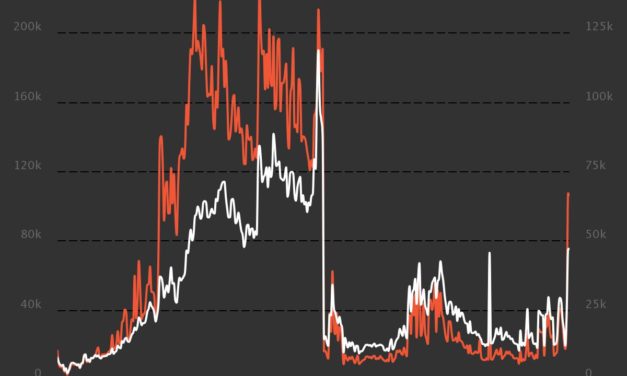
An article in the Wall Street Journal has claimed sales of non-fungible tokens (NFTs) are “flatlining” — in the same week that the top five collections alone accounted for more than $1 billion in primary and secondary sales.The article cited data from NFT market analysis platform Nonfungible suggesting the number of NFT sales has fallen by 92% since an all-time high in September 2021. Wallets active in the Ethereum (ETH) NFT market were also said to have declined by 88% since a high in November 2021.“The NFT market is collapsing,” the article concluded. Red line shows number of sales with volume on left y-axis, white shows active market wallets, volume on right y-axis. Source: NonfungibleHowever, onchain data from Dune Analytics’ dashboard suggest that the NFT market is still robust, with information showing that NFT users and transactions are much higher than what’s reported by Nonfungible.Dune Analytics total active NFT users Dune Analytics NFT transactions per day Analytics also show that volume per day in USD on Ethereum NFTs over the week is some of the highest seen since February with popular marketplace OpenSea seeing nearly $550 million in volume on May 1 alone.Dune Analytics. Source.Analysis from Tom Schmidt, partner at venture capital firm Dragonfly Capital shows a similar story when focused on OpenSea transactions and USD volume.come on, man pic.twitter.com/CTJFldAHNk— Tom Schmidt (@tomhschmidt) May 3, 2022Sub-sectors within the NFT market are emerging and while some areas of the oversaturated market are in a downturn, others are seeing major gains.Nansen’s analytics platform which indexes NFT collections by type show that “Blue Chip” NFTs — established and highly prized brands such as the Bored and Mutant Ape Yacht Club and Azuki tokens — are far outperforming art or gaming tokens.The Nansen Blue Chip-10 Index tracking the top 10 NFT projects is up 81% year to date (YTD), while comparatively the indexes tracking the top art and gaming NFT collections are respectively down 39% and 49% YTD.This phenomenon of NFT market capital consolidating into the top collections was pointed out in an analysis by NFTstatistics.eth who shared a chart in late April showing the top 5 collections are driving the Ethereum NFT market.This trend continues: BAYC, Azuki, CloneX, Doodles & now Moonbirds separating themselves from everyone else. I’ve talked about large-caps outperforming, but it’s really the top-5 projects driving all the gains. pic.twitter.com/UsUlwHMJ9M— NFTstatistics.eth (@punk9059) April 26, 2022

“There’s clearly a trend right now that five or six of the most successful projects are sharply outperforming while the rest are flat to down,” pseudonymous NFT market analyzer NFTstatistics.eth told Cointelegraph.Related: OpenSea top-10 NFT projects soar as new liquidity enters the marketThe data from Nonfungible shows a spike on May 1 with the number of sales and active wallets that day hitting numbers not seen in their data from November 8 2021 directly correlating with the record-breaking (and Ethereum breaking) Otherside metaverse land sale by Yuga Labs again contradicting the claim that NFT sales are “flatlining.” It’s not clear why the Nonfungible data the WSJ relied on is misaligned with Dune’s data, however it could be due to the inclusion of sales volume from P2E gameAxie Infinity by Nonfungible.Volume for the popular play-to-earn hit an all-time high of over $40 million on November 4 2021 before a gradual decline to its current levels of around $500,000 according to CryptoSlam data.But the collapse in popularity of a P2E game as NFTstatistics.eth says “is an extremely different message from ‘NFTs are collapsing.’”@DJohnson_CPA suggests that AxieInfinity was so big it dominated numbers in November and has since collapsed. Seems possible. From where I sit, this is an extremely different message from “NFTs are collapsing”https://t.co/lq66GbhbAj— NFTstatistics.eth (@punk9059) May 3, 2022

While the current debate focuses on Ethereum NFTs, Solana is fast becoming a popular blockchain for this type of asset and is the second-largest blockchain behind Ethereum for NFT sales volume.Last week, the Solana NFT project Okay Bears topped OpenSea’s 24-hour sales tracker for the first time, and holds fourth place behind the Mutant Ape Yacht Club in 7 day sales volume on CryptoSlam with over $47 million worth transacted.

Čítaj viac

Algorand becomes first US blockchain sponsor of FIFA World Cup

Blockchain network Algorand (ALGO) has partnered with FIFA inking a sponsorship and technical partner deal as the network becomes the soccer association’s first official blockchain platform.The deal announced on Monday, May 2 will also see Algorand become a regional supporter in North America and Europe for the 2022 FIFA World Cup to be held in Qatar in November and December.BREAKING: @FIFAcom has announced #Algorand will become the official blockchain of FIFA, empowering the global football community with cutting-edge, sustainable technology. Read more https://t.co/LTTUqGNLNA @FIFAWorldCup #FIFAWorldCup pic.twitter.com/LuEFTY3WK6— Algorand (@Algorand) May 2, 2022Algorand will also be an official sponsor of the FIFA Women’s World Cup in Australia and New Zealand in 2023.The proof-of-stake chain will assist FIFA in developing its “digital assets’ strategy”, with the announcement explaining blockchain technology in the context of non-fungible tokens (NFTs). Therefore, it may be likely that Algorand could assist FIFA with developing its own NFT collection. Additionally, as part of the partnership, Algorand will be providing an “official blockchain-supported wallet solution.”FIFA President Gianni Infantino expressed his delight at the partnership saying it was an “indication of FIFA’s commitment to continually seeking innovative channels for sustainable revenue growth” adding that he is looking forward to a “long and fruitful partnership with Algorand.”Algorand is another crypto firm to sponsor the FIFA World Cup as cryptocurrency exchange Crypto.com became the official crypto trading platform sponsor for the 2022 World Cup in March. It is an interesting move since crypto is banned in Qatar, but reasonable when considering the huge numbers of international spectators.Related: Algorand aims to convert network transaction fees into carbon offsetsThe competition held every four years last took place in Russia and was one of the world’s most viewed sporting events, with the 2018 World Cup watched by over 3.2 billion people — around half of the world’s population aged over four. Around 1.1 billion people alone tuned in live for the 90-minute final between France and Croatia.Algorand is the first new United States-based sponsor of the World Cup since 2011. The past decade has seen the association in hot water with U.S. federal prosecutors on charges of bribery, money laundering, and corruption, with recent indictments in April 2020 for bribes in connection to the selection of World Cup host countries, including Qatar.Over the last 24 hours, the price of Algorand’s native token has jumped by nearly 20% to $0.72 from a 24-hour low of $0.58 on account of the announcement.

Čítaj viac

More than $1.6 billion exploited from DeFi so far in 2022

The decentralized finance (DeFi) space has been rife with hacks, exploits, and scams so far this year with over $1.6 billion in crypto stolen from users, surpassing the total amount stolen in 2020 and 2021 combined.Analysis from blockchain security firm CertiK revealed the statistics on May 2 showing the month of March having the most value stolen at $719.2 million, over $200 million more than what was stolen in all of 2020. The March figure is largely due to the Ronin Bridge exploit where attackers made off with over $600 million worth of crypto. We have seen $1.6B lost in the #crypto/#web3 world so far this year. In just the first 4 months on 2022 we have passed the total amount lost in 2021 ($1.3B) and in 2020 ($516MM). https://t.co/jDohhaUYUN— CertiK (@CertiKTech) May 2, 2022April was a busy month for attacks with CertiK recording 31 major incidents, an average of nearly one a day. The most valuable was the $182 million siphoned from Beanstalk Farms using a flash loan attack.CertiK noted the nearly $80 million lost by Fei Protocol, the second most valuable heist last month, and the $10 million lost from automated market maker protocol Saddle Finance which both took place at the end of the month.Both protocols took to Twitter to offer their respective attackers a bounty in exchange for returning the stolen funds. Whilst the chances of that happening may be slim, it’s not unheard of as the Poly Network hacker in 2021 returned nearly all of the $610 million stolen from the network along with refusing a $500,000 bounty reward.CertiK said that April 2022 “holds the record for highest dollar amount losses in flash loan attacks ever recorded by us” with losses from that type of exploit reaching $301.4 million. In comparison, flash loan attack losses in January, February, and March 2022 combined were only $6.7 million.Related: The biggest crypto heists of all timeThe analysis of this year’s DeFi exploits comes as the total value locked (TVL) in DeFi has dropped below $200 billion for the first time since March 16 according to DeFiLlama.Between April 30 and May 1, TVL dropped by just over 3.5% to $195.87 billion, only slightly recovering to $199.42 billion today Tuesday, May 3. The last 30 days since April 3 have seen a 13.5% decrease in TVL and a nearly 22% decline since the all-time high of over $254 billion on December 2, 2021.

Čítaj viac

Solana suffers 7th outage in 2022 as bots invade the network

The Solana (SOL) network suffered a seven-hour outage overnight between April 30 and May 1 due to a large number of transactions from nonfungible token (NFT) minting bots.A record-breaking 4 million transactions, or 100 gigabits of data per second, congested the network causing validators to be knocked out of consensus resulting in Solana going dark at roughly 8 PM UTC on April 30.It wasn’t until seven hours later on May 1, 3 AM UTC that validators were able to successfully restart the main network.Validator operators successfully completed a cluster restart of Mainnet Beta at 3:00 AM UTC, following a roughly 7 hour outage after the network failed to reach consensus. Network operators an dapps will continue to restore client services over the next several hours. https://t.co/ezqEYQYKWl— Solana Status (@SolanaStatus) May 1, 2022The bots hoarded a popular application used by Solana NFT projects to launch collections called Candy Machine. In a Twitter post by Metaplex, the company confirmed that traffic from bots on their app was partially to blame for the network crash.Today #Solana mainnet-beta went down partially due to botting on the Metaplex Candy Machine program. To combat this, we have merged and will soon deploy a botting penalty to the program as part of a broader effort to stabilize the network. https://t.co/QaAZT3VxXz— Metaplex (@metaplex) May 1, 2022

Metaplex shared it would be implementing a 0.01 SOL or $0.89 charge on wallets that attempt to complete an invalid transaction which the firm said: “is typically done by bots that are blindly trying to mint.”The outage caused the price of SOL, the blockchain’s native coin, to crash by nearly 7% to $84, although trading since has seen prices recover to just over $89.The most recent outage marks the 7th time this year that Solana has suffered outages according to its own status reporting. Between January 6 and January 12 in 2022 the network was plagued with issues causing partial outages for between 8 and 18 hours.Solana said “high compute transactions” caused a reduction in network capacity to “several thousand” transactions per second (TPS), much lower than the advertised 50,000 TPS.Later in January, over 29 hours of downtime was recorded between the 21st and 22nd of the month, with excessive duplicate transactions again causing network congestion and outages on the blockchain.Related: Scalability or stability? Solana network outages show work still neededIn September 2021, Solana was hit with a major outage with the network offline for over 17 hours. Solana attributed that outage to a distributed denial-of-service (DDOS) attack on an initial DEX offering with bots spamming the network with 400,000 per second. Industry observers commented on what has been often touted as an “Ethereum killer.” At this point Solana should start posting business hours— pseudotheos in (@pseudotheos) May 1, 2022

Solana was the second network to strain under notable transaction volume related to NFTs over the weekend. The Ethereum (ETH) transaction cost surged to an average of over $450 due to a release of 55,000 NFTs by Yuga Labs with some users paying up to 5 ETH or $14000 in gas fees for transactions and much more to mint one of the NFTs.

Čítaj viac

Dogecoin Jesus? Roger Ver resurfaces on Twitter, backs DOGE over BTC

Roger Ver, an early investor and ardent promoter of Bitcoin (BTC) which earned him the moniker “Bitcoin Jesus” has resurfaced on Twitter after a year and backed Dogecoin (DOGE) in an interview, preferring it for payments over the world’s first crypto.In an interview with Bloomberg, the Bitcoin.com founder said how he was a fan of the memecoin due to its fast transaction times and low fees:“Dogecoin is significantly better, it’s cheaper and more reliable [than Bitcoin]. If I had to pick three contenders for the world’s dominant cryptocurrency, they would be Doge, Litecoin and Bitcoin Cash.”Ver also took time in the interview to voice his support for honorary Dogecoin CEO Elon Musk’s Twitter takeover.“It’ll certainly make Twitter more attractive,” said Ver. “I am really, really grateful that Musk is out there calling out censorship.”Although Ver was a proponent of Bitcoin for years, he now spends his days as a Bitcoin Cash (BCH) evangelist, the altcoin which forked from Bitcoin after a dispute over the block size.A video posted in March to Ver’s YouTube channel shows he and his entourage onboarding retail merchants and taxi drivers to use Bitcoin Cash as a preferred payment method in Saint-Martin.Ver says that Bitcoin Cash is the true vision of Bitcoin creator Satoshi Nakamoto, and despite all his advocacy for the crypto, he claims he isn’t all in on BCH:“I am definitely a cryptocurrency whale still, I’ve always had a wide assorted basket in cryptocurrency. I was never a Bitcoin or Bitcoin Cash maximalist.”Related: Roger Ver’s next life: Cryonics meets cryptoIn his return to Twitter, Ver wasted little time calling attention to crypto’s first principles, with his second tweet after his hiatus on April 28. He said that custodial wallets like those used by traders interacting with centralized exchanges would cause Bitcoin to lose a “key revolutionary property.”If regular people are all using custodial wallets, Bitcoin will have lost a key property that made it so revolutionary.— Roger Ver (@rogerkver) April 28, 2022Noncustodial wallets where the user retains control over the assets is something that allows Bitcoin to stand out from banks and other financial products. [embedded content]

Čítaj viac

Získaj BONUS 8 € v Bitcoinoch

nakup bitcoin z karty

Registrácia Binance

Burza Binance

Aktuálne kurzy