

Autor Cointelegraph By Jesse Coghlan

Delaware, New Jersey advance bills banning crypto ATMs

Delaware and New Jersey have both advanced legislation to ban cryptocurrency ATMs in what is becoming a growing trend across US states, with lawmakers concerned that the kiosks are overwhelmingly used for scams.The Delaware House Economic Committee on Tuesday passed House Bill 441 to the full chamber, which would ban owning, installing, or operating a cryptocurrency kiosk.It followed the New Jersey Senate Commerce Committee’s unanimous vote on Monday to send its bill banning crypto ATMs to the full chamber.At least three other US states — Indiana, Tennessee and Minnesota — have passed total bans on crypto ATMs in response to their use for scams.The FBI said in May that it received nearly 13,500 complaints about crypto ATMs in 2025 involving over $388 million in losses, a 23% increase in complaints and a 58% increase in losses from 2024. Over half of the complaints involved people aged over 50, with losses exceeding $302 million.Cyndie Romer, a representative who sponsored the bill in Delaware, said crypto ATMs “reduce digital currency to a predatory cash grab.” “Regular crypto traders generally do not use crypto ATMs due to their much higher fees, which can be upwards of 20% of the value of the transaction, versus the 0.4% to 1% in fees for online exchanges,” she added. “There is no reason to support a business structure that enables scammers to extort money from our most vulnerable populations.”A crypto ATM at a service station in Dover, Delaware’s capital. Source: Coin ATM RadarDelaware’s bill would also ban fiat-to-crypto sales that “replicate or substitute” crypto ATMs, such as through point-of-sale systems or cashiers. It also mandates that any crypto ATMs must be removed within 90 days after the bill is signed into law.The bill outlines penalties of up to $10,000 for violations, and if a kiosk is found to be operating, it must refund its fees to all users or pay into a consumer protection fund if users can’t be found.New Jersey’s bill would similarly ban owning, controlling, installing, managing, selling, or offering to sell a crypto ATM due to “a significant rise in scams associated with their use.”It outlines penalties of up to $10,000 for a first offense, doubling to $20,000 for subsequent offenses.Bitcoin ATM operators push backIndiana became the first US state to ban crypto ATMs with a law signed in March. Tennessee followed with its ban in April, while Minnesota passed a ban in May. Some US cities have also passed or are weighing ordinances banning crypto ATMs, while some states, including Arizona and California, have capped the value of transactions allowed by crypto ATMs.Related: Canada proposes crypto ATM ban over scams and money launderingBitcoin Depot, once the largest operator of crypto ATMs in the world with over 9,000 kiosks, cited regulatory pressure as a major reason it filed for bankruptcy last month.However, crypto ATM operators have long claimed they are not at fault for scams through their machines, and many have put in place on-screen scam warnings or self-imposed transaction limits to curb illicit transactions.Bitcoin Depot had told an ICIJ investigation on crypto scams in December that it “cannot be held liable for the criminal acts of third-party scammers” and said it had “robust warnings and safeguards” on its machines and during transactions.Magazine: When privacy and AML laws conflict: Crypto projects’ impossible choice

Čítaj viac
Hyperliquid, Paradigm urge revision of GENIUS money laundering rule

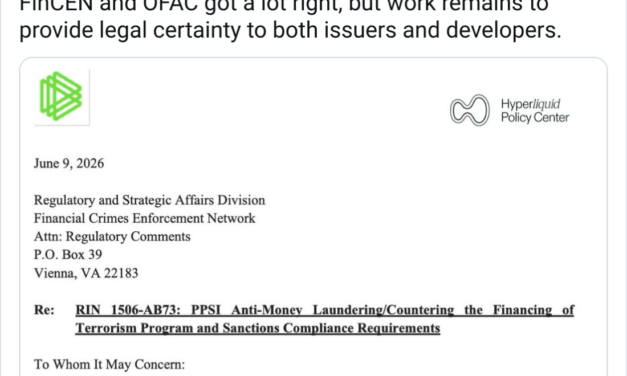
The lobbying arm of crypto futures exchange Hyperliquid and venture capital firm Paradigm has urged the US Treasury to revise a proposed anti-money laundering and sanctions rule for stablecoin issuers.The Hyperliquid Policy Center and Paradigm said in a letter on Tuesday that some secondary market obligations should be clarified or narrowed “to avoid unintended consequences for permissionless blockchain infrastructure and the DeFi ecosystem.”The pair said they endorse the Financial Crimes Enforcement Network’s (FinCEN) approach of putting compliance obligations on the “primary market,” such as issuers who have customer information, and taking a “limited approach” to the secondary market, where issuers only see wallets and transactions.“The same principle should guide the agencies’ implementation of AML and sanctions requirements for stablecoins deployed to permissionless environments,” they argued.The letter was in response to a rule the Treasury proposed in April to implement GENIUS Act provisions relating to stablecoin issuers, requiring stablecoin issuers to have the capability to block, freeze or reject transactions that violate US law or sanctions on both the primary and secondary markets.Source: Stefan SchroppHyperliquid and Paradigm said the proposal sweeps secondary market activity into an issuer’s compliance perimeter that they “cannot meaningfully police.”They argued it also treats smart contract interactions as an activity that carries sanctions liability “regardless of whether the issuer has any relationship with, or visibility into, the transacting parties.”The pair said an issuer who is facing the obligations proposed would be incentivized to only deploy into a permissioned environment, which they argued would see US-regulated stablecoins pulled out of decentralized finance to create “a void filled by unregulated, offshore, non-dollar alternatives.”Related: Solana Institute CEO says CLARITY Act must shield open-source developersUS President Donald Trump signed the GENIUS Act into law last year, which outlined how stablecoins and their issuers are to be regulated. Federal agencies are currently looking at how to implement the law, which is set to go into effect in January 2027 at the latest.The Senate is currently debating a crypto bill that could include further rules for stablecoin issuers and remove liability for developers of crypto platforms regarding money laundering and sanctions compliance.Provisions for the legislation, dubbed the CLARITY Act, are still under discussion, and some lawmakers are pushing for a full Senate vote on the bill before the November elections.Magazine: The legal battle over who can claim DeFi’s stolen millions

Čítaj viac

Crypto users wary as Anthropic releases Claude Mythos with safeguards

AI company Anthropic on Tuesday released the first public version of its powerful Claude Mythos model, called Fable 5, with some crypto users worried it could be used for malicious purposes, despite embedded guardrails. Anthropic said last month that its Mythos model uncovered more than 10,000 high or critical-severity vulnerabilities in “systemically important software,” leading many to question if it should be publicly released.This was despite the company saying on Tuesday that Fable 5 was “made safe for general use,” and has safeguards that reroute some topics, such as cybersecurity, to a different model, Claude Opus 4.8 “Releasing a model this capable comes with risks. Without safeguards, Fable 5’s capabilities in areas like cybersecurity could be misused to cause serious damage,” it said.Source: ClaudeThe guardrails have done little to reassure crypto users, with AI increasingly being used to attack crypto platforms. In April, the value of crypto stolen in hacks hit $629.7 million, the highest since February 2025, which analysts linked to the use of the technology. Mythos release sparks warnings from crypto usersSimon Dedic, founder of the venture firm Moonrock Capital, posted to X on Tuesday that with Fable 5, the “cost and skill required to find exploitable flaws in smart contracts is about to drop to basically zero.”“For DeFi, this should be a massive wake-up call. Unaudited protocols will become sitting ducks. Known exploits will get replayed on forks around the clock. Even small projects will get targeted simply because trying costs next to nothing now,” he added.Related: AI agents with crypto could escape and become ‘unstoppable,’ experts warnDedic repeated calls online, suggesting that crypto users should protect themselves from the model, including revoking wallet approvals, removing as much value from protocols as possible and moving crypto to fresh hardware wallets.Curve Finance co-founder Michael Egorov, however, said that the threat Claude Mythos posed to crypto was likely overblown as its success in finding bugs in other software might not translate to funding smart contract vulnerabilities in DeFi. In May, Anthropic said Claude Mythos found thousands of critical vulnerabilities in important software through Project Glasswing. For open-source projects, which are central to how crypto protocols are managed, Mythos found around 6,200 high or critical-severity vulnerabilities in more than 1,000 projects it investigated.Egorov argued that the software Mythos found vulnerabilities in had millions of lines of code, while smart contracts have a few thousand, “and both humans and ‘usual’ AI perfectly fit that code in context and can reason well about it.”“I suspect we might not be having a wave of DeFi code hacks, but we may see a lot of things in OpSec [operational security] getting hacked (looking like multisig keys compromises) and supply chain attacks on frontend dependencies, and those are way less dangerous in true DeFi,” he said.Meanwhile, Anthropic said a “small group” of cybersecurity and infrastructure providers would get access to Claude Mythos 5, the same model as Fable 5 but with safeguards lifted in some areas.Magazine: AI-driven hacks could kill DeFi — unless projects act now

Čítaj viac

Over 200 crypto firms push Senate to pass CLARITY Act

More than 200 crypto companies and organizations have urged the US Senate to pass the CLARITY Act, amid concerns that continued stalling could see it miss an important legislative window.In a letter on Monday shared by crypto lobby group Stand With Crypto, the group called on Senate Majority Leader John Thune and Minority Leader Chuck Schumer “to bring the Clarity Act to the Senate floor without delay.”It said the Senate Banking Committee’s vote last month to pass the bill took “months of serious, bipartisan work” and the Senate should “build on that momentum and give members the opportunity to advance durable market structure legislation.”The bill would outline how the Securities and Exchange Commission and the Commodity Futures Trading Commission would regulate crypto, but it has stalled multiple times in the Senate this year as lawmakers and lobbyists have disagreed on its provisions.Source: Stand With CryptoBanking groups have pushed for the bill to include a ban on platforms offering stablecoin yields, while the crypto industry has lobbied to include protections for developers of decentralized crypto platforms, both sparking months of negotiations between the groups. The letter, signed by the lobby groups Stand With Crypto, The Digital Chamber, the Blockchain Association, and the Crypto Council for Innovation, said the bill would keep crypto jobs, investment and market activity in the US and make the country a “global leader in digital asset innovation.”“Digital asset markets are global, growing, and central to the future of financial infrastructure,” the letter said. “The question before Congress is whether that future will be built in the United States — under U.S. law, U.S. oversight, and American values — or continue moving to offshore jurisdictions with less transparency, weaker consumer protections, and limited accountability.”Related: Crypto’s CLARITY Act faces partisan fight over ethics on Senate floorThe Senate has yet to schedule floor time for the bill ahead of the midterm elections in November, which has led analysts to drop their odds of the bill passing this year.Galaxy Digital said on Friday that it lowered its odds of the bill passing in 2026 to 60% from 75%, saying it must pass the Senate before the August recess in late July, as “after that, the window effectively closes.”The Senate Agriculture and Banking Committees passed their versions of the bill concerning commodities and securities laws, and each of those needs to be married up before being put to the Senate for debate.Lawmakers have also flagged the bill needs amendments around ethics and policing illicit finance if it is to receive support for the at least 60 votes required for the legislation to pass without prolonged debate.Senator Cynthia Lummis, who has worked to advance the bill, told CNBC on Wednesday that lawmakers are addressing the issues of ethics and illicit finance that could see it lose support on the floor.Galaxy said it has not seen information showing that the bill, or negotiations around it, have advanced, or that the provisions at issue have been resolved.Magazine: Will the CLARITY Act be good — or bad — for DeFi?

Čítaj viac

UK financial regulator floats allowing 10% crypto allocations for retail funds

The UK’s Financial Conduct Authority has proposed allowing some authorized investment funds to hold up to a 10% allocation of crypto exchange-traded notes, closing a regulatory gap between retail investors and funds.The FCA floated the idea in a quarterly consultation paper on Friday, which would allow retail-focused funds called undertakings for collective investment in transferable securities, or UCITS funds, and some non-UCITS funds to gain exposure to crypto.The regulator said it wanted authorized funds to “remain contemporary and consistent with the demands of investors” while ensuring consumers “are adequately protected and markets function well.”The proposal seeks to align rules on who can buy crypto products after the FCA lifted its ban on retail investors being able to trade crypto exchange-traded notes in August, as the regulator looked to align retail access to crypto with other countries.The FCA said in its consultation that its proposed 10% cap would “set conservative restrictions on assets to which a fund can be exposed, in exchange for allowing these funds to be marketed to retail consumers.”An excerpt from the FCA’s consultation pitching allowing retail funds limited exposure to crypto products. Source: FCAThe regulator added that it didn’t believe allowing retail-focused funds “to have significant exposure” to crypto products was appropriate, “given the speculative nature of the underlying cryptoassets.”Related: UK Lords warn BoE could regulate pound stablecoins into irrelevanceRetail funds that want to invest in crypto must also show that the investment is “consistent with the disclosed investment objectives and risk profile of a given fund,” the FCA said.The proposal said that unregulated and qualified investor schemes could invest in “more speculative assets,” and it would not apply a limit to holdings, but those funds can’t be marketed or sold to retail investors. The FCA is also seeking input on whether it should prevent funds centered on holding so-called “long-term assets” such as property and other retail-focused funds from holding crypto exchange-traded notes, arguing that it does not consider crypto to be consistent with the funds’ investment objectives.The consultation on the proposal will last for five weeks, until July 13.It comes as the UK has been clearing a path for crypto, with the FCA and Bank of England consulting on proposed rules for stablecoins, crypto custody and staking.The Bank of England last month said it was reconsidering parts of its proposed stablecoin regime after crypto companies warned that holding caps and reserve requirements could stifle adoption.In April, the FCA also made new rules for tokenized funds to make it easier for asset managers to use blockchains and sought feedback on guidance to clarify requirements for stablecoin issuance, crypto trading, custody and staking.Magazine: How crypto laws changed in 2025 — and how they’ll change in 2026

Čítaj viac

Získaj BONUS 8 € v Bitcoinoch

nakup bitcoin z karty

Registrácia Binance

Burza Binance

Aktuálne kurzy