Autor Cointelegraph By Jesse Coghlan

Developing countries love the Metaverse, rich nations not keen: WEF survey

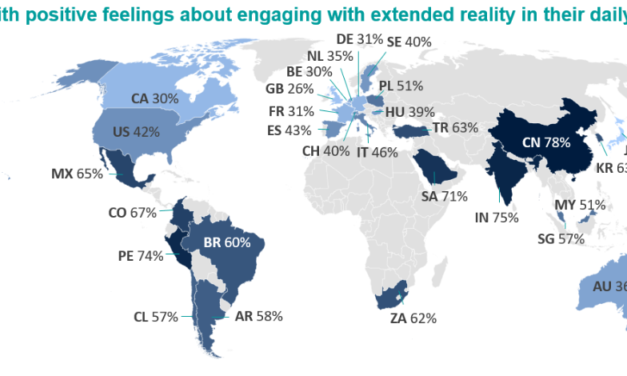
Excitement for the Metaverse and virtual or augmented reality (VR/AR) is much greater in developing countries than in high-income countries according to a survey conducted for the World Economic Forum (WEF).Market research firm Ipsos released the results of the survey on May 25 showing the concept is now widely recognized: 52% of more than 21,000 adults surveyed across 29 countries are familiar with the Metaverse and 50% have positive feelings about engaging with it in daily life.China, India, Peru, Saudi Arabia, and Colombia were the top five countries where two-thirds or more of respondents said they had positive feelings towards it.China had the highest, with 78% harboring positive feelings toward using a metaverse daily followed by India at 75%.Feelings by country of engaging in a metaverse in daily life, darker areas indicate higher percentage of positive feelings in that region. Source: IpsosThe lowest scoring countries with less than one-thirds of respondents positive about the Metaverse were also countries with the highest incomes.Japan scored the lowest with just 22% exhibiting positive feelings followed by the United Kingdom (26%), Belgium (30%), Canada (30%), France (31%), then Germany (31%).Interestingly the concept was less familiar in those high income countries too, with fewer than 30% in France, Belgium and Germany.Turkey was most familiar with the Metaverse at 86%, followed by India (80%), China (73%) and the higher income country of South Korea (71%). Poland scored the lowest at 27%.Respondents were also surveyed on the areas of life they agree the Metaverse will impact the most. Developing countries such as South Africa, China and India agreed areas like virtual learning, entertainment, digital socializing and even applications like remote surgery would make an impact on people’s lives.Related: How the Metaverse could impact the lives of kidsAgain respondents from high income Japan, Belgium and France had the lowest percentages of those who agreed that Metaverse applications would significantly change people’s lives.Developing countries seem to be more enthusiastic about crypto and blockchain across the board, according to an April report from cryptocurrency exchange Gemini which pointed out half of respondents in India, Brazil and the Asia Pacific region purchased their first cryptocurrency in 2021.The report made the case that inflation and currency devaluation are the drivers of crypto adoption in those regions stating that residents of countries that experienced 50% or more currency devaluation were five times more likely to plan to purchase crypto over countries that experienced less inflation.

Čítaj viac


OpenEthereum support ends with the Merge fast approaching

One of the most popular Ethereum (ETH) clients, OpenEthereum has ended support for its software in preparation for the upcoming Ethereum Merge. OpenEthereum creates “clients” or software used to interact with the Ethereum network allowing anyone to create an Ethereum node to mine the cryptocurrency which is currently using a proof-of-work (PoW) consensus mechanism.In a Twitter thread the OpenEthereum team explained that with the Merge approaching and the legacy codebase becoming “increasingly difficult to manage” due to its age that it was the right time to end support. OpenEthereum support has officially ended.The repo is now archived, and all maintenance and updates have stopped.Why? And what next? Read the — OpenEthereum is Deprecated (@OpenEthereumOrg) May 24, 2022The project was formerly owned by blockchain infrastructure company Parity Technologies before it transitioned ownership to the OpenEthereum decentralized autonomous organization (DAO) in December 2019.At the time Parity wrote they wanted to ensure the codebase is “maintained and lives on for as long as the community finds it useful,” OpenEthereum wrote:“The usefulness has run its course, and we look forward to the next phase of clean, green and massively scalable blockchain infrastructure.”The OpenEthereum team wrote that “well documented” clients were required to “navigate the upcoming Merge and successful shift to proof-of-stake (PoS),” directing users to change clients to other providers such as Nethermind or Erigon.Related: Core Ethereum developer details changes to expect after the MergeThe Merge is the name for the planned upgrade to the Ethereum blockchain which will merge the existing proof-of-stake Beacon Chain launched in December 2020 into the current proof-of-work main net which validates transactions on the network.The planned upgrade has seen constant delays since first proposed in 2016 and initially had a deployment date of 2019. It was believed the Merge would happen in mid-2022 but delays occurred in April. Due to the upcoming Repsten testnet merge Ethereum developer Preston Van Loon said last week the upgrade would happen in August 2022 “if everything goes to plan.”

Čítaj viac

CryptoSat’s first nanosatellite blasts off Wednesday on SpaceX rocket

If all goes to plan Wednesday’s SpaceX rocket launch in Florida will blast a “crypto-satellite” into low Earth orbit, paving the way for secure blockchain-related cryptography in spaceCryptosat, as the name hints, is the company which created “Crypto1”, a crypto-satellite module hitching a ride aboard a Falcon 9 rocket for SpaceX’s Transporter 5 mission. The blockchain satellite technology has already been trialled on the International Space Station. “We’re basically joining the Uber of spaceflight,” co-founder of Cryptosat Yonatan Winetraub told Cointelegraph, “Everybody goes into the same orbit and we’re one of the passengers.”“SpaceX launch a bunch of satellites, each one of them is doing something else,” he added, “It doesn’t matter for our service, we are hoping to use our satellite to provide cryptographic services for our customers here on Earth which won’t interfere with the other satellites at all.”The Crypto1 satellite is a coffee mug sized module created using over-the-counter parts. In space it will provide a physically unreachable and tamper-proof platform from which blockchain and ledger applications can be launched.Co-founder Yan Michalevsky said this type of platform is the first off-world “root-of-trust” – a source which can always be trusted within a cryptographic system – which is “not dependent on other satellites by other companies” but actually provides the hardware in orbit, adding:“There’s a lot of need for this. If we’re looking into protocols, especially in Web3, there are whole financial systems and smart contract systems, kind of digital legal agreements that depend on the trustworthiness of the cryptography behind it.”Michalevsky said one of the most exciting applications for the module is to set up zero knowledge proof protocols which he says are being used more often for uses like voting in a decentralized autonomous organization (DAO) to make decisions without exposing individuals’ votes.Other applications for the module include the possible deployment of an entire blockchain, having the ledger out of reach from attackers could mean crypto mining could becomes a relic of the past as it would theoretically no longer need decentralization through multiple validators. He said a trusted module in space is required given attackers have the incentive and ability to gain access to Earth based modules, however the technology to capture and tamper with a satellite isn’t available.Related: Cointelegraph Magazine — Space invaders: Launching crypto into orbit “Another feature that is unique is as the communication is done via radio frequency you can’t really hide and do an attack,” Winetraub added, “anybody with an antenna will know if you’re doing something funny.”“We’ve seen a great boom in blockchain technology in recent years, and we can provide these services out in space. What we hope is to be able to service the blockchain industry and provide these modules that everybody can count on with a level of security that is unprecedented.”Slow commsSatellite communication with the ground is a sticking point for any organization with an asset in orbit, as uploading data from Earth is slow. Winetraub said that “internet communication is not something that is trivial to do in space.”“Working with a space asset is not the same as working here on Earth,” he added, “on the ground if something goes wrong you just open a terminal and debug it, when that’s in space that’s not always available.”“It goes around the Earth, we start debugging, we figure out the problem, now we need to wait an hour and a half until it comes back around.”He said bridging the gap between what people are used to in terms of fast internet communication and the constraints of space is an ongoing effort which started with a series of experiments the firm conducted on the International Space Station (ISS) earlier this year.Related: Blockchain fail-safes in space: SpaceChain, Blockstream and CryptosatIn March a Cryptosat satellite took part in multiple experiments on the ISS, one experiment created cryptographic signatures with the keys generated and kept in space. Tweets mentioning a Cryptosat Twitter account generated the certificate with a digital signature over the tweet in reply to the mention.Would you give it a second? It’s going to space! @yowinetraub. You can verify your certificate at https://t.co/ePSYzSCItR pic.twitter.com/GmqxXGqHDz— Cryptosat Bot (@cryptosatbot) March 24, 2022Speaking on the experiments Michalevsky said they “enabled us to establish interesting use cases in the space,” adding:“Essentially what we were doing with this experiment was practicing operations on our end, in terms of communicating with space, working with space agencies, running code both on the ground and in space and having them work together.”On what’s next for Cryptosat after the launch Michalevsky said they’re not patting themselves on the back and taking a break just yet:“We’re already in the stages of planning the next satellite, hopefully aiming for the end of this year, there’s a lot to do such as continuing to upgrade the software platform.”“We’re aiming for several of [the modules in orbit] in these initial stages,” he added, “but ultimately we foresee potentially a couple dozen of them to provide continuous availability as they’re orbiting the Earth.”Expansion on the ground to communicate with the orbiting modules was also on the cards for the firm with Michalevsky saying the goal is to have a ground station seeing at least one satellite at all times.The consumer facing product is an area Michalevsky wants to work on too as he says the space industry doesn’t have simple interfaces for users of Web3 applications.“We want to build really great API’s to provide things like signing NFTs in space, provide things that are not only enterprise, back end applications, but also very useful for consumers, and then enable them to build financial infrastructures on top of this constellation of trusted satellites.”He added: “We’ll dig deeply into the blockchain space and create a lot of ground infrastructure that would be interoperable with the blockchains different protocols.”

Čítaj viac

Sam Bankman-Fried could spend up to $1B in 2024 to thwart Trump comeback

The billionaire founder and CEO of theFTX cryptocurrency exchange Sam Bankman-Fried has revealed he intends to spend anywhere between $100 million and $1 billion to help influence the 2024 United States presidential election campaigns.In a podcast interview on May 24 Bankman-Fried was asked how much money he might donate during the next presidential election cycle, answering he’d give “north of $100 million” with a “soft ceiling” of $1 billion if he were to bankroll the person running against former president Donald Trump.“I would hate to say hard ceiling because who knows what’s going to happen between now and then.”According to the government watchdog OpenSecrets, which tracks data on campaign finance and lobbying, a $1 billion donation would break existing records multiple times over.The largest individual political donors are currently the Republican business owners Sheldon and Miriam Adelson who spent $218 million in 2020.Bankman-Fried continued by saying the amount he donates is “super contingent” and “really dependent on exactly who’s running where and for why,” adding it’s likely he would spread the money across multiple organizations.“I think that I’m going to be looking a lot less at political parties from that perspective and a lot more about sane governance and ads for the things that I care the most about.”He said one of the most important issues to him is preventing the next pandemic which he thinks would cost “tens of billions of dollars.”“The United States has both a big opportunity and big responsibility to the world to shepherd the West in a powerful but responsible manner,” and added that everything the country does has “massive ripple effects on what the future looks like.”Bankman-Fried has donated millions to politicians in the past contributing $5.2 million in donations to now-President Joe Biden’s 2020 election campaign. Related: Sam Bankman-Fried: The crypto whale who wants to give billions awayHe also backs the political action committee (PAC) “Protect Our Future” set up in January 2022 which to April spent $9 million supporting Democratic candidates.Earlier in May the PAC spent in the range of $8 to $10 million backing Carrick Flynn who failed to win the Democratic primary election for the newly created Oregon 6th District seat in the U.S. House of Representatives.However, there may be a scenario where Bankman-Fried decides not to donate any money at all, although he thinks the possibility of that is “very low”:“There’s a world which ends up being close to zero if things just work out such that there isn’t much I’m excited about.”The FTX CEO didn’t state in the interviews which crypto related policies he would push for. Over at rival exchange Coinbase, efforts are ramping up in terms of lobbying for crypto favorable policies with last week’s announcement of a “crypto native” think tank, the Coinbase Institute. It will publish research on crypto and Web3 to bolster the exchange’s lobbying efforts. In 2021 the firm was the biggest spending blockchain company in terms of lobbying with over $1.3 million spent.

Čítaj viac

Targeted phishing scam nets $438K in crypto and NFTs from hacked Beeple account

Digital artist and popular non-fungible token (NFT) creator Mike Winkelmann, more commonly known as Beeple, had his Twitter account hacked on Sunday, May 22 as part of a phishing scam.Harry Denley, a Security Analyst at MetaMask, alerted users that Beeple’s tweets at the time containing a link to a raffle of a Louis Vuitton NFT collaboration were in fact a phishing scam that would drain the crypto out of users’ wallets if clicked.⚠️ Beeple’s Twitter account has been compromised (ATO) to post a phishing website to steal funds.0x7b69c4f2ACF77300025E49DbDbB65B068b2Fda7D0xF305F6073CFa24f05FF15CA5b387DD91f871b983 pic.twitter.com/0MPNwOPlEu— harry.eth (whg.eth) (@sniko_) May 22, 2022The scammers were likely looking to capitalize on a real recent collaboration between Beeple and Louis Vuitton. Earlier in May, Beeple designed 30 NFTs for the luxury fashion brand’s “Louis The Game” mobile game which were embedded as rewards to players.The scammer continued to post phishing links from Beeple’s Twitter account leading to fake Beeple collections, luring in unsuspecting users with the promise of a free mint for unique NFTs.Bad actors continue have access to Beeples Twitter account and they have now tweeted another phishing domain.This one just prompts the user to send ETH to an EOA (0xcad7fc974F61A08ADEF110D1BA446fa5b5B5Bb27).Infra: 44.227.238.106 pic.twitter.com/HzTga1OvNK— harry.eth (whg.eth) (@sniko_) May 22, 2022

The phishing links were up on Beeple’s Twitter for around five hours and on-chain analysis of one of the scammers’ wallets shows the first phishing link scored them 36 Ethereum (ETH) worth roughly $73,000 at the time.The second link netted the scammers around $365,000 worth of ETH and NFTs from high-value collections such as the Mutant Ape Yacht Club, VeeFriends, and Otherdeeds amongst others bringing the grand total value stolen from the scam to around $438,000.On-chain data shows the scammer selling the NFTs on OpenSea and putting their stolen ETH into a crypto mixer in an attempt to launder the gains.Beeple later tweeted that he had regained control of his account and added to remind his followers that “anything too good to be true IS A F*CKING SCAM.”ugh we’ll that was fun way to wake up. Twitter was hacked but we have control now. Huge thanks to @garyvee ‘a team for quick help!!!! — beeple (@beeple) May 22, 2022

Related: Needed: A massive education project to fight hacks and scamsBeeple has created three of the top ten most expensive NFTs sold to date including one which sold for $69.3 million, the most expensive ever sold to a sole owner. This attention has made him a target for hacks.In November 2021, an admin account on Beeple’s Discord was hacked with scammers there also promoting a similarly fake NFT drop which resulted in users losing around 38 ETH.Earlier this month, cybersecurity firm Malwarebytes released a report which highlighted a rise in phishing attempts as scammers try to cash in on NFT hype. The firm noted the use of fraudulent websites depicted as legitimate platforms is the most common tactic used by scammers.

Čítaj viac

Získaj BONUS 8 € v Bitcoinoch

nakup bitcoin z karty

Registrácia Binance

Burza Binance

Aktuálne kurzy